ICD-10 code S61.201A: Open wound of left index finger without nail damage
ICD-10 code S61.201A covers a left index finger wound of unstated type ICD-10 co...

Last Updated: Oct 16, 2026
Billable Code Specific Code
S23.122D is the billable ICD-10-CM code for subluxation of T3/T4 thoracic vertebra, subsequent encounter.
It applies once active treatment has finished and the patient returns for follow-up, rehabilitation, or routine management. It also covers MS-DRG mapping, present on admission guidance, and the documentation an auditor will look for.
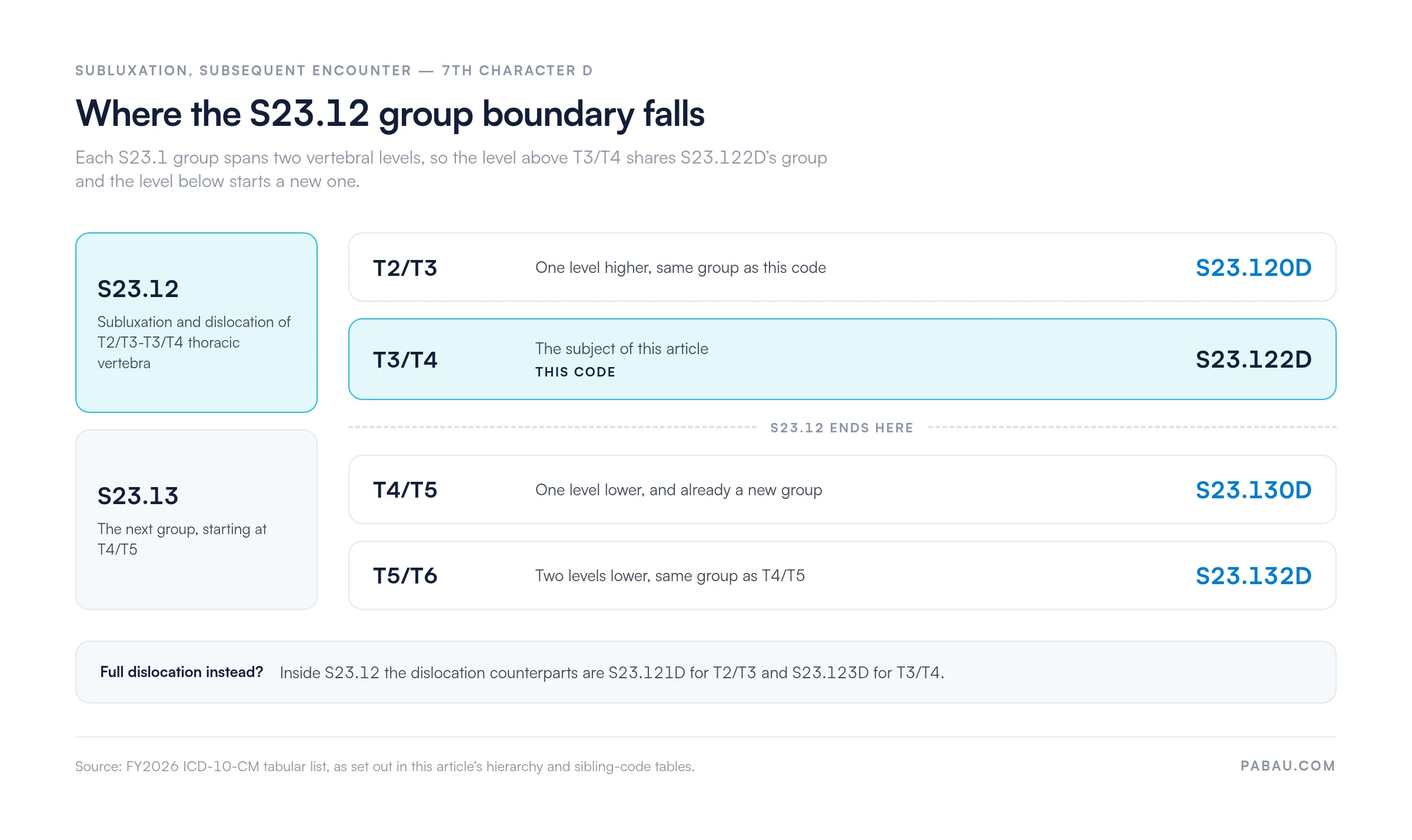
The S23.1 subcategory carries a structural quirk worth knowing before you pick a level. Each of its groups spans two vertebral levels rather than one. The level above T3/T4 therefore shares this code's group, while the level below starts a new one.
Let Pabau's smart automation suggest the right codes, reduce claim denials, and keep your practice compliant—effortlessly.
Automate repetitive tasks and focus on what matters most—your patients.
Reduce coding errors and ensure compliance with the latest regulations.
Clean claims, fewer denials, and faster reimbursements.
Powerful insights and reporting to help your practice thrive.
HIPAA compliant SOC 2 certified GDPR-compliant Trusted by 4,000+ clinics worldwide

S23.122D is the billable ICD-10-CM code for subluxation of the T3/T4 thoracic vertebra at a subsequent encounter.
The base code S23.122 is not billable, so a claim needs the 7th character A, D, or S appended.
The 7th character D means active treatment has finished and the patient is in the healing or follow-up phase.
Group S23.12 covers T2/T3 and T3/T4, so the neighbor above is S23.120D while the neighbor below jumps to S23.130D.
Practice management software like Pabau checks ICD-10 coded claims before submission, so fewer avoidable denials reach the payer.
ICD-10 Code S23.122D describes subluxation of the T3/T4 thoracic vertebra at a subsequent encounter. The code is billable and specific under ICD-10-CM, so it can go straight onto a claim without a more granular code beneath it. It became effective October 1, 2025 for the FY2026 ICD-10-CM code year, and the prior-year version carries forward unchanged. The code sits inside the S23 category, which covers dislocations and sprains of the joints and ligaments of the thorax.
A subluxation is a partial dislocation. The vertebral joint moves out of normal alignment but does not fully separate. At T3/T4 this injury usually follows trauma, such as a motor vehicle collision, a fall, or a contact sport impact. It can also occur with significant axial loading. Presentation includes localized thoracic pain and limited range of motion, and sometimes neurological symptoms from cord or root irritation.
The table below summarizes the key facts a coder needs before using this code on a claim.
For every ICD-10-CM injury code in the S and T chapters, the 7th character signals the type of encounter. It tells the payer whether you are billing for active treatment or for follow-on care. Choosing the wrong character is one of the most common coding errors across the injury chapter.
The ICD-10-CM Official Guidelines for Coding and Reporting tie “subsequent encounter” to the phase of care. The patient has already had active treatment and is back for follow-up or routine management. It does not mean the injury happened previously. Use D for a patient at a second post-op check after spinal stabilization. Use S for a patient with chronic thoracic pain years after a healed subluxation, paired with the specific residual condition.
A common error is billing S23.122A for every visit because it was the patient’s first visit with your practice. The 7th character follows the phase of care, not whether the patient is new to you. If another provider already started active treatment, you are in a subsequent encounter.
S23.122D sits in a specific branch of the ICD-10-CM injury chapter. The hierarchy runs from the chapter down to this one billable code. Parent-level notes apply to every code in the block. Read the branch above before you assign a code inside it.
Group S23.12 spans two vertebral levels rather than one. It holds four base codes: S23.120 and S23.121 cover T2/T3, while S23.122 and S23.123 cover T3/T4. The T4/T5 level sits one vertebra lower and is not in this group at all. It starts group S23.13.
Before assigning any S23 code, confirm the documented level is thoracic rather than cervical or lumbar. A cervical subluxation belongs in the S13 category and a lumbar one in S33. The CDC ICD-10-CM tabular list shows the parent notes that apply across the whole S23 block.
Sibling codes let a coder pick the most precise option and document the level of severity accurately. Chiropractors, physical therapists, and sports medicine physicians use this family most often. They also need to separate subluxation from full dislocation across several thoracic levels.
On the procedure side, a thoracic subluxation treated with spinal manipulation of one or two regions is billed with CPT 98940. Pairing the two correctly is what establishes medical necessity for the visit.
These clinical terms are accepted synonyms that map to S23.122D in ICD-10-CM documentation. Coders should recognize them in operative reports, discharge summaries, and referral letters. Verify that the record states both the level, T3/T4, and the encounter type before assigning this code.
Note that “thoracic subluxation” without a specified level is insufficient for S23.122D. The record must name T3/T4. Terms such as “mid-thoracic subluxation” or “thoracic vertebral injury” without a level need a query back to the treating provider first.
MS-DRG assignment decides how an inpatient stay groups for Medicare reimbursement. When S23.122D is the principal diagnosis, it falls into the medical back problems family. The split turns on whether a major complicating condition is documented. There is no separate CC-level group in this pair, so a CC alone does not move the case.
MS-DRG definitions are updated annually. Cross-reference the CMS MS-DRG Definitions Manual for the fiscal year you are billing before you finalize an inpatient claim. Never treat a grouping as a fixed value.
The POA indicator applies to inpatient claims only. It is not required on outpatient or professional fee claims. POA reporting lets CMS separate conditions that were present at admission from those that arose during the stay.
Because the 7th character D marks a subsequent encounter, the subluxation itself predates the visit. Where S23.122D is the principal diagnosis on an inpatient claim, Y is normally the correct indicator. An N on a subsequent-encounter code is worth a documentation review before submission.
Missing documentation is the main trigger for denials on this code. The record has to support all three elements S23.122D encodes: the injury type, the spinal level, and the encounter type. Validation inside claims management software catches an incomplete element before the claim leaves the practice.
The checklist below sets out what the medical record must contain to hold up at audit.
For a practice running high volumes of musculoskeletal claims, a pre-submission check on 7th character completeness and level specificity pays for itself. Reading the denial codes your payers return will tell you which of the three elements your notes keep dropping.
Run a monthly audit on any S23.122A codes that appear more than twice for the same patient and injury. If active treatment concluded, those visits should be recoded to S23.122D. Audits using Pabau’s claims management software can surface these patterns before a payer or RAC audit does.
Today the missing 7th character usually surfaces after the payer sends the claim back. A coder re-opens the encounter, confirms whether active treatment had already happened elsewhere, changes S23.122A to S23.122D, and resubmits. The rework costs more staff time than the original coding did.
Practice management software like Pabau moves that check to the point of coding. The diagnosis, the encounter note, and the charge sit on one patient record. A coder can see straight away whether a prior visit established active treatment. Pabau’s claims management software then checks the coded claim through our Claim.MD integration before it goes out.
The result is fewer thoracic injury claims coming back for a character the record already supported. Every Pabau subscription includes claims management, so this is not a module you add later.

Pabau’s claims management software validates ICD-10 coded claims through our Claim.MD integration, so coding errors surface inside the practice. You then track each claim through to payment on the same record.

The three checks that decide this code are all settled in the clinical note. Confirm subluxation rather than full dislocation. Confirm T3/T4 rather than a neighboring level. Confirm that active treatment is already behind the patient.
The level check is the one worth building a habit around, because S23.12 does not stop where a coder expects. If the record says T4/T5, the code is S23.130D and no amount of 7th character care will fix a wrong group.
Pabau checks the coded claim before it leaves the practice, so an incomplete element surfaces while the encounter is still open. Book a demo to see how that works on your own injury claims.

Need the full medical billing process? What is medical billing walks through every stage from charge capture to payment posting.
Want to cut claim denials before they happen? Denial management in healthcare covers the common denial triggers and how to build a systematic response.
Looking for a clean-claim submission checklist? Clean claim requirements details the data elements every claim needs to clear the clearinghouse.
Billing spinal manipulation alongside this diagnosis? Chiropractic billing cheat sheet lists the codes and modifiers that pair with thoracic subluxation visits.
ICD-10 Code S23.122D is the billable ICD-10-CM code for subluxation of the T3/T4 thoracic vertebra at a subsequent encounter. It is valid for FY2026, effective October 1, 2025. Use it when a patient who has already had active treatment returns for follow-up, rehabilitation, or routine management.
Yes. S23.122D is a billable and specific ICD-10-CM code, valid for reimbursement in FY2026. The base code S23.122 has no 7th character, so it cannot go on a claim. Only S23.122A, S23.122D, and S23.122S are valid for billing.
S23.122A applies while the patient is receiving active treatment, such as a first ED visit, initial surgery, or first immobilization. S23.122D applies once active treatment has finished and the patient is healing. That covers physical therapy, medication management, and follow-up imaging reviews.
D applies while the original injury is still being managed through healing or recovery. S applies once the injury has healed but a residual condition persists, such as chronic thoracic pain or a neurological deficit. For sequela coding, code the residual condition first and add S23.122S as a secondary code.
Yes. S23.122D took effect on October 1, 2025 for the FY2026 ICD-10-CM code year. It was active in FY2025 and carries forward unchanged. Always check the current-year tabular list before putting any code on a live claim.
As a principal inpatient diagnosis, S23.122D groups to MS-DRG 551, medical back problems with MCC, or MS-DRG 552, medical back problems without MCC. The split depends on whether a major complicating condition is documented. There is no separate CC-level group in this pair. MS-DRG definitions change annually, so verify against the current CMS MS-DRG Definitions Manual.
S23.120D covers subluxation of T2/T3 at a subsequent encounter, one level above T3/T4. Both codes sit in group S23.12, which spans T2/T3 and T3/T4. The distinction is the documented level, so the note must name the exact vertebral pair.