ICD-10 code S61.201A: Open wound of left index finger without nail damage
ICD-10 code S61.201A covers a left index finger wound of unstated type ICD-10 co...

Last Updated: Oct 16, 2026
Billable Code Specific Code
S15.029S is the billable ICD-10-CM code for major laceration of unspecified carotid artery, sequela.
Let Pabau's smart automation suggest the right codes, reduce claim denials, and keep your practice compliant—effortlessly.
Automate repetitive tasks and focus on what matters most—your patients.
Reduce coding errors and ensure compliance with the latest regulations.
Clean claims, fewer denials, and faster reimbursements.
Powerful insights and reporting to help your practice thrive.
HIPAA compliant SOC 2 certified GDPR-compliant Trusted by 4,000+ clinics worldwide

ICD-10 code S15.029S describes major laceration of unspecified carotid artery, sequela, a billable ICD-10-CM code valid for HIPAA-covered transactions.
The 7th character S designates a sequela encounter, meaning the patient presents with a late effect of a previously resolved carotid artery injury.
Use S15.029S only when laterality is not documented. S15.021S (right) and S15.022S (left) are preferred when the record specifies which artery was injured.
Pabau’s claims management software helps practices assign and validate ICD-10-CM codes like S15.029S within a structured billing workflow, reducing claim errors.
ICD-10 code S15.029S is a billable, specificity-level ICD-10-CM diagnosis code valid for submission on HIPAA-covered transactions. It requires no further digit extension. The table below summarizes the key administrative details coders need before submitting a claim.
Per the CMS ICD-10-CM coding resources, coders should verify billable status against the current fiscal year release before submitting. Code validity and descriptions can change annually.
S15.029S sits within a well-defined parent-to-child chain. Understanding the full hierarchy helps coders navigate to the correct specificity level and identify related codes for crosswalk or sequencing decisions.
S15.0 (injury of carotid artery of neck) and S15.02 are both non-billable parent codes. Billable specificity is only achieved at the 7-character level. Practices using claims management software can configure code validation rules to flag non-billable parent codes before submission.
The 7th character is what transforms the non-billable S15.029 into a valid, submittable code. There are three options, each describing a distinct phase of care.
Confusing the D and S suffixes is one of the most common errors in trauma injury coding. Subsequent encounter (D) applies while the original injury is still resolving. Sequela (S) applies only once that injury has healed and the patient has a new, related condition.
Accurate patient care management at each visit supports the correct 7th-character selection.
Check the visit notes before assigning the S suffix. If the provider is still treating the original carotid laceration, the encounter is subsequent (D), not sequela (S). Sequela coding requires documentation that the acute injury phase is closed. The current condition must be a late effect, not an ongoing phase of the same injury.
In software built for sports medicine, injury codes connect to rehab milestones and clearance decisions.
A sequela is a condition that results directly from a prior injury after the acute phase has resolved. Per the ICD-10-CM Official Guidelines for Coding and Reporting (Section I.C.19), sequela coding for traumatic injuries requires two elements:
The sequela code does not stand alone. It is reported alongside the code describing the resulting condition. For example, a patient who developed carotid stenosis after a prior major carotid laceration would have the stenosis code listed first. S15.029S would be coded as the cause. This distinction matters for HIPAA-compliant documentation and billing workflows.
There is no time limit on sequela coding. A late effect can be coded years after the original injury, provided the documentation clearly links the current condition to the prior trauma.
A major laceration in ICD-10-CM injury coding differs from a minor or superficial laceration by the severity and depth of the vessel injury. In the context of carotid artery injury, major laceration typically refers to a complete or near-complete transection, or a laceration involving significant vessel wall disruption. Minor lacerations are coded separately under S15.01x codes. Where a payer still requires a paper claim, the practice needs the current revision of the form.
The carotid arteries supply blood to the brain and face. An injury of this severity often carries lasting clinical consequences, which is why sequela coding is clinically meaningful rather than administrative.
Late effects can include neurological deficits, chronic vascular complications, or structural changes to the artery. Practices that use structured patient records can document these longitudinal changes more reliably across visits. When the late effect includes a neurological deficit, a CVA nursing care plan template standardizes how that ongoing care gets documented.
The “029” segment of this code reflects unspecified laterality. ICD-10-CM provides laterality-specific alternatives whenever the documentation supports it. Coders should always query for laterality before defaulting to the unspecified code.
S15.021S and S15.022S follow the standard laterality convention for S15.02x codes. Confirm both against the current CMS ICD-10-CM tabular list before submitting a claim. Use the CDC/NCHS ICD-10-CM web tool to confirm active codes for the relevant year.
Sequela coding for injury codes follows specific rules in the ICD-10-CM Official Guidelines. These are the documentation elements that support a valid S15.029S assignment:
Good structured medical documentation practices at the clinical level directly reduce coding errors at the billing stage. When the original injury encounter is well-documented and the late effect is clearly linked in the follow-up notes, sequela coding is straightforward.
Injury cases like this one often carry legal weight too.
The S15 category covers injuries of blood vessels at neck level. Coders working with S15.029S will frequently need to navigate adjacent codes for sequelae of other carotid or neck vessel injuries. The table below covers the most commonly referenced sequela codes in this category.
The AAPC Codify ICD-10-CM lookup provides searchable navigation of the full S15 category. It also includes DRG mapping data for a broader view of carotid artery injury codes. Coders working across trauma categories will see the same 7th-character logic in S23.131S. That logic also covers vessel injuries at other body levels, such as S95.001D at foot level.
Accurate code assignment starts at the point of documentation. Pabau’s digital forms capture the structured visit details that sequela coding requires:
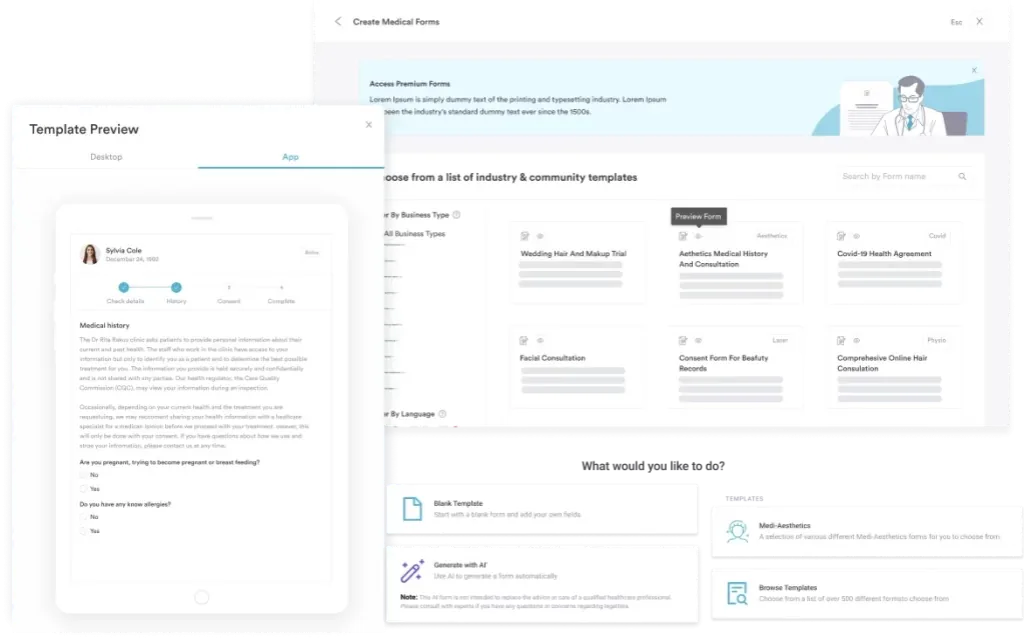
For practices managing traumatic injury follow-up and long-term sequela cases, Pabau’s claims management tools support structured code assignment and validation within the patient record workflow. This links clinical documentation directly to billing accuracy, since coding errors usually start when notes and claims are managed separately.
The same principle applies to maintaining patient record continuity for credible sequela documentation.
Build a sequela documentation checklist into your follow-up visit intake process. Confirm the original injury has resolved and name the late effect the patient presents with today. Check that the note links that effect to the prior trauma. All three elements are needed for valid sequela code assignment.

Pabau helps practices manage patient records, assign diagnosis codes, and submit claims without switching between systems. See how structured clinical workflows reduce coding errors from the point of care.

ICD-10 code S15.029S covers a narrow, infrequent scenario: A patient whose original carotid injury has fully healed, now presenting with a separate condition it caused. Getting the encounter type right depends entirely on what the visit notes say, not on how much time has passed since the original injury.
Coding S15.029S correctly comes down to documentation: The record must show the injury resolved and name the causal link to today’s condition. Structured patient records keep that link visible across every follow-up visit, so the claim holds up on first submission. Book a demo to see how Pabau supports accurate diagnostic code workflows.

Need a parallel example of sequela coding outside the S15 category? S06.344S covers a traumatic cerebral hemorrhage sequela and its documentation requirements.
Coding a neck injury at the subsequent-encounter stage? S14.103D walks through a cervical spinal cord injury still in the healing phase.
Need a 7th-character example for a healing cervical spine injury? S12.150K covers a displaced C2 spondylolisthesis subsequent encounter.
Coding an unspecified lumbar procedure? Lumbar region anesthesia billing covers billing for lumbar injections, discography, and minor decompression work with no more specific code.
Looking for another laceration code at the subsequent-encounter stage? S21.349D covers a puncture wound still in the healing phase.
ICD-10 code S15.029S is the billable diagnosis code for major laceration of unspecified carotid artery, sequela. It applies when a patient presents with a late effect of a previously resolved major carotid artery laceration. Laterality, left or right, was not documented in the original or current record.
Yes. S15.029S is a billable, specificity-level ICD-10-CM code valid for submission on HIPAA-covered transactions as of FY2026 (effective Oct 1, 2025). Coders should verify billable status against the current CMS fiscal year release before submitting, as code validity can change annually.
S15.029A (initial encounter) is used when the patient is receiving active treatment for the carotid artery injury. S15.029D (subsequent encounter) applies during the healing phase when active treatment has ended but the injury has not yet fully resolved. S15.029S (sequela) applies only after the original injury has healed, when the patient’s condition is a direct late effect of that injury.
Use the S suffix once the acute carotid artery injury has fully resolved and the current visit is for a condition it caused. There is no time limit on sequela coding under ICD-10-CM guidelines. The record must document both the late effect being treated and its causal link to the original trauma.
All three are sequela codes for major carotid artery laceration. S15.021S specifies the right carotid artery, S15.022S specifies the left, and S15.029S is used when laterality is unspecified. Always use the laterality-specific code when the documentation supports it. Reserve S15.029S for cases where laterality genuinely cannot be determined.
The immediate parent is S15.029 (major laceration of unspecified carotid artery, without a 7th character), which is non-billable. Above it sit S15.02, S15.0, and S15, each a broader, non-billable parent requiring further specificity.