ICD-10 Code T31.77: Burns involving 70-79% of body surface
ICD-10 code T31.77: Quick reference and code details ICD-10 code T31.77 is the b...

Last Updated: Nov 5, 2026
Billable Code Specific Code
S06.8AAD is the billable ICD-10-CM code for primary blast injury of brain, not elsewhere classified with loss of consciousness status unknown, subsequent encounter.
It sits in the S06.8A subcategory, added to ICD-10-CM in FY2023 for brain injury caused by the pressure wave of an explosion. The 6th character A means the record does not show whether the patient lost consciousness. The 7th character D marks follow-up care after active treatment has ended.
Let Pabau's smart automation suggest the right codes, reduce claim denials, and keep your practice compliant—effortlessly.
Automate repetitive tasks and focus on what matters most—your patients.
Reduce coding errors and ensure compliance with the latest regulations.
Clean claims, fewer denials, and faster reimbursements.
Powerful insights and reporting to help your practice thrive.
HIPAA compliant SOC 2 certified GDPR-compliant Trusted by 4,000+ clinics worldwide

S06.8AAD codes a primary blast injury of the brain at a follow-up visit, when the record cannot show whether the patient lost consciousness.
The 6th character A means LOC status is unknown. If the note documents LOC without a duration, S06.8A9D is the correct code.
The 7th character D means active treatment has ended. A second visit during active treatment still takes A.
Pair the code with an explosion external cause code, such as W40, X96, Y36.2 or Y38.2, carrying the same 7th character D.
Pabau, our practice management and billing platform, scrubs each claim for missing or invalid details before it leaves the practice.
ICD-10 Code S06.8AAD covers a primary blast injury of the brain, not elsewhere classified, at a follow-up encounter where LOC status is unknown. It is a billable code in Chapter 19 (S00-T88), under category S06 (Intracranial injury) and subcategory S06.8 (Other specified intracranial injuries).
A primary blast injury is damage done by the overpressure wave of an explosion as it passes through the skull. Fragments that strike the head cause secondary injury, and being thrown by the blast causes tertiary injury. Those wounds, fractures and contusions are coded to their own S codes.
Each part of the code adds one fact. S06.8A names the blast injury to the brain. The 6th character A says the record does not show whether the patient lost consciousness. The 7th character D says active treatment is over and the visit is routine follow-up care.
The S06.8A subcategory was added in FY2023, effective October 1, 2022, and has not changed since. “Not elsewhere classified” matters here. If the injury fits a more specific S06 subcategory, such as concussion, that code describes it instead.
The table below maps every structural element of ICD-10 Code S06.8AAD so coders can confirm the right character at each position.
The 7th character in S06.8AAD records the phase of care. ICD-10-CM Official Guidelines tie “subsequent” to the end of active treatment, so a second appointment during active treatment still takes A.
Don’t confuse the two A characters. In S06.8AAD, the 6th-character A means LOC status unknown. A 7th-character A would mean initial encounter, which gives S06.8AAA.
A practical decision rule follows from the note. Monitoring, rehabilitation or follow-up after the acute phase supports a D in the final position. New active intervention for the injury itself calls for an A there. A persistent downstream condition calls for an S, with that condition sequenced first.
The 6th character of every S06.8A code records loss of consciousness (LOC). Pick the row that matches what the note documents, because the coder never infers LOC status on the provider’s behalf.
The bottom two rows are the ones coders mix up. S06.8A9D needs a note that says the patient lost consciousness. S06.8AAD fits when the record cannot say either way, for example after an unwitnessed blast with no patient recall.
The 6th characters 7 and 8 record death before regaining consciousness. Those codes take the 7th character A only, so they never appear at a subsequent encounter.
The tabular notes for S06.8A and its parent category S06 set out which codes travel with S06.8AAD. The CDC/NCHS ICD-10-CM web tool lists the full set of notes.
What it excludes: An Excludes2 note covers any condition classifiable to S06.4-S06.6 and focal cerebral edema (S06.1). Excludes2 means the conditions are separate, so a documented epidural, subdural or subarachnoid hemorrhage is coded alongside S06.8AAD. The Excludes1 note at S06 bars head injury NOS (S09.90) from any S06 code.
Six codes are regularly picked in place of S06.8AAD, or the other way round. The table below, based on the AAPC ICD-10-CM reference, maps the key differences.
The clearest split is between S06.8AAD and S06.89AD. Both sit under S06.8 and both record LOC status unknown. Only S06.8A- describes injury from the blast wave itself, while a fall or assault injury that fits no other subcategory goes to S06.89-.
Concussion works differently. Because S06.8A is “not elsewhere classified”, a concussion documented after an explosion is coded to S06.0X- instead. Query the provider when the note uses both terms without saying which describes the injury.
Three questions, asked in order, settle which of these codes a follow-up note supports.
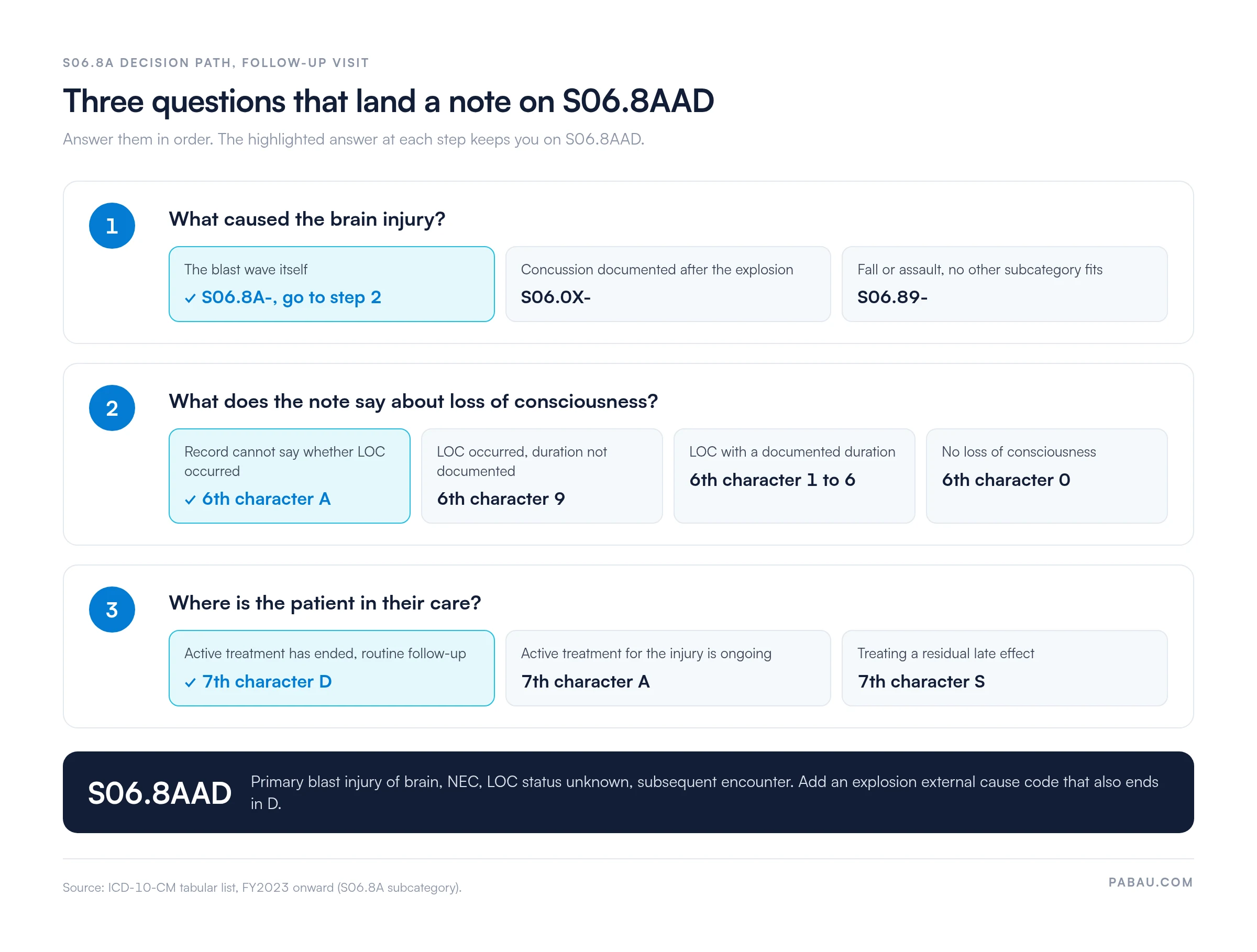
Check your EHR’s annual code update cycle before each new fiscal year. The S06.8A subcategory launched in FY2023, so older code sets do not include it. Run a code validity check in your practice management system at the start of each ICD-10-CM update cycle to confirm S06.8AAD is active and billable.
Supporting ICD-10 Code S06.8AAD at a subsequent encounter requires the provider note to contain specific elements. Per CMS ICD-10-CM Official Guidelines Chapter 19, the documentation drives the injury code, and the coder does not interpret ambiguous findings. Medical billing compliance for this code rests on the elements below being in the chart.
The Chapter 19 note tells coders to add a secondary code from Chapter 20 to show the cause of injury. For S06.8AAD, that code describes the explosion and who set it off, which the diagnosis code alone does not convey.
Match the 7th character of the external cause code to the injury code, so S06.8AAD takes a D external cause code. Sequence S06.8AAD as the principal or an additional diagnosis. The external cause code always follows and never leads.
Place of occurrence (Y92), activity (Y93) and external cause status (Y99) codes are reported only at the initial encounter. Leave them off a subsequent-encounter claim, including Y99.1 for military activity.
Medicare covers follow-up TBI encounters when medical necessity is established. Local Coverage Determinations govern related services, such as neurology, neuropsychological testing and rehabilitation.
A Claim.MD clearinghouse checks each claim against payer edits before forwarding it, so format and code errors come back before adjudication.
Reviewing electronic remittance advice after adjudication shows which payer rules trigger denials on this code.
Denials on ICD-10 Code S06.8AAD cluster around predictable documentation and coding errors. Structured denial management workflows and the denial codes returned on the ERA trace most rejections to one of the seven causes below.
Without a check before submission, an S06.8AAD error tends to surface weeks later on the remittance. Someone then has to find the claim, compare each character with the note, and resubmit.
In Pabau, the claim opens pre-filled from the invoice. Claim validation scrubs it for missing or invalid details before it goes to Claim.MD. If a claim still comes back rejected, Pabau flags it as Needs action and links straight to the field to correct.
The coder still owns the code choice. Three characters each carry a separate clinical fact, so the five steps below follow the standard ICD-10-CM workflow for a blast injury follow-up.
If a payer returns CARC 11 (the diagnosis is inconsistent with the procedure), check the 6th character first. S06.8AAD says nobody knows whether the patient lost consciousness. If the record documents LOC, query the provider and recode to S06.8A9D or the matching duration code.

Pabau’s claim validation catches missing or invalid details before submission, so S06.8AAD blast injury claims reach the clearinghouse clean.

S06.8AAD belongs on a claim only when three facts line up. The brain injury came from a blast wave, the record cannot confirm LOC, and active treatment is over. Change one fact and the code changes with it, to S06.8A9D, S06.89AD or S06.8AAA.
Pabau validates each claim before it leaves the practice and points a rejection to the exact field to fix. To see how the billing workflow handles blast injury and other TBI codes, book a demo with the team.

Want a structured approach to reducing claim rejections? Clean claim best practices outlines the documentation and coding standards that keep TBI and other injury claims from being returned.
Coding diffuse TBI with LOC of unknown length? ICD-10 code S06.2X9D covers the diffuse brain injury counterpart at a subsequent encounter.
Following up a traumatic bleed coded alongside the blast injury? ICD-10 code S06.6X1D applies the same LOC ladder to a subarachnoid hemorrhage.
ICD-10 Code S06.8AAD is the billable code for a primary blast injury of the brain with loss of consciousness status unknown, at a subsequent encounter. It applies when the blast wave itself injured the brain, the record cannot say whether the patient lost consciousness, and active treatment has ended.
S06.8A9D means the patient lost consciousness but the note does not record for how long. S06.8AAD means the record cannot say whether the patient lost consciousness at all. Both are subsequent-encounter codes for a primary blast injury of the brain.
Use 7th character D when active treatment for the injury has ended and the encounter is for routine follow-up, rehabilitation monitoring or recovery checks. A second visit during active treatment still takes A, because the character tracks the phase of care.
Use an explosion code that ends in the 7th character D, as the injury code does. Common choices are W40 for accidental explosions, W39 for fireworks and X96 for assault with an explosive. War, military operations and terrorism take Y36.2, Y37.2 or Y38.2 codes. Place, activity and status codes are left off follow-up claims.
The note must describe the explosion, attribute the brain injury to the blast wave, and record LOC status with the reason it is unknown. It must also show that active treatment has ended and include neurological findings. Missing elements weaken medical necessity and invite denials.
Yes, S06.8AAD is a valid billable ICD-10-CM code for Medicare and Medicaid claims when the documentation supports it. Coverage of the related service still depends on the applicable Local Coverage Determination. Check the current tabular and the relevant LCD before submitting.