ICD-10 Code Z86.73: Personal history of TIA
ICD-10 Code Z86.73: Definition, descriptor, and code hierarchy ICD-10 Code Z86.7...

Last Updated: Nov 20, 2026
Billable Code Specific Code
R11.0 is the billable ICD-10-CM code for nausea, used when the note documents nausea and no vomiting. Its inclusion terms are nausea NOS and nausea without vomiting.
If the patient also vomited, R11.2 applies instead. When a confirmed diagnosis explains the nausea, that diagnosis leads the claim and R11.0 is usually left off.
Let Pabau's smart automation suggest the right codes, reduce claim denials, and keep your practice compliant—effortlessly.
Automate repetitive tasks and focus on what matters most—your patients.
Reduce coding errors and ensure compliance with the latest regulations.
Clean claims, fewer denials, and faster reimbursements.
Powerful insights and reporting to help your practice thrive.
HIPAA compliant SOC 2 certified GDPR-compliant Trusted by 4,000+ clinics worldwide

R11.0 covers nausea alone: it applies only when the clinical record documents nausea with no concurrent vomiting episode.
R11.0 is a billable, valid ICD-10-CM code for FY 2027 and all HIPAA-covered electronic transactions.
When a known underlying diagnosis is documented, that condition should lead the claim and R11.0 moves to secondary or is omitted.
Nausea and vomiting together take R11.2, and vomiting alone takes one of the seven R11.1- codes.
ICD-10 code R11.0 is the billable ICD-10-CM code for nausea, used when the note documents nausea and no vomiting. CMS’s FY 2027 ICD-10-CM files list it under category R11 (Nausea and vomiting), with “Nausea NOS” and “Nausea without vomiting” as its inclusion terms. The category sits in Chapter 18, which covers symptoms, signs and abnormal findings (R00 to R99). R11.0 needs no further character, so it can go on a claim as it stands.
The CDC/NCHS ICD-10-CM web tool confirms R11.0 as valid and billable for FY 2027, with the descriptor unchanged in the current code set.
R11.0 covers nausea presented in isolation. The clinical record documents nausea, and no vomiting episode is noted. The code does not extend to presentations where vomiting is also documented, regardless of sequence or severity.
R11.0 carries no Excludes note of its own. The note sits one level up, on category R11, and it is an Excludes1 note. An Excludes1 condition is never coded alongside an R11 code. It takes its own code instead:
Two more limits come from the code itself and from the Official Guidelines.
The most common coding error in the R11 group is selecting R11.0 when the encounter warrants R11.2 or an R11.1- code. The decision hinges on what the provider documented, not on which symptom was more prominent.
As a practical rule, read the provider note before selecting. If the words “vomited” or “vomiting” appear anywhere in the documentation for that encounter, R11.0 is not the right code. R11.2 or an R11.1- code fits instead. The diagram below runs the same check in order, starting with the integral-symptom rule.
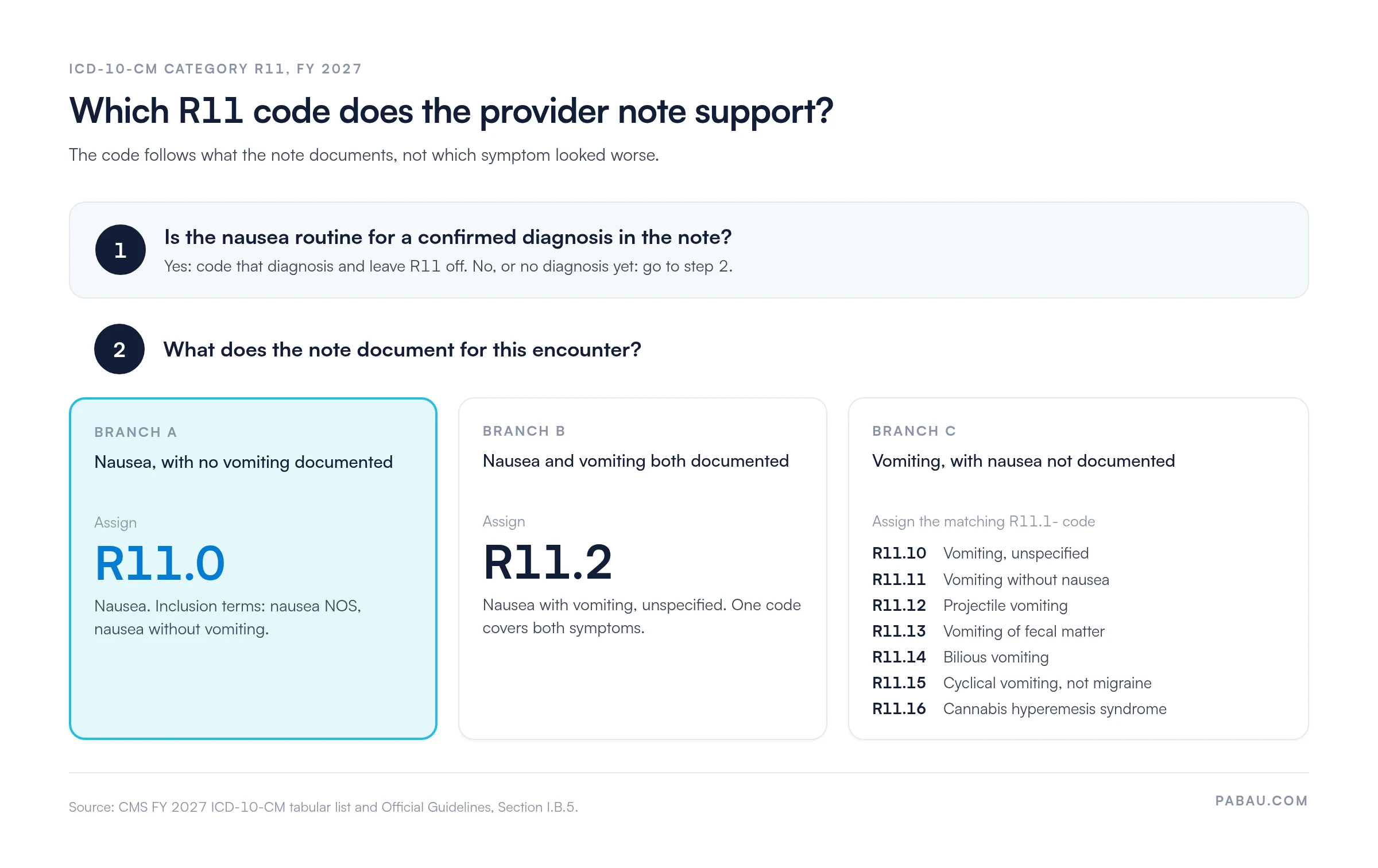
Category R11 holds nine billable codes in FY 2027. R11.1 (Vomiting) is a subcategory that groups the seven R11.1- codes and cannot be billed on its own. Knowing the full sibling set prevents both undercoding and overcoding when documentation is complex.
Before assigning any R11 code, check whether the note distinguishes between nausea and vomiting as separate symptoms. If the provider wrote only ‘nausea and vomiting’ without specifying which occurred, R11.2 is the safer default. Reserve R11.0 for encounters where the absence of vomiting is explicit in the documentation.
R11.0 applies in three primary clinical contexts. In each case, the provider note must actively document nausea without a concurrent vomiting episode.
Section I.C.18.a of the FY 2027 Official Guidelines allows symptom codes like R11.0 when the provider has not established a related definitive diagnosis.
ICD-10-CM has no dedicated code for chronic or persistent nausea. Coders use R11.0 for recurring nausea presentations, but the clinical record must do more work to justify the code at each encounter.
What the provider note must state for a chronic nausea encounter to support R11.0:
When an underlying cause is eventually confirmed (say, gastroparesis or functional dyspepsia), that diagnosis should replace or supplement R11.0. Per ICD-10-CM Official Guidelines, symptom codes are not coded additionally when they are routine and expected manifestations of a confirmed condition.
Accurate coding of R11.0 starts in the clinical note, not in the billing system. These are the documentation elements that must be present before the code is assigned.
The ICD-10-CM Official Guidelines for Coding and Reporting, updated annually by CMS, govern these rules in Section I.C.18 on symptom codes. Coders should review this section at each fiscal-year update.
R11.0 is a symptom code, and payers, including Medicare and Medicaid, apply extra scrutiny to symptom-only claims. The core requirement is medical necessity. The provider evaluated nausea as a presenting complaint warranting the level of service billed.
Most R11.0 denials are preventable. They fall into four patterns that consistent coding and documentation workflows can eliminate.
Tracking denial management workflows at the practice level shows whether R11.0 errors are systematic. It also tells coding teams where corrective education will stop the same mistake on the next batch of claims. To decode the denial codes a payer returns on these claims, match each CARC and RARC to its fix.
Run a quarterly audit of all claims submitted with R11.0 as the principal diagnosis. Flag any where a secondary code also documents a confirmed diagnosis. That pairing signals a sequencing error: the established condition should have led the claim. Correcting the pattern at the coder level prevents the same denial from recurring month after month.
Most R11.0 denials start in the clinical note, before anyone opens the billing screen. The note either never says whether the patient vomited, or a confirmed diagnosis sits behind the symptom code.
In Pabau, the practice management platform we build, clinicians chart in note templates the practice designs itself. A practice can add a “vomiting: yes/no” field to its nausea note template. The coder then reads the answer from the note instead of guessing between R11.0 and R11.2.
Pabau also handles claims management end to end. Its Claim.MD integration sends CMS-1500/837P claims, runs real-time eligibility checks, and returns ERA remittances. Each denial then posts against the visit and note that produced it.
Our guide to medical billing basics walks through each stage, from note completion to claim submission.

Build a nausea note template that records vomiting yes or no, then send CMS-1500 claims through Pabau’s Claim.MD integration. See how it works for your practice.

R11.0 is a narrow code with a narrow clinical scope. It needs nausea documented without vomiting, no confirmed cause that explains the symptom, and sequencing that places it correctly against any associated diagnosis. Getting those three elements right eliminates the majority of R11.0 claim denials.
The cheapest fix happens in the note template, long before a claim is built. Add a vomiting yes/no field to your nausea template, and audit R11.0 claims for a confirmed diagnosis sitting in second place. Book a demo to see how Pabau links that note template to the claims your team sends through Claim.MD.

Need a clean-claim reference for R11.0 submissions? Clean claim requirements in medical billing outlines what every field on a CMS-1500 must contain before submission.
Want to understand how the clearinghouse fits into your billing workflow? Medical claims clearinghouse guide explains how claim validation and payer routing works end to end.
Looking to track and reduce your overall denial rate? Revenue cycle management overview covers the full claim lifecycle from eligibility check through payment posting.
Coding nausea with vomiting instead? ICD-10 code R11.2 covers encounters where the note documents both symptoms.
ICD-10 code R11.0 is used to report a clinical encounter where the patient presents with nausea alone and no vomiting is documented. It is a Chapter 18 symptom code. It is valid when no confirmed underlying diagnosis has been established, or when nausea is not an integral feature of a known condition.
Yes. R11.0 is a valid, billable ICD-10-CM diagnosis code for FY 2027 and is accepted for all HIPAA-covered electronic claim transactions. Its descriptor is unchanged in the FY 2027 code set.
R11.0 (Nausea) applies when only nausea is documented and no vomiting occurred. R11.2 (Nausea with vomiting, unspecified) applies when both symptoms are documented in the same encounter. The distinction is determined by provider documentation, not by which symptom was more severe or the reason for the visit.
Yes, in certain circumstances. R11.0 may serve as the principal (first-listed) diagnosis when nausea is the reason for the encounter and no confirmed diagnosis exists at its close. Per ICD-10-CM Official Guidelines, symptom codes are appropriate as principal when no definitive diagnosis has been determined. If a confirmed diagnosis exists, that condition sequences first.
The provider note must document nausea explicitly as a presenting complaint and state or imply that no vomiting occurred. It should describe duration and onset. It must also confirm that no underlying diagnosis exists, or explain why nausea is separately reportable alongside a known condition. Vague symptom descriptions such as “feeling unwell” do not adequately support R11.0 for payer review.