ICD-10 code S61.201A: Open wound of left index finger without nail damage
ICD-10 code S61.201A covers a left index finger wound of unstated type ICD-10 co...

Last Updated: Oct 16, 2026
Billable Code Specific Code
Q11.3 is the billable ICD-10-CM code for macrophthalmos.
Most congenital eye malformation cases reach a billing team without complete documentation, and Q11.3 is no exception. Coders regularly receive records that confirm an enlarged globe but lack the explicit "congenital" qualifier - turning a straightforward billable encounter into a rework cycle.
ICD-10 Code Q11.3 is a billable and specific ICD-10-CM diagnosis code representing macrophthalmos, the congenital enlargement of the globe of the eye. It has been in place since ICD-10-CM's original 2015 implementation, has kept a no-change status every fiscal year since, and remains current in the FY2026 edition (October 1, 2025 - September 30, 2026), valid for submission on HIPAA-covered transactions.
Coders can confirm this classification using the AAPC Codify lookup, where Q11.3 sits under the parent category Q11 (Anophthalmos, microphthalmos and macrophthalmos), itself within the broader chapter Q00-QA0 (Congenital malformations, deformations and chromosomal abnormalities).
The parent code Q11 is non-billable. Only the four-character subcodes under it carry billable/specific status. Q11.3 is the only subcode in that family representing an enlarged globe, making it the sole correct code when macrophthalmos is the documented diagnosis.
Let Pabau's smart automation suggest the right codes, reduce claim denials, and keep your practice compliant—effortlessly.
Automate repetitive tasks and focus on what matters most—your patients.
Reduce coding errors and ensure compliance with the latest regulations.
Clean claims, fewer denials, and faster reimbursements.
Powerful insights and reporting to help your practice thrive.
HIPAA compliant SOC 2 certified GDPR-compliant Trusted by 4,000+ clinics worldwide

ICD-10 Code Q11.3 is a billable, specific ICD-10-CM code for macrophthalmos, the congenital enlargement of the ocular globe – in place since ICD-10-CM’s 2015 launch and unchanged in the current FY2026 edition (October 1, 2025 – September 30, 2026).
Q11.3 falls under the Q11 category covering anophthalmos, microphthalmos, and macrophthalmos – all congenital malformations of the eye; only the subcodes (Q11.0, Q11.1, Q11.2, Q11.3) are billable, not the parent Q11.
Documentation must specify the congenital nature of the condition, laterality where applicable, and imaging or clinical findings confirming globe enlargement – missing any of these is a common denial trigger.
Pabau’s claims management software and structured patient records help ophthalmology and surgical practices capture the documentation detail Q11.3 requires at the point of care.
Use this table for at-a-glance verification before claim submission. All fields reflect the FY2026 ICD-10-CM edition. When operative intervention is indicated, practices may also need eye-specific procedure codes such as V2632 on the same claim.
Cross-reference this code against the CDC/NCHS ICD-10-CM web tool to confirm billability for the current fiscal year, particularly if you are working from a cached codebook or an older EHR reference set.
Macrophthalmos is a congenital condition in which the globe of the eye is abnormally enlarged at birth. Unlike acquired globe enlargement, which may develop secondary to glaucoma or other ocular disease, macrophthalmos in the ICD-10-CM context refers specifically to the congenital form present from birth. This distinction is what determines whether Q11.3 or a different code applies.
The condition is rare and most commonly identified during neonatal examination or early pediatric ophthalmology assessment. It may be isolated or associated with other ocular anomalies.
Ophthalmologists and pediatric eye specialists managing these patients – and the billing teams supporting surgical practice workflows or dermatology practices handling similarly rare congenital diagnoses – should be aware that documenting the congenital origin is the critical differentiator for correct coding.
Key clinical features that distinguish macrophthalmos for coding purposes:
Buphthalmos (enlargement of the eye due to infantile glaucoma) is a clinically similar presentation but coded differently. Confirm with the treating physician whether the diagnosis is primary congenital macrophthalmos or secondary enlargement from glaucoma before assigning Q11.3. Using the wrong code here is a common reason for payer query.
The Q11 ICD-10 codes category covers three distinct congenital malformations of the eye globe. Each condition has its own billable subcode; the parent Q11 is non-billable and should never appear on a claim as the submitted diagnosis. Understanding the full family helps coders select the right code when the record describes degrees of globe size abnormality.
This requirement to code at the most specific billable level isn’t unique to Q11 – the same principle applies across ICD-10-CM.
Submitting Q11 rather than Q11.3 on a claim will result in a rejection, as payers require a billable/specific code at the highest level of specificity available.
Strong medical record keeping tools let you pull birth and neonatal notes whenever a family returns.
Coders and clinicians use different language. A physician may document “congenital globe enlargement” or “enlarged ocular globe” in the chart without using the term macrophthalmos directly. All of the following map to Q11.3 for coding purposes, provided the congenital origin is clearly stated in the medical record.
Using these synonyms to index the diagnosis in ICD-10-CM reference tools – including the CMS ICD-10 codes page – will route coders to Q11.3. The key requirement in every case: the word “congenital” or an equivalent phrase indicating the condition was present at birth must appear in the physician’s documented diagnosis.
The FY2026 ICD-10-CM Official Guidelines for Coding and Reporting, published jointly by CMS and NCHS, govern correct assignment of Q11.3. Several rules are particularly relevant to this code.
Q11.3 may function as either a principal diagnosis or an additional diagnosis depending on the encounter type. When the patient presents specifically for evaluation or management of macrophthalmos, assign Q11.3 as the principal diagnosis. When the condition is incidentally noted alongside a primary presenting complaint, assign it as a secondary code.
Coders maintaining clinical documentation compliance across ophthalmology practices should document the sequencing rationale in the chart to support audit review, particularly for high-cost encounters where the congenital diagnosis affects reimbursement calculation.
ICD-10-CM guidelines state that congenital conditions may be coded throughout the patient’s life whenever they remain clinically relevant – not only in the newborn period.
A patient seen at age 30 for an ophthalmology consultation where macrophthalmos is documented as an active condition may still receive Q11.3 as a diagnosis code. The condition does not “expire” once the patient leaves infancy.
Q11.3 carries an Excludes1 note: macrophthalmos in congenital glaucoma (Q15.0). An Excludes1 note means the two codes are mutually exclusive – when the globe enlargement is caused by congenital glaucoma (buphthalmos), the correct code is Q15.0, not Q11.3.
Coders should confirm from the documentation whether the enlargement is primary and isolated (Q11.3) or secondary to congenital glaucoma (Q15.0) before finalizing the code, and check for any additional notes at the Q11 parent level that apply across the category.
Payers will scrutinize documentation for congenital malformation codes, including Q11.3. The medical record must support the diagnosis at the level of specificity the code requires. Missing elements are the most common reason Q11.3 encounters generate queries or denials.
Required documentation elements for a Q11.3 claim to stand up to review:
Practices using structured medical record documentation workflows reduce the chance of these elements being missed at the point of care. Building a documentation checklist into intake and clinical note templates – including standardized eye exam templates – catches these missing elements before the claim goes out.
Build a condition-specific documentation prompt into the ophthalmology consultation note template. For macrophthalmos encounters, the template should prompt the clinician to state: (1) congenital onset, (2) laterality, (3) the clinical finding that confirms globe enlargement, and (4) the purpose of the current encounter. This takes under 60 seconds and prevents the most common Q11.3 documentation omissions.
Q11.3 sits within a broader family of congenital eye malformation ICD-10 codes. Coders need to know the adjacent codes to confirm they have selected the most accurate one and to correctly code associated conditions when multiple diagnoses are documented. The table below maps the most commonly referenced related codes.
Practices referencing intraparenchymal hemorrhage codes for other complex diagnoses will recognize the same pattern here: build a related-code crosswalk into documentation templates rather than relying on memory. When the record describes multiple concurrent congenital eye findings, each condition with its own distinct code should be captured separately rather than attempting to code only the most prominent finding. Box-by-box requirements on the professional claim form change by payer, so one filled sample is not a universal template.
Verify each code in the WHO ICD-10 browser for international reference before mapping back to the ICD-10-CM version for US payer submission.
Getting Q11.3 right depends on what happens before the claim is generated. Accurate coding for congenital eye malformations starts with structured clinical note capture that prompts clinicians to document every required element at the point of care.
Pabau’s claims management software connects the clinical documentation workflow directly to billing, reducing how often coding details get lost between the exam room and the claim. Clinicians complete structured digital assessment forms that capture congenital onset, laterality, and examination findings; those notes then populate directly into the billing workflow without manual re-entry.
The result is fewer claim queries on diagnostic codes like Q11.3 where documentation specificity is what separates a clean claim from a denial.
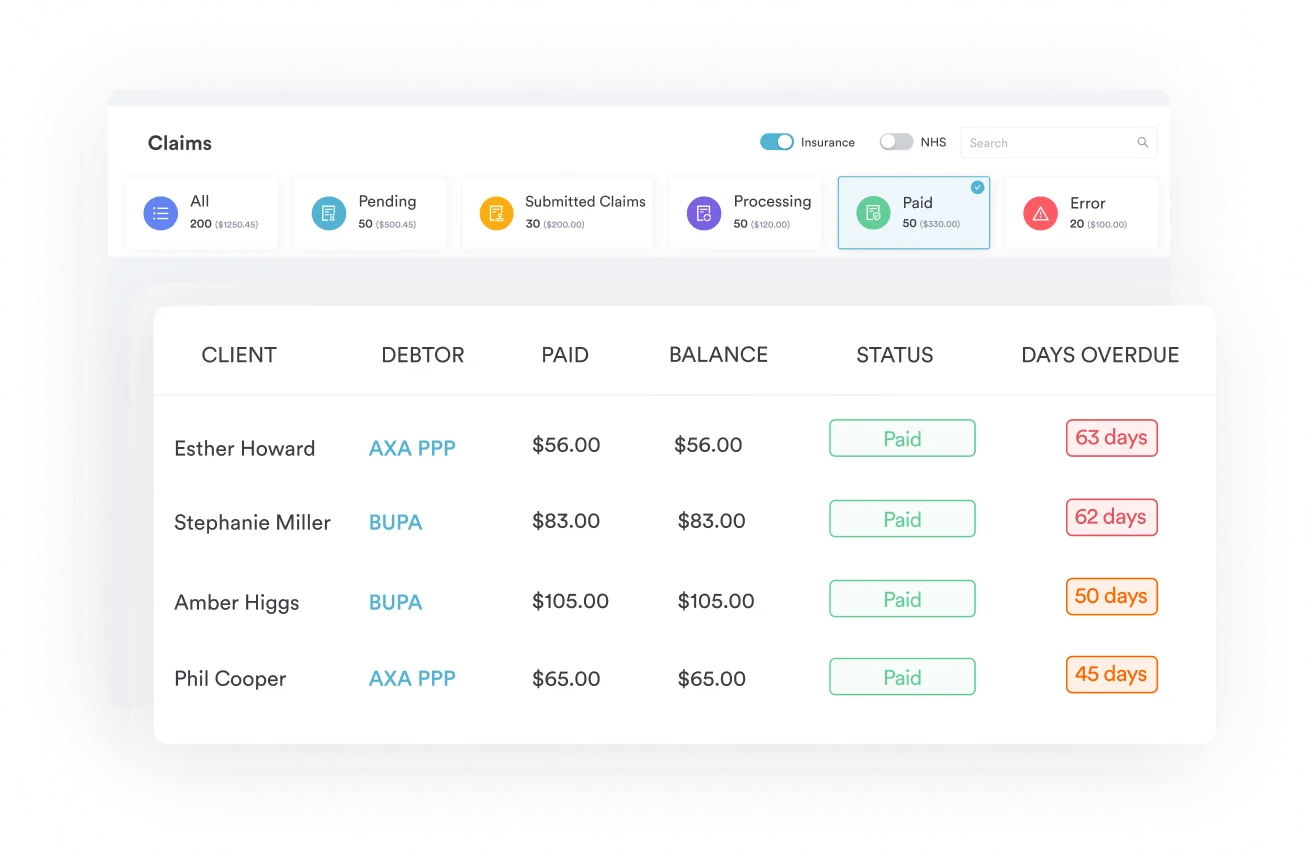
For ophthalmology and surgical practices building out their documentation standards.
A macrophthalmos consultation template, for example, would prompt the physician to confirm congenital origin, record laterality, and document the clinical basis for the diagnosis before the patient leaves the consultation. This takes the coding quality problem and solves it at the source.
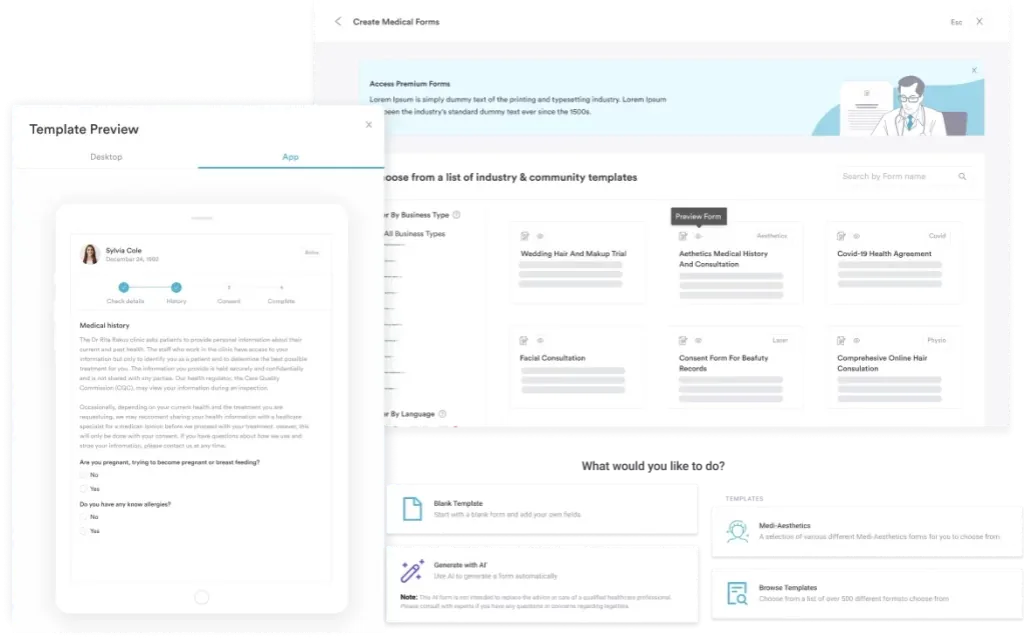
Pabau’s AI-assisted clinical documentation further supports this by transcribing and structuring consultation notes in real time, so key clinical details – including the phrases that trigger correct ICD-10-CM code assignment – are captured accurately rather than reconstructed from memory after the fact.
Practices managing patient data management across ophthalmology caseloads find this particularly useful for rare conditions like macrophthalmos where clinicians may see fewer than a handful of cases per year.
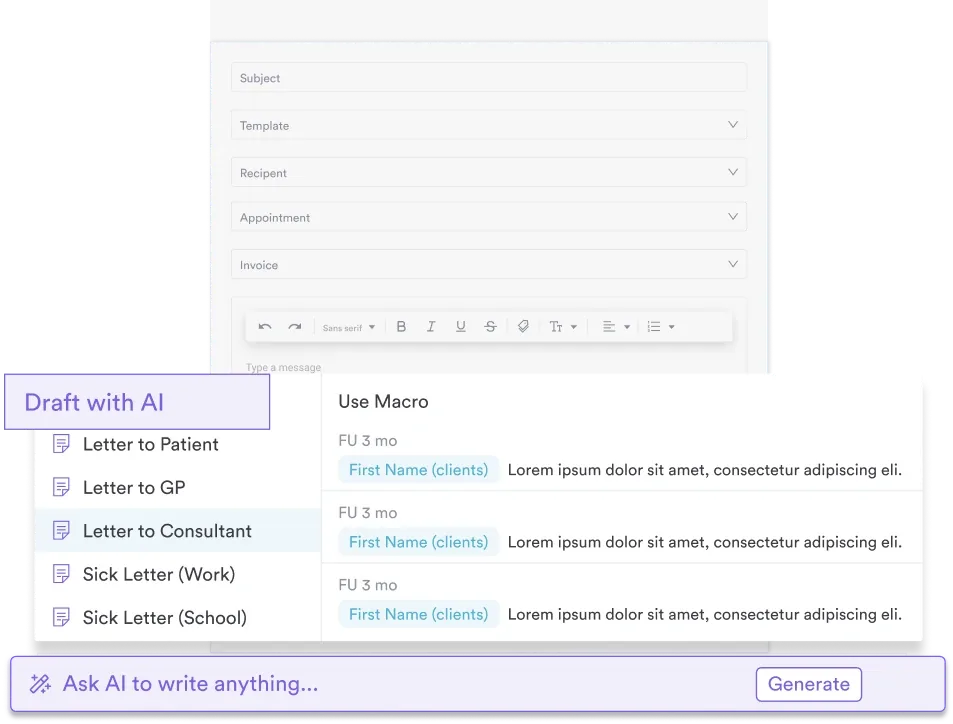

Pabau connects clinical note capture to billing workflows so the documentation detail Q11.3 and similar congenital malformation codes require is captured at the point of care, not chased down after claim rejection.

Macrophthalmos is rare, which means coders encounter Q11.3 infrequently – and that infrequency is precisely why documentation is so often incomplete. The code is straightforward to apply when the physician has documented the congenital nature of the condition, but without that specificity, claims stall.
Pabau’s structured clinical forms and AI-assisted note capture give ophthalmology practices the documentation framework to get Q11.3 right the first time. To see how Pabau handles congenital condition coding workflows in practice, explore the platform further or book a demo and speak with the team.

Billing a suspected poisoning workup? CCSD code 0132B for thallium testing covers the billing code for the thallium level test ordered to investigate suspected metal exposure.
Billing a clinical biochemistry blood test? CCSD code 0135B for thiocyanate testing explains the billing code for the thiocyanate level blood test, a clinical biochemistry investigation.
Billing a barbiturate level test? CCSD code 0138B for thiopental testing covers the billing code for the thiopental level blood test that measures a fast-acting barbiturate.
ICD-10 Code Q11.3 is a billable and specific ICD-10-CM diagnosis code representing macrophthalmos, the congenital enlargement of the globe of the eye. It falls under the Q11 category (Anophthalmos, microphthalmos and macrophthalmos) within chapter Q00-QA0 (Congenital malformations, deformations and chromosomal abnormalities). The code has been in place since ICD-10-CM’s 2015 implementation and remains unchanged in the current FY2026 edition.
Yes. Q11.3 is a billable/specific ICD-10-CM code valid for submission on HIPAA-covered transactions. The parent code Q11 is not billable; only the four-character subcodes (Q11.0, Q11.1, Q11.2, Q11.3) carry billable status and should be used on claims.
Macrophthalmos (Q11.3) refers to congenital enlargement of the globe; microphthalmos (Q11.2) is the opposite, a congenitally small globe; and anophthalmos (Q11.0 or Q11.1) describes absence of the eye entirely, either as a cystic remnant or complete absence. All three are congenital conditions in the Q11 category, each requiring its own distinct billable subcode.
The medical record must include a physician-documented diagnosis explicitly stating macrophthalmos or a recognized synonym with congenital origin confirmed, along with clinical or imaging findings that support globe enlargement beyond normal limits. Laterality should be noted where clinically relevant, and the encounter reason (monitoring, surgical consultation, etc.) should be documented to support correct sequencing as principal or additional diagnosis.
CPT codes commonly paired with Q11.3 include ophthalmology evaluation codes (92002-92014 for examinations), ocular biometry codes used in surgical planning, and eye-specific surgical procedure codes when operative intervention is indicated. The specific CPT code depends on the service rendered; Q11.3 functions as the supporting diagnosis code confirming medical necessity across those encounters.
ICD-10-CM Q11.3 (Macrophthalmos) has been in effect since ICD-10-CM’s original implementation on October 1, 2015 (FY2016), and it has kept a no-change status every fiscal year since – including the current FY2026 edition, in use for dates of service from October 1, 2025 through September 30, 2026.