ICD-10 Code Y76.0: Diagnostic obstetric and gynecological devices
ICD-10 Code Y76.0: Definition and billable status ICD-10 Code Y76.0 is a valid, ...

Last Updated: Oct 23, 2026
Billable Code Specific Code
O66.3 is the billable ICD-10-CM code for obstructed labor due to other abnormalities of fetus. It covers dystocia caused by a structural fetal condition, such as fetal ascites, hydrops, meningomyelocele, sacral teratoma, a fetal tumor or a hydrocephalic fetus.
The abnormality must be documented as the mechanical cause of the obstruction, not an incidental finding. The tabular also requires an additional code identifying the cause of obstruction, and the delivery claim needs an outcome-of-delivery code from Z37.
Let Pabau's smart automation suggest the right codes, reduce claim denials, and keep your practice compliant—effortlessly.
Automate repetitive tasks and focus on what matters most—your patients.
Reduce coding errors and ensure compliance with the latest regulations.
Clean claims, fewer denials, and faster reimbursements.
Powerful insights and reporting to help your practice thrive.
HIPAA compliant SOC 2 certified GDPR-compliant Trusted by 4,000+ clinics worldwide

O66.3 is a billable ICD-10-CM code for labor obstructed mechanically by a structural fetal abnormality, not by malpresentation.
Its inclusion terms are fetal ascites, hydrops, meningomyelocele, sacral teratoma, fetal tumor and hydrocephalic fetus causing the obstruction.
O66.3 has no Excludes1 note against its O66 siblings, so the documented cause of the obstruction decides which O66 code applies.
Every O66.3 delivery claim also needs a code for the cause of obstruction, an outcome-of-delivery code from Z37 and a Z3A gestation code.
Pabau’s claims management submits claims through Claim.MD and lets you track claim status and denials.
ICD-10 Code O66.3 has the official descriptor “Obstructed labor due to other abnormalities of fetus.” It is a specific, billable code, valid for delivery encounters from October 1, 2024 onward, per the CDC/NCHS ICD-10-CM official tabular tool. The “other abnormalities” framing separates it from the malpresentation codes in O64 and from the named dystocia codes O66.0 through O66.2.
The ICD-10-CM tabular list includes six fetal conditions under O66.3, and each counts only when it causes a mechanical obstruction to vaginal delivery. A fetal anomaly present at delivery that doesn’t block the pelvis or birth canal doesn’t qualify.
Per the CMS ICD-10-CM code files, the included conditions are:
The physician must document which specific abnormality is obstructing labor. A vague attestation such as “fetal anomaly present” doesn’t support O66.3, so query the physician first. If the note still names no cause, O66.9 applies, and payers check this distinction on review.
O66.3 has no Excludes1 note against its O66 siblings. The Excludes1 notes that involve it sit on other codes. O33.7 (maternal care for disproportion due to other fetal deformities) and O65.4 (obstructed labor due to fetopelvic disproportion, unspecified) both point to O66.3.
Beyond those notes, code selection is differential. Each O66 code names a different cause of obstruction, so a different documented cause usually means a different code.
Fetal malpresentation, such as a face, brow or occiput posterior position, is not an “abnormality of the fetus” in the O66.3 sense. Those scenarios belong in the O64 block, because O66.3 is reserved for structural anomalies rather than positional variants.
The documented cause drives the choice. Read the delivery note for that cause, then match it to one row below.
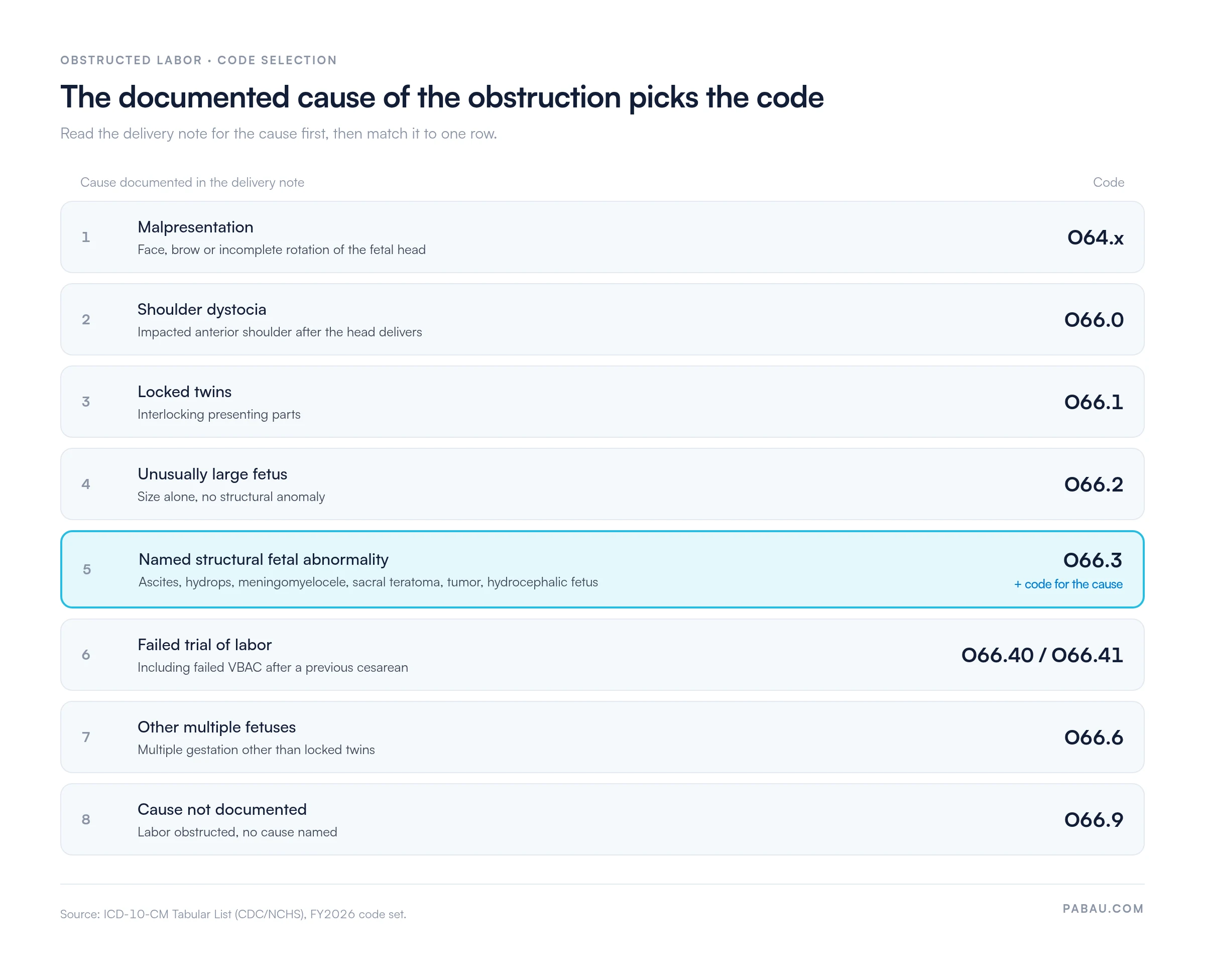
Knowing the O66 siblings helps coders rule O66.3 in or out before assigning it. The table lists the billable codes in category O66, per the AAPC ICD-10-CM code reference. O66.4 is a non-billable parent, so its two subcodes appear instead. Twin deliveries need extra care: locked twins take O66.1, while obstruction from other multiple fetuses takes O66.6.
O66.3 requires physician documentation that goes beyond simply noting a fetal anomaly in the chart. The medical record must establish a causal chain: the specific structural fetal finding mechanically prevented or significantly obstructed vaginal delivery.
Document the causal chain explicitly in the delivery note rather than relying on the prenatal record to speak for itself. Payer reviewers audit the delivery encounter documentation. A generic ‘fetal anomaly noted’ without a link to the obstruction can draw a medical necessity denial on O66.3 claims.
Correct sequencing depends on the care setting. In inpatient delivery admissions, O66.3 is typically the principal diagnosis when the obstructed labor is the condition chiefly responsible for the admission. In outpatient settings, code the condition established at the end of the visit.
Additional codes required or commonly used alongside ICD-10 Code O66.3 include:
Clean claim submission on O66.3 encounters means checking that every required additional code is on the claim before it leaves the practice. A claim with O66.3 as the only code can trigger a technical denial that needs resubmission.
Major payer types approach O66.3 differently, and requirements vary by payer and state. The following reflects general patterns, so always verify the specific payer’s coverage policy before submission.
Check each payer’s authorization and documentation rules when the delivery admission is scheduled. A missing authorization found at that point costs a phone call rather than a denied claim.
Denials on ICD-10 Code O66.3 cluster around a predictable set of documentation and coding errors. Here are the common patterns and how to address them:
Practices can also build denial management workflows that make these checks routine for O66.3 and other obstetric codes. When a denial does come back, our guide to denial codes for billers explains what each adjustment reason code means.
Run a quarterly audit of your O66.3 claims against the denial codes they return. CARC 197 (precertification or authorization absent) and CARC 16 (claim lacks information or has billing errors) are two to watch on delivery claims. Tracking which denial reason appears most often tells you whether your documentation process or your coding workflow needs fixing first.
On a delivery claim, a biller pulls the diagnosis codes from the delivery note, enters them for submission, then checks payer portals for the result. Each step happens somewhere different, so a denial can sit unnoticed until the payment is overdue.
Pabau, the practice management platform we build, keeps those steps together. Its claims software for obstetrics submits claims through Claim.MD, our clearinghouse partner, and lets you track each claim’s status and any denial.
Pabau sends the codes your team enters, so your coder still chooses O66.3, the cause code, Z37.x and Z3A.xx. What changes is the follow-up. A denial shows up beside its claim while the delivery record is still fresh, so your biller can correct and resubmit it quickly.

Pabau’s claims management submits claims through Claim.MD and lets you track claim status and denials. Your team sees which O66.3 delivery claims need follow-up and resubmits them while the record is fresh.

Assign O66.3 only when the delivery note names the structural fetal abnormality and states that it obstructed labor. If the note says less, query the physician before you code, or fall back to O66.9. A different documented cause, such as shoulder dystocia or a failed VBAC, points to a different O66 code.
The payoff is fewer resubmissions. Build the cause code, Z37.x and Z3A.xx into your delivery claim template, and fewer technical denials reach your queue. That habit belongs in your wider medical billing workflow, not only on O66.3 claims.
Book a demo to see how Pabau submits your obstetric claims through Claim.MD and tracks each one until it’s paid.

Managing obstetric denials across multiple payers? Denial management in healthcare covers systematic approaches to reducing first-pass rejection rates on complex delivery codes.
Need a reference for claim denial codes? Denial codes in medical billing explains the CARC and RARC codes behind rejected claims.
Documentation doesn’t name the cause? ICD-10 code O66.9 covers obstructed labor, unspecified, and when that fallback applies.
Was an instrumental delivery attempted first? ICD-10 code O66.5 covers a failed attempt with vacuum extractor and forceps.
ICD-10 Code O66.3 is the billable ICD-10-CM code for obstructed labor caused by a structural abnormality of the fetus. Examples include fetal ascites, hydrops, meningomyelocele, sacral teratoma, fetal tumor and hydrocephalic fetus, when the finding mechanically prevents vaginal delivery. It does not apply to malpresentation or shoulder dystocia, which have separate codes.
Yes. O66.3 can be reported alongside a cesarean delivery procedure code when the documented fetal abnormality prompted the operative delivery. The cesarean procedure code (ICD-10-PCS or CPT) is reported separately, and O66.3 serves as the diagnosis supporting medical necessity for the procedure.
O66.9 (Obstructed labor, unspecified) is the fallback code when documentation does not specify the cause of obstruction. O66.3 requires the physician to name a specific structural fetal abnormality and link it causally to the obstruction. If the delivery note states only that labor was obstructed, O66.9 is the correct code. Payers review O66.3 claims more closely when the documentation lacks that specificity.
Frequent denial triggers on O66.3 are a missing outcome-of-delivery code Z37.x, a missing cause-of-obstruction code, and fetal anomaly documentation too vague to support the code. A missing gestation code Z3A.xx and a code that doesn’t match the documented cause also lead to denials. Pre-submission checks and physician queries for documentation specificity prevent many of them.