ICD-10 Code S42.444P: Medial epicondyle fracture, right humerus
ICD-10 Code S42.444P: full descriptor and code validity ICD-10 Code S42.444P car...

Last Updated: Oct 13, 2026
Billable Code Specific Code
M91.0 is the billable ICD-10-CM code for juvenile osteochondrosis of the pelvis. It covers four named growth disturbances of the pelvis. These are osteochondrosis of the acetabulum, the iliac crest [Buchanan], the ischiopubic synchondrosis [van Neck], and the symphysis pubis [Pierson].
Legg-Calve-Perthes disease is not one of them. That eponym is the descriptor for M91.1, and coxa plana and pseudocoxalgia belong to M91.2 and M91.3. Those three are hip-site codes that each need a fifth character for laterality. M91.0 needs none, because the tabular list gives it no right or left option.
Let Pabau's smart automation suggest the right codes, reduce claim denials, and keep your practice compliant—effortlessly.
Automate repetitive tasks and focus on what matters most—your patients.
Reduce coding errors and ensure compliance with the latest regulations.
Clean claims, fewer denials, and faster reimbursements.
Powerful insights and reporting to help your practice thrive.
HIPAA compliant SOC 2 certified GDPR-compliant Trusted by 4,000+ clinics worldwide

M91.0 is the billable ICD-10-CM code for juvenile osteochondrosis of the pelvis, valid for fiscal year 2026 and complete at four characters.
Its official inclusion terms are juvenile osteochondrosis of the acetabulum, the iliac crest [Buchanan], the ischiopubic synchondrosis [van Neck], and the symphysis pubis [Pierson].
Legg-Calve-Perthes disease is not an M91.0 term. It is the descriptor for M91.1, while coxa plana is M91.2 and pseudocoxalgia is M91.3.
Those three hip-site subcategories each need a fifth character for laterality, so M91.1, M91.2 and M91.3 are not billable on their own. M91.0 needs no such character.
Pabau integrates with Claim.MD to support electronic claim submission and real-time eligibility checks for codes including M91.0, reducing denial risk before claims reach the payer.
ICD-10 Code M91.0 carries the full descriptor “Juvenile osteochondrosis of pelvis” in the ICD-10-CM tabular list.
That list is maintained by the Centers for Medicare and Medicaid Services (CMS). The code has been valid and billable since ICD-10-CM’s U.S. adoption in 2015, and it remains active for fiscal year 2026. The table below provides the key reference data at a glance.
Juvenile osteochondrosis of the pelvis is a growth disturbance at a pelvic ossification center in a skeletally immature patient. Blood supply or mechanical loading at the growth center is disrupted, and the bone passes through fragmentation, sclerosis, and then reossification.
M91.0 gathers four of these presentations under one code, each named for the pelvic structure involved. Because the skeleton is still growing, remodeling can restore near-normal architecture once the process resolves.
Presentation depends on which structure is affected. Osteochondrosis of the ischiopubic synchondrosis, known as van Neck disease, appears most often in children between roughly four and twelve years old. It is frequently bilateral and frequently asymptomatic. On X-ray, its swollen and irregular appearance can be mistaken for osteomyelitis or a bone tumor.
Iliac crest osteochondrosis, or Buchanan disease, tends to appear in active adolescents as pain along the upper rim of the pelvis. Symphysis pubis involvement, Pierson disease, presents with pubic or groin pain. Acetabular osteochondrosis shows as irregular ossification of the hip socket itself rather than the femoral head.
Imaging is what carries the diagnosis. X-ray findings include fragmentation, flattening, or increased density at the affected ossification center. MRI adds bone marrow edema and early avascular change, and it helps rule out the infection or tumor that van Neck disease can imitate. The imaging report is also where the coder finds the named pelvic structure that M91.0 depends on.
The ICD-10-CM tabular list names four inclusion terms under M91.0. When the physician’s note uses any of them, M91.0 is the code to assign. The CDC/NCHS ICD-10-CM official tool lists these four terms and no others.
Three terms coders often expect to find here are absent from that list. Legg-Calve-Perthes disease, coxa plana, and pseudocoxalgia are the descriptors for M91.1, M91.2, and M91.3. All three sit at the femoral head, not the pelvis, so none of them is a synonym for M91.0. The acetabulum is the only inclusion term that reaches into the hip joint, and it is pelvic bone, so it stays with M91.0.
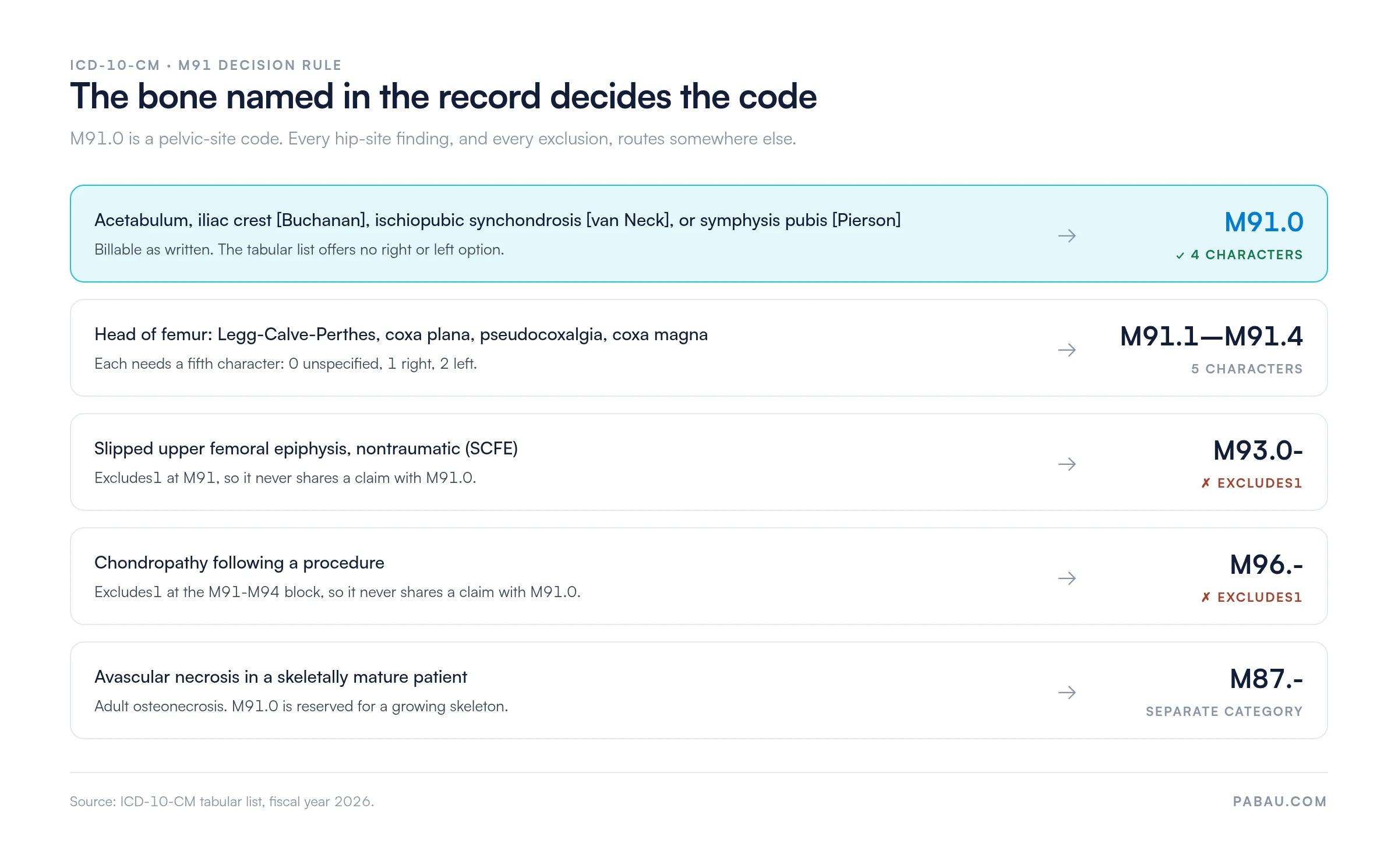
Query the physician when a note names a hip condition without saying which bone is involved. The answer decides between M91.0 and the M91.1 through M91.4 range, and it protects the claim from a site-specificity denial. The routing below shows where each documented site sends the claim.
ICD-10-CM exclusion notes define the boundaries of M91.0 and govern whether conditions may be coded together. Misreading these notes is a common source of coding errors and subsequent claim denials.
The M91 category – “Juvenile osteochondrosis of hip and pelvis” – holds seven subcategories. M91.0 is the only one without a laterality character. Every other subcategory needs a fifth character of 0, 1, or 2 for unspecified, right, or left.
Those conditions sit in one hip, so the tabular list demands a side. The table below maps the whole category for quick reference during code selection. The same site-first logic runs through the rest of the ICD-10-CM codes index.
Legg-Calve-Perthes disease is the single most common source of M91.0 miscoding, and it is never M91.0. LCP is avascular necrosis of the femoral head, and ICD-10-CM gives it its own subcategory, M91.1, with a laterality character. According to the WHO ICD-10 browser, the M91 block is organized by anatomical site rather than by eponymous disease name.
Avascular necrosis adds a second layer, because a skeletally mature patient with femoral head necrosis is coded to M87.- instead. The table below consolidates the four scenarios coders confuse most often into a single decision reference.
Build a one-line rule into your coding cheat sheet. If the note says Perthes, coxa plana, or pseudocoxalgia, the code is M91.1, M91.2, or M91.3 with a laterality character. M91.0 is correct only when the record names a pelvic structure. That single check removes the most common M91 denial before the claim is ever built.
A physician note that supports M91.0 must do more than mention a diagnosis name. The note has to confirm both the clinical diagnosis and the patient characteristics that make the code appropriate. Missing any of the elements below raises the likelihood of a medical necessity denial or an audit finding.
A structured pre-submission checklist for pediatric musculoskeletal codes reduces rework across the whole M91 range. Each of the five elements above converts neatly into a checklist line that a biller confirms before the claim goes out.
M91.0 is primarily a pediatric diagnostic code, which means Medicare is rarely the primary payer. The payers most likely to process M91.0 claims are commercial insurers and Medicaid managed care plans covering children. An electronic eligibility check before the appointment confirms active coverage and any authorization requirement in advance. Payer-specific considerations for M91.0 include the following:
Practices that manage orthopedic and pediatric patients should build these authorization rules into the pre-visit workflow. Knowing which plans require authorization for which procedure codes alongside M91.0 prevents the most common authorization-related denials.
Most M91.0 denials trace back to one of five predictable root causes, and each one is preventable if caught before submission. Applying denial management discipline at the code level lets billing teams repair a thin note before submission rather than during an appeal. A pre-submission review step for pediatric orthopedic claims should check each of the criteria below.

Run a pre-submission audit on all M91 claims each week. Pull every claim with an M91 diagnosis code and check the subcategory against the bone named in the radiology report. Catching a wrong subcategory before transmission costs minutes; catching it after a denial costs hours and risks timely filing limits.
M91.0 rarely appears on a claim in isolation. It is paired with procedure codes that reflect the evaluation, imaging, or treatment of juvenile pelvic osteochondrosis. It also travels onto physical therapy claims as a supporting diagnosis, not only onto orthopedic evaluation claims. The pairings below represent the most commonly billed combinations for this diagnosis.
Pair M91.0 with any of these CPT codes and omit the imaging documentation or the authorization reference number, and the denial is predictable. Attaching both to the record before submission is what keeps these pairings clean.
Most practices check M91 coding by hand. The radiology report sits in one system, the code lookup in another, and the claim in a third. The code gets retyped at each step, and every retype is a chance to drop the fifth character or pick the wrong subcategory.
Practice management software like Pabau keeps the diagnosis attached to the patient instead. The code is recorded at the visit and carried straight onto the claim, so nobody rekeys it. Pabau’s claims management software then submits electronically through Claim.MD and tracks the remittance back to the invoice.
For a pediatric orthopedic caseload, that means fewer M91 claims returned for a missing laterality character or an unsupported juvenile diagnosis. The eligibility check runs before the appointment, so an authorization problem surfaces while the visit can still be rescheduled.

Pabau integrates with Claim.MD to validate ICD-10-CM codes and run eligibility checks before claims reach the payer. See how the workflow handles codes like M91.0 from documentation through to remittance.

ICD-10 Code M91.0 is a site-specific code, and the site is the pelvis. It covers osteochondrosis of the acetabulum, the iliac crest, the ischiopubic synchondrosis, and the symphysis pubis.
Three errors cost practices money here. Coders reach for M91.0 on a Legg-Calve-Perthes diagnosis, skip the documentation of juvenile status, or violate an Excludes1 relationship. All three are caught by a structured pre-submission review.
The bone named in the radiology report is the whole decision, and confirming it takes a coder seconds. Build that one check into the review and the M91 denial rate falls without any other change. To see how Pabau handles M91.0 from documentation through to payment, book a demo.

Need a guide to reducing claim denials across billing workflows? Denial management in healthcare covers the root causes of claim rejections and the operational fixes that reduce denial rates.
Want to understand how electronic claims reach payers? Medical claims clearinghouse explains how clearinghouses validate, route, and report on claims before they reach the insurer.
Looking for guidance on submitting a compliant claim? Revenue cycle management outlines the end-to-end process from patient encounter to final payment posting.
ICD-10 Code M91.0 is the billable ICD-10-CM diagnosis code for juvenile osteochondrosis of the pelvis. It covers growth disturbances at the pelvic ossification centers in skeletally immature patients. The code sits in the M91 category within Chapter XIII of ICD-10-CM and is valid for fiscal year 2026. M91.0 is complete at four characters and takes no laterality digit.
M91.0 has four official inclusion terms. They are osteochondrosis (juvenile) of the acetabulum, of the iliac crest [Buchanan], of the ischiopubic synchondrosis [van Neck], and of the symphysis pubis [Pierson]. Every one of them is a pelvic structure. If the documented condition sits at the head of the femur, M91.0 is the wrong code.
Yes, M91.0 is a billable ICD-10-CM code valid for submission on claims for fiscal year 2026. It is not a header or non-billable parent code. No additional character or laterality extension is required to make the code complete for billing.
M91.0 describes juvenile osteochondrosis of the pelvis. M91.1 describes juvenile osteochondrosis of the head of the femur, which is Legg-Calve-Perthes disease. These are different bones, not two site variants of one condition. M91.0 is billable as written, while M91.1 needs a fifth character for laterality: M91.10 unspecified leg, M91.11 right leg, or M91.12 left leg.
No. Legg-Calve-Perthes disease is the official descriptor for M91.1, not an inclusion term under M91.0. LCP is avascular necrosis of the head of the femur, which is anatomically distinct from the pelvis. Code it as M91.10, M91.11, or M91.12 depending on the side documented. M91.0 is never correct for a Legg-Calve-Perthes diagnosis.
Coxa plana is flattening of the head of the femur, usually as a late result of Legg-Calve-Perthes disease. It does not map to M91.0. ICD-10-CM gives coxa plana its own subcategory, M91.2, with a laterality character: M91.20, M91.21, or M91.22. Pseudocoxalgia works the same way and maps to M91.3.
No. Slipped capital femoral epiphysis (M93.0-) has an Excludes1 relationship with M91, meaning these codes must never appear together on the same claim. If both diagnoses are documented, the treating physician should clarify which is the confirmed primary diagnosis before the claim is submitted.