ICD-10 code S61.201A: Open wound of left index finger without nail damage
ICD-10 code S61.201A covers a left index finger wound of unstated type ICD-10 co...

Last Updated: Oct 16, 2026
ICD-10 code M26.4 is the billable ICD-10-CM diagnosis code for malocclusion, unspecified. It applies when the record confirms a malocclusion but never names the Angle class or the bite pattern behind it. That one detail decides most denials on this code, and the cost lands on billers as rework.
A note that documents Class I, II or III belongs on a specific M26.2 code. Choose M26.4 anyway and the payer reads it as under-coding. The sections below cover the code’s scope, the documentation payers expect, and the errors that stall payment.

ICD-10 code M26.4 reports malocclusion when the clinical note does not name the Angle class or the bite pattern.
The code is billable and valid in the FY2026 ICD-10-CM edition, which took effect on October 1, 2025.
A documented Angle class belongs on M26.211, M26.212 or M26.213, so M26.4 would be a specificity error.
Open bite, overjet, crossbite and crowding carry their own codes, and none of them default to M26.4.
TMJ disorders sit in the M26.6 range and get reported separately when both conditions are treated.
M26.4 is billable on its own, with no seventh character and no laterality digit to add. Dental and orthodontic billers reach for it when the chart stops at the word malocclusion.
The table below holds the reference detail worth checking before a claim goes out.
ICD-10-CM changes every October 1. The FY2026 edition took effect on October 1, 2025, per the CMS ICD-10 codes page. Check that your billing system carries the current tables, because a revised or retired code invites a technical rejection.
Malocclusion means the teeth or the dental arches do not meet the way they should. The term stretches from mild crowding with no functional effect to skeletal discrepancies that need surgery. Angle’s classification, published in 1899, is still how most clinical notes describe it.
Angle’s system also splits Class II into divisions, and ICD-10-CM gives those divisions no codes of their own. M26.4 stays in play only while the note leaves the type open. Once the clinician records a class or a pattern, a specific M26.2 or M26.3 code takes over.
M26 collects every dentofacial anomaly, from jaw size to temporomandibular joint disorders. Knowing the neighbors saves time, since the specific code you need is usually one row away.
The CDC/NCHS ICD-10-CM web tool holds the authoritative code tree.
M26 itself is a header and cannot be billed. M26.4 is one of two unspecified fallbacks here, alongside M26.9 for a broader dentofacial anomaly. Coders also meet the M26.6 TMJ codes on the same chart, and those stay separate from the malocclusion code.
The M26.2 subcategory holds the specific malocclusion codes, and Angle’s classes live under M26.21. When the note names the class, one of those codes is the correct choice. Reporting M26.4 instead breaks the ICD-10-CM rule to code to the highest available specificity.
M26.211 reports Angle’s Class I, where the molar relationship is normal and the anterior teeth are irregular. The code carries no further subdivision. There is no right, left or bilateral option to choose, so laterality never enters the decision here.
M26.212 reports Angle’s Class II, the distocclusion pattern with the lower molar set behind the upper. Division 1 and division 2 are clinical descriptions, and neither has its own ICD-10-CM code. A documented overbite that meets the Class II threshold still belongs here rather than on M26.4.
M26.213 reports Angle’s Class III, where the lower molar sits ahead of the upper. Most underbites land here. Ask the treating clinician to state the class in the note, so the claim can carry this code instead of the unspecified one.
M26.219 covers malocclusion described in Angle’s terms when the class itself is missing. It fits a note reading “Angle malocclusion” with no number attached. Where the record never mentions Angle’s system at all, M26.4 stays the right answer. Read the note for the word Angle before you settle on M26.4.
Four questions settle almost every case at the billing desk.
The note says malocclusion, with no class named. Which code? M26.4. The record confirms the diagnosis without naming a class or a pattern, which is the situation this code exists for.
The note says Class II, division 1. Which code? M26.212. ICD-10-CM has no division-level codes, so the class alone drives the choice.
First screening, class not determined yet. Which code? M26.4, and it holds for that visit. Once study models, radiographs and the clinical exam settle the class, later visits carry the specific code.
The note is ambiguous. What now? Send a coding query. Asking the clinician to confirm the Angle class takes minutes, and it protects the practice from a specificity denial.
Payers reviewing a malocclusion claim look for a short list of elements. Thin notes are the usual reason an M26.4 claim fails on re-review. The chart has to show the diagnosis, the reasoning behind it, and the plan that follows.
Prior authorization is a separate hurdle. Some commercial plans want photographs, study models and radiographs before they approve orthodontic treatment. Several also expect a stated Angle class in the packet, so M26.4 on its own will not clear every payer. Read the policy in front of you rather than assuming.
A dental claim carries two code sets. ICD-10-CM describes the diagnosis, while CDT procedure codes describe the treatment. The American Dental Association maintains CDT, and the two sets are not interchangeable. M26.4 supports the medical necessity of a CDT procedure and never replaces one.
From there the path is mechanical. The diagnosis goes in box 21 of the CMS-1500 form, or the equivalent field on an ADA dental claim form. The clearinghouse checks the format and the code edition, then the payer weighs medical necessity. Each stop can stop the claim for its own reason.
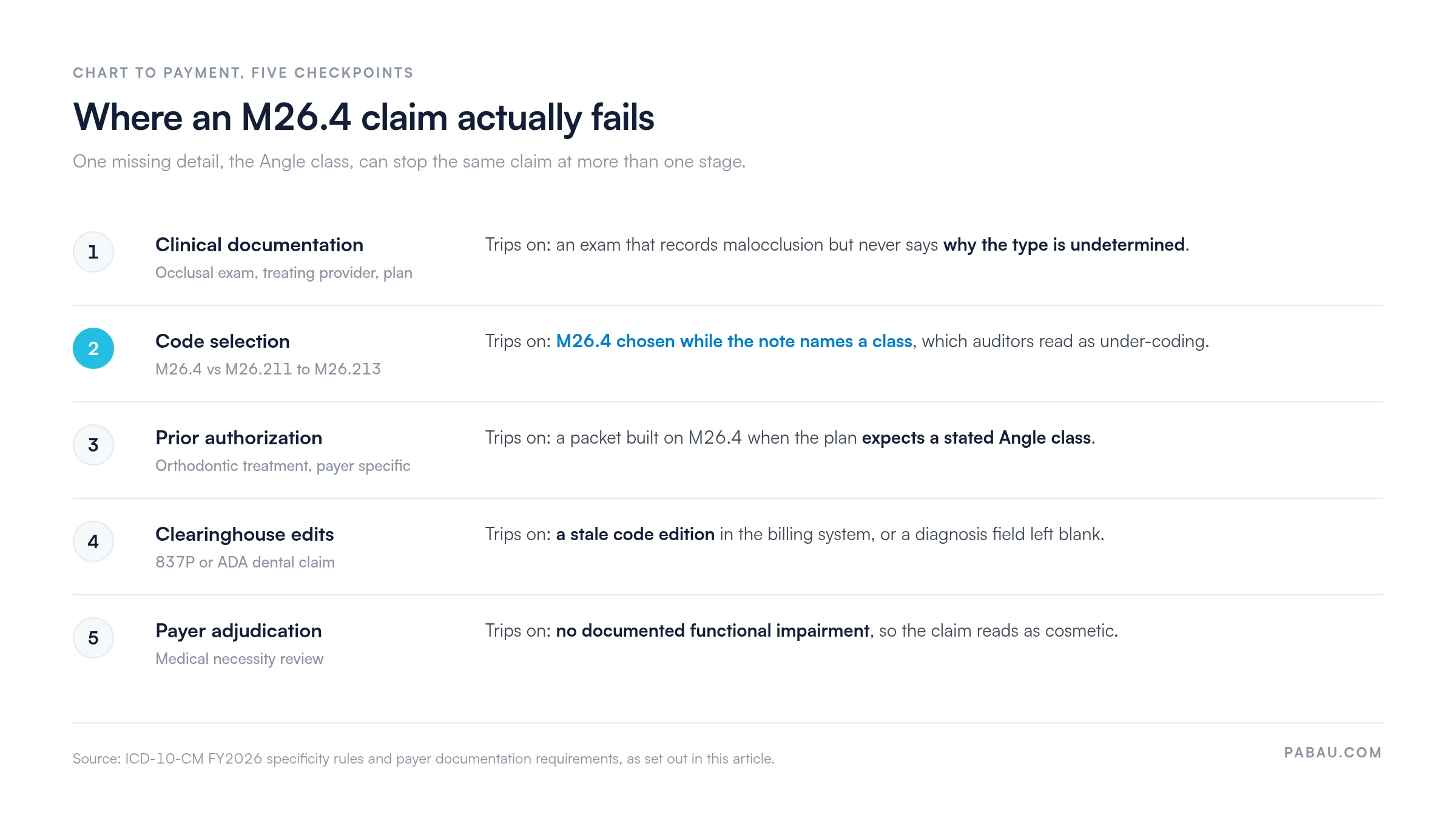
Coverage is where functional malocclusion and cosmetic treatment part ways. Most medical plans decline orthodontic work done for appearance, whatever diagnosis code sits on the claim.
Document the speech difficulty, the chewing problem or the joint dysfunction explicitly, because those notes carry the claim. A clean claim matters more here than on routine work, since these submissions draw closer review.
Five checks take about a minute, and they remove most of the rework.
These four errors are the ones that put M26.4 claims back on a biller’s desk.
Practices that query the clinician before submission catch these errors early. The ones that query after a denial pay for the same claim twice, in staff time and in delayed revenue.
Keep the coding query to two questions. First, does the record support an Angle Class I, II or III for this visit? Second, is there documented functional impairment, such as speech, chewing or joint symptoms? Those two answers settle the code choice and the medical necessity argument in one pass.
Practices see M26.4 next to a handful of M26 relatives on the same chart. The table below lists the ones that turn up most often in dental and orthodontic billing.
The M26.6 range causes the most trouble. Malocclusion and TMJ disorder share a parent category while describing different problems. Report both when both are diagnosed and treated, and report one when only one is.
Payers publish their own rules for mismatched pairs, and the denial codes on the remittance tell you which rule you tripped.
Most dental and orthodontic teams split this work across two desks. The clinician records the occlusal findings, and a biller reads them later and picks the code. When the note is thin, M26.4 becomes the safe default, and the specificity denial follows.
Practice management software like Pabau keeps both halves on one record. The diagnosis stored on the patient’s chart seeds the diagnosis field on the claim form, so nobody retypes it. An ICD-10-CM lookup library sits inside that screen, refreshed with each official release, which keeps the current tables in front of your billers.
Pabau’s claims management software also checks that the fields a claim needs are complete before the send button unlocks. For US practices, the Claim.MD integration covers 837P submission, eligibility checks, claim status and 835 remittance posting. Fewer retyped codes mean fewer claims coming back for a detail that was already in the chart.
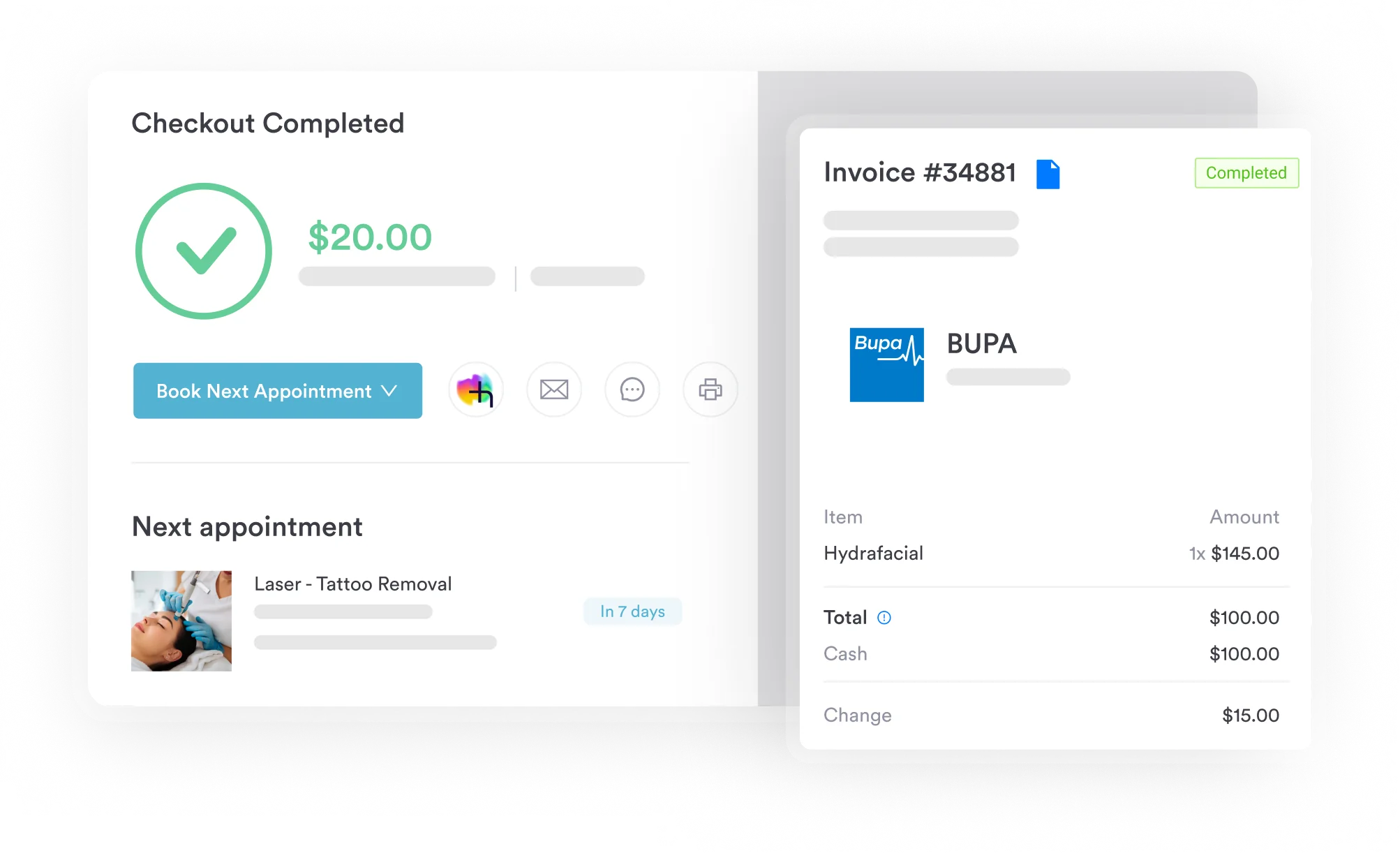

Pabau seeds the claim form from the patient’s chart, gives billers an ICD-10-CM lookup library, and checks that required claim fields are complete before submission. See how that works for your practice.

M26.4 is valid and billable in one situation, where the record confirms malocclusion and never names the type. Read the note before you code, and the choice between M26.4 and the M26.2 codes stops being a judgment call.
Practices that stop losing these claims fix the note, not the appeal. A short query to the treating clinician costs minutes, while a denied orthodontic claim costs weeks. To see how Pabau carries the diagnosis from the chart onto the claim, book a demo with the team.

Coding a temporomandibular joint dislocation this week? CPT code 21485 covers closed treatment of a complicated TMJ dislocation and what the claim needs.
Billing for an interdental fixation device? CPT code 21110 walks through the application, the documentation, and the reimbursement rules.
Need to read a rejection quickly? Denial codes in medical billing explains the common payer rejection reasons and the fix for each one.
Losing hours to reworked claims? Denial management in healthcare sets out the workflow that keeps the same denial from repeating.
Wondering what your clearinghouse checks? Medical claims clearinghouse explains the validation a claim passes before it reaches the payer.
No. M26.4 is complete at four characters, with no seventh character and no left, right or bilateral option. Adding digits creates an invalid code and a technical rejection.
Yes. When malocclusion is the reason for the encounter, M26.4 can lead the claim. Report related conditions, such as a TMJ disorder, as additional diagnoses on the same claim.
No. CDT codes describe dental procedures and are maintained by the American Dental Association. Diagnosis coding still comes from ICD-10-CM, so M26.4 sits alongside a CDT code rather than in place of one.
M26.4 names malocclusion without a type. M26.9 is broader and covers an unspecified dentofacial anomaly, which may not involve the bite at all. Use M26.9 only when the record does not confirm malocclusion.
No. ICD-10-CM has no age-specific malocclusion code, so M26.4 applies at any age. Age affects payer policy and prior authorization rules, not the code itself.