ICD-10 Code S42.444P: Medial epicondyle fracture, right humerus
ICD-10 Code S42.444P: full descriptor and code validity ICD-10 Code S42.444P car...

Last Updated: Oct 13, 2026
ICD-10 code I41 is the diagnosis code for myocarditis in diseases classified elsewhere. It is a manifestation-only code that must always appear in secondary position behind the underlying causative condition. Coders frequently submit it alone or sequence it first, which causes automatic claim denial.
The other common failure is reaching for an I41 subcategory that does not exist. I41.0, I41.1, I41.2 and I41.8 appear in the WHO’s international ICD-10 and in national variants such as Germany’s ICD-10-GM. The US clinical modification has never carried them, so in ICD-10-CM I41 is a single billable code with no children.
This guide sets out the 12 etiologies I41’s Excludes1 note bars you from pairing it with. It also covers the sequencing rule, the documentation a note must contain, and the six most common reasons payers reject I41 claims.

ICD-10 code I41 reports myocarditis caused by an underlying classified disease, always sequenced second.
ICD-10-CM gives I41 no subcategories, and it is billable and specific at three characters.
I41.0, I41.1, I41.2 and I41.8 belong to the WHO’s international ICD-10, not to the US modification.
An Excludes1 note bars I41 for 12 named etiologies, from Chagas disease to sarcoidosis, because each already has its own combination code.
Submitting I41 without the required etiology code triggers automatic payer denial in most systems.
Pabau’s claims management software flags incomplete diagnosis pairs before submission.
ICD-10 code I41 is the billable, specific ICD-10-CM diagnosis code for myocarditis in diseases classified elsewhere, valid for FY2026 encounters. It sits within Chapter 9 (Diseases of the Circulatory System), block I30-I5A (Other forms of heart disease). It is classified as a manifestation code, meaning it can never serve as a standalone primary diagnosis.
The “diseases classified elsewhere” phrasing is the key clinical signal: The myocarditis exists because of an underlying condition that is coded first. Without that primary etiology code, I41 has no clinical context and payers will reject the claim. Manifestation dependency runs through several cardiovascular categories, so the pattern is worth learning once.
I41 is complete at three characters. There is no fourth character to add, and an encoder that offers you one is not running ICD-10-CM.
Typhus is the only underlying disease the tabular names in its own “code first” note. It is an example, not the whole permitted set, so any documented etiology that is not excluded by name can sit in front of I41.
Search for I41.1 and you will find it described as “myocarditis in viral diseases.” That descriptor comes from the WHO’s international ICD-10 and from the national variants built on it. ICD-10-CM, the version US payers adjudicate against, has carried I41 as a single undivided code in every annual release from FY2016 through FY2026.
The reason is structural. The international classification splits I41 by the type of underlying infection. ICD-10-CM handles those same scenarios with dedicated combination codes that capture the organism and the myocarditis in one code. Diphtheritic myocarditis is A36.81. Meningococcal myocarditis is A39.52. Mumps myocarditis is B26.82. None of them needs a second code, and I41’s Excludes1 note explicitly bars you from adding one.
The table below maps each international subcategory to what ICD-10-CM uses in its place. Use it to translate a code you found in a non-US reference before it reaches a claim.
The practical rule falls out of that last row. ICD-10-CM keeps I41 alive only for the residual cases, where the underlying disease has no combination code of its own. Each scenario the international classification would have split into I41.0, I41.1 or I41.2 already has its own dedicated code in the US modification. The WHO’s ICD-10 browser is where those international subcategory definitions live. Seeing them side by side is the quickest way to confirm that a code you were handed is not a US code.
I41 carries an Excludes1 note naming 12 etiologies. Excludes1 means “not coded here”: The excluded code and I41 can never appear on the same claim for the same condition. Each of these codes already captures the myocarditis, so it is submitted alone.
Influenza and Chagas disease each span more than one code, which is why 12 named etiologies produce 15 rows. Pick the row that matches the documentation, and submit that code on its own.
The etiology-manifestation convention in ICD-10-CM Official Guidelines Section I.A.13 requires that the underlying disease always be sequenced first, with I41 appearing in secondary position. The rule is mandatory, and it decides whether the claim processes or is denied.
Electronic encoders display manifestation codes in italics as a visual cue that the code cannot stand alone. Coders who override that cue and list I41 as the principal diagnosis will generate a coding error caught by payer edit systems. The same etiology-first structure governs every manifestation code in the classification, not this one alone.
Example pair (typhus myocarditis): A75.9 (typhus fever, unspecified) sequenced first, then I41 (myocarditis in diseases classified elsewhere) in secondary position. Never the reverse.
Counter-example (Chagas myocarditis): B57.2 alone. The code already reads “Chagas’ disease (chronic) with heart involvement,” and chronic Chagas disease with myocarditis is one of its inclusion terms. Adding I41 creates an Excludes1 conflict.
I41 pairs with any documented underlying disease that its Excludes1 note does not name. In practice that is a short list, because the classification already gave most infectious causes a combination code. The table below separates the pairings that work from the ones that generate an invalid combination.
The rheumatic row is the one to read twice. Rheumatic myocarditis is a frequent encounter in cardiology billing, and it has its own home in I00-I09 rather than a place behind I41. I40 carries an explicit Excludes1 for acute rheumatic myocarditis (I01.2), which is the nearest formal warning the tabular gives. The CMS ICD-10 codes page publishes the annually updated tabular files where every one of these notes can be confirmed.
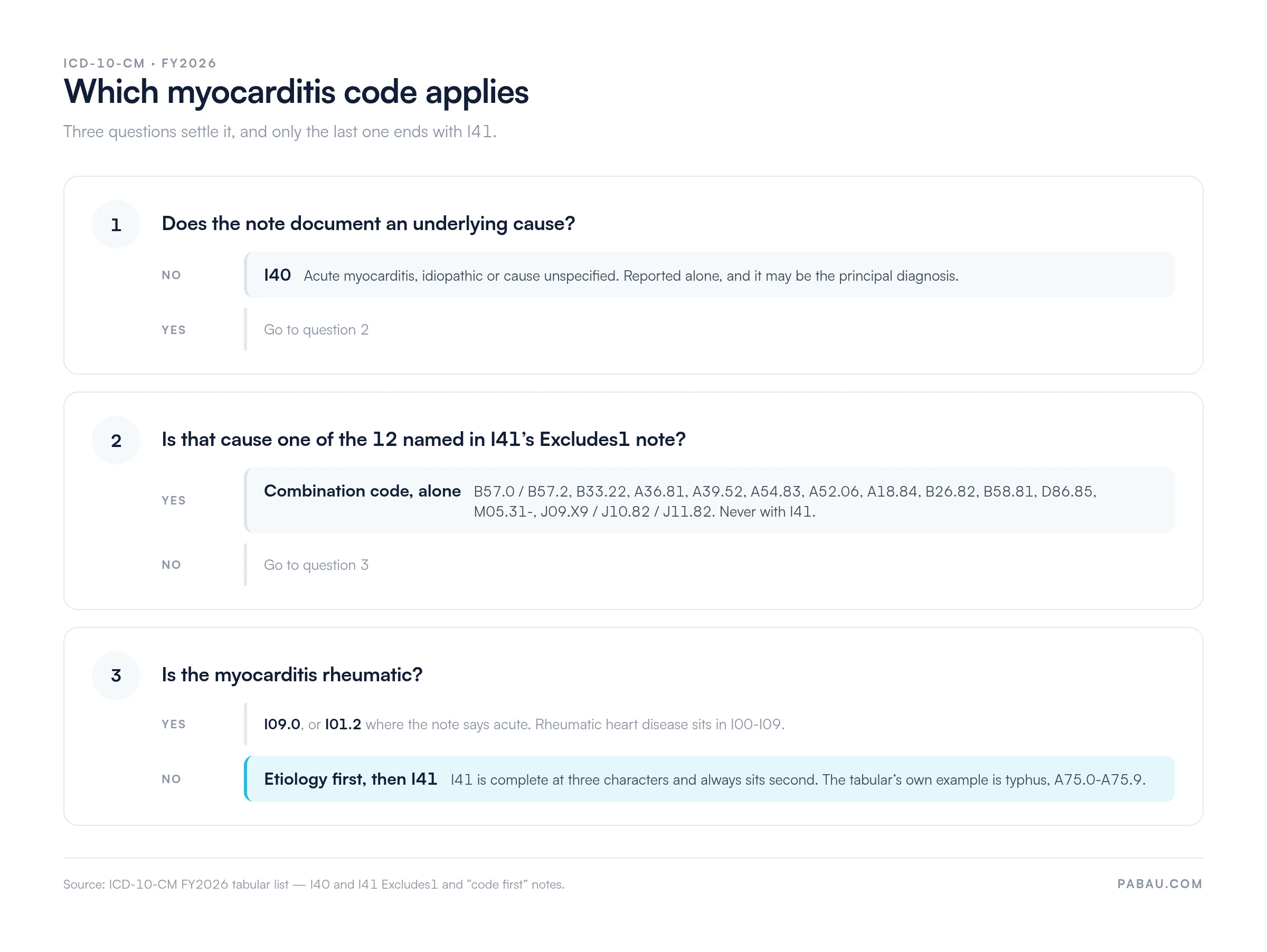
I40 (acute myocarditis) and I41 (myocarditis in diseases classified elsewhere) describe different clinical situations. I40 is for acute myocarditis where the cause is either idiopathic or not separately classifiable. I41 is for myocarditis that exists as a complication of a separately documented underlying disease. The wrong choice misrepresents the clinical picture, and it can change DRG assignment on inpatient claims.
Neither code carries an Excludes1 note naming the other, so the choice between them is driven by documentation rather than by a hard tabular prohibition. Report the one that matches the chart, not both. If the record documents viral myocarditis, the answer is usually a viral combination code such as B33.22 rather than either I40 or I41.
Three questions separate the four possible answers. The decision path below runs them in the order a coder should ask them.
A physician’s note that confirms myocarditis without identifying a causative disease cannot support I41. The documentation must establish a causal chain: The underlying disease is present, and the myocarditis is a complication of it. Vague or inferential wording drives denials as reliably as incorrect sequencing does.
ICD-10-CM Official Guidelines Section IV bars “rule out” and “suspected” diagnoses from supporting I41 in outpatient settings. The condition must be confirmed. CMS guidance for inpatient records follows Section II, which allows “probable” diagnoses at discharge, but only where the underlying disease is clearly documented. The charge detail behind an I41 claim should reference the diagnostic findings that confirmed the myocarditis and the underlying condition.
The AAPC ICD-10-CM lookup lets coders check a suspected etiology code against I41’s Excludes1 list before submission. That single check prevents the most common invalid pairing.
Most payers process I41 claims through automated edit systems that check whether a valid etiology code is present and sequenced correctly. Claims that fail this check are denied at adjudication, before a human reviewer ever sees them. Submitting through a clearinghouse that validates diagnosis code pairs before transmission catches these errors earlier in the workflow.
Practice management software like Pabau integrates with Claim.MD, which submits claims directly to thousands of US payers. The integration adds real-time eligibility checks and 835 ERA processing that identifies denial reasons at the remittance stage. The remittance returned on a denied I41 claim carries CARC codes. Those codes say whether the error was sequencing, a missing etiology, or documentation the payer judged insufficient.

Six denial patterns account for the majority of I41 rejections. Each has a straightforward corrective action once you read the denial codes the payer returned.
Claims that meet clean claim requirements from the outset carry a valid etiology-manifestation pair in the correct sequence. Submitting them that way removes the most common I41 denial trigger before adjudication ever runs.
Run a three-point audit on any claim carrying I41. Confirm the code is exactly three characters, with no fourth digit. Confirm the documented etiology is not one of the 12 names on the Excludes1 list. Confirm the etiology code sits in position 1. Those three checks resolve the top I41 denial reasons before the claim reaches the payer.
A sequencing error on I41 usually surfaces once the remittance comes back. The coder reopens the encounter, swaps the order, and resubmits. Payment lands two or three weeks later than it should have, and the same correction gets made again on the next lupus or typhus encounter.
Pabau is an all-in-one practice management system, and its claims software for billers reads the diagnosis pair while the claim is still in the practice. A manifestation code sitting in position 1 is flagged there, as is one sent with no etiology behind it.
The coder fixes it once, at the point of submission, rather than chasing it through a denial and a resubmission. Every subscription includes the claims tools, so a single-site cardiology practice works from the same validation as a multi-location group.

Pabau’s claims management software flags incomplete diagnosis pairs and routes ICD-10 claims through Claim.MD’s real-time validation before they reach the payer. See how it works for cardiology and internal medicine practices.

ICD-10 code I41 is one of the more denial-prone codes in cardiovascular billing, and its failure points are few. There is no subcategory to choose. Three decisions remain. Check whether the etiology is excluded by name. Decide which code goes in position 1. Confirm the note documents the causal link.
Get those three right and the claim clears on the first pass. Get one wrong and the rework costs more staff time than the check would have taken.
Book a demo to see how Pabau catches an incomplete diagnosis pair before a cardiology claim reaches the payer.

Need to understand how denial codes work after a rejection? Denial codes in medical billing explains CARC and RARC codes and how to respond to payer-specific rejections.
Want to see how clearinghouse submission works end-to-end? Medical claims clearinghouse walks through how electronic claims are validated and transmitted to payers.
Looking for revenue cycle context on ICD-10 claim management? What is revenue cycle management covers how diagnosis coding fits into the broader payment collection workflow.
ICD-10 code I41 is the ICD-10-CM diagnosis code for myocarditis in diseases classified elsewhere. It is a manifestation code. Use it when myocarditis develops as a complication of a separately documented underlying disease that has no combination code of its own. The tabular’s own example of such a disease is typhus (A75.0-A75.9). I41 is valid for FY2026, is billable and specific at three characters, and must always be sequenced after the etiology code.
Yes. I41 is a billable and specific ICD-10-CM code at three characters, and it has been since the code set took effect in FY2016. Being billable does not mean it can stand alone, though. As a manifestation code, it still requires the underlying disease to be reported in primary position. A claim carrying I41 by itself will be denied.
I40 (acute myocarditis) applies when myocarditis is idiopathic or the cause is unspecified, and it can serve as the primary diagnosis. I41 applies when myocarditis is secondary to a documented underlying disease, and it can only appear in secondary position. I40 subdivides into I40.0, I40.1, I40.8 and I40.9, while I41 has no subcategories at all. Neither code carries an Excludes1 note naming the other, so report whichever one the documentation supports rather than both.
No. ICD-10 code I41 is a manifestation code and cannot be sequenced as the primary diagnosis. ICD-10-CM Official Guidelines Section I.A.13 requires the underlying causative disease to be listed first, with I41 in secondary position. Submitting I41 as the principal diagnosis will generate a payer denial in most automated adjudication systems.
Sequence U07.1 (COVID-19) first, then the code for the documented cardiac manifestation. That order comes from ICD-10-CM Official Guidelines Section I.C.1.g.1.d, which covers non-respiratory manifestations of COVID-19. The second code is not I41.1: No such code exists in ICD-10-CM. AHA Coding Clinic addressed viral myocarditis due to COVID-19 in its 2025 first-quarter issue and directed coders to B33.22 (viral myocarditis). Check that issue and your payer’s current policy before submitting.
The most common reason is submitting I41 without the required etiology code, followed by listing I41 in primary position rather than secondary. Other denial triggers include submitting a subcategory that does not exist in ICD-10-CM, such as I41.0 or I41.1. Pairing I41 with an etiology named in its Excludes1 note, such as Chagas disease or sarcoidosis, is another. Using I41 for rheumatic myocarditis instead of I09.0 and documenting only a “rule out” diagnosis will also trigger rejections.
No. ICD-10-CM has never subdivided I41, in any annual release from FY2016 to FY2026. I41.0, I41.1, I41.2 and I41.8 are real codes in the WHO’s international ICD-10 and in national variants such as ICD-10-GM. None of them is valid on a US claim. Report I41 at three characters, and where the etiology is one of the 12 named in its Excludes1 note, report that combination code instead.