ICD-10 Code Z86.73: Personal history of TIA
ICD-10 Code Z86.73: Definition, descriptor, and code hierarchy ICD-10 Code Z86.7...

Last Updated: Nov 20, 2026
Billable Code Specific Code
E80.6 is the billable ICD-10-CM code for other disorders of bilirubin metabolism. Coders frequently reach for R17 (jaundice, unspecified) or leave the physician's documented diagnosis uncoded at the right specificity level, both of which trigger avoidable claim denials. E80.6 sits in ICD-10-CM Chapter 4 (endocrine, nutritional, and metabolic diseases), not Chapter 18 (signs and symptoms), which means the physician has identified and documented a confirmed metabolic disorder, not an unexplained symptom.
Getting the category right matters: a metabolic disorder code carries different payer policy implications than a sign or symptom code.
Let Pabau's smart automation suggest the right codes, reduce claim denials, and keep your practice compliant—effortlessly.
Automate repetitive tasks and focus on what matters most—your patients.
Reduce coding errors and ensure compliance with the latest regulations.
Clean claims, fewer denials, and faster reimbursements.
Powerful insights and reporting to help your practice thrive.
HIPAA compliant SOC 2 certified GDPR-compliant Trusted by 4,000+ clinics worldwide

ICD-10 code E80.6 is the billable ICD-10-CM code for other disorders of bilirubin metabolism, with Dubin-Johnson and Rotor’s syndromes as its inclusion terms.
Both syndromes raise conjugated bilirubin, which separates them from Gilbert syndrome (E80.4) and Crigler-Najjar syndrome (E80.5).
Use E80.7 only when the record names no specific bilirubin disorder, and query the physician before you settle there.
Once the physician confirms the syndrome, code E80.6 instead of R17 and keep the fractionated bilirubin results with the note.
Pabau, the practice software we build, sends US claims through Claim.MD, checks eligibility first and brings ERA remittances back to the patient record.
ICD-10 code E80.6 is the billable code for other disorders of bilirubin metabolism, meaning specified disorders with no E80 code of their own. CMS’s FY2026 ICD-10-CM code tables list two inclusion terms under it, Dubin-Johnson syndrome and Rotor’s syndrome.
Both are rare, autosomal recessive conditions that raise conjugated (direct) bilirubin while liver enzymes usually stay normal. That conjugated pattern sets them apart from Gilbert and Crigler-Najjar syndromes, which raise unconjugated bilirubin and carry their own codes.
The alphabetic index sends three more terms to E80.6: familial conjugated hyperbilirubinemia, constitutional hyperbilirubinemia and a defect of bilirubin excretion. Two close neighbors stay out. Gilbert syndrome, including familial nonhemolytic jaundice, codes to E80.4. Crigler-Najjar syndrome codes to E80.5, with one code for Type I and Type II alike.
Before the code goes on a claim, these are the facts a coder or biller confirms first.
In the FY2026 ICD-10-CM tabular list, neither category E80 nor code E80.6 carries an Excludes1 or Excludes2 note. E80 has one Includes note, for defects of catalase and peroxidase. The notes that do affect E80.6 sit higher up, at chapter and block level, plus notes on the P50-P61 block and P59.
Check the tabular list for the fiscal year of the date of service in the CDC’s ICD-10-CM browser, since notes can change between releases.
Similar lab pictures land on different codes, and sometimes different chapters, at the bilirubin end of category E80. The table shows each common mix-up and the fact that decides it.
While the workup is still open, R17 is the right code for the visit. Switch to E80.6 once the physician confirms the syndrome, and drop R17 from that episode.
Start every bilirubin disorder at the alphabetic index, then confirm it in the tabular list. The index sends Gilbert syndrome to E80.4, Crigler-Najjar syndrome to E80.5, and Dubin-Johnson and Rotor syndromes to E80.6. If an older claim used E80.6 for Gilbert or Crigler-Najjar, correct the code before any resubmission.
E80.6 needs a named, confirmed metabolic diagnosis in the physician’s note. The note also has to show the reasoning that links the lab results to that diagnosis. A claim backed only by a bilirubin result invites medical necessity denials and audit findings.
Keep these five elements with the encounter, so they’re on hand at audit or appeal.
The lab work behind the diagnosis is billed on its own line. The direct bilirubin fraction goes on 82248, and E80.6 supports its medical necessity once the syndrome is confirmed.
Two illustrative outpatient notes show the difference. The first reads: “Raised direct bilirubin, possible Dubin-Johnson, recheck in three months.” That diagnosis is uncertain, and Official Guidelines Section IV.H says an uncertain outpatient diagnosis isn’t coded as confirmed. Code the documented sign instead and wait for the workup.
The second reads: “Dubin-Johnson syndrome. Direct bilirubin raised, ALT, AST and ALP normal, urinary coproporphyrin pattern consistent. Benign, no treatment needed.” It names the disorder and ties it to the results, so E80.6 holds up.
Coverage for E80.6 encounters follows your Medicare Administrative Contractor’s local policies and each commercial payer’s rules. Prior authorization isn’t usually tied to the diagnosis code. It may apply to related services, such as genetic testing, depending on the payer.
Getting the code and documentation right before submission is what earns a clean claim. On a low-volume code like E80.6, each resubmission cycle stretches collection time.
For medical billing compliance, keep current MAC policies and payer bulletins in your coding reference library. CMS releases ICD-10-CM updates each October and sometimes again in April, so check the code set in force on the date of service.
Most E80.6 denials trace back to a handful of root causes. Each one can be fixed at the documentation and coding stage, before it ever reaches appeal.
Reviewing denial management workflows each quarter helps coding teams map E80.6 denials to their root causes. The fix then lands upstream, in the note template or the coder’s checklist, rather than in appeal letters.
The ICD-10-CM convention for “other” codes is simple. Use one only when the documented condition has no specific code of its own. The chart shows where each documented diagnosis lands, and the five steps below get you there.
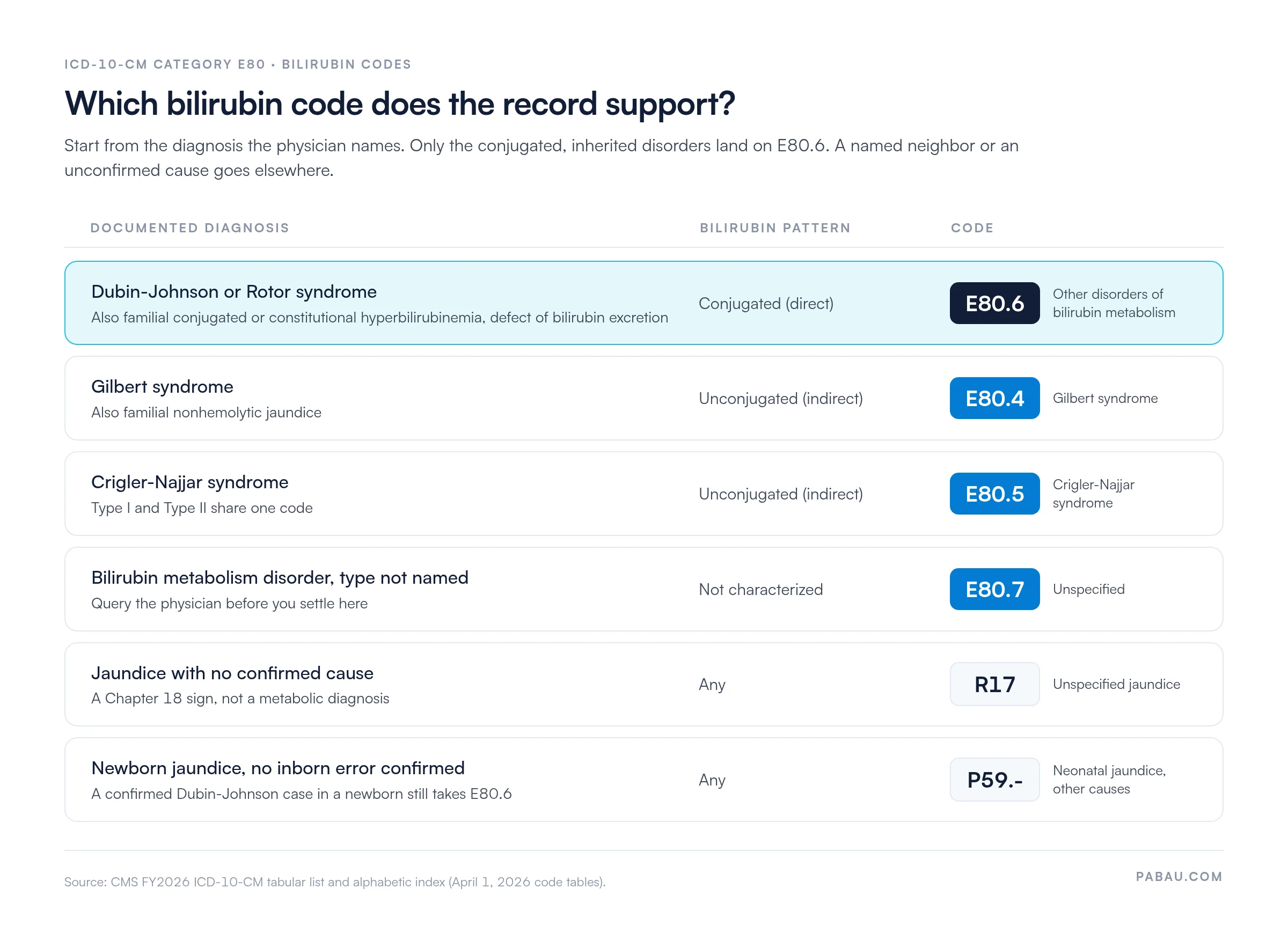
Use the AAPC ICD-10-CM code lookup when cross-checking index entries against the tabular list in complex reviews. For how code selection feeds the wider revenue cycle, start with medical billing fundamentals.
Category E80 holds two families, the porphyrias at E80.0 to E80.3 and the bilirubin disorders at E80.4 to E80.7. Keeping the split in mind stops a condition from landing in the wrong subcategory.
The WHO ICD-10 browser shows the international classification for comparison with overseas records. US billing always uses the CM version, which you can browse in our ICD-10-CM diagnostic codes library.
Run a quarterly audit of claims submitted with E80.7 (unspecified bilirubin disorder). Pull the encounter notes and check whether the physician documented a named syndrome. If they did, those encounters belonged on E80.4, E80.5 or E80.6, which is worth raising with the treating team.
Most E80.6 denials start before submission. A missing bilirubin fraction, a symptom code left on the claim or an unchecked eligibility status sends the claim back. On a low-volume code, each round trip adds weeks to collection.
Pabau keeps the encounter note, documents and claim on the same patient record. US practices check eligibility through Claim.MD before the visit and send claims electronically from the record. ERA remittances come back into Pabau, so your team can match a denial to the note behind it.
Pabau doesn’t choose the code for you. Your coders still decide between E80.4, E80.5, E80.6 and E80.7, but the record, the claim and the remittance sit in one place.

Pabau sends US claims through Claim.MD, runs eligibility checks and brings ERA remittances back to the patient record. Your team spends less time on rework for low-volume codes like E80.6.

E80.6 belongs on a claim when the physician names Dubin-Johnson syndrome, Rotor syndrome or another specified bilirubin disorder. Gilbert and Crigler-Najjar keep their own codes, and jaundice without a confirmed cause stays on R17.
If you change one habit, make it the physician query. A two-line question costs far less than a denied claim, and it turns a vague E80.7 or R17 into an E80.6 you can defend.
Once the coding is settled, medical billing software can carry the routine submission and remittance work. Book a demo to see how Pabau sends E80.6 claims through Claim.MD and brings each remittance back to the record.

Still waiting on the workup? ICD-10 code R17: Unspecified jaundice covers the visit before a cause is confirmed.
Billing the lab work behind the diagnosis? CPT code 82248: Direct bilirubin billing guide explains how the direct fraction is reported.
Need a framework for managing denied metabolic disorder claims? Denial management in healthcare covers root-cause analysis, appeal timelines and workflow fixes for coding-related denials.
Want to understand how the clearinghouse fits into your revenue cycle? Claim.MD clearinghouse overview explains how electronic claims and ERA processing work.
Looking for the ground rules of clean claim submission? Clean claim requirements details what payers expect, including diagnosis code specificity and documentation standards.
E80.6 is the billable ICD-10-CM code for other disorders of bilirubin metabolism. Its inclusion terms are Dubin-Johnson syndrome and Rotor’s syndrome, and it’s valid as a principal or secondary diagnosis.
No. Gilbert syndrome indexes to E80.4 in the FY2026 ICD-10-CM, not E80.6, and familial nonhemolytic jaundice indexes there too. Crigler-Najjar syndrome likewise has its own code, E80.5.
Usually not. It’s a lifelong but benign condition, and most patients need no treatment beyond reassurance. Jaundice can deepen with illness, pregnancy or oral contraceptives, so it’s worth noting triggers in the record.
Bilirubin fractionation is the usual pairing. CPT 82247 reports total bilirubin and CPT 82248 reports direct bilirubin. A liver panel or genetic testing may follow, subject to each payer’s policy.
Yes, on inpatient claims, because E80.6 isn’t on the FY2026 POA exempt list. Dubin-Johnson and Rotor syndromes are inherited, so the indicator is normally Y, since congenital conditions count as present on admission.