ICD-10 code S61.201A: Open wound of left index finger without nail damage
ICD-10 code S61.201A covers a left index finger wound of unstated type ICD-10 co...

Last Updated: Oct 16, 2026
Billable Code Specific Code
E45 is the billable ICD-10-CM code for retarded development following protein-calorie malnutrition.
ICD-10 Code E45 sits in the malnutrition block of Chapter 4 and carries specific inclusion terms, excludes notes, and documentation requirements that distinguish it from adjacent codes. A broader coding reference spanning CPT, ICD-10-CM, and HCPCS structure can help coders confirm formatting rules like these across code families.
Let Pabau's smart automation suggest the right codes, reduce claim denials, and keep your practice compliant—effortlessly.
Automate repetitive tasks and focus on what matters most—your patients.
Reduce coding errors and ensure compliance with the latest regulations.
Clean claims, fewer denials, and faster reimbursements.
Powerful insights and reporting to help your practice thrive.
HIPAA compliant SOC 2 certified GDPR-compliant Trusted by 4,000+ clinics worldwide

ICD-10 Code E45 is a billable ICD-10-CM diagnosis code describing retarded development following protein-calorie malnutrition, including physical growth retardation and delayed development.
E45 requires explicit physician documentation of both protein-calorie malnutrition and its causal link to the developmental delay; coders cannot infer this from clinical indicators alone.
E45 is distinct from E46 (unspecified protein-calorie malnutrition) and E44 (moderate or mild malnutrition without developmental effects); choosing the wrong code risks upcoding or claim denial.
Pabau’s clinical documentation tools and claims management software help practices capture the structured notes and ICD-10 coding required to support accurate E45 billing.
ICD-10 Code E45 is a billable ICD-10-CM diagnosis code. Its official description is Retarded development following protein-calorie malnutrition. The code is valid for HIPAA-covered transactions and is accepted for claim submission when correctly documented.
According to the CDC/NCHS ICD-10-CM web tool, E45 is classified under the malnutrition block and specifically captures developmental sequelae, not simply the malnutritional state itself. That distinction is clinically and billingwise significant.
Protein-calorie malnutrition (PCM) can impair the physical and cognitive development of children when it occurs during critical growth windows. E45 captures those downstream developmental consequences, not the malnutrition itself.
The code applies when a patient presents with growth retardation or developmental delay that is causally linked to prior or current protein-calorie malnutrition. The malnutrition is the cause, and the retarded development is the effect. Both must be documented for E45 to be assignable.
Clinicians working in pediatrics, nutrition, and metabolic health commonly encounter this presentation. The same causal-documentation logic that governs E45 also applies to codes elsewhere in ICD-10-CM.
E45 is not limited to the pediatric inpatient setting. Any clinician documenting the long-term developmental impact of protein-calorie malnutrition can assign this code, provided the causal relationship is explicit in the medical record.
The ICD-10-CM tabular list includes official inclusion terms under E45. These are specific conditions that are classified here, not synonymous definitions. If the patient’s condition matches one of these terms and the underlying cause is protein-calorie malnutrition, E45 is the correct code.
These inclusion terms reinforce that E45 captures the physical and growth manifestations of developmental delay caused by PCM. The term “retarded development” in the code description is a broad clinical category. The inclusion terms narrow it to nutrition-driven physical growth failure.
Comparing the best EHRs for primary care pays off when you track chronic conditions like these long term.
Understanding the excludes notes is where many coding errors originate. E45 has notes that prevent it from being used in certain clinical scenarios.
The Excludes1 note for failure to thrive (R62.5x) tells coders that E45 and failure to thrive are mutually exclusive. ICD-10-CM does not allow the two to be reported together on the same claim, even when both presentations seem clinically present. Coders must select the single code that matches what the physician has documented as the primary condition.
Practical implication: Because E45 and R62.51 (failure to thrive, child) are mutually exclusive under the Excludes1 note, never report both on the same claim. If the documentation does not establish protein-calorie malnutrition as the cause of the developmental delay, code R62.51 or another appropriate code from the E40-E46 block instead of E45, not alongside it.
E45 sits in a block of seven codes that cover different types and severities of malnutrition. Knowing where E45 falls in that block prevents the most common mismatch errors.
One postpartum scenario sits outside this block. Malnutrition diagnosed in the six weeks after delivery is coded O25.3, because Chapter 15 takes sequencing priority. The obstetric code is first-listed, and an E40-E46 code can follow to specify the malnutrition type.
The CMS ICD-10 codes page maintains the annual ICD-10-CM tabular updates. Practices should verify code status each fiscal year, as the E40-E46 block has remained stable but exclusion notes and coding guidelines can be revised.
The three adjacent codes most often confused in practice are E44, E45, and E46. Each requires a different clinical scenario and a different documentation trigger.
Upcoding to E45 when only E46-level documentation exists is an audit risk. Downcoding to E46 when a physician has explicitly documented PCM-caused developmental delay wastes a more specific and clinically accurate code. The decision tree hinges entirely on what the physician has written.
Similar causal-chain sequencing applies elsewhere in ICD-10-CM. The causal condition and its manifestation must both be documented before coders can assign both codes or a combined specific code.
When reviewing documentation for E45 assignment, look for two specific physician statements: (1) a confirmed diagnosis of protein-calorie malnutrition and (2) an explicit statement that the developmental delay or growth retardation is caused by or a result of that malnutrition. One without the other is insufficient. Flag the record for physician clarification before submitting the claim.
ICD-10-CM Official Guidelines require that coders only assign a diagnosis code based on physician documentation. For E45, the bar is higher than most nutritional deficiency codes because the code captures a causal relationship, not just a clinical state.
Strong patient compliance documentation workflows also reduce the risk of incomplete records that leave coders without the information they need to assign E45 accurately.
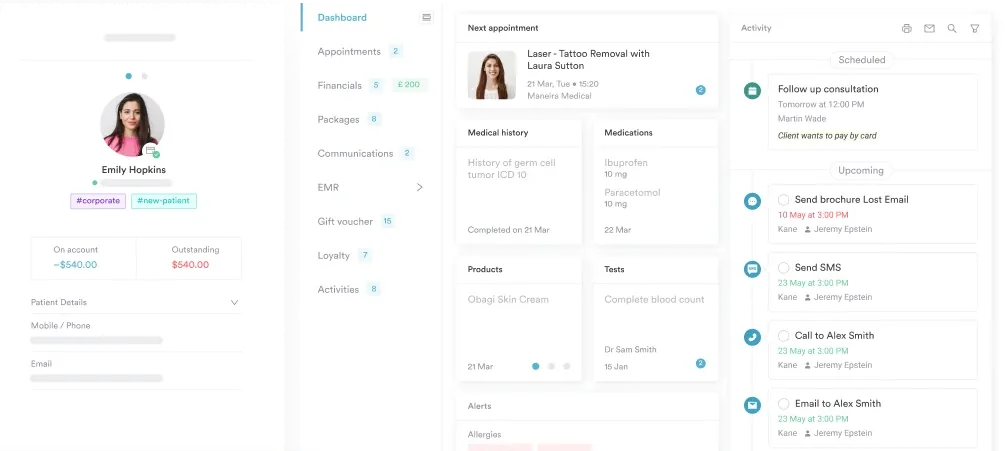
Structured clinical documentation in practice management software like Pabau, through tools such as medical records management, allows practices to build templates that prompt clinicians for exactly these data points during the encounter, reducing query cycles and coding delays.
Several ICD-10-CM Official Guidelines apply when assigning E45. These don’t change the code itself but affect how it is reported on a claim.
E45 can be reported as a principal diagnosis when the developmental delay due to PCM is the reason for the encounter. When PCM is also still active and separately documented, E44 or another specific malnutrition code may be reported as an additional diagnosis alongside E45.
If the encounter is primarily for an active acute condition and E45 is an underlying or complicating factor, sequence accordingly per the ICD-10-CM guidelines for sequencing principal vs. additional diagnoses. Accurate sequencing matters for claims management software workflows that validate code order before submission.

E45 can serve as a primary diagnosis when the clinical encounter is centered on evaluating or managing the developmental consequences of protein-calorie malnutrition. Nutritional counseling visits, developmental assessments, and follow-up for growth-failure patients are common scenarios.
Diagnosis codes rarely travel alone on a claim. Procedure codes such as CPT code 19020 carry documentation standards of their own, and payers expect both halves of the claim to agree.
E45 is valid for HIPAA-covered electronic transactions. Practices with HIPAA-compliant clinical workflows can submit E45 on professional and institutional claims where the code is medically supported. Never submit E45 without the supporting documentation described above. Doing so creates compliance exposure regardless of whether the claim is paid.
The AAPC Codify ICD-10-CM lookup provides a searchable reference for E45 and adjacent codes, including coding tips and payer-specific guidance that may supplement the official tabular.

Pabau’s structured clinical documentation tools and integrated claims management help practices capture the physician notes needed for codes like E45, reducing query cycles and denial rates.

The World Health Organization published ICD-11 in 2019, and while the US has not yet adopted it for billing purposes, understanding the crosswalk helps practices prepare for future migration. The ICD-10-CM to ICD-11 mapping for E45 is approximate. Use the WHO ICD-11 browser for definitive crosswalk verification.
ICD-11 restructures the malnutrition chapter with updated severity criteria and post-coordination capabilities. The developmental sequelae concept present in E45 is preserved in ICD-11, though the specific code structure differs. Practices in ICD-11 pilot environments should confirm the exact mapping before clinical use.
Codes like E45 fail at the documentation stage more often than at the coding stage. The causal linkage requirement, the need for specific clinical language, and the distinction from adjacent malnutrition codes all depend on what the physician writes in the encounter note.
Pabau’s structured note templates allow practices to build prompts directly into the clinical workflow. For a metabolic health, pediatric nutrition.
Practices using metabolic health EMR workflows often find that structured templates reduce the coder query rate for nutrition-related codes significantly.
Beyond documentation, patient care management workflows in Pabau connect clinical records to billing, so the ICD-10 codes a coder needs are surfaced alongside the encounter notes rather than requiring manual cross-referencing.

Build a separate documentation template for protein-calorie malnutrition visits that includes mandatory fields for: (1) PCM diagnosis confirmation, (2) anthropometric measurements with growth chart reference, and (3) a free-text field prompting clinicians to describe the causal relationship between PCM and any developmental findings. This single change typically prevents the missing documentation that most often blocks E45 assignment.
E45 is a specific, billable ICD-10-CM code that captures a measurable clinical consequence of protein-calorie malnutrition, not the malnutrition itself. Getting it right means having the physician explicitly document both the nutritional diagnosis and its causal role in the patient’s growth or developmental delay.
Pabau’s structured clinical documentation tools make it easier to build the prompts clinicians need at the point of care, reducing query cycles and supporting cleaner claim submissions. To see how Pabau handles nutrition-related documentation and ICD-10 coding workflows, book a demo.

Coding a related otorhinolaryngological device incident? See how Y72.8 is documented and sequenced under the same ICD-10-CM causal-attribution principles.
Coding a shoulder capsulorrhaphy with coracoid transfer? shoulder capsulorrhaphy billing guide CPT code 23462 reports an open anterior capsulorrhaphy with coracoid process transfer, a shoulder repair and reconstruction procedure.
Billing an anesthesia encounter accurately? The 00147 billing guide walks through the documentation ICD-10-CM and CPT coding share in common.
ICD-10 Code E45 is a billable ICD-10-CM diagnosis code with the official description “Retarded development following protein-calorie malnutrition.” It falls under Chapter 4 (Endocrine, Nutritional and Metabolic Diseases) in the E40-E46 malnutrition block and is valid for HIPAA-covered claim submission when appropriately documented by a physician.
Use E45 when the physician has explicitly documented that protein-calorie malnutrition has caused retarded development, growth retardation, or nutritional stunting. Use E46 when PCM is diagnosed but the type or severity is unspecified and no developmental sequelae are documented. E46 is the default when documentation is insufficient for a more specific code. E45 requires the causal link to be explicit in the record.
Yes, E45 can be assigned as a primary diagnosis when the reason for the encounter is to evaluate or manage developmental delay or growth retardation caused by protein-calorie malnutrition. Developmental assessments, nutritional follow-up visits, and growth failure evaluations are common scenarios where E45 is appropriate as the principal diagnosis.
The ICD-10-CM code for retarded development due to protein-calorie malnutrition is E45. Its inclusion terms cover nutritional short stature, nutritional stunting, and physical retardation due to malnutrition. All of these presentations map to E45 when protein-calorie malnutrition is documented as the cause.
R62.51 (failure to thrive, child) and E45 cannot be used together. The Excludes1 note between E45 and the R62.5x failure-to-thrive codes makes the two mutually exclusive, so coders must pick the one code that matches the physician’s documentation rather than billing both on the same claim.
ICD-11 preserves the concept of developmental sequelae from protein-calorie malnutrition, though the code structure differs from ICD-10-CM. The approximate mapping falls within ICD-11’s malnutrition block. Because US adoption of ICD-11 has not been confirmed, practices should verify the current crosswalk via the WHO ICD-11 browser before applying any mapping in a live billing environment.