GLP-1 diet plan
A GLP-1 diet plan is a structured eating framework for patients taking semagluti...

2
Last Updated: Oct 13, 2026

Spasmodic dysphonia is a focal dystonia of the laryngeal muscles, not vocal strain or a psychological condition.
Three types exist: adductor, abductor, and mixed. Each one calls for a different diagnostic and treatment approach.
Botulinum toxin injections into the laryngeal muscles are the most widely used treatment for adductor spasmodic dysphonia.
No cure exists, so management aims at sustained symptom relief through repeat injection cycles or surgery.
ICD-10-CM coding may use J38.3 or G24.8. Verify either one against the current CMS tabular list before billing.
Spasmodic dysphonia is a rare focal dystonia of the laryngeal muscles. First signs typically appear between the ages of 30 and 50, according to the National Institute on Deafness and Other Communication Disorders. Despite that clear neurological basis, it remains one of the most frequently misdiagnosed voice disorders in practice.
Patients often spend years cycling through anxiety treatment, vocal rest, and conventional speech therapy before the underlying dystonia is recognized. Separating spasmodic dysphonia from muscle tension dysphonia early changes the whole treatment pathway. It also prevents months of ineffective management.
Spasmodic dysphonia is classified as a focal dystonia, a neurological movement disorder in which the laryngeal muscles contract involuntarily during speech. The National Institute on Deafness and Other Communication Disorders describes it as a condition of the muscles that open and close the vocal folds. The voice breaks unpredictably mid-sentence as a result.
The dystonic movement originates in the central nervous system, which places the condition within neurology despite its voice-based presentation. Calling it functional or psychosomatic sends the patient down the wrong pathway for years.
The condition predominantly affects adults, with onset most often reported in middle age. Women appear to be affected more frequently than men, though the precise ratio varies across published epidemiological data.
The most common form, adductor spasmodic dysphonia, occurs when the vocal folds close too tightly during voiced speech. The result is a strained, effortful, or strangled voice quality. Patients often describe it as choking on their own words.
Spasms are most prominent on vowel-heavy speech and voiced consonants. Whispering, singing, or speaking at the extremes of pitch may sound normal, which is what misleads clinicians into dismissing the complaint.
In abductor spasmodic dysphonia, the vocal folds open inappropriately during voiceless consonants such as /s/, /h/, and /f/. The voice breaks into a breathy or aphonic quality mid-word. This form is considerably less common, accounting for roughly 15 to 20% of cases.
The breathiness can be mistaken for vocal fold paralysis, so laryngoscopic assessment is essential for differentiation.
Mixed spasmodic dysphonia involves features of both adductor and abductor patterns, and occurs in a small minority of patients. It is the most complex subtype to manage and may require combination treatment.
Practitioners meeting a mixed presentation should refer early to a specialist experienced in laryngeal dystonia. Single-modality treatment is rarely sufficient here.
Diagnosing spasmodic dysphonia requires a multidisciplinary evaluation, and no single test is definitive. The American Speech-Language-Hearing Association recommends a combined assessment involving a speech-language pathologist, an otolaryngologist, and ideally a neurologist. Neurology input matters most where other dystonic features are present or the presentation is atypical.
Flexible laryngoscopy during connected speech is the primary visualization tool. The clinician watches vocal fold movement during tasks designed to provoke spasms: voiced, vowel-rich sentences for adductor assessment, and voiceless consonant-loaded phrases for abductor assessment.
Laryngeal electromyography (EMG) provides neurophysiological confirmation. It shows abnormal bursts of muscle activity in the thyroarytenoid or posterior cricoarytenoid muscles, depending on subtype. EMG earns its place when laryngoscopy leaves the diagnosis uncertain, or when injection sites are being planned.
The most significant differential diagnosis is muscle tension dysphonia (MTD). Both conditions produce a strained voice, and stress can worsen either one.
The distinction sits in how the muscles behave. Spasmodic dysphonia involves neurological muscle activation that persists regardless of posture, relaxation, or manual laryngeal therapy. MTD typically responds to those approaches, so a patient who improves meaningfully during the assessment session is unlikely to have a dystonia. That single observation guides treatment selection.
Other differentials to exclude include vocal fold paralysis, essential tremor, and psychogenic voice disorders. Essential tremor can coexist with spasmodic dysphonia rather than replace it as a diagnosis.
A structured cranial nerve screen also helps separate a dystonia from a vagus or recurrent laryngeal nerve lesion. Our cranial nerve examination checklist sets out those steps in the order most clinicians run them.
A thorough case history is a useful early filter before imaging and laryngoscopy. Cover the onset pattern, the contexts that trigger symptoms, and how the voice responds to situational factors.
Record the patient’s voice in three speaking contexts before the specialist referral. Use conversational speech, reading aloud from a standardized passage, and a sustained vowel or singing task. Sending those recordings with the referral strengthens it, and cuts the number of specialist appointments needed to reach a diagnosis.
There is currently no cure for spasmodic dysphonia. The NIDCD and the National Spasmodic Dysphonia Association both state that available treatments manage symptoms rather than resolve the underlying neurological cause. Patients do better when they understand that repeat treatment cycles are expected, not a sign of failure.
Botulinum toxin injections into the laryngeal muscles are the most commonly used treatment for adductor spasmodic dysphonia, supported by substantial peer-reviewed evidence. The toxin goes into the thyroarytenoid muscles, bilaterally in most adductor cases, with EMG guidance confirming needle placement.
The mechanism is temporary chemodenervation. The injected muscle produces less force during spasm, so the voice flows with fewer interruptions.
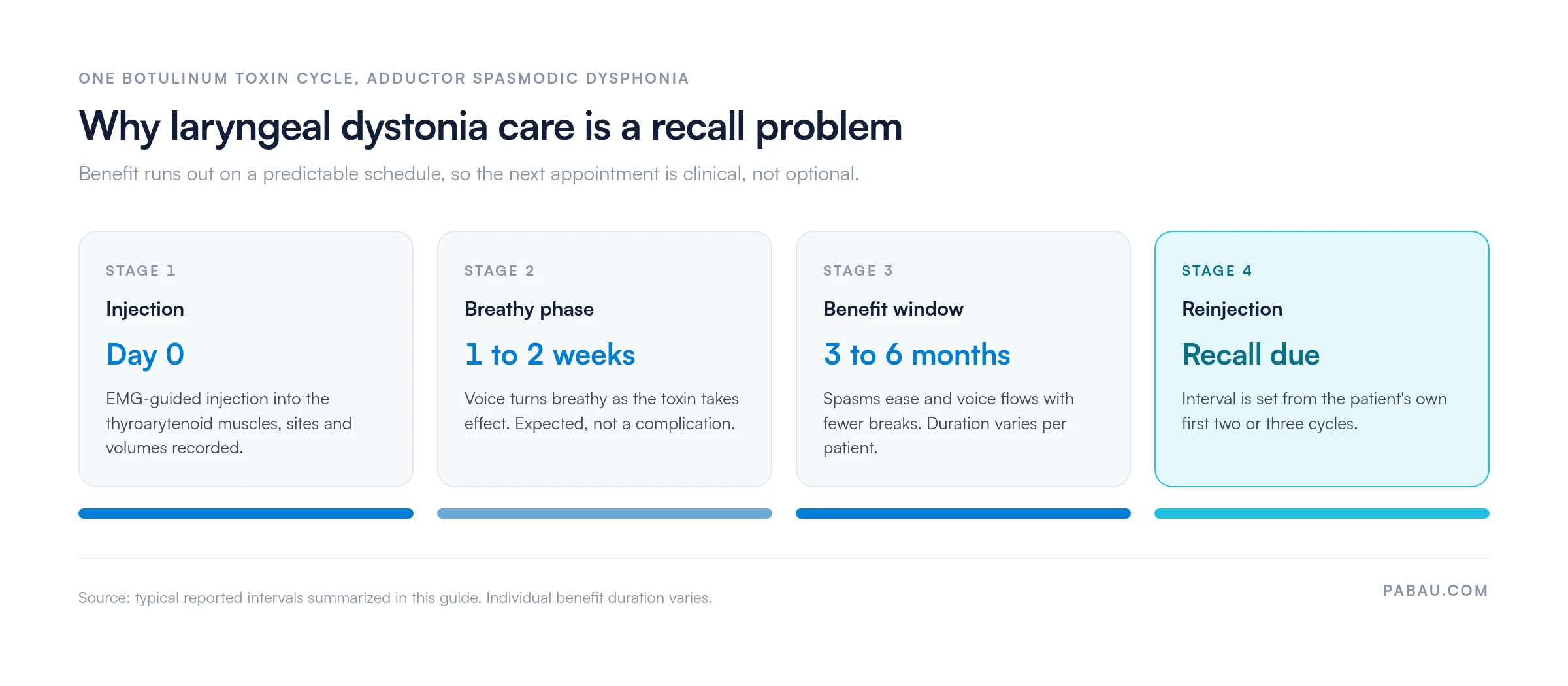
Patients commonly experience a period of breathiness after injection as the toxin takes effect. It lasts one to two weeks in most cases before voice quality improves. The benefit period varies considerably between individuals, and typically runs three to six months before repeat injection is needed.
Dosages are set by the injecting clinician from individual response, muscle bulk, and prior injection history. Dosing protocols should not be generalized in patient-facing materials. The sequence below is what a practice ends up scheduling around.
For abductor spasmodic dysphonia, botulinum toxin is injected into the posterior cricoarytenoid muscle. That procedure is technically more demanding and has a narrower therapeutic window. Response rates are generally lower than for the adductor form, so it calls for specialist expertise.
Two surgical approaches are used for selected patients with adductor spasmodic dysphonia. Type II thyroplasty widens the glottis to reduce the effect of adductor spasms on voice production. An EMR built for physical therapy keeps exercise prescriptions and outcome measures in the same record.
Selective laryngeal adductor denervation-reinnervation (SLAD-R) sections the recurrent laryngeal nerve branches supplying the thyroarytenoid muscle. The surgeon then reinnervates with a non-phonatory nerve, which holds muscle tone without dystonic activation.
Published outcomes for SLAD-R suggest durable benefit in selected patients, though long-term follow-up data remain limited. Patient selection is critical, and neither procedure suits abductor spasmodic dysphonia.
Speech-language pathology has a defined but adjunctive role here, because it cannot resolve the dystonia directly. It earns the referral in three contexts:
Referring clinicians should state those goals in the referral itself. A patient who was told that speech therapy alone would fix a dystonic voice comes away disappointed.
Accurate ICD-10-CM coding for spasmodic dysphonia depends on the underlying classification logic. Two codes appear in practice, and the right selection follows how the condition is framed in the medical record.
J38.3, other diseases of vocal cords, is the code most frequently cited for spasmodic dysphonia in US clinical billing. It sits in the respiratory system chapter and captures vocal cord conditions that do not fit a more specific code.
G24.8, other specified dystonias, is the neurologically grounded alternative. Where the treating clinician has documented spasmodic dysphonia as a focal dystonia, G24.8 reflects the underlying diagnosis more accurately. Some specialist practices and neurology billing teams prefer it for exactly that reason.
Coding teams should verify both codes against the current CMS ICD-10-CM tabular list before applying either one. The appropriate primary code may also depend on whether the treating specialty is otolaryngology or neurology.
Practices running long-term injection programs benefit from a claims management workflow that tracks code usage across repeat cycles. It also flags coding inconsistencies inside a single care episode, before the claim goes out.
For spasmodic torticollis, a related focal dystonia of the neck muscles, the primary ICD-10-CM code is G24.3. It is sometimes encountered alongside laryngeal dystonia in the same patient. Assessing neck rotation with a cervical torsion test helps rule out cervicogenic causes before attributing symptoms to dystonia.
When coding repeat botulinum toxin appointments, confirm that the clinical note documents the diagnosis as focal dystonia or laryngeal dystonia. A note that says only ‘voice disorder’ weakens the case for G24.8, and invites rejection on grounds of diagnosis-procedure mismatch.
Managing spasmodic dysphonia over time differs from managing episodic or acute conditions. The defining feature is predictable recurrence. Patients on botulinum toxin return for repeat injection every three to six months, often for decades. That pattern shapes how a practice structures scheduling, records, and communication.
Recall systems matter more here than in many other clinical contexts. A patient whose symptoms have returned, and who has not been prompted to rebook, spends weeks in significant vocal impairment before attending.
Automated appointment workflows can hold each patient’s own interval, set once the first two or three cycles reveal their response pattern. Staff no longer have to track every re-treatment window by hand.

Documentation standards in this caseload are specific. Each injection episode should record the injection sites, the volumes administered, the patient’s pre-injection voice rating, and any adverse effects from the prior cycle.
That longitudinal record is the evidence base for dosing adjustments over the years. Structured client records with custom templates can embed those fields into every injection note, instead of leaving consistency to free text.

Multidisciplinary coordination is the other practical challenge. A patient may have laryngoscopy in one location, injections from a laryngologist in another, and speech therapy follow-up through a third provider.
Clear referral documentation reduces duplication and missed steps. Name the subtype confirmed, the response to prior treatment, and the current stage of the injection cycle.
Patients with laryngeal dystonia sometimes carry a second focal dystonia, and cervical cases often reach physical therapy for posture and pain management. Where a practice runs both caseloads, an EMR for rehab teams keeps the referral history and the outcome scores on one record instead of two.
For practices holding the full care episode, telehealth software supports interim check-ins. A brief voice review between injections rarely justifies a journey across town.

Consent documentation for botulinum toxin injection deserves specific attention. Four points belong in the conversation before the patient signs:
Practices that have to show one consistent consent record across a whole team benefit from standardized digital forms. Version control comes with them, which keeps the file audit-ready without a paper chase.
Most specialist practices track laryngeal dystonia patients in three places at once. The calendar holds the appointment, a paper file holds consent, and a free-text note holds the clinical detail. The recall depends on someone remembering, and the voice ratings from cycle four are hard to line up against cycle one.
Practice management software like Pabau holds the whole cycle in one record. Recall runs on each patient’s own interval. Injection notes follow a fixed template for sites, volumes, and voice ratings, and signed consent stays attached to its episode.
The result is a caseload that runs on a schedule rather than on memory. Any clinician who opens the record sees the last injection, the last voice rating, and the date the next appointment falls due.

Pabau helps specialist practices coordinate multidisciplinary care, schedule repeat injection cycles, and keep detailed clinical records for long-term conditions like spasmodic dysphonia.

Spasmodic dysphonia care is a long-term relationship that rarely fits a single appointment cycle. Patients return every three to six months for botulinum reinjection, and need consistent voice outcome documentation between visits. Coding has to stay current with each CMS revision as well.
Continuity slips where record-keeping is fragmented, and that is where avoidable reinjections, repeat consent forms, and coding errors appear. Pabau gives otolaryngology, neurology, and allied health practices one place to schedule the cycles, compare voice ratings against an earlier baseline, and version-control off-label consent.
Book a demo to see how a multi-year laryngeal dystonia caseload runs end to end in one platform.

Need a repeatable cranial nerve screen for voice complaints? Cranial nerve examination checklist walks the twelve nerves in exam order, with space to record findings.
Assessing tongue movement alongside a voice complaint? Hypoglossal nerve test covers the technique and what an abnormal result points to.
Documenting swallowing safety in a laryngeal caseload? Penetration-aspiration scale template gives you the scoring frame for instrumental swallow assessments.
Want a simple way to track change between treatment cycles? Global rating of change scale captures patient-reported improvement as one comparable score.
Building a speech and language assessment battery? Expressive One-Word Picture Vocabulary Test explains administration, scoring, and where the results are useful.
Spasmodic dysphonia is a focal dystonia, a neurological movement disorder in which involuntary spasms of the laryngeal muscles interrupt voice production during speech. It is not a psychological condition or the result of vocal misuse. The underlying mechanism is not fully established, though the condition is consistently classified as a movement disorder of the larynx.
There are three types. Adductor spasmodic dysphonia is the most common, and produces a strained or strangled voice. Abductor spasmodic dysphonia causes breathy voice breaks on voiceless consonants. Mixed spasmodic dysphonia features elements of both. Each type involves different laryngeal muscles and calls for a different treatment approach.
Diagnosis requires a multidisciplinary evaluation combining flexible laryngoscopy during connected speech, assessment by a speech-language pathologist, and often laryngeal electromyography (EMG). There is no single definitive test. The key differential to exclude is muscle tension dysphonia, which presents similarly but responds to different treatment.
Botulinum toxin injections into the laryngeal muscles are the most widely used treatment, particularly for adductor spasmodic dysphonia. Surgical options including thyroplasty and selective laryngeal adductor denervation-reinnervation (SLAD-R) suit selected patients. Speech therapy plays an adjunctive role. No treatment currently cures the condition, so every approach manages symptoms.
Both conditions produce a strained or effortful voice. The distinction is neurological origin. Spasmodic dysphonia involves involuntary dystonic muscle activation that does not respond to relaxation or manual laryngeal therapy. Muscle tension dysphonia typically improves with those approaches. That difference determines which treatment pathway is appropriate.
Two codes are used in practice: J38.3 (other diseases of vocal cords) and G24.8 (other specified dystonias). The choice depends on how the condition is documented and on the treating specialty. Where spasmodic dysphonia is clearly documented as a focal dystonia, G24.8 may reflect the diagnosis more accurately. Always verify against the current CMS ICD-10-CM tabular list before billing.