Newborn head circumference chart
A newborn head circumference chart plots a baby’s head measurement against...

1
Last Updated: Oct 14, 2026

The sit and reach test measures lower back and hamstring flexibility with a seated forward reach, first described by Wells and Dillon in 1952.
Scores are read against age- and sex-specific norms. A below-average score flags hamstring tightness and lower back pain risk, not a diagnosis.
Five protocol variants exist, and the modified version is preferred clinically because it adjusts for arm and leg length.
Practice management software like Pabau lets physical therapy and sports medicine practices trend scores over time against the client record.
Hamstring tightness shows up in almost every musculoskeletal screen, in both clinical and athletic populations. The sit and reach test gives you a fast, low-cost flexibility benchmark that takes under three minutes to administer. What separates a useful clinical data point from a number that goes nowhere is knowing how to run it and how to read it.
This guide is written for physical therapists, sports medicine clinicians, exercise physiologists, and fitness professionals. It covers the protocol, the scoring tables, the five main variants, the validity evidence, population-specific adjustments, and how to improve a score.
The sit and reach test is a standardized flexibility assessment of the lower back and hamstrings. Wells and Dillon described it in 1952 in the Research Quarterly. It is now one of the most widely administered field tests in clinical and sport science settings.
Its appeal is practical. No specialist training is needed, the equipment is cheap, and normative data exists for most age groups. In practice you will meet it in musculoskeletal screening, pre-participation physicals, occupational health assessments, and school fitness batteries.
Coaches and conditioning staff use it as a baseline flexibility marker during pre-season testing. Before you draw any conclusion from a score, be clear on what the number does and does not tell you.
The test measures the posterior chain: the hamstrings, the lower back, and to a lesser degree the lumbar and thoracic spine. How much each structure contributes to the final score is still debated in the literature.
A participant with tight hamstrings but good lumbar mobility can score the same as someone with flexible hamstrings and restricted lumbar flexion. That is the central validity problem. The test is a composite measure rather than an isolated assessment of either structure.
To separate hamstring length from the lumbar contribution, pair it with a joint-specific measure. The 90-90 hamstring test isolates hamstring extensibility at a fixed hip angle, so a low sit and reach score stops being ambiguous.
Poor sit and reach scores are associated with hamstring tightness and elevated lower back pain risk. That is a statistical association, not a causal one. The test screens flexibility. It does not diagnose a condition.
The setup is minimal. Most clinical and educational settings already have what they need, or can build a low-cost substitute in minutes.
No specialist training equipment or sensors are required. That simplicity is why the test is still standard in school, clinical, and community sport settings worldwide. Check the markings on your box each year, because a worn or misprinted scale quietly breaks every comparison you make.
Consistent administration is the single biggest influence on reliability. Run the same warm-up and positioning protocol every time.
The three most common administration errors are knee flexion during the reach, bouncing into position, and an inconsistent warm-up. Each one inflates the score and destroys test-retest comparability. Document the variant and the unit of measurement next to the raw score, or the number will not survive its first comparison.
Scores are read against population norms stratified by age and sex. The tables below reflect commonly cited values from the Canadian Standardized Test of Fitness (CSTF). They also draw on the ACSM Guidelines for Exercise Testing and Prescription.
Values are in centimeters, using the standard box where the 26 cm mark aligns with the foot plate. For current Canadian testing and movement guidance, see the Canadian Society for Exercise Physiology guidelines.
Females score higher than males in every band in the table, but the margin is not fixed. It runs from about 1 cm at the 20-29 excellent threshold up to 7 cm in the older average bands. Hip structure and ligament laxity explain most of the difference.
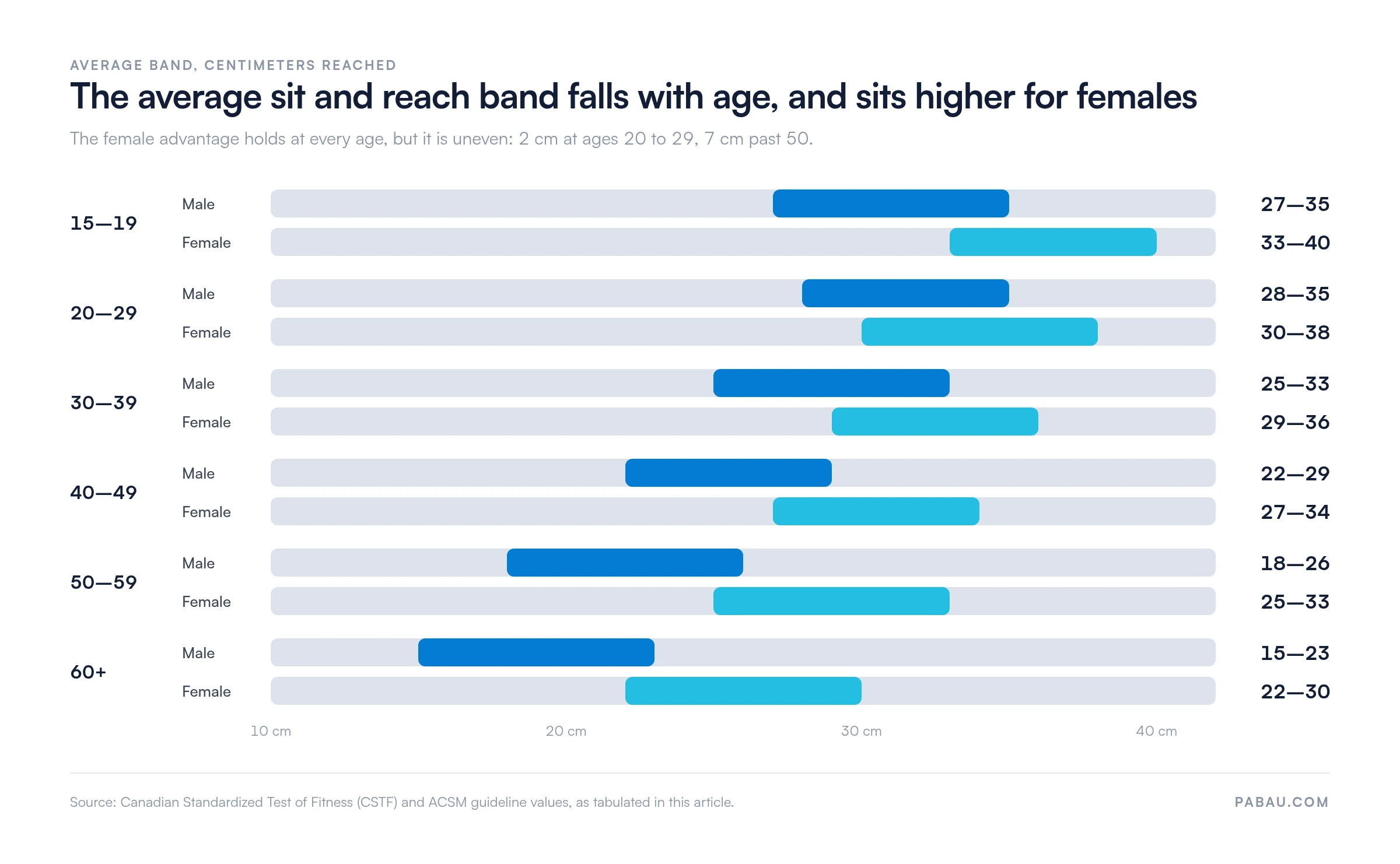
Both sexes decline gradually from the mid-30s onward, which reflects normal age-related loss of posterior chain flexibility. Interpretation uses five bands: excellent, above average, average, below average, and poor.
A single below-average score is not grounds for a diagnosis. Treat it as a prompt for further assessment and targeted flexibility work.
The standard protocol has well-documented limitations around body proportions. Five variants address them in different ways. The table below summarizes which one to use and when.
The modified sit and reach test is preferred in clinical work because body proportions distort the standard score. A long-trunked, short-legged person outreaches a short-trunked, long-legged person with identical hamstring flexibility.
The Back Saver variant is the one used in the FitnessGram battery across US schools. Scores from different variants are not interchangeable, so never compare across protocols.
Test-retest reliability is consistently high. Intraclass correlation coefficients (ICC) above 0.90 are reported across multiple studies when the protocol is standardized. That makes the test a reasonable longitudinal tracking tool in clinical practice.
Validity is more contested. The test cannot separate hamstring flexibility from the lumbar spine’s contribution. Two people with identical scores may have different flexibility profiles at the joint level. The ACSM Guidelines treat it as a general indicator of posterior chain mobility rather than a standalone diagnostic measure.
That distinction matters in your documentation. Recording “below average sit and reach score” is appropriate. Recording “hamstring flexibility deficit diagnosed” from this test alone is not.
The test’s wide adoption reflects genuine practical strengths. Every clinician using it should also know where its information ends.
The limitations matter just as much when you explain a score to a patient or a colleague.
The protocol modifications and the norm tables both change by group. Here is what to adjust for the four groups you are most likely to test.
Flexibility norms for trained athletes differ from general population tables. A distance runner with very tight hamstrings may still beat average population norms.
Flexibility is one quality among several in a sport fitness battery. Adding an upper body power test captures explosive output in the same session, and it runs in under five minutes.
In sport, intra-individual tracking across a training season tells you more than a cross-sectional comparison. Practices running sports medicine software can hold those seasonal trends across a whole athlete roster.
The Back Saver variant is used in the FitnessGram battery across US school systems, because bilateral leg extension loads a developing lumbar spine harder. Norm tables for children use the FitnessGram Healthy Fitness Zone criteria, not ACSM adult norms. The two table sets are not interchangeable.
Posterior chain flexibility declines predictably with age, and the 60+ band reflects that. For older adults with a history of lumbar disc pathology or acute low back pain, test only after clinical clearance.
The Chair Sit and Reach variant, performed from a seated chair position, is often the safer choice. Pairing it with a functional measure such as the 30-second chair stand test gives you strength and flexibility from the same visit.
In rehab, the test works as an outcome measure across a treatment episode. The trajectory matters more than the absolute score. A patient recovering from a hamstring strain who moves from 15 cm to 28 cm in eight weeks has a meaningful result. That holds even though 28 cm sits below the population average.
Flexibility is trainable. Consistent stretching aimed at the hamstrings and the lumbar region produces measurable improvement in 4 to 8 weeks.
Improvement is specific to the training performed. A patient who stretches the hamstrings but never the lumbar spine will improve one component and then plateau. Identify which structure is the limiting factor before you write the program.
A sit and reach score written on a paper sheet or buried in a free-text note cannot be trended. You cannot compare it across sessions, flag it when it drops below a threshold, or pull it into a patient report. Practice management software like Pabau changes that.
Pabau’s measurements tracking software logs numerical assessment results against a client record and shows them in one longitudinal view. A physical therapist records the result at intake, at four weeks, and at discharge. All three points then sit in one view.
Clinical notes and appointment history live in the same record, so the score never sits on its own. Digital intake forms let you capture baseline flexibility data, training history, and injury history before the appointment starts.

Practices working from software for physical therapists can build assessment workflows that prompt a re-test at set intervals. Outcome monitoring then stops depending on whoever remembers to ask.
For a multidisciplinary team, centralized flexibility data means the physical therapist, the sports medicine physician, and the strength coach share one baseline. That matters for clinical communication and for outcome accountability.

Pabau’s measurements tracking and client records give physical therapy and sports medicine practices one place to document and trend sit and reach scores. Scores stay attached to the client record from intake to discharge.

Administer the sit and reach test at the same time of day across sessions. Flexibility is measurably higher in the afternoon than in the morning, because of diurnal variation in spinal disc hydration and muscle temperature. Note the test time next to the score, and your longitudinal data becomes comparable.
The sit and reach test earns its place through simplicity, reproducibility, and the depth of the normative data behind it. The discipline is in the reading. It is a general indicator of posterior chain flexibility, not a diagnosis, and not comparable between protocol variants.
Pick the variant that suits your population, standardize every part of administration, and record the result where it can be compared later. Do all three and a three-minute field test starts producing usable clinical intelligence. Skip the last one and you have a number in a note nobody reads again.
Book a demo to see how Pabau trends sit and reach scores across a course of treatment.

Need to isolate hamstring length from lumbar mobility? The 90-90 hamstring test measures hamstring extensibility at a fixed hip angle, which the sit and reach test cannot do.
Want a joint-specific range of motion measure? The ankle dorsiflexion test gives you a repeatable number for the ankle, useful when calf tightness limits squat and gait mechanics.
Screening older adults for fall risk? The functional reach test measures forward reach from standing, so it captures balance rather than posterior chain flexibility.
Building a return-to-sport battery? The star excursion balance test adds dynamic single-leg control to the flexibility and strength measures you already record.
The sit and reach test measures the combined flexibility of the hamstring muscles and lower back. Lumbar and thoracic spinal flexion make a secondary contribution. It is a composite posterior chain assessment, not an isolated measure of either structure. Two individuals with the same score may have different flexibility profiles at the joint level.
A good score varies by age and sex. For males aged 20-29, above 35 cm counts as above average. For females in the same range, the threshold is 38 cm. Females score higher than males in every band, though the margin runs from about 1 cm to 7 cm. Scores decline with age in both sexes, so always compare against the matching age-stratified table.
The standard test uses a fixed reference point at the foot plate. Individuals with longer arms or shorter legs therefore carry a built-in scoring advantage. The modified test resets the zero reference point to each person’s sitting reach position before testing. That removes the body-proportion bias and makes scores comparable across body types, which is why clinical settings prefer it.
The test has good test-retest reliability, with ICC values typically above 0.90 when the protocol is standardized. Its construct validity is more debated. Because it cannot separate hamstring from lumbar spine contributions, it works as a general indicator of posterior chain mobility. It is not a diagnostic test and should not be read as one.
Daily static hamstring stretching held for 30 to 60 seconds per side produces measurable improvement in 4 to 8 weeks for most people. Adding lumbar mobility work such as cat-cow and pelvic tilts addresses the spinal component of the test. Frequency matters more than intensity. Daily light stretching outperforms three intense sessions a week for sustained gains.
Yes, with adjustments. For athletes, intra-individual tracking over a training season is more useful than a cross-sectional comparison, because sport-specific flexibility profiles vary widely. For older adults, age-appropriate norms apply. The Chair Sit and Reach variant may be safer for anyone with lumbar disc pathology or acute low back pain. Always use the norm table that matches the variant you administered.