CRM for chiropractors: how to manage patients, bookings and marketing
A CRM for chiropractors is a patient relationship management system built around...

Last Updated: Oct 13, 2026

Primary care marketing runs on trust and proximity, so patients pick a family physician for access and rapport rather than brand awareness.
A complete Google Business Profile and consistent local listings give an independent practice the highest return for the least spend.
Automated recall messages, post-visit review requests, and embedded online booking turn routine practice admin into steady patient acquisition.
A 90-day plan split into foundations, channels, then measurement lets a small practice build momentum without pulling staff off clinical work.
Six numbers show whether the marketing is working, from new patient count to the appointment-to-show rate.
Primary care marketing is how a family practice gets found, chosen, and remembered by people who live nearby. Most independent practices lose more patients to friction than to the competitor down the road. An unclaimed listing, a website that cannot take a booking, and silence after the visit all cost you patients.
The single biggest lever is local visibility, because someone searching for a doctor nearby is ready to book today. Get that right and the rest of your marketing has something to build on.
The eight steps below run in the order a practice should tackle them, ending with a 90-day plan.
Primary care marketing covers how a family medicine, GP, or direct primary care (DPC) practice attracts, keeps, and reactivates patients. It is local by nature.
The American Medical Association says physician advertising must be accurate, and must never deceive or mislead. That boundary shapes every tactic in this guide.
Specialists market to a referring audience. Primary care competes for local trust instead. Patients choose on proximity, on how fast they can be seen, and on whether the practice feels like it understands them.
DPC practices carry a longer sale, because you are recruiting members to a subscription rather than filling a single appointment. That pushes the emphasis toward relationships, community visibility, and retention rather than acquisition alone.
Before any spend, write down who you want more of. A message written for the whole town lands weakly with every person who reads it.
Your persona needs three parts, which are demographics, payer mix, and the care needs your practice is set up to handle.
Three questions get you there:
Once you know who you are talking to, the next question is what they find when they look you up.
Your website is the highest-converting asset you own, and most primary care sites are built for the practice rather than the patient.
Three elements decide whether a visitor books. They need a visible way to book above the fold, plain information on who you accept, and provider bios that feel human.
An embedded online booking widget removes the phone call. That call is a genuine barrier for anyone browsing at 9pm or between meetings, and the moment usually passes before morning. Keep the flow to three steps or fewer, then test it on a phone before you launch.
Trust signals do as much work as functionality. Patient testimonials, professional headshots, and any accreditations reduce the hesitation people feel before booking with a stranger. If you run a DPC membership, spell out what it includes on the same page.
A common mistake is burying the booking link in the navigation menu. Put it in the header of every page, in a color nothing else on the site uses.
Google’s map pack sits above the organic results for local searches, and ranking in it costs only time.
For a primary care practice, no other channel matches that ratio of intent to cost. Someone typing “primary care doctor near me” is usually ready to book that week.
Claiming and verifying your listing is free, according to Google’s own guidance. What lifts you up the map pack after that is completeness and activity.
Local SEO does not stop at the listing. Your name, address, and phone number must match across Healthgrades, Zocdoc, Yelp, and every insurance directory that lists you. An old suite number left behind on one profile is enough to muddy the signal.
Social media for primary care is a slow channel, and the goal is community trust rather than reach. Think of each platform as a different room in the same building.
Facebook serves the local community, Instagram carries warmth and behind-the-scenes moments, and LinkedIn matters if you are chasing employer DPC contracts.
HIPAA applies to every post you publish. Guidance from the HHS Office for Civil Rights makes the line clear. Patient information shared on social media can breach the rules even without a name, if someone could identify the person. Safe content types include:
Consistency beats frequency here. Two considered posts a week outperform five rushed ones, and scheduling them ahead protects clinical time.
Running your own health fair or wellness evening takes more planning than posting about someone else’s. A marketing plan for events lays out the promotion schedule, the budget and the follow-up.
If you are writing a social media policy for staff, a HIPAA compliance checklist is the quickest way to set the boundary in writing.
Reviews are the last thing an undecided patient checks before booking.
Over 70% of patients read online reviews before choosing a provider, according to survey work from Software Advice. For primary care, Google and Healthgrades carry the most weight.
Ask for honest feedback and never offer an incentive. The FTC’s endorsement guides prohibit paying for positive reviews, and the platforms say the same in their own policies. Timing does the heavy lifting. Ask straight after a good visit, while the feeling is still fresh.
Practice management software like Pabau can carry that ask for you. Its online reputation management tools send an SMS or email once the appointment closes, so the request never waits on someone remembering. That removes the awkwardness of asking face to face and keeps new reviews arriving week after week.
One mistake trips practices up here. Sending 40 invitations in a single week looks like a campaign, to patients and to Google alike. A steady trickle tied to each appointment holds up far better.
Email is the cheapest retention channel a practice has, and retention is where primary care earns its margin. Three sequences cover most of the patient lifecycle.
A welcome series introduces the practice and a monthly note keeps you visible. Seasonal prompts bring people back for physicals and flu shots.
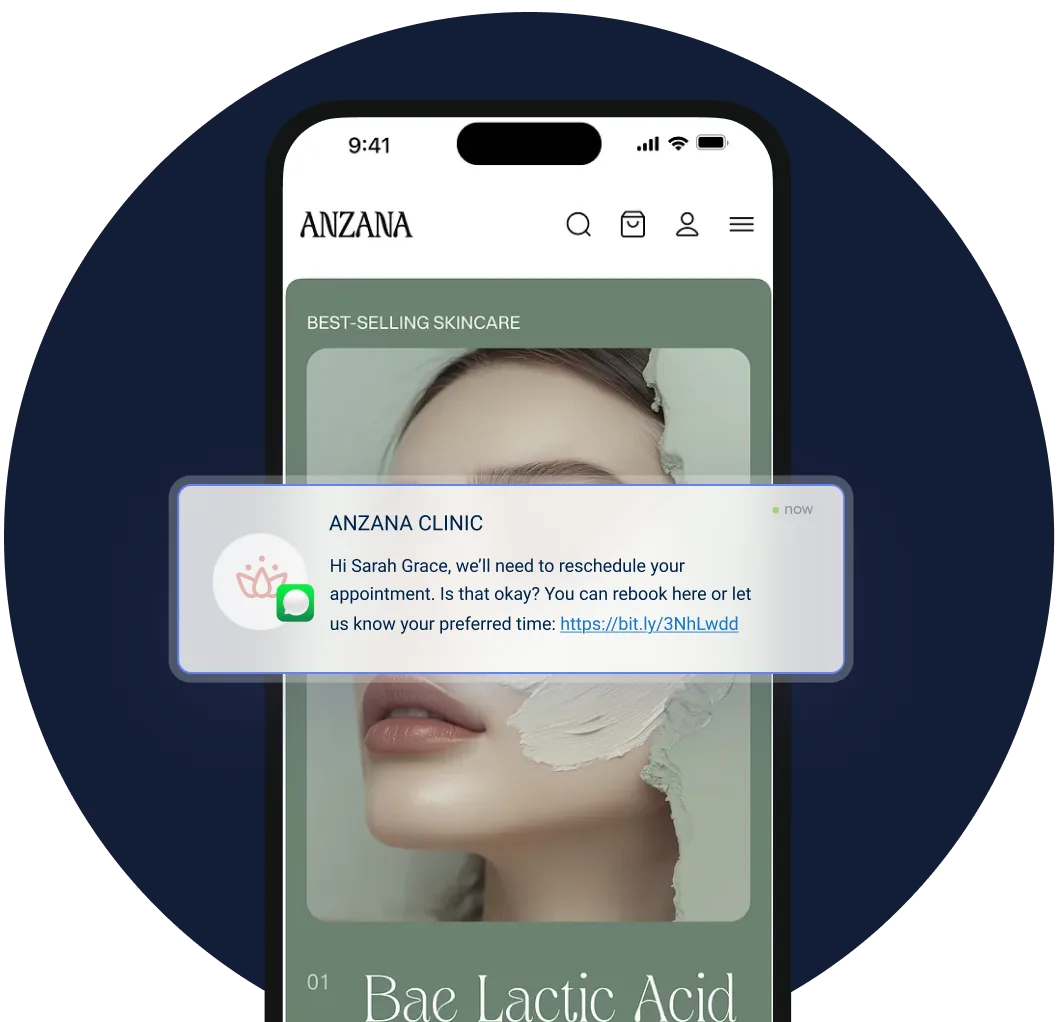
Appointment reminders sit alongside those three. Sent 48 hours out, they cut no-shows and protect revenue you have already earned.
HIPAA changes what you can send. Any email carrying protected health information needs a Business Associate Agreement (BAA) with the platform sending it.
A general health tips newsletter carries less risk. A segmented campaign, say reminders to patients with diabetes, needs a HIPAA-compliant tool and a signed BAA in place.
For DPC practices, renewal is the campaign that pays for itself. A three-part sequence at 60 days out, 30 days out, and renewal day reduces churn with no ad spend at all.
Independent practices without hospital ties have no institutional referral pipeline, so they build their own. Two routes are worth the effort.
Local specialists. Cardiologists, orthopedic surgeons, and dermatologists all send patients back to a primary care physician for ongoing management. A short introductory letter, a lunch-and-learn, or a LinkedIn note about your panel capacity opens the door. Tell them again whenever your panel opens up or your services change.
Local employers. Many DPC practices contract directly with employers to offer primary care as a staff benefit. A 100-employee company paying $50 to $70 per member per month is worth $60,000 to $84,000 a year. Pitch what an HR director cares about, which is fewer sick days, faster access, and lower downstream specialist costs.
Log every referral you receive by source, even in a spreadsheet. Without that record, you cannot tell which relationships deserve another lunch.
Marketing you cannot measure is a cost, not an investment. Six numbers, checked once a month, tell you nearly all of what you need to know.
Check all six in one monthly sitting. You can pull new patient counts and show rates from software for family practices without adding a separate analytics tool.
Then let the numbers set the priority. If website conversion is low, fix the booking flow before you buy more traffic. If reviews have stalled, switch on the post-visit request before you build a content calendar.
Knowing the eight steps is one thing. Sequencing them around a full clinic day is another. Below is an order a solo or two-physician practice can hold to, along with the metric each phase is meant to move.
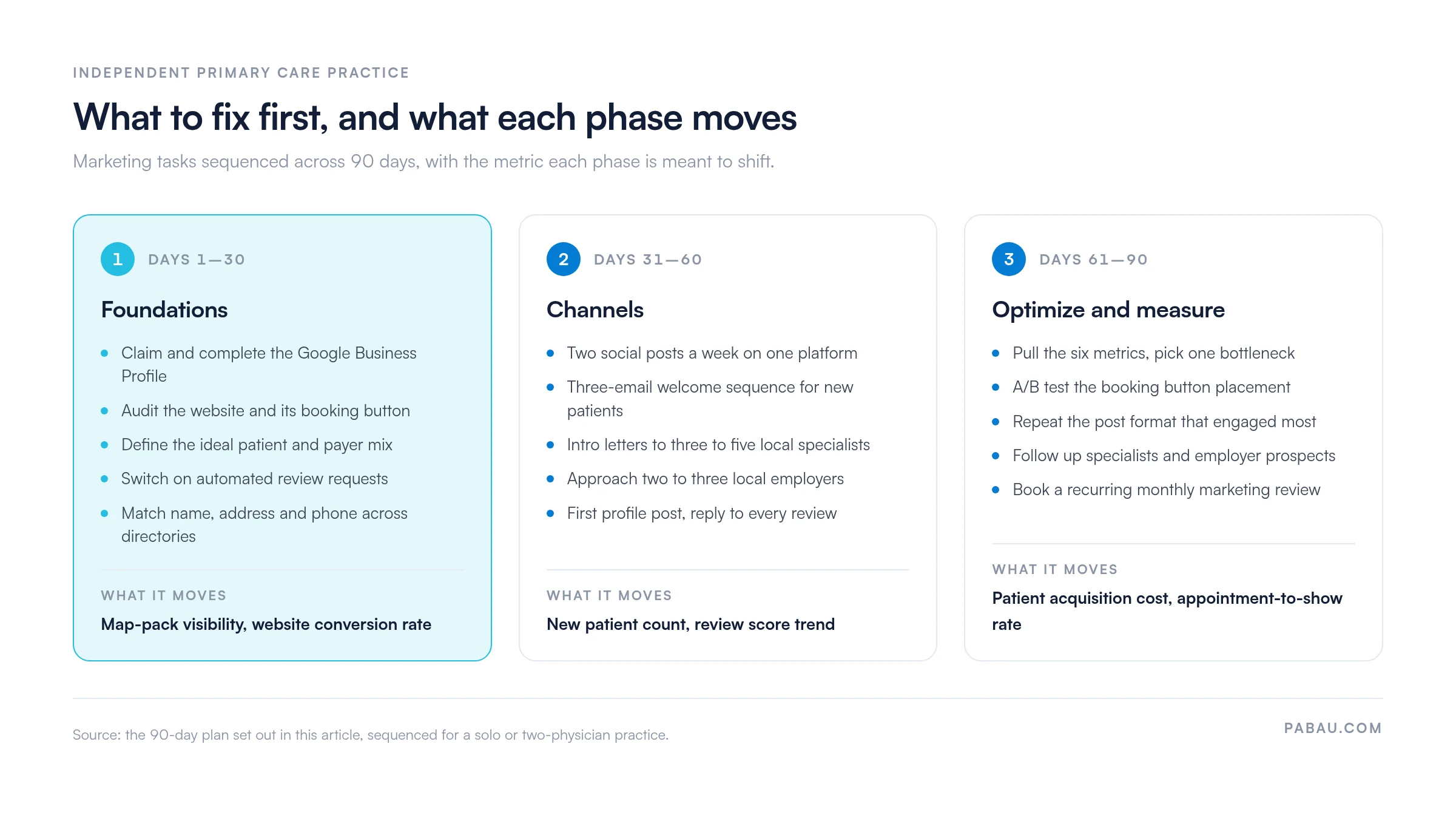
Three actions cost nothing but time. Claim your Google Business Profile and switch on review requests in your practice management system. Then make online booking the main call to action on your website. Those three alone can move new-patient flow inside 30 days.
By day 90 the pattern is clear. Most of this work runs off your appointment book, so your choice of primary care software decides how much stays manual.
Almost every step above is repetitive work. Someone has to remember to ask for the review, spot the patient who is overdue, and check whether last month’s numbers moved. In a busy week, that is the work that slips.
Pabau runs those jobs off the appointment itself. When a visit closes, the review request goes out. When a patient with hypertension passes their follow-up window, a recall message fires without anyone building a list first. The marketing keeps running on the days the practice is busiest.
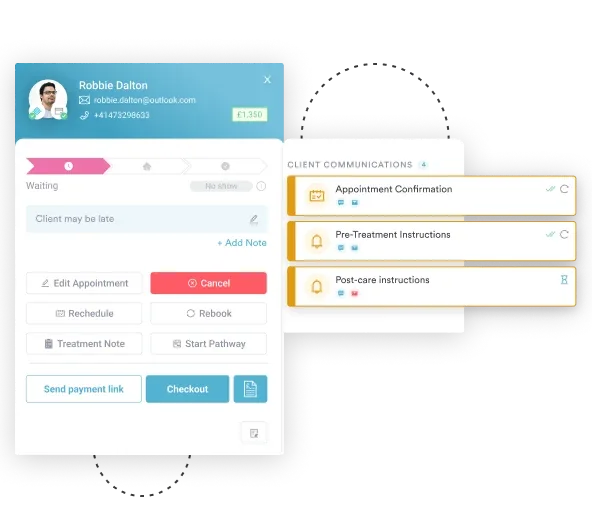
Four parts of the platform do most of the marketing work for a primary care practice:
The result is a marketing plan that survives a busy week. It no longer depends on a staff member finding a free half hour between patients.

Recall campaigns, review requests, online booking, and patient messaging all run off the appointment itself, so your marketing keeps working while you see patients.

The practices that win locally are rarely the ones with the biggest budget. They are the ones whose listing is complete, whose website takes a booking, and whose follow-up happens without being remembered.
So pick the three cheapest actions and finish them this month. A claimed profile and a working booking button make every later channel cheaper, because you stop paying to send traffic somewhere that leaks.
Would you rather the follow-up ran itself? Book a demo and we will walk through the recall, review, and booking workflows built for primary care.

Choosing the system that runs all of this? Best primary care EHR options reviews the platforms independent practices are choosing and what to look for.
Running a direct primary care practice? Direct primary care EHR guide covers the software requirements that make membership management practical.
Opening a practice from scratch? Starting a medical practice walks through the setup decisions that shape your first year of patient growth.
Work backward from what a patient is worth to you rather than copying a percentage. Add up the revenue an average patient brings in a year, then decide what you can pay to acquire one. Track patient acquisition cost monthly and adjust from there.
Local listing work shows first, often within four to six weeks of claiming and completing the profile. Reviews build over a quarter. Referral relationships take six months or more, so start them early and judge them late.
Usually only once the free channels are working. Paid search sends traffic to the same website and the same booking flow, so a leak there costs you twice over. Run ads when your profile, site, and reviews already convert.
Yes. Written HIPAA authorization is required before you publish anything that identifies a patient, including photos, first names, and treatment details. A verbal thank-you is not enough, and a general consent form signed at intake rarely covers marketing.
Reply publicly without confirming the person was a patient, because acknowledging treatment can itself breach HIPAA. Thank them, give a phone number, and move the detail offline. A calm reply reassures the future patients reading it, who are the audience that matters.