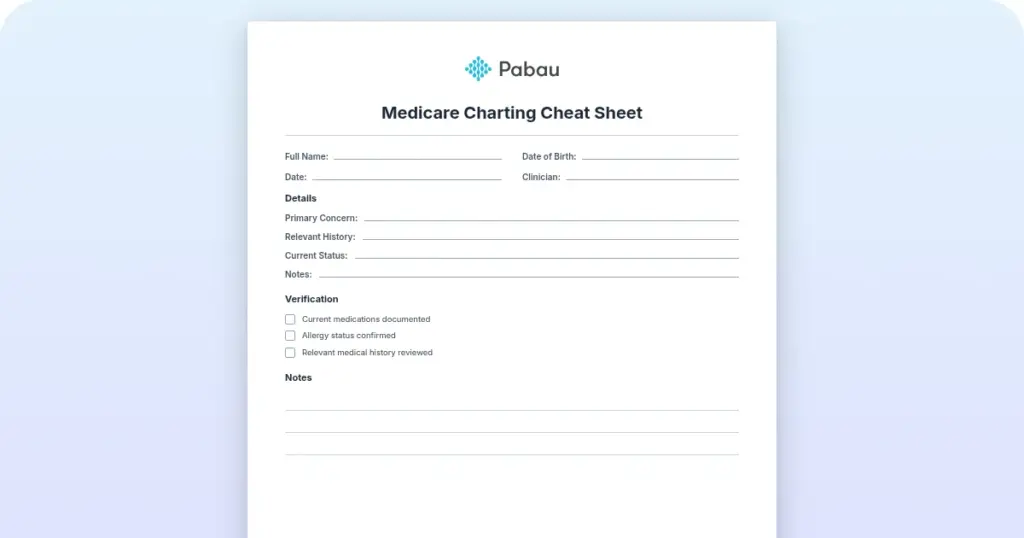
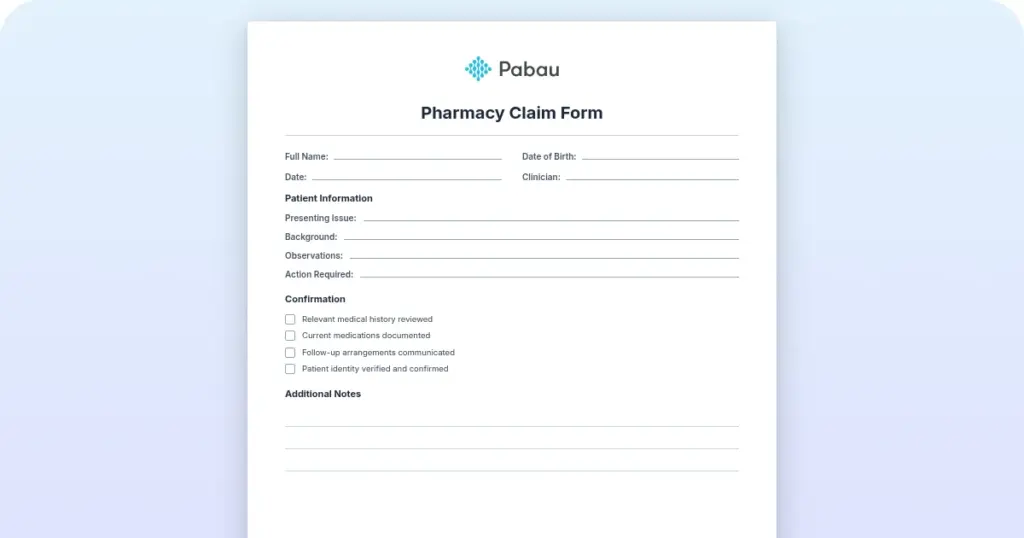
Medicare charting cheat sheet
A Medicare charting cheat sheet is a one-page reference that lists what Medicare...

2
Last Updated: Oct 21, 2026

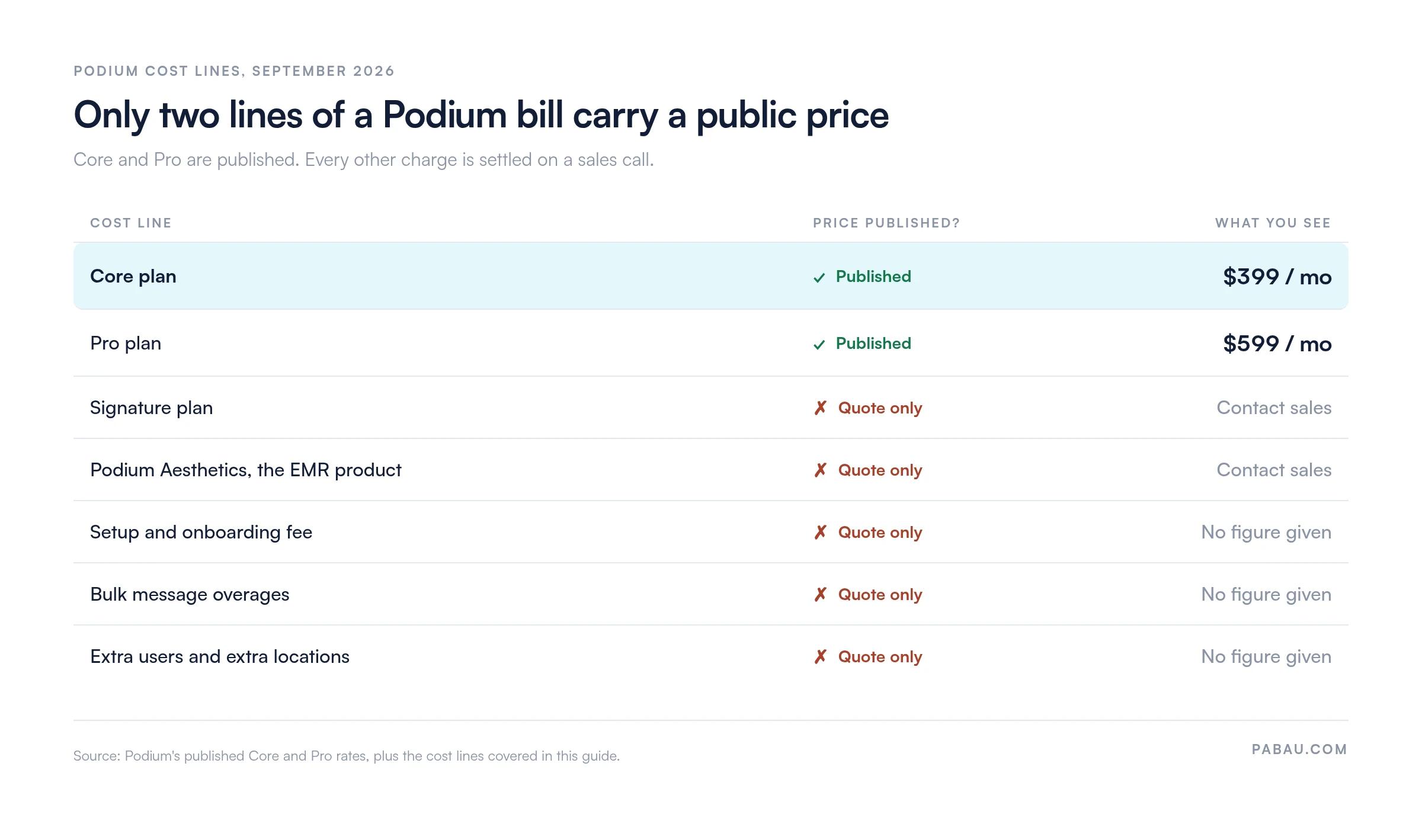
Podium pricing starts at $399 a month for Core and $599 for Pro, both billed on an annual contract.
The Signature plan and Podium Aesthetics, its EMR product for practices, carry no published price at all.
Setup fees, message overages, extra users, and extra locations are settled on the sales call, not on the pricing page.
The $399 and $599 plans cover reviews, messaging, and payments, so records and billing stay a separate line item.
Practice management software like Pabau bundles reviews, messaging, booking, and clinical records from $62 a month.
Podium pricing looks simple until you ask for a quote. Two plans carry a public number, $399 a month for Core and $599 for Pro, and both assume a 12-month contract. The rest of the invoice, from the setup fee to per-location charges, gets settled on a sales call.
That matters if you run a practice, because the figure you compare against your current software is only part of what you pay.
This guide walks through each plan, the add-ons that move the total, the fees buyers report after signing, and the alternatives worth pricing first.
Podium sells three plans. Core and Pro carry published monthly rates, and Signature comes from a sales rep. All three are billed annually, so the monthly figure assumes a 12-month commitment rather than a rolling month.
The differences between the three come down to what each tier unlocks and what it caps.
Core is the entry tier, built for a single-location business. For $399 a month on an annual contract, you get automated Google and Facebook review requests. The plan also covers a unified inbox for two-way texting, text-to-pay collection, and a webchat widget.
Core leaves out AI Employees, Podium’s automated lead responder, along with expanded reporting, multi-location management, and higher message volumes. Those four omissions are the usual reason a business moves up a tier.
Pro adds AI Employees, which answers inbound leads and runs the opening text conversation without a person involved. Multi-location support extends to five sites. The plan suits businesses whose revenue depends on how fast the first reply goes out.
Do the arithmetic before you upgrade. Count the inbound leads you handle in a month, then weigh what a faster first reply is worth against $2,400 a year.
Signature is the enterprise tier, and Podium publishes no price for it. You contact sales and receive a quote. It covers unlimited users, custom integrations, dedicated onboarding, and service-level commitments the self-serve plans leave out.
Four charges sit outside the plan price, and each one scales with how hard you use the platform.
Picture a two-site practice on Core. The plan covers one location and four users. That makes the second site and the fifth staff member add-ons before a single text goes out. Add a recall campaign to 500 patients, and the 250-message allowance is gone by mid-month.
Podium’s published rates cover the plan and stop there. Four other charges surface in buyer reports on Capterra and G2, and none of them sit next to the $399 figure.
Laid out line by line, only two rows of a Podium invoice carry a number you can check before the call.
The pattern is familiar in small business communication tools. The headline rate reads well on the demo, then normal usage grows into it by the third invoice.
The plans above cover the general local-business platform. In 2026 Podium launched Podium Aesthetics, a separate product for practices that adds an EMR, scheduling, intake forms, and charting. Podium publishes no price for it.
So a practice cannot compare Podium on the website at all. The $399 and $599 rates buy reviews, messaging, and payments. The clinical product is quoted, which means your number depends on a call you have not had yet.
Compliance belongs on that same call. Any tool carrying patient messages in the US sits inside your HIPAA obligations. Confirm in writing whether Podium will sign a Business Associate Agreement for your account. Marketing language is not a substitute for that document.
On the general plans, a practice still runs separate systems for:
Price those subscriptions alongside the $399, and a small practice can end up paying twice to move one patient through one visit.
If you run a practice, ask which Podium product your quote covers. Core and Pro are rates for the general platform, while Podium Aesthetics is quoted separately. Two sales calls can produce two very different numbers for the same practice.
For a busy local business with no clinical side, usually yes. Podium holds 4.3 out of 5 on Capterra and 4.6 on G2 across thousands of reviews. Reviewers praise review generation that works, an inbox that speeds up lead response, and payments that make collecting money easier.
The complaints are just as consistent. The price is steep for a single job, add-ons lift the monthly total, and the annual term frustrates businesses whose needs change mid-contract.
Podium earns its rate in three situations:
It fits less well where the work is clinical. A practice needs scheduling, documentation, consent, and billing to move together, and the published plans cover none of that.
Three platforms come up most often against Podium, and each aims at a different budget.
Birdeye is the closest match. It chases the same multi-location local business audience with comparable review and messaging tools, and buyers describe its pricing as more flexible. Our Birdeye vs Podium comparison sets the two side by side.
NiceJob and Broadly aim lower. Both suit home services and trades where review generation is the whole job and the budget is tighter than Podium allows. Neither matches Podium on feature depth.
If none of the three fits, our roundup of Podium alternatives covers the wider field. Our software comparisons for practices line up the platforms a practice usually shortlists.
Most of the surprise in software pricing comes from questions nobody asked on the demo. Work through these five before you commit:
Two mistakes come up again and again. The first is comparing one Podium plan against one competitor plan, when the honest comparison is monthly spend across every tool each option replaces.
The second is treating a quote as negotiable on price alone. Message allowances, seat counts, and onboarding terms often move more easily than the rate does.
Most practices pricing up Podium already pay for a booking system and a records system. Podium sits on top of both, which is why the monthly total climbs faster than the plan rate suggests.
Pabau, practice management software built for medical and aesthetic practices, runs that patient journey from one place. Booking, clinical notes, consent forms, payments, and online reputation management share one record, from $62 a month. Every subscription includes every feature, so there is no tier to climb to switch review requests on.
Recall and reminder work runs the same way. SMS and email campaigns pull from the patient list your calendar already uses, so a follow-up knows which treatment the patient had and when. Pabau holds 4.7 out of 5 on Capterra from more than 600 verified reviews.


Pabau brings review requests, patient messaging, online booking, clinical notes, and billing into a single system built for medical and aesthetic practices. See what you could stop paying for twice.

Podium’s published price answers a smaller question than the one you are asking. That $399 buys reviews, messaging, and payments for one location, which is fair value for a business whose work ends at the counter.
A practice is the harder case. The clinical product carries no public price, and the general plans leave records and billing untouched. The charges you cannot see are the ones that move the total. Get every figure in writing, then compare full stacks rather than plan against plan.
If that comparison ends with two subscriptions doing one job, it is worth fixing. Book a demo to see how Pabau runs reviews, messaging, booking, and patient records on a single bill.

Still weighing up who else does this job? Podium alternatives ranks the platforms practices shortlist most often, with what each one costs.
Looking at Birdeye as the safer swap? Birdeye alternatives covers the same market at several price points, including options built for healthcare.
Comparing Podium against a retail-first tool? Clientbook vs Podium shows how the two differ on messaging, follow-up, and who each one was designed for.
Wondering where Pabau sits in the field? Pabau competitors and alternatives gives an honest read on the trade-offs before you book a demo.
Yes, in most cases. Podium quotes through a sales rep rather than a checkout page. The rate, the setup fee, and the message allowance are all open before you sign. Prepaying a 12-month term is the usual lever. Ask for any concession to appear in the contract, not just on the call.
Podium’s integrations are built around general business tools such as CRM and point-of-sale systems. It publishes no broad EMR or EHR connector for medical and aesthetic practices. Its own clinical product, Podium Aesthetics, is sold separately from the Core and Pro plans and carries no published price.
Both. Each plan caps the number of users and the number of locations, so the bill rises when you pass either limit. Core covers up to four users and one site. Podium does not publish the rate for an extra seat or an extra location, so ask for both figures.
Podium’s published rates are monthly figures on a 12-month agreement, so the standard offer is annual rather than rolling. Reviewers report a penalty for ending a term early. If you want month-to-month billing, raise it before signing and check the notice period for renewal.