3 Hour Glucose Test Results Chart
A 3 hour glucose test results chart lists the cutoff for each blood draw in the ...

1
Last Updated: Oct 14, 2026

Clientbook is a clienteling app built specifically for jewelry and luxury retail stores.
Podium is a broader local business platform covering messaging, review generation, and payments.
Only one of nine compared capabilities sits fully on both platforms, so the two rarely compete.
Clientbook leads on clienteling depth, while Podium leads on reputation and multi-channel messaging.
Practice management software like Pabau suits practices that need scheduling, client records, and communications together.
Most retail and local business owners shopping for clienteling and customer communication software narrow the shortlist to two tools. Clientbook and Podium both handle customer outreach and follow-up, yet they serve different use cases.
Clientbook was built for jewelry and luxury retail associates who need deep clienteling. That means purchase history, wish lists, occasion reminders, and in-store follow-up workflows. Podium was built for local businesses that need review generation, multi-channel messaging, and text-to-pay in one inbox. Its customers include auto dealers, dentists, retailers, and service firms.
The two products share less ground than a shortlist of two usually implies. Of the nine capabilities compared below, one sits fully on both platforms. So the right answer depends almost entirely on which problem you are trying to solve.
This guide compares both platforms on features, pricing, reviews, and use case fit. It also introduces practice management software like Pabau as a third option for wellness and aesthetic practices.
Clientbook is a clienteling app designed for jewelry stores and luxury retail environments. It helps sales associates build lasting relationships with high-value customers through structured follow-up, detailed purchase records, and personalized outreach.
Clientbook’s narrow focus is both its strength and its limitation. It does the job well for jewelry retailers, but it offers little to businesses outside that vertical.
Podium is a customer communication and reputation management platform targeting local businesses across a wide range of industries. Where Clientbook is vertical-specific, Podium is horizontal, serving auto dealerships, dental practices, legal firms, home services companies, and retailers.
Podium’s breadth means it covers many use cases adequately. What it lacks is the deep clienteling workflow a jewelry retailer needs.
Here is a side-by-side look at how the two platforms compare across the dimensions that matter most to retail and local business buyers.
Clientbook is the clear winner on clienteling. Its associate-facing workflows let staff log every customer interaction and track the items a customer is interested in. Automated prompts then tell an associate to follow up before an anniversary or a special occasion. That structure suits high-ticket, relationship-driven retail selling.
Podium has no equivalent. It stores contact records and conversation history in its inbox, and that is where the depth stops. There is no wish list feature, no occasion-based reminder engine, and no structured follow-up workflow for associates. For a jewelry retailer, that absence decides the comparison.
Both platforms offer two-way SMS, so the difference is breadth and context. Podium’s unified inbox aggregates messages from SMS, website chat, Facebook Messenger, and Google Business Messages. That makes it useful for a business fielding leads from several channels at once.
Its campaign tooling is mature too, with bulk messaging, keyword automations, and drip sequences behind it.
Clientbook’s messaging is narrower. It covers SMS conversations between an associate and one customer, tied closely to that customer’s profile. You can see a purchase history while texting, which is useful context on the shop floor. What Clientbook lacks is webchat, social channel integration, and bulk campaign tooling.
Podium’s reputation management is one of the main reasons local businesses choose it. Automated post-interaction review requests drive Google review volume. The platform also monitors reviews across sites and surfaces them in one dashboard. Where Google star ratings influence foot traffic, that advantage shows up in bookings.
Service businesses already running a practice system often get the same outcome from built-in automated reputation management, without paying for a second subscription.
Clientbook does not offer review management, and it never claimed to. A jewelry store that wants to grow its Google review count needs a separate tool for it, or Podium alongside Clientbook.
Podium Payments lets businesses send payment links by SMS, so a customer can pay from their phone. There is no portal to log into and no card number to read out. It suits service businesses collecting a balance once the work is finished. Podium’s product pages list it as a named feature rather than an integration.
Clientbook has no equivalent payment feature. Jewelry retailers usually take payment through their point-of-sale system, so the omission may not matter day to day. For a buyer judging both tools on commerce functionality alone, Podium wins.
Pricing for both platforms takes a conversation with their sales teams. Neither Clientbook nor Podium publishes detailed prices. Here is what is known from public sources and reviewer commentary.
Podium’s pricing comes up often in reviews as a concern for small and mid-sized businesses. Reviewers on G2 and Capterra say the platform can feel expensive for a business that only needs one or two of its features.
Clientbook pricing is discussed far less publicly. It is a specialist tool for one vertical, so the per-location model is probably calibrated for jewelry retail budgets.
G2 reviewers rate Clientbook 4.8/5, which reflects satisfaction among the audience it was built for. Trustpilot reviewers give Podium 4.1/5 from 356 reviews. Contract flexibility and pricing are the pain points they raise most.
Clientbook’s 4.8/5 on G2 reflects a tight product-market fit. The people using it are the people it was built for. It has no verifiable Capterra listing, so its G2 score is the only figure worth quoting.
Podium’s scores spread wider because its buyer base does too. Reviewers who run Podium across several channels tend to rate it highly. Businesses using one feature find the price harder to justify.
Clientbook is the right buy for jewelry and luxury retailers whose repeat sales depend on associate relationships. If your business matches the profile below, it is the stronger of the two.
If you run a jewelry store and nobody follows up after a purchase today, Clientbook gives you the system for it straight away. The in-store workflow is simple enough for any associate to adopt without a long learning curve.
Podium suits local businesses with a broader communication challenge rather than a clienteling one. It works best where volume matters. That means many customers, several inbound channels, and pressure to grow the Google review count.
There is a caveat. Podium’s value compounds as you use more of it. If you only need review generation, the pricing can feel steep. The businesses that get the most from it run the inbox, reviews, and payments together.
For jewelry retailers, the choice comes down to which problem is most urgent. The trade-off is clienteling depth against reputation management breadth.
Some larger jewelry retailers run both tools side by side, because the feature sets barely touch. Clientbook handles the associate-customer relationship, and Podium handles inbound communication and reputation. The chart below shows how little the two actually share.
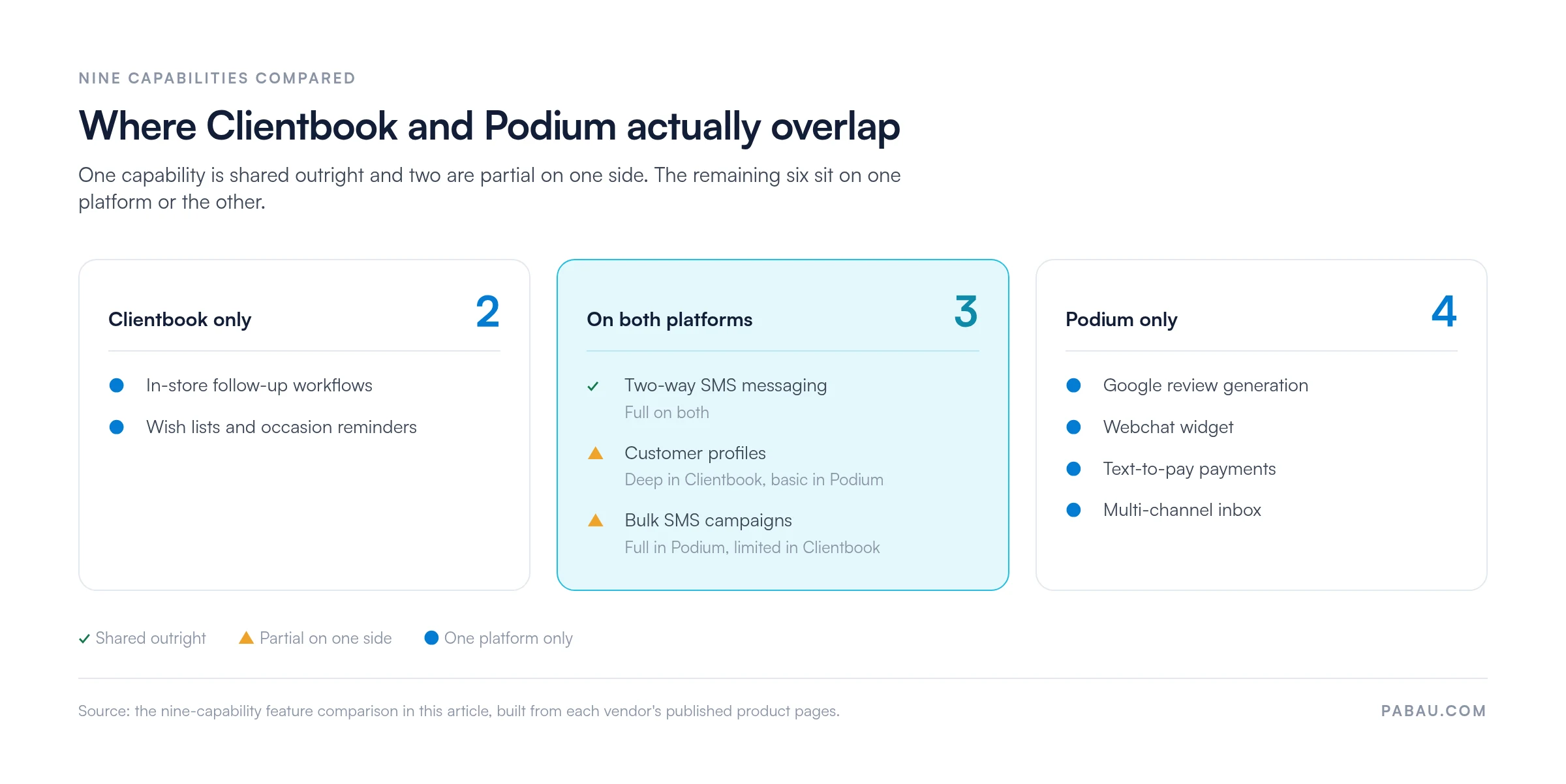
Run a 30-day test before you buy. Count the follow-ups you missed with existing customers, then count the months you went without new Google reviews. Whichever number looks worse tells you which tool to prioritize. If both look bad, the two platforms complement each other rather than compete.
Neither Clientbook nor Podium was designed for healthcare or wellness practices. If you run a med spa, aesthetic clinic, or wellness practice and ended up comparing these two tools, Pabau is worth a look instead.
Pabau is an all-in-one practice management platform. It brings scheduling, detailed client records, automated follow-ups, and reputation tools into one system. That replaces a clienteling app running alongside a separate messaging tool.
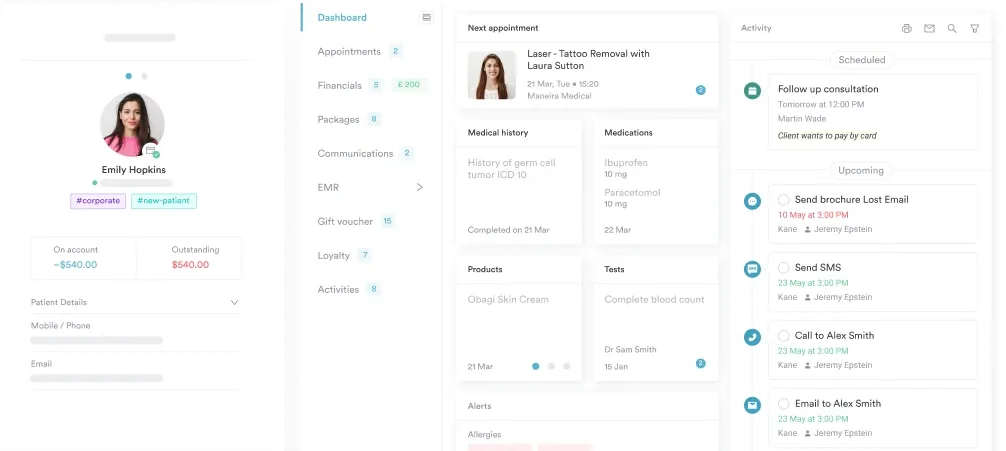
Podium sells reputation management as a standalone product, and Clientbook sells clienteling for retail. Pabau embeds both jobs in a full practice workflow. Automated post-appointment review requests go out without manual setup, and client profiles hold consultation notes, treatment history, and preferences next to the appointment record.
Email and SMS campaigns cover the outreach side, so recall reminders and post-treatment check-ins go out on schedule rather than when someone remembers. Our side-by-side platform comparisons show where Pabau lands against other tools in the wellness space.

Every subscription includes every feature, so the reputation tools and the campaign tools are not locked behind a higher tier.
Pabau is rated 4.6/5 from 557 reviews on Capterra. Contact sales for a custom quote, since the subscription scales with your location count and team size.
It suits a practice that has outgrown running client relationships across disconnected systems. Structured onboarding gets the setup right before you rely on it.

Pabau brings scheduling, client records, automated follow-ups, and reputation management into one platform for aesthetic and wellness practices. One system instead of three.

Clientbook and Podium are easier to choose between than most head-to-head software pairs, because they solve different problems. If associate relationships drive your repeat sales, Clientbook is the better buy. If your growth depends on reviews, inbound messages, and getting paid by text, Podium is.
The trade-off worth remembering is that neither tool covers the other’s ground. Buy one and you accept that the other problem stays unsolved. Buy both and you pay two subscriptions for two mostly separate jobs.
If neither profile fits, and you run a practice or wellness business, Pabau was built for that context. Book a demo to see how it handles client records, automated follow-ups, and reviews in one system.

Wondering which platforms actually compete with Pabau? Pabau competitors and alternatives walks through the tools practices shortlist most often and where each one fits.
Weighing a marketing tool against a full practice system? Pabau vs Mailchimp shows what changes when client communication runs inside the client record.
Looking at med spa platforms at the multi-location end? Zenoti competitors covers the alternatives larger groups weigh up before they commit.
Clientbook is a clienteling app built for jewelry and luxury retail stores, focused on customer profiles, wish lists, occasion reminders, and associate follow-up workflows. Podium is a customer communication platform for local businesses, focused on review generation, multi-channel messaging, and text-to-pay. They solve different problems and can be used together without much overlap.
For clienteling specifically, yes. Clientbook’s wish lists, occasion reminders, and purchase history tracking are purpose-built for jewelry retail in a way Podium is not. If a jewelry store also wants to grow its Google review count, Podium covers that job. It does not replace Clientbook’s core associate-client relationship tools.
No. Podium stores basic contact records and conversation history. It has no wish list feature, no occasion-based reminder engine, and no structured in-store follow-up workflow. Businesses that need clienteling depth should use Clientbook or an equivalent specialist tool.
Neither platform publicly discloses pricing. Podium is frequently cited in G2 and Capterra reviews as expensive relative to small business budgets, with annual contracts that include lock-in clauses. Clientbook pricing is less discussed publicly. Both require a sales conversation to receive a quote.