Health appraisal form
A health appraisal form is a record a licensed provider signs to document someon...

2
Last Updated: Oct 13, 2026

Birdeye fits multi-location enterprises, while Podium is built for SMS-first local service businesses.
Birdeye monitors reviews across more than 200 sites, and Podium concentrates on Google and Facebook.
Neither vendor publishes a rate card, so both quote by location count and feature tier.
Both need a separate practice management system to trigger a review request after an appointment.
Healthcare and wellness practices can automate review requests inside practice management software like Pabau.
Birdeye and Podium both collect reviews and handle customer messaging, but they are built for different buyers. Birdeye serves multi-location enterprises managing reputation across hundreds of branches. Podium serves local service businesses that want to convert leads and gather reviews over SMS.
If you are choosing between them for a healthcare or wellness practice, a third question matters more than either feature list. Neither platform knows when a treatment finished, so a second system has to tell it.
Birdeye is a reputation and customer experience platform used by multi-location businesses and enterprise brands. Its core strength is review management at scale. The platform monitors reviews across more than 200 sites. It also sends automated requests, handles responses, and tracks sentiment by location from one dashboard.
Beyond reviews, Birdeye offers webchat, social media messaging, and business listing management. According to Capterra, Birdeye holds a 4.7/5 rating from 657 verified reviews. Users frequently cite strong Google review integration and responsive support. The platform suits franchise groups, multi-location retailers, and healthcare networks that need centralized reputation oversight.
Podium is an SMS-first customer communication and review platform designed for local service businesses. Its primary use case is simple. Send a text after a service visit, and turn the reply into a Google or Facebook review. The unified inbox pulls SMS, webchat, and social messages into one view, which helps small teams work without juggling apps.
Podium’s strength is ease of use. Businesses can get review requests flowing within hours of signing up, and onboarding is light. Capterra reviewers give Podium a 4.3/5 rating from 477 reviews, praising the clean inbox and the straightforward SMS tools. The platform suits single-location service businesses, dental practices, auto shops, and similar local operators.
Review management is where Birdeye and Podium diverge most. Birdeye’s breadth is its main advantage. It monitors and generates reviews across more than 200 platforms, including Google, Facebook, Healthgrades, Zocdoc, and industry directories. Automated request sequences run across several channels, and one dashboard reports review data for every location.
Podium takes a narrower but faster approach. Review generation focuses on Google and Facebook, and SMS is the delivery method. Because most requests arrive by text, response rates tend to beat email-based systems. For a single-location practice that wants Google review volume, that simplicity is a genuine advantage.
Both platforms support automated review requests, but neither ties review generation to a clinical event on its own. For a healthcare business, that means integrating a separate practice management system, then maintaining it.
Podium’s messaging product is its strongest feature. The unified inbox consolidates SMS, webchat, and Facebook Messenger into a single view, and the SMS tools are polished. For local businesses handling inbound leads by text, the path from first message to booked appointment is short.
Birdeye covers more channels, supporting SMS, webchat, social media direct messages, and video chat on some plans. The tradeoff is complexity. Running omnichannel messaging across dozens of locations takes more operational lift. Enterprise teams with dedicated marketing or operations staff can absorb that. Smaller teams often cannot.
Birdeye includes business listing management, covering Google Business Profile, Facebook, Yelp, and dozens of other directories. Changes made in Birdeye push out to connected listings automatically, which saves time for brands running hundreds of location profiles. Listing accuracy feeds local search rankings, so central management reduces the risk of inconsistent details.
Podium’s listing management is more limited, since the platform concentrates on review generation rather than directory coverage. A business that needs active syndication across 50 or more directories will find Birdeye more comprehensive.
Birdeye’s reporting is one of its clearest enterprise differentiators. The dashboard shows review volume, average rating trends, sentiment analysis, and competitive benchmarking, at both location and group level. Multi-location operators can see which branches are falling behind and investigate the pattern across the group.
Podium’s analytics cover the basics, namely review count, rating trends, and messaging performance. For a single-location business, that is enough. Past three or four locations, Birdeye’s reporting depth pulls clearly ahead.
Birdeye integrates with a wide range of third-party applications, including CRM platforms, practice management systems, and point-of-sale tools. That breadth matters to enterprise buyers who need Birdeye to pull customer data from an existing system and trigger review requests automatically.
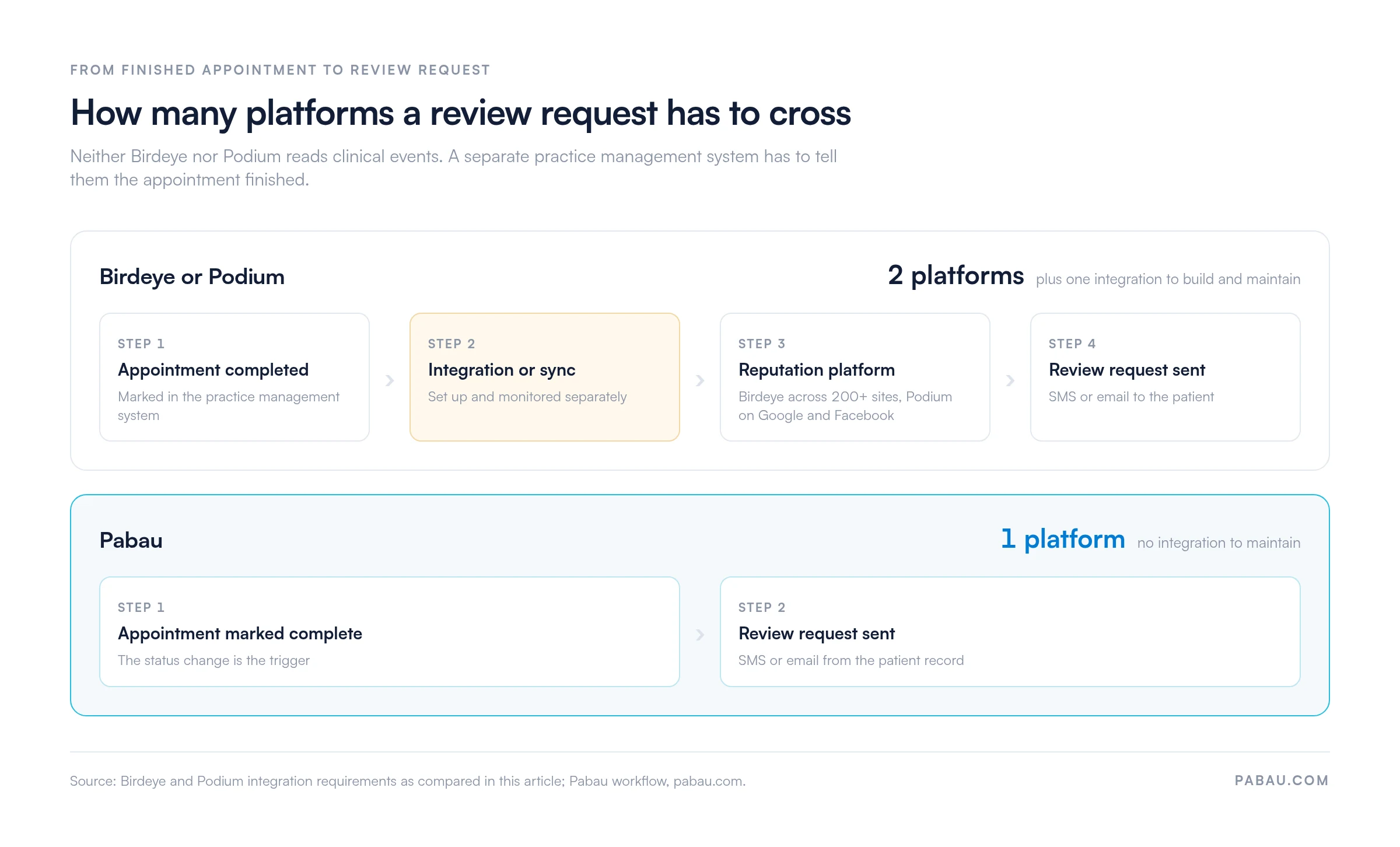
Podium connects to CRMs, POS systems, and selected practice management tools, with a smaller library aimed at its SMB market. Either way, a healthcare business runs the review workflow through a second system. The appointment lives in the practice management system, and the request goes out from the reputation platform. The chain below shows what that adds.
Neither Birdeye nor Podium publishes pricing on its website. Both quote by deal, and cost scales with location count, feature selection, and contract length. G2 reviewers describe Birdeye as expensive for small businesses, and more competitive at multi-location scale. Contract lock-in comes up often.
Podium is quote-based too. G2 reviewers report price increases at renewal, and note that key features sit in higher tiers. A single-location business can get reasonable value from the core SMS and review tools. Add multi-location coverage or deeper analytics and the cost climbs quickly.
Birdeye’s key strength is scale. It is built for organizations managing reputation across many locations, and the reporting, listing management, and review tools work together at that size.
Podium’s strength is simplicity and speed to value. Local service businesses can get SMS review requests running quickly, and the unified inbox reduces friction across channels.
Sending fewer than 500 review requests a month across one or two locations? Podium’s setup speed and SMS focus will likely get you there faster. Run a three-month pilot before signing a long-term contract on either platform.
Choose Birdeye when reputation management has to run at scale, across many locations, with data flowing into one reporting view. The breadth of review site coverage, listing management, and analytics depth justifies the higher price for that buyer.
Choose Podium for a local, single-location service business where speed matters more than reporting depth. If the goal is more Google reviews with minimal setup, the SMS-first approach gets there faster than most alternatives.
The decision comes down to business type and scale. Birdeye suits large multi-location organizations that need enterprise reputation management, listing syndication, and analytics across hundreds of sites. Podium suits single-location local businesses that want fast, SMS-driven review collection with little setup. Our side-by-side platform comparisons cover the same ground for other practice tools.
For a healthcare or wellness practice, both platforms need a separate practice management system to link review workflows to clinical events. That extra layer costs money and setup time, which is worth weighing before you sign.
Healthcare and wellness practices have a specific problem that neither Birdeye nor Podium solves on its own. A review request works best when it goes out the moment a treatment is marked complete. That timing depends on data that already sits in the patient record.
Pabau is practice management software for healthcare and wellness practices, and it treats the review request as part of the appointment. When a treatment is marked complete, the request goes out by SMS or email. There is no second integration to maintain, and no patient data living in two systems.
The same platform holds clinical notes, consent forms, scheduling, and the reputation workflow. For multi-location groups, reporting, staff management, and patient records roll up to group level. Pricing starts at $62/month for one user and is published, unlike the quote-only models of Birdeye and Podium.

According to Capterra reviewers, Pabau holds a 4.7/5 rating from 600+ verified reviews. Praise centers on the combination of clinical and reputation management, and on onboarding support. For med spa software specifically, the native review automation removes the need for a standalone reputation tool.
Weighing Pabau against other clinical platforms? Our roundup of Pabau alternatives covers the main options and the practice type each one suits.

Pabau links automated review requests, patient messaging, and clinical records in one workflow. No separate reputation platform to integrate or maintain.

Reputation tools only pay off when the request reaches the patient at the right moment. Birdeye and Podium both do that well inside their target markets, and neither was designed around a clinical calendar.
If you run one or two locations and want Google reviews quickly, Podium is the shorter route. If you run a large multi-location group and need directory coverage and group reporting, Birdeye earns its price.
For a healthcare or wellness practice, the question is whether a second platform is worth maintaining at all. Book a demo to see how Pabau sends review requests straight from the appointment record.

Weighing Pabau against other platforms? Pabau competitors and alternatives sets out the main options and the practice type each one suits.
Comparing wellness and med spa platforms? Zenoti competitors reviews the software groups shortlist alongside a reputation tool.
Want the rest of our head-to-head breakdowns? Pabau comparison hub puts the most common practice platforms side by side.
Birdeye is an enterprise reputation platform built for multi-location businesses needing review management across 200+ sites. Podium is an SMS-first tool designed for single-location local businesses that want Google and Facebook reviews quickly by text. Birdeye offers more depth and scale. Podium offers simpler, faster setup.
Birdeye does not publish pricing publicly. Costs are quote-based and scale with the number of locations and features required. G2 and Capterra reviewers consistently describe Birdeye as expensive for small businesses. Pricing becomes more competitive at enterprise scale.
Yes, for single-location local service businesses, Podium generally offers a simpler and cheaper entry point. Its SMS-first review requests are quick to set up and tend to generate strong response rates. Birdeye’s deeper features and pricing model make more sense for multi-location organizations.
Birdeye is purpose-built for multi-location management. It offers centralized reporting, listing syndication, and review monitoring across all branches from a single dashboard. Podium’s multi-location capabilities are more limited at scale, as noted in user reviews on G2 and Capterra.
Birdeye’s main competitors include Podium, Reputation.com, and Yext in the reputation and local SEO space. For healthcare and wellness practices, Pabau is a purpose-built alternative. It combines review automation, patient messaging, and clinical management in one platform.