Birdeye alternatives range from all-in-one practice platforms to specialist review tools, so the right fit depends on your size, budget, and HIPAA needs.
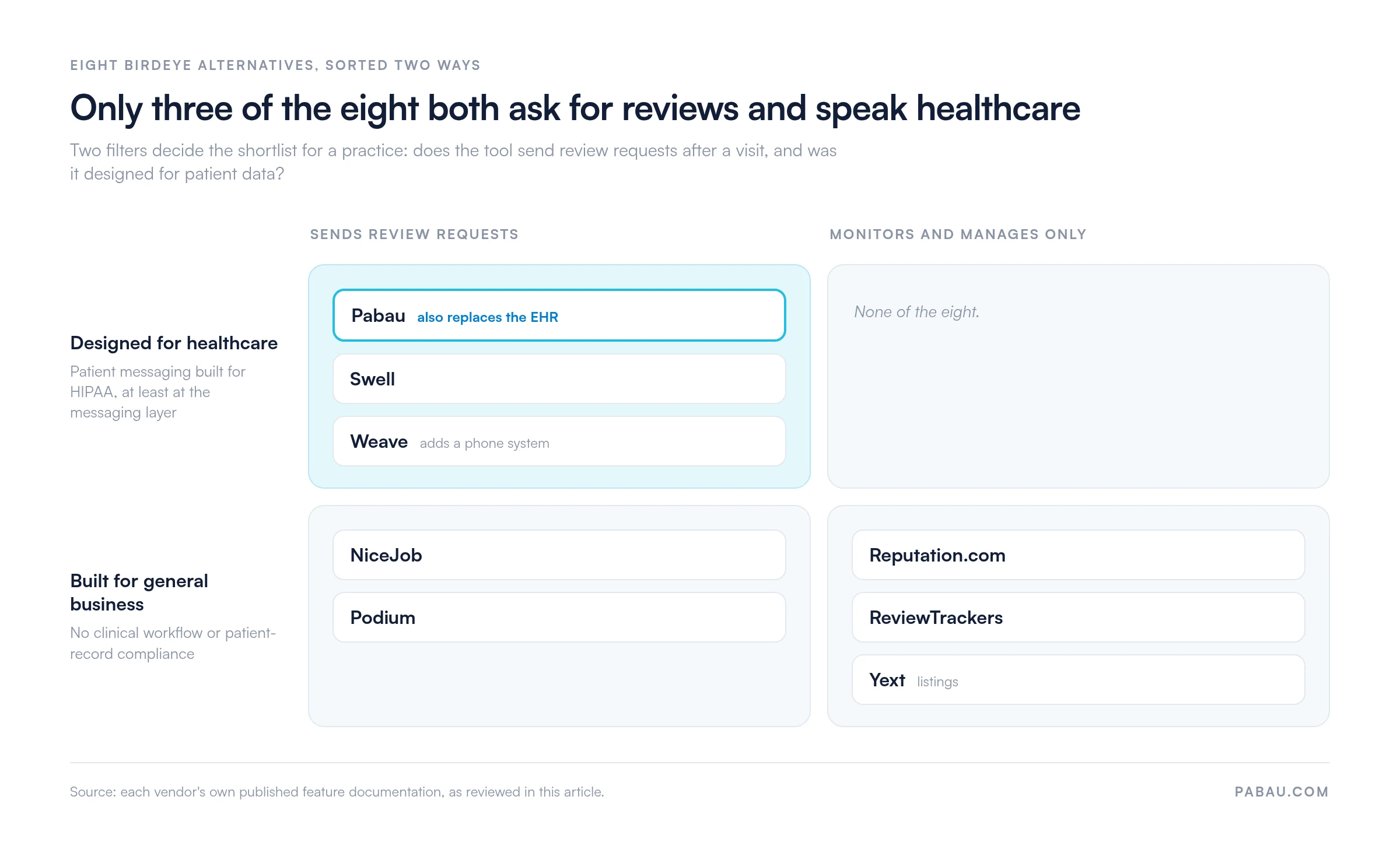
Only three of the eight both send review requests and were designed for patient data: Pabau, Swell, and Weave.
Pabau is the only option here that combines review automation, patient messaging, clinical records, and scheduling in one platform.
Most practices running Birdeye alongside their EHR are paying twice for overlapping functionality. Birdeye handles reputation and messaging. The EHR handles records and scheduling. Neither talks to the other without an API setup that someone has to maintain.
For a busy practice owner, that means two logins, two support lines, and two renewal cycles. Review requests fire from an integration webhook rather than from the appointment itself. When that webhook fails, review automation stops until somebody notices.
The Birdeye alternatives market has matured. You can now choose between review-only tools, dental communication platforms, listing managers, and all-in-one practice platforms. This guide covers eight of them, ranked by fit for healthcare and aesthetic practices. The ranking follows two filters: review generation and healthcare design.
Found our content helpful?
The eight options compared at a glance
Eight tools, one table. Use this to shortlist before reading the full reviews below.
Name
Best for
Standout feature
Starting price
Rating
Pabau
Healthcare and aesthetic practices
All-in-one review automation, EHR, and scheduling
Depends on location and user count. Book a demo for a quote.
4.7/5 (600+) on Capterra
Swell
Healthcare review automation on a budget
Healthcare-friendly review automation with messaging
Contact sales
4.7/5 (175+) on Capterra
Weave
Dental and medical phone-centric practices
Phone system and review management combined
Contact sales
4.4/5 (390+) on Capterra
NiceJob
Small businesses on a tight budget
Simple automated review requests by email and SMS
From $75/month
4.9/5 on Capterra
Podium
Local businesses and SMS marketing
SMS-first review collection and webchat
Contact sales
4.3/5 (500+) on Capterra
Reputation.com
Enterprise and multi-location brands
Deep analytics and competitive benchmarking
Contact sales
3.9/5 (95 reviews)
ReviewTrackers
Analytics-first multi-platform monitoring
Aggregated review dashboards across 100+ sites
Contact sales
4.6/5 (130+) on Capterra
Yext
Listings and local SEO management
200+ publisher network for listing syndication
Contact sales
2.8/5 on Trustpilot
Why healthcare practices outgrow Birdeye
Birdeye is a capable reputation platform, but it was built for local businesses broadly rather than for healthcare. Four friction points come up repeatedly when practice owners test it against their own workflows.
Two-system cost: Birdeye sits on top of your existing EHR or practice management software. That means two subscriptions, two data syncs, and review requests that depend on an API integration. When the integration breaks, review automation stops.
Per-location pricing: Birdeye prices by location for multi-location businesses. A practice group with five sites can watch costs compound quickly, especially when each location needs its own dashboard configuration.
Healthcare-specific limits: Birdeye offers HIPAA-compliant messaging, but that compliance covers the messaging layer rather than the clinical record. Practices still need a separate compliant system for patient data, which undercuts the efficiency argument.
Integration dependency: triggering review requests from appointment completion requires an integration with your PMS. The setup takes time, and any PMS update can break it. A native platform removes the dependency.
None of that makes Birdeye a weak product. It makes it a layer sitting on top of a system that already knows when the appointment finished.
1. Pabau: best Birdeye alternative for healthcare practices
Rating4.7/5★★★★★Top pick
The bottom line
Review requests fire from the appointment record itself, so there is no integration to keep alive.
Who it’s for
Aesthetic and medical practices replacing an EHR plus a reputation tool
Multi-location practice groups needing consolidated reporting
Practices that want one HIPAA boundary rather than two
Anyone paying for Birdeye on top of a PMS
PricingQuote-basedscales by location and user count
Review requests trigger natively from appointment completion
Messaging carries the patient's treatment context
Every subscription includes every feature
What doesn’t
More platform than a non-clinical business needs
The breadth of functionality means a learning curve
Pabau is a practice management platform built for healthcare and aesthetic practices. It handles scheduling, clinical records, billing, patient messaging, and review automation in one system. There is no separate reputation tool to configure or maintain.
The difference from Birdeye is where the trigger lives. When a patient’s appointment is marked as finished, Pabau sends the review request automatically. There is no webhook, no API integration, and no third-party trigger. Birdeye needs your EHR to push it a signal first.
Key features
Native review automation: appointment-triggered review requests by SMS and email, with no integration required
Patient messaging: two-way SMS and email tied to the patient’s appointment history and clinical record
HIPAA-compliant data handling: covers the full clinical record and communication layer, not only the messaging interface
Multi-location support: consolidated dashboards, location-level reporting, and unified patient records across sites
Built-in EHR and scheduling: clinical notes, consent forms, before-and-after photos, online booking, and calendars
SMS and email campaigns: recall campaigns, targeted promotions, and post-treatment follow-ups
Online booking and client portal: patients self-book and manage appointments without staff intervention
Reporting and analytics: revenue, appointment, and patient retention reports across all locations
Where Pabau shines
Removes the two-system problem: practices running Birdeye alongside an EHR pay two subscriptions and maintain one integration. Pabau replaces both with a single platform.
Zero-configuration review automation: requests fire from appointment data that already exists in the system. No setup, no webhook monitoring, no integration maintenance.
Clinical context in messaging: a post-appointment message can name the treatment the patient just had. Birdeye only knows that if the integration passes the data through.
Multi-location with clinical operations: Birdeye’s multi-location dashboard is reputation-focused. Pabau adds room scheduling, staff timesheets, inventory, and clinical records across every site.
Where Pabau falls short
Not a standalone reputation tool: Pabau is a full practice platform. If you only want review management for a non-clinical business, it is more than you need.
Learning curve: reviewers note that the breadth of functionality takes new users time to work through.
Customer reviews
“Pabau has transformed how we manage patient reviews. The automated follow-up after each appointment has increased our Google review count significantly without any extra work from the team.” (Verified Capterra reviewer, 5 stars)
According to Capterra, Pabau holds a 4.7 out of 5 rating from over 600 verified reviews. Reviewers highlight the all-in-one platform and the responsiveness of the support team.
Who Pabau is best for
Aesthetic and medical practices that want to replace their EHR and their reputation tool with one platform
Multi-location practice groups that need consolidated reporting across sites
Practices managing HIPAA-sensitive patient data that want one compliance boundary rather than two
Practices currently paying for Birdeye on top of a separate practice management system
Pricing
Plan / Tier
Price
Details
Starter
Book a demo for a quote
Pricing depends on location and user count
Team / Group
Scales by location and user count
Volume-based pricing
Enterprise
Custom pricing
Contact sales for a quote
Pabau publishes no flat monthly figure, because pricing scales with your location count and user count. The demo ends with a quote for your own setup, and every subscription includes every feature.
2. Swell: best for healthcare review automation on a budget
Rating4.7/5★★★★★
The bottom line
A healthcare-positioned review tool that costs less than Birdeye and stops short of clinical records.
Less analytical depth for multi-location benchmarking
Swell is positioned as a healthcare-friendly review and messaging platform, which makes it one of the more targeted Birdeye alternatives for clinical settings. It automates review requests by SMS and email after an appointment, and it includes a patient messaging inbox.
Key features
Review automation: post-appointment SMS and email review requests
Two-way messaging: a patient inbox for two-way SMS conversations
Webchat: a website chat widget routing to a staff inbox
Google and Facebook focus: review funnels optimized for Google Business Profile and Facebook
Where Swell shines
Healthcare-positioned from the start, unlike NiceJob or Podium, which are built for general service businesses
Affordable next to Birdeye for practices that only need review automation and basic messaging
Rated 4.7/5 across 175+ Capterra reviews and 4.6/5 across 210+ G2 reviews
Where Swell falls short
No native practice management, EHR, or clinical notes, so practices still need a separate system
Limited EHR integration depth compared with what an all-in-one platform provides
Less analytical depth than Birdeye for multi-location performance benchmarking
Who Swell is best for
Small healthcare and wellness practices that want a purpose-built review tool without moving to an all-in-one platform
Budget-conscious practices where Birdeye’s pricing is the primary objection
Pricing
Plan
Price
Who it’s for
Key features
All plans
Contact sales / no published pricing
Healthcare and wellness practices
Review automation, messaging, webchat
Swell publishes no plan pricing on its own website, so every figure comes out of a sales conversation. Practices generally report it landing below Birdeye for review automation alone.
3. Weave: best for dental and medical practices combining phone and reviews
Rating4.4/5★★★★★
The bottom line
Weave replaces the practice phone system and the review tool in one move, but not the EHR.
Who it’s for
Dental practices replacing a phone system and Birdeye together
Small to medium medical practices that run on the phone
Weave’s core product is a VoIP phone system built for dental and medical practices, with review automation and patient reminders layered on top. It is a genuine Birdeye alternative for practices that want to replace their phone system and their reputation tool at the same time.
Key features
VoIP phone system: practice phone with caller ID that pulls up patient details automatically
Automated review requests: post-appointment SMS asking for a Google or Facebook review
Appointment reminders: automated SMS and email reminders with two-way confirmation
Payment collection: text-to-pay and in-office payment options
Where Weave shines
Replaces two tools at once for dental practices: the phone system and the review platform
Patient details appearing on screen during incoming calls cuts noticeable admin time
Strong adoption in dental, rated 4.4/5 across 390+ Capterra reviews and 4.5/5 on G2
Where Weave falls short
Requires hardware setup for the phone system, which adds upfront cost and installation work
Built primarily for dental and primary care, so aesthetic and wellness practices are underserved
No native clinical notes, EHR, or scheduling, so it still needs a separate practice management system
Who Weave is best for
Dental practices wanting to replace their phone system and Birdeye in one move
Small to medium medical practices that mostly communicate with patients by phone
Highest user satisfaction scores in this comparison
Fast setup for non-technical owners
Published pricing you can check before you call
What doesn’t
No HIPAA compliance for US patient data
No clinical workflow or EHR integration
Limited analytics next to Birdeye or Reputation.com
NiceJob automates review requests by email and SMS, and it turns satisfied customers into Google and Facebook reviewers efficiently. Its pricing is published, its setup is fast, and its user satisfaction scores are consistently high.
Key features
Automated review invitations: email and SMS sequences triggered after service delivery
Review stream widget: embeds your recent reviews on your website automatically
Referral campaigns: automated referral requests to satisfied customers
Basic CRM: contact management for small service businesses
Where NiceJob shines
Highest user satisfaction scores in this comparison: 4.9/5 on Capterra and 4.8/5 on G2
Fast setup and simple to use for non-technical business owners
Affordable enough for solo practitioners or small practices trying review automation for the first time
Where NiceJob falls short
No HIPAA compliance, which rules it out for US healthcare practices handling patient data
No healthcare-specific features, clinical workflow, or EHR integration
Limited analytics compared with Birdeye or Reputation.com
Who NiceJob is best for
Wellness studios, fitness businesses, or non-clinical beauty services that want affordable review automation
Not suitable for regulated US healthcare practices
Pricing
Plan
Price
Who it’s for
Key features
Reviews
From $75/month
Small businesses
Review automation, referrals, website widget
Pro
From $125/month
Teams wanting more volume and automation
All Reviews plan features, at a higher tier
NiceJob publishes both plan prices on its own website. Its Sites website product is sold separately and carries a one-off setup fee, so it sits outside these two tiers.
5. Podium: best for local businesses and SMS marketing
Rating4.3/5★★★★★
The bottom line
Strong SMS review generation for local businesses, with no HIPAA scope and no clinical records.
Who it’s for
Dental practices keeping a separate PMS
Retail and service businesses outside healthcare
Teams handling high inquiry volume by text
Local businesses that want webchat and reviews together
SMS review requests convert well straight after a visit
Short onboarding and a clear interface
Unified inbox across SMS, Messenger and webchat
What doesn’t
No HIPAA-compliant patient data handling
No native EHR or practice management
No published pricing, and per-location costs climb
Podium is the most frequently cited Birdeye alternative in comparison articles, and its SMS-first approach to review generation works well for local businesses. A customer gets a text shortly after their visit, clicks the link, and leaves a Google review in under a minute.
The two platforms overlap heavily, so it is worth reading the direct matchup. Our Birdeye vs Podium comparison sets them against each other on reviews, messaging, and cost.
Key features
SMS review requests: automated text messages after a visit, linking straight to the Google review form
Webchat widget: live chat on your website that routes to a team SMS inbox
Payments: text-to-pay functionality for service businesses
Unified inbox: collects messages from SMS, Facebook Messenger, Google Business chat, and webchat
Where Podium shines
Best-in-class SMS review generation for non-healthcare local businesses
A user-friendly interface with a short onboarding time
Webchat and the unified inbox suit service businesses managing high inquiry volume
Where Podium falls short
No HIPAA-compliant patient data handling for clinical workflows
No native EHR or practice management, so healthcare practices still need a separate system
No published pricing at all, so budgeting means going through sales first
Customer reviews
“The SMS review flow is incredibly easy for customers to complete. Our review count on Google doubled within three months.” (Verified Capterra reviewer)
Podium scores 4.3 out of 5 on Capterra across 500+ reviews, and 4.5 on G2 across 1,600+ reviews. Negative themes include the sales process and per-location costs for growing businesses.
Who Podium is best for
Dental practices that already have a separate practice management system and want review automation on top
Retail and service businesses outside healthcare, where HIPAA compliance is not a consideration
Pricing
Plan
Price
Who it’s for
Key features
Core
Contact sales / no published pricing
Single-location businesses
Reviews, messaging, webchat
Pro
Custom pricing
Multi-location businesses
All Core features plus bulk messaging and reporting
Podium publishes no dollar figures on its own pricing page, so both tiers run through sales. Figures quoted on software directories do not come from Podium itself.
6. Reputation.com: best for enterprise and multi-location brands
Rating3.9/5★★★★★
The bottom line
Enterprise-grade review analytics for large networks, priced out of reach for an independent practice.
Who it’s for
Large healthcare networks with 10 or more locations
Franchise groups benchmarking location against location
Enterprise pricing rules out small practice groups
Complex implementation, and thin support for small accounts
No clinical workflow or patient records
Reputation.com competes with Birdeye at the enterprise tier. Its review management dashboard is sophisticated, with competitive benchmarking, sentiment analysis, and location-level performance tracking across large chains and franchise groups.
Key features
Multi-location dashboard: location-level review performance and competitive benchmarking
Sentiment analysis: AI-powered categorization of review themes across a portfolio of locations
Survey tools: customer experience surveys with reporting
Social monitoring: tracks brand mentions across social platforms
Where Reputation.com shines
The best analytics depth in the category for large, multi-location brands
Competitive benchmarking helps franchise operators compare performance across locations
Where Reputation.com falls short
Enterprise pricing makes it inaccessible for independent practices or small practice groups
Reviewers rate it 3.9 out of 5 across 95 reviews, and note implementation complexity and thin support for smaller accounts
No clinical workflow, patient records, or HIPAA-specific configuration designed for practice operations
Who Reputation.com is best for
Large healthcare networks or franchise groups with 10 or more locations that need enterprise-grade analytics
Not suitable for independent practices or practice groups under five locations
Pricing
Plan
Price
Who it’s for
Key features
Enterprise
Contact sales / no published pricing
Large multi-location brands and franchises
Reviews, surveys, social monitoring, competitive benchmarking
Reputation.com quotes per organization and publishes no plan pricing. Expect an annual enterprise contract rather than a monthly card payment.
7. ReviewTrackers: best for analytics and review monitoring
Rating4.6/5★★★★★
The bottom line
Best-in-class review monitoring across 100+ sites, with no way to ask a patient for one.
Who it’s for
Agencies managing reputation for several practice clients
Large practice groups that already generate reviews well
Multi-location operators who need scheduled reporting
Aggregates reviews from 100+ platforms in one dashboard
Clean multi-location reporting
Respond across platforms from a single interface
What doesn’t
Does not send post-visit review requests
No patient messaging or HIPAA scope
Narrower than Birdeye on feature depth
ReviewTrackers is a monitoring and analytics platform. It aggregates reviews from 100+ sites into one dashboard, tracks sentiment trends, and generates reports. It is built for agencies and multi-location operators who need to understand their review landscape rather than generate new reviews.
Key features
Review aggregation: pulls reviews from 100+ platforms into a single dashboard
Sentiment analysis: categorizes review themes and tracks them over time
Response management: respond to reviews across platforms from one interface
Custom reporting: scheduled report delivery for multi-location operators
Where ReviewTrackers shines
Excellent monitoring depth across 100+ platforms, useful for practices active on several review sites
Clean reporting dashboards for multi-location performance tracking
Rated 4.6/5 across 130+ Capterra reviews, mostly for that monitoring depth
Where ReviewTrackers falls short
Not a review generation platform: it monitors existing reviews but sends no automated post-visit requests
No patient messaging, clinical workflow, or HIPAA compliance features
Buyers expecting Birdeye-equivalent feature depth will find it narrower in scope
Who ReviewTrackers is best for
Agencies managing reputation for several practice clients
Large practice groups that already generate reviews well and need better monitoring and reporting
Pricing
Plan
Price
Who it’s for
Key features
All plans
Contact sales / no published pricing
Agencies and multi-location operators
Review monitoring, sentiment analysis, reporting
ReviewTrackers publishes no plan pricing on its own website, so every quote comes from sales. Pricing scales with the number of locations you monitor.
8. Yext: best for listings and local SEO management
Rating2.8/5★★★★★
The bottom line
Yext keeps your listings consistent everywhere, but it never asks a patient for a review.
Who it’s for
Multi-location practice chains with inconsistent listings
Syncs business data across 200+ publisher directories
Removes duplicate listings that hurt local search
Location pages for multi-location brands
What doesn’t
Monitors reviews but never requests them
Trustpilot reviewers cite renewal lock-in and cost
No patient communication or healthcare compliance
Yext is primarily a listings management platform rather than a review generation tool. It syncs your business information across 200+ publishers including Google, Apple Maps, Bing, and Yelp. That keeps listings consistent and removes the duplicate entries that harm local search rankings.
The two products barely overlap, which is the main thing to understand before comparing them. Our Birdeye vs Yext comparison covers where each one actually helps a practice.
Key features
Listing syndication: syncs business data across 200+ publisher directories from one place
Review monitoring: aggregates reviews from multiple platforms for monitoring rather than generation
Pages product: customizable location pages for multi-location brands
Search experience cloud: AI-powered business search for websites and apps
Where Yext shines
Best-in-class listings management for franchise brands and large multi-location operators
Consistent name, address, and phone data across publishers is valuable for local SEO
Where Yext falls short
Not a review generation tool: Yext monitors reviews but sends no review requests to patients or customers
A Trustpilot score of 2.8/5 reflects frustration with renewal lock-in and cost relative to outcome
No patient communication, clinical workflow, or healthcare compliance features
Who Yext is best for
Multi-location practice chains that struggle with inconsistent Google Business Profile information
Complementary to a review generation tool rather than a replacement for one
Pricing
Plan
Price
Who it’s for
Key features
Essential
Contact sales / no published pricing
Single-location businesses
Listings, review monitoring
Complete
Custom pricing
Multi-location brands
All Essential features plus pages, analytics, search
Yext has moved away from published per-plan monthly pricing, so both tiers now run through sales. Quotes are shaped by location count and by which products you take.
How the platforms compare on features
The table below covers the features that matter most for healthcare and aesthetic practices. HIPAA claims follow each platform’s published documentation, so verify them directly before you sign anything.
Feature
Pabau
Swell
Weave
NiceJob
Podium
Review automation
✅ Native, no integration
✅
✅
✅
✅
Patient messaging (2-way)
✅
✅
✅
❌
✅
HIPAA-designed features
✅ Full platform
⚠️ Not confirmed
⚠️ Limited
❌
⚠️ Messaging layer only
Native EHR / clinical notes
✅
❌
❌
❌
❌
Scheduling / booking
✅
❌
❌
❌
❌
Multi-location support
✅
⚠️ Basic
⚠️ Limited
❌
⚠️ Per-location pricing
Separate platform required
❌ All-in-one
✅ Needs EHR
✅ Needs EHR
✅ Needs EHR
✅ Needs EHR
Which option is best for a healthcare practice?
Healthcare practices face a different decision than a restaurant or a retail shop. Two filters do most of the narrowing before price comes up, and they cut the list of eight down to three.
Three of the eight clear both filters, and Yext and ReviewTrackers never send a request at all. Positions follow each vendor’s own feature documentation.
Three requirements then decide between the platforms that are left.
HIPAA considerations: any tool handling patient communication data in the US has to be assessed against HIPAA. Pabau is designed with HIPAA considerations across its full clinical platform. Podium and Weave design for HIPAA at the messaging layer only, and NiceJob has no HIPAA provisions. Request a BAA from any vendor before you send patient data. The rest of the practice still needs its own compliance management software.
Integration versus native: tools that integrate with your EHR need setup and ongoing maintenance. When your EHR updates, the integration can break. A native platform carries no integration risk, because review automation lives in the same system as the appointment data.
Total cost: comparing a review tool’s monthly cost against a full platform’s monthly cost misses the point. Add the Birdeye subscription, the EHR subscription, and the integration maintenance. Then weigh that total against one subscription covering all three.
Practice type
Recommended tool
Why
Aesthetic or medical practice
Pabau
Replaces the EHR and the reputation tool, and review automation is native
Dental practice
Weave or Pabau
Weave to replace the phone system, Pabau to replace the EHR
Multi-location practice group
Pabau
Consolidated reporting, unified patient records, and native review automation across sites
Small wellness studio
Swell or NiceJob
Affordable review automation without the overhead of a full practice platform
Enterprise health network
Reputation.com
Enterprise analytics and competitive benchmarking across many locations
How to choose the right platform for your practice
The decision framework is simpler than the number of options suggests. Four questions narrow it down for most practices, and the same four work when you run our side-by-side software comparisons against any other vendor.
Do you already have an EHR or practice management system? If yes, your review tool has to integrate with it or replace it. An all-in-one platform removes the integration dependency altogether.
Are you a US healthcare practice handling patient data? If yes, HIPAA considerations are non-negotiable. Request a Business Associate Agreement before any vendor processes patient data. That single question narrows the viable options sharply.
How many locations do you operate? Single-location practices can use almost any tool here. Multi-location groups should check per-location pricing carefully, because it compounds as the group grows.
What is your primary problem to solve? Too few reviews points to NiceJob or Swell. Weak monitoring points to ReviewTrackers. Inconsistent listings point to Yext. Disconnected clinical systems point to Pabau.
Pro Tip
Run this check before you evaluate any Birdeye alternative. Add up your current software cost: the EHR, the reputation tool, and any separate messaging platform. Compare that total against a single all-in-one platform. For many practice groups, consolidation costs less before you even count the time saved on integration maintenance.
How Pabau replaces both your review tool and your EHR
Today the review request leaves through a webhook. Your front desk marks the appointment complete in the EHR, the EHR pushes a signal to Birdeye, and Birdeye sends the text. Three systems have to agree before one message goes out.
In Pabau, the appointment record and the review request live in the same database. Marking the appointment complete is the trigger. The message can name the treatment the patient just had, because the clinical note sits in the same record.
The outcome is one subscription instead of two, one support line instead of two, and no integration to monitor. Practices moving off a Birdeye-plus-EHR stack usually find the total drops, and review volume stops depending on a webhook.
See how Pabau handles patient reviews natively
Book a 20-minute demo to see how review automation, patient messaging, and clinical records work together in one platform, with no extra integrations to maintain.
Most practices paying for Birdeye are also paying for a separate EHR. That means paying twice and maintaining an integration that can break. The right replacement depends on how much else you want to consolidate while you are at it.
Small wellness studios get what they need from Swell or NiceJob. Dental practices should look at Weave when a phone system replacement is already on the table. Enterprise networks can justify Reputation.com’s analytical depth.
Aesthetic and medical practices running a Birdeye-plus-EHR stack have the most to gain from collapsing the two into one. Pabau’s automated patient reviews fire from appointment completion, with no integration to configure. Book a demo to see it running inside a full clinical workflow.
Continue your research
Weighing Birdeye against Podium specifically?Birdeye vs Podium sets the two platforms against each other on reviews, messaging, and cost.
Already decided Podium is not the answer?Podium alternatives ranks the tools worth shortlisting next, and says who each one suits.
Want to see how Pabau stacks up more broadly?Pabau competitors and alternatives lays out the honest trade-offs against the rest of the market.
Comparing vendors side by side?Pabau comparison hub covers head-to-head evaluations across scheduling, clinical records, and billing.
Frequently asked questions
What is the best alternative to Birdeye for healthcare practices?
Pabau is the best Birdeye alternative for healthcare and aesthetic practices, because it replaces both Birdeye and your EHR in one platform. Review automation triggers natively from appointment completion, with no integration to configure. Swell is the next strongest option for practices keeping their existing EHR.
Is there a HIPAA-compliant alternative to Birdeye?
Pabau is designed with HIPAA considerations across its full clinical platform, covering patient records, messaging, and data handling in one system. Podium and Weave design for HIPAA at the messaging layer only. Request a Business Associate Agreement from any vendor and verify their HIPAA scope before you send patient data.
What are the cheapest Birdeye alternatives for small practices?
NiceJob starts from $75 per month on its Reviews plan, which makes it the most affordable standalone review tool here. Swell is the better choice when you need healthcare positioning. Neither suits a US practice with strict HIPAA requirements.
Does Pabau replace Birdeye for medical practices?
Yes, for most medical and aesthetic practices. Pabau covers review automation, patient messaging, scheduling, clinical notes, and billing in one platform, which replaces both Birdeye and a separate EHR. Review requests fire from the same system that records the appointment, so there is no third-party integration to maintain.