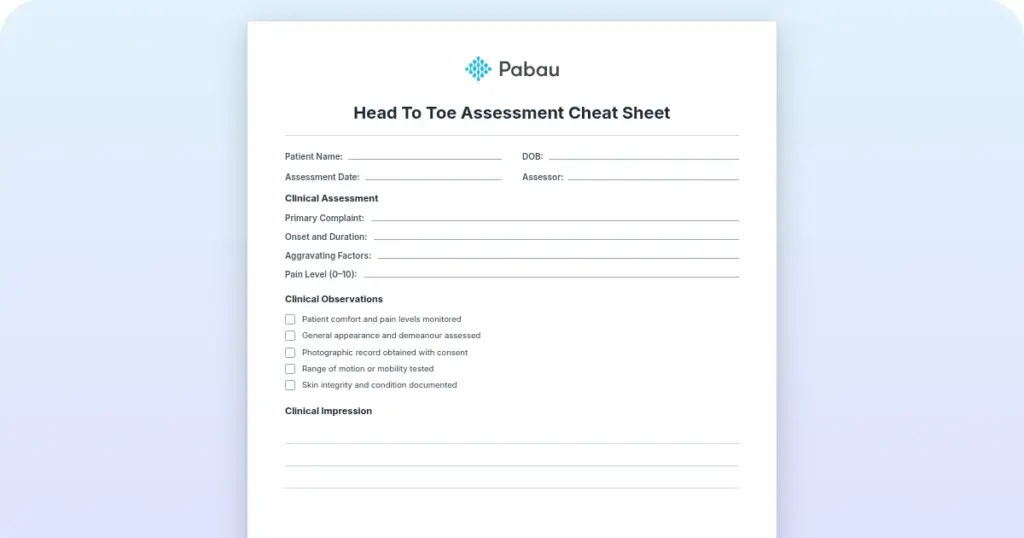
Head to toe assessment cheat sheet: Printable nursing guide
A head to toe assessment cheat sheet gives you one fixed order at the bedside, s...

5
Last Updated: Oct 23, 2026
A patient workup is the structured sequence a clinician runs to evaluate a patient and decide what to do next. It has five steps: medical history, physical examination, medication reconciliation, diagnostic testing, and a documented assessment and plan. Those steps hold across primary care, aesthetic medicine, and allied health. What changes by specialty is the depth of each one, not the order.
The sequence itself is not complicated. Inconsistency is what breaks it. History gets collected twice, labs get ordered without a stated clinical question, and the assessment gets written from memory an hour later. This guide walks through each step and shows which section of the note it fills. It also covers how practice management software like Pabau changes the sequence in practice.

A patient workup runs five steps: medical history, physical examination, medication reconciliation, diagnostic testing, and a documented assessment and plan.
Medication reconciliation is the step most often skipped under time pressure, and inaccurate drug lists remain a common source of preventable harm.
Each workup step feeds a specific SOAP note section, so documenting as you go replaces writing the note from memory later.
A note listing the systems reviewed and the negative findings is defensible, while one saying only exam normal is not.
Pabau’s patient intake software pre-populates the record before the appointment, so the workup starts from a filled profile rather than a blank chart.
A workup covers four kinds of information plus one output. The information is the medical history, the physical examination, the medication list, and the diagnostic tests. The output is a documented assessment and plan. Every specialty runs a version of this, and the depth of each part varies far more than the order does.
Structure matters because cognitive shortcuts get dangerous at volume. A clinician seeing 15 patients a day needs a fixed sequence, the way a pilot runs a pre-flight checklist on a familiar route. The American Academy of Family Physicians traces most primary care diagnostic errors to the encounter itself. Incomplete history taking and examination are among the most common contributors.
A complete patient workup has five components. They follow a logical sequence, with each one building on the last. Experienced clinicians often run them in parallel during a live encounter.
Medical history taking is where most diagnostic errors start. Clinicians who rush the history end up compensating with tests, ordering more labs rather than fewer. The history opens with the chief complaint, in one sentence in the patient’s own words. From there the history of present illness expands on onset, duration, severity, and any prior treatment.
The structured history also covers past medical and surgical history, current medications and allergies, and family history for heritable conditions. Social history matters where it bears on the clinical picture, so record smoking status, alcohol use, occupation, and living situation. Medical forms sent before the appointment capture most of this before the clinician enters the room. That frees the consultation for clarification and examination rather than data entry.
Pabau’s patient intake software writes completed answers straight into the client record. The workup then starts from a filled profile rather than a blank chart.

The physical exam confirms or challenges what the history suggested. A systems-based approach starts from general appearance, then works through the cardiovascular, respiratory, abdominal, neurological, and musculoskeletal systems. Working in that fixed order stops the presenting complaint from narrowing the exam.
Vital signs anchor every exam. Blood pressure, heart rate, respiratory rate, temperature, and oxygen saturation give objective baseline data before any further assessment. In aesthetic and wellness practices the exam is often more focused, such as a skin assessment or a body composition measurement. The principle of working through a consistent sequence still holds.
Document positive and negative findings. A note that says only “exam normal” is not defensible. A note that lists the systems reviewed and the specific negative findings is.
Medication reconciliation prevents the most harm and gets skipped most often under time pressure. Medication safety has been a standing Joint Commission priority, and inaccurate lists at the point of care remain a recurring source of preventable harm.
A complete reconciliation covers four things:
Prior encounters matter here too. A medication that sits on the list but has not been taken consistently changes the clinical picture, so ask about adherence rather than assuming it. Keeping medications and allergies in the same record as the appointment and the consultation note removes the switch between systems.

Tests confirm clinical hypotheses rather than replacing them. Reach the point of ordering investigations with a working differential already formed from the history and the examination. Ordering a comprehensive metabolic panel because a patient seems unwell is not a diagnostic strategy.
The Merck Manuals make the same point about interpretation. A result means little without a pretest probability to read it against, so a population reference range is a starting point rather than an answer. Common workup panels include a complete blood count, a basic or comprehensive metabolic panel, thyroid-stimulating hormone, urinalysis, and a lipid panel. Selection depends on the clinical presentation and the specialty. Imaging follows the same logic, ordered when it will change management rather than as a reflexive add-on.
The assessment synthesizes what the workup gathered: the most likely diagnosis, the working differential, and the clinician’s confidence in each. The plan turns that into actions, covering treatment, tests, referrals, patient education, and the follow-up timeline. Documentation quality matters most in this section, because it is what the next clinician reads first.
SOAP note format structures this cleanly. Subjective is the patient’s story, Objective is the exam and test findings, Assessment is the clinical impression, and Plan is the actions. In the Assessment section, state the most likely diagnosis first. List differentials below it in decreasing probability, each with the evidence supporting or refuting it.
Documentation is not a post-encounter admin task. A note written from memory 45 minutes later loses the detail that mattered, so the strongest clinicians document during the workup itself. SOAP is the standard format across most clinical settings, though progress notes, encounter summaries, and structured templates do the same job in different contexts.
Documenting as you go only works because each step feeds a particular section of the note. The mapping below is what makes it possible to leave the room with a finished record.

Three principles separate a defensible workup note from a weak one.
Where the note lives is a documentation decision too. Under HIPAA, workup notes holding protected health information must sit in systems with access controls, audit logging, and encryption. A practice moving off paper benefits from software that enforces those requirements by default rather than through manual process.
Pabau Scribe, our AI medical scribe, drafts the note while the consultation is happening. The record then comes from the encounter rather than from memory.

Document medication reconciliation as a discrete section in every workup note, not as part of the general history narrative. When a prescribing decision is challenged later, the record needs a dated and complete medication list. That is the difference between a defensible note and an indefensible one.
A reusable template gives every clinician in a practice the same starting point. The goal is consistency rather than rigidity. Every patient gets the same structured assessment regardless of who sees them, which protects quality across a team and makes peer review straightforward.
The table below follows the standard clinical sequence. Our history and physical form packages the same structure as a document you can download and adapt. Either way, fit it to your specialty. An aesthetic practice weights the history and examination differently than a primary care encounter, but the structure holds.
A practice using medical records management inside a practice management system can embed this template into the note-taking workflow itself. Every field maps to a section of the record, and the finished workup joins the patient’s cumulative timeline instead of sitting as a standalone document.

Two clinicians can follow the same five steps and end up with very different records, depending on what their tools do for them. Say the history arrives on a paper form at reception and gets transcribed after the consultation, while medications live in a separate spreadsheet. That workup creates several chances for information to be lost or mistyped.
The AMA maintains an ongoing body of research on how much of the clinician workday electronic records consume, and where that time goes. The practical win comes from removing the steps that create risk and friction, not from adding automation for its own sake.
Pabau is built for practices running aesthetic, wellness, and private medical services. The intake form collects the workup history before the appointment and fills the matching fields in the record. During the consultation, clinicians work from a structured note template. Afterwards the finished workup sits in a searchable, auditable timeline alongside prior visits, lab results, and treatment records.
CMS innovation models tie payment to care coordination and documented quality. That puts the workup record inside the reimbursement question rather than beside it, which makes the system holding it an infrastructure decision with clinical consequences.

Pabau gives your practice digital intake forms, structured clinical notes, medication tracking, and a complete patient record in one system. See how it works on a personalized demo.

The workup rewards consistency more than it rewards depth. A clinician running the same five steps in the same order catches more than one who goes deep on whatever the presentation suggests. The sequence is the safeguard, and it works precisely because it does not bend to the case in front of you.
The documentation half is where that effort either pays back or disappears. A note written during the encounter is worth more than a fuller one written afterwards, because the later version is a reconstruction. So the tooling question is a narrow one: can the record be written while the patient is still in the room?
That is the trade the workup asks for. A little structure at the front of every encounter buys a record that still holds up months later. Book a demo to see how Pabau handles intake, clinical notes, and medications in one workflow.

Documenting the workup as you go? SOAP charting breaks down how to structure each section while the encounter is still running.
Need a systems review the workup can pull from? 12-point review of systems gives you the full checklist in a form patients can complete before the visit.
Comparing tools for clinical notes? Clinical notes software sets out what to look for when notes have to live inside the patient record.
Following a patient across visits? Progress note template covers the note that carries the plan forward after the initial workup.
A patient workup is the structured clinical process used to evaluate a patient’s health status. It covers medical history taking, physical examination, medication reconciliation, diagnostic testing, and a documented assessment and plan. Every specialty runs a version of it, from primary care to aesthetic medicine.
Take a thorough medical history including the chief complaint and HPI, then conduct a physical examination. Complete medication reconciliation, order and interpret diagnostic tests based on the presentation, and finish with a documented assessment and plan. SOAP note format is the usual structure for that final step.
The clinical standard is the SOAP note format. Subjective holds the history and chief complaint, and Objective holds the exam findings and test results. Assessment holds the clinical impression, and Plan holds the treatment, referrals, and follow-up. Complete notes in real time where possible, use specific language, and give a documented rationale for each plan item.
SOAP stands for Subjective, Objective, Assessment, and Plan. It is the most widely used structure for recording workup findings. Clinical specialties teach it as the default shape of an encounter note. Subjective captures the patient’s history and chief complaint. Objective records the examination findings and test results. Assessment states the clinical impression, and Plan details the treatment decisions and follow-up.