CRM for chiropractors: how to manage patients, bookings and marketing
A CRM for chiropractors is a patient relationship management system built around...

Last Updated: Oct 13, 2026
An oral health assessment is a structured clinical examination of a patient’s teeth, gums, soft tissues, bite, and health history. A dentist or dental hygienist performs it to detect disease, stratify risk, and guide treatment planning.
According to the National Institute of Dental and Craniofacial Research (NIDCR), roughly a quarter of US adults aged 20 to 64 have untreated tooth decay. A documented assessment is how a practice finds that disease before it turns into an emergency appointment. The findings then drive what gets treated, when the patient is recalled, and who needs closer monitoring.

An oral health assessment covers teeth, gums, soft tissues, bite, and patient history, and a dentist or hygienist performs it.
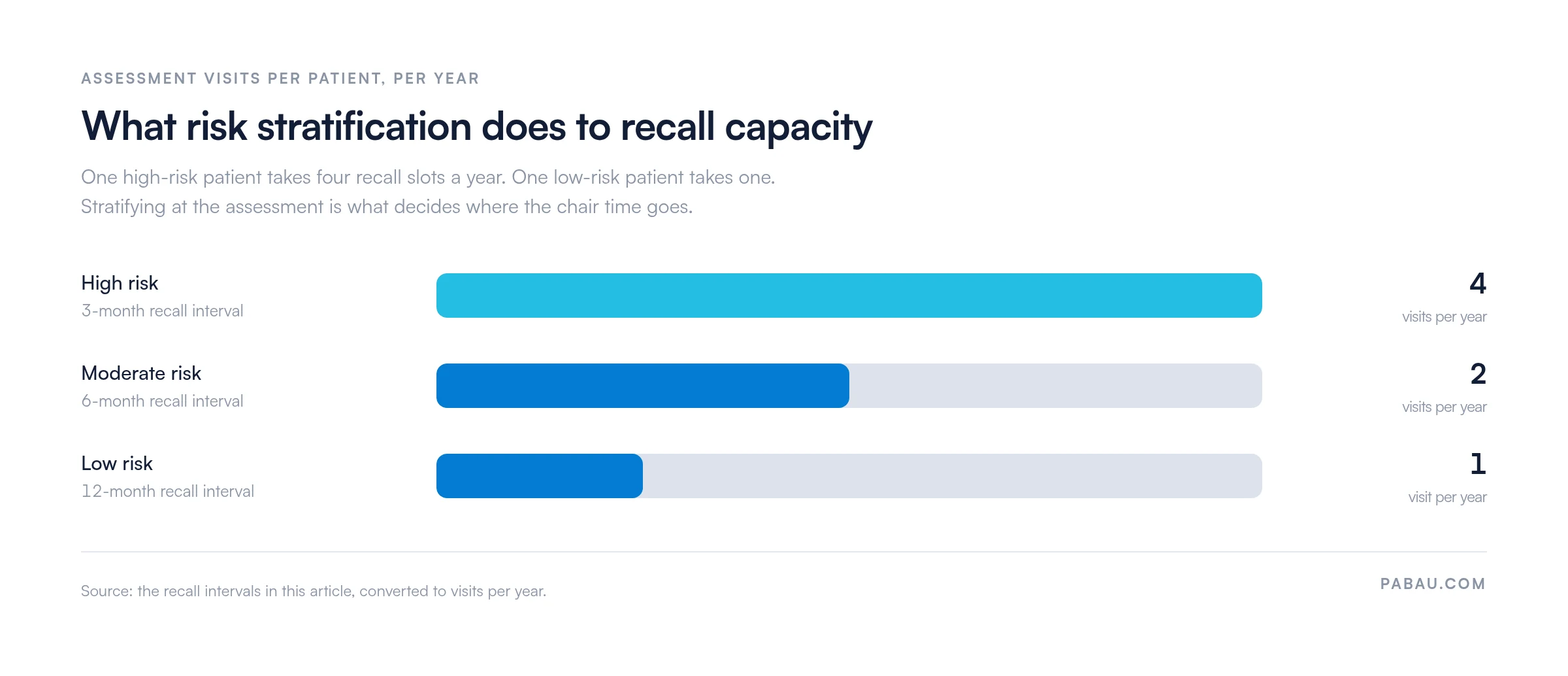
Risk stratification sets the recall interval, so low-risk patients return every 12 months and high-risk patients every 3 months.
Several US states, including California and Michigan, mandate a kindergarten oral health assessment on a standardized form such as Michigan’s KOHA.
Digital intake forms and automated recall scheduling reduce documentation burden while keeping assessment records HIPAA-compliant and audit-ready.
An oral health assessment is a systematic process in which a licensed dental professional evaluates a patient’s oral cavity, health history, and risk factors. The output is a baseline record, a list of any pathology found, and a care plan. Dentists and dental hygienists both perform assessments, though scope varies by jurisdiction and qualification level.
The American Dental Association (ADA) maintains the CDT code set that separates these visits for documentation and billing. A comprehensive oral evaluation is D0150, a periodic oral evaluation is D0120, and a limited, problem-focused evaluation is D0140.
The assessment differs from a routine dental examination in its depth. An examination may confirm an existing diagnosis or check post-treatment healing. An assessment collects medical and dental history, current medications, dietary habits, and socioeconomic risk factors. It adds a head-to-neck soft tissue review alongside the clinical dental exam, and those inputs shape the whole care pathway.
A thorough oral health assessment covers several distinct clinical domains. Most practices capture the findings straight into the patient record, so medical records management decides how easily the next clinician can read them. The core components are:
The soft tissue examination deserves particular emphasis. Oral cancer carries a five-year survival rate above 80% when caught at Stage I, and that figure falls sharply in later stages.
Screening at every assessment creates a documented clinical habit that protects patients and practitioners. A suspicious lesion is referred for biopsy or specialist evaluation, never characterized conclusively in the practice notes.
An oral health risk assessment is a structured scoring process that classifies each patient as low, moderate, or high risk. The classification covers caries, periodontal disease, and oral cancer, and it sets the recall interval and preventive protocol. The CAMBRA framework, or Caries Management by Risk Assessment, offers one validated approach to caries risk stratification.
Risk level is reassigned at each assessment visit rather than carried forward. A patient who was high-risk after active periodontal treatment may step down to moderate 12 months later. That depends on probing depths stabilizing and home care improving, and the rationale for the change belongs in the record.
Stratifying at the assessment is also a capacity decision, because each risk band consumes a different share of the recall diary.
Systemic links add another layer to risk stratification. Patients with uncontrolled Type 2 diabetes show higher rates of periodontal inflammation, and periodontal infection in turn worsens glycemic control. Recording systemic conditions in the oral health record, with the patient’s consent, completes the clinical picture without crossing into primary care.
Flag high-risk patients with a color-coded status in your practice management system. Every clinician reviewing the schedule then sees the risk level before the patient walks in, including a locum covering someone else’s list.
Pediatric oral health assessments follow the same structural logic as adult assessments, but several US states attach regulatory weight to them. California and Michigan both require an assessment as a condition of kindergarten entry.
California’s program is administered jointly by the California Department of Public Health and the California Department of Education. A licensed dental professional completes the official form before or shortly after school enrollment. Michigan runs its Kindergarten Oral Health Assessment (KOHA) program through the Department of Health and Human Services, on a standardized form.
The KOHA form captures caries status, treatment urgency, and referral need. Requirements differ between California, Michigan, and other states with similar programs, so the mandate is state-specific rather than nationwide. A practice seeing pediatric patients should work from the form its own state publishes.
The American Academy of Pediatrics (AAP) recommends a first dental visit by the child’s first birthday. Where a tooth erupts earlier, the visit should happen within six months of eruption.
Parents can do part of this at home, but only part. A parent can spot visible cavities, staining, or swelling, and can note whether a child complains of pain. Probing periodontal pockets, finding early interproximal caries, and reading soft tissue changes all need a clinician. Home observation prompts a clinical visit. It does not replace one.
An oral health assessment form documents the clinical findings and history gathered during the visit. Well-built patient intake software reduces the chance of a missed field and makes records easier to search, audit, and share with specialists. A complete form captures the following data points in a consistent sequence:

HIPAA governs how these records are stored, transmitted, and accessed. A practice using digital records needs software that meets the HIPAA Security Rule on access controls, encryption, and audit logs. Dedicated clinical documentation software enforces those controls by default instead of leaving them to individual staff.
UK practices apply GDPR in place of HIPAA, with broadly similar rules on consent, access, and retention.
A standardized checklist buys repeatability, so every patient gets the same systematic evaluation whoever is in the chair that day. The table below summarizes the assessment domains and what to look for in each.
Each domain generates a brief clinical note in the patient record rather than a tick in a box. For soft tissue, a note reading “soft tissues examined, no abnormalities detected” carries far more medico-legal weight than a checkbox labeled “OCS done”.
A well-documented oral health assessment generates a lot of paperwork from one visit. It produces a medical history update, a periodontal chart, a dental chart, a radiographic report, a risk classification, and a recall plan.
Without integrated software, those elements sit across paper forms, spreadsheets, and separate charting tools, so the same data gets re-keyed more than once.
Practice management software like Pabau connects documentation, scheduling, and recall in one workflow. Pabau’s digital forms let a practice build its own oral health assessment template, which patients complete before they arrive. The submitted data flows into the patient record, where clinicians review history, update charting, and assign a risk level without switching systems.
Recall scheduling is where the software earns its place. A high-risk patient leaving the chair should be scheduled or flagged for a three-month recall straight away. Pabau’s automated recall workflows send SMS and email reminders based on the interval assigned at the assessment.
Pabau’s medical scheduling software lets a practice set a different interval for each patient rather than applying a blanket six-month policy. Disease risk accumulates between visits, so the patients on a three-month recall are the ones the diary should protect.
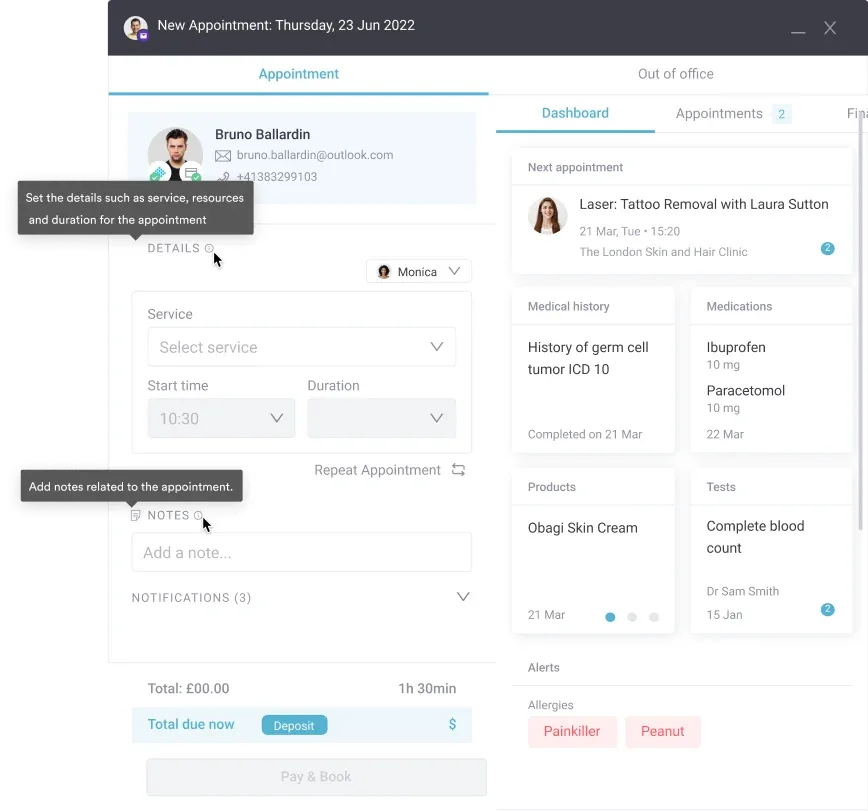
Compliance and audit-readiness round out the operational case. The platform keeps records encrypted, enforces access controls, and generates audit logs that satisfy HIPAA in the US and equivalent UK obligations.
A centralized, version-controlled form library also stops clinicians using an outdated assessment template. Our guide to managing medical forms covers how to keep that library current across a multi-practitioner team.
Review your oral health assessment form template every 12 months against current ADA clinical guidelines and any state regulatory updates. A template carrying outdated risk criteria or missing consent fields is hard to defend if a case is later disputed.

Digital forms, structured charting, automated recalls, and HIPAA-compliant record storage, in one platform built for healthcare practices.

A systematic oral health assessment is the clinical foundation every later decision rests on. Without one, treatment planning stays reactive. With one, a practice can stratify risk, schedule recalls by need, and catch pathology early across the whole patient list.
A thorough assessment costs chair time now and saves it later. That only holds if the risk level you assign actually changes the recall date. Book a demo to see how Pabau documents assessments, assigns recall intervals, and keeps dental records audit-ready.

Need the form itself? Dental examination form gives you a printable structure for recording the clinical findings covered above.
Charting the findings tooth by tooth? Dental chart for teeth sets out the notation and symbols to use in the record.
Turning findings into a plan? Plan of care explains how to document treatment goals and review dates after an assessment.
An oral health assessment is a structured clinical examination of the teeth, gums, soft tissues, bite, and patient health history. A dentist or dental hygienist performs it to detect disease, classify risk, and create a care plan. It goes beyond a routine check-up by adding risk stratification and a documented recall plan.
A dental hygienist typically checks periodontal pocket depths, bleeding on probing, plaque and calculus levels, and soft tissue appearance. Soft tissue review includes the oral cancer screen. The hygienist also reviews dietary and hygiene habits, and may take radiographs or update the medical and dental history, depending on scope of practice.
Recall frequency depends on individual risk. Low-risk patients typically return every 12 months and moderate-risk patients every six months. High-risk patients return every three months, which covers active caries, periodontal disease, tobacco use, and systemic conditions affecting oral health. The ADA advises setting intervals from each patient’s risk profile rather than applying one policy to everyone.
A dental examination generally focuses on diagnosing a specific complaint or confirming an existing condition. An oral health assessment is broader. It collects a full health history, evaluates all oral structures systematically, stratifies disease risk, and produces a documented recall and prevention plan. In billing terms, the assessment maps to ADA code D0150 rather than the periodic D0120.
A complete oral health assessment form includes patient identification, medical and dental history, and social and lifestyle history. It then records extraoral and intraoral clinical findings, periodontal charting, the dental chart, and radiographic notes. It closes with a risk classification and a documented treatment and recall plan.
Parents can observe visible signs such as obvious cavities, staining, swelling, or complaints of pain, and those observations should prompt a clinical visit. Parents cannot perform the clinical parts of an assessment. Probing, soft tissue evaluation, and radiographic review all require a licensed dental professional.