OSHA respirator medical evaluation questionnaire
The OSHA respirator medical evaluation questionnaire is the mandatory health for...

3
Last Updated: Oct 15, 2026
Noterro pricing starts at $33 a month for the Core plan, with Plus at $55 and Max at $77, each including one practitioner seat.
Extra practitioners cost $13.20, $22, or $27.50 a month depending on which tier you pick.
The three plans are feature-gated, so the price you pay also decides which tools your practice can use. File uploads and text reminders start on Plus, while memberships, packages, and insurance claims processing only arrive on Max. Annual billing takes 15% off every tier, and the 14-day trial asks for no credit card.
This guide breaks down what each plan includes and how the bill scales with headcount. It also covers what happened to the legacy plans and how Noterro compares with ClinicSense and Pabau. All figures come from Noterro’s own pricing page and are quoted in US dollars.

Noterro sells three feature-gated plans: Core at $33 a month, Plus at $55, and Max at $77.
Each plan includes one practitioner seat. Extra seats cost $13.20, $22, or $27.50 a month by tier.
File uploads, text reminders, waitlists, and the Noterro GO app start on the Plus plan.
Memberships, packages, and full insurance claims processing are only on Max.
Annual billing saves 15% on every tier, and the 14-day free trial needs no credit card.
Noterro retired its legacy plans on April 28, 2026 and moved those practices onto current tiers.
Noterro is cloud-based practice management software built for allied health practitioners. It was previously known as SOAP Vault before rebranding. The platform targets massage therapists, chiropractors, physiotherapists, acupuncturists, and other manual therapy practitioners. Those practices need SOAP charting, online booking, and invoicing without the weight of a full hospital-grade EHR.
The platform is not designed for aesthetic clinics, medspas, or multi-specialty healthcare practices. If you run a chiropractic practice or a small physiotherapy practice with one to five practitioners, Noterro fits the profile it was built for. Larger practices, and those in aesthetics and surgery, will usually find the feature set too narrow.
Knowing what Noterro covers sets the context for judging whether its plan structure suits your practice size and specialty mix.
Noterro costs $33, $55, or $77 a month depending on the plan, and each price includes one practitioner seat. Noterro publishes three tiers: Core, Plus, and Max. They are feature-gated, so moving up a tier unlocks functionality rather than simply adding capacity.
Every additional practitioner on the account carries its own monthly charge, and that seat rate rises with the tier. Assistant seats and support are included on all three plans. Paying for a year upfront cuts 15% off both the base price and the extra-seat rate.
Two costs sit outside the tier price. File storage is a $5 monthly add-on for Core subscribers, and the AI charting tools run on credits at $0.01 each after the first 300. Neither shows up in the headline figure, so add them in before you compare tiers.
Each tier builds on the one below it, so Plus includes all of Core and Max includes all of Plus. The split matters most around reminders, file uploads, and insurance billing. Those three decide which plan a practice actually needs, and they are the most common reason practices upgrade.
Core carries the day-to-day essentials for a solo practitioner who bills privately and books online.
Plus is the tier most multi-practitioner practices land on, because it turns on the tools patients notice.
Max is aimed at practices that sell recurring care or bill insurers directly.
Several capabilities stay off the menu on every tier. Noterro has no marketing automation, no inventory tracking, no multi-location management dashboard, and no advanced analytics. A solo massage therapist rarely misses any of it. A physical therapy practice opening a second site will feel the limits quickly.
Annual billing saves 15% and applies to every tier and every seat. On Plus, that moves a solo practice from $55 a month to $46.75, or $561 for the year. The discount also lands on extra practitioners, so a three-person Plus practice pays $18.70 per extra seat instead of $22.
A year upfront costs the equivalent of 10.2 months at the monthly rate. The break-even point follows from that: stay past roughly ten months and annual billing wins. Monthly billing suits seasonal practices, fast-growing teams, and anyone still testing the platform.
Price the tier you need, not the one you start on. If text reminders or file uploads are on your list, budget for Plus at $55 rather than Core at $33. An upgrade three months in wipes out any saving you made by starting low.
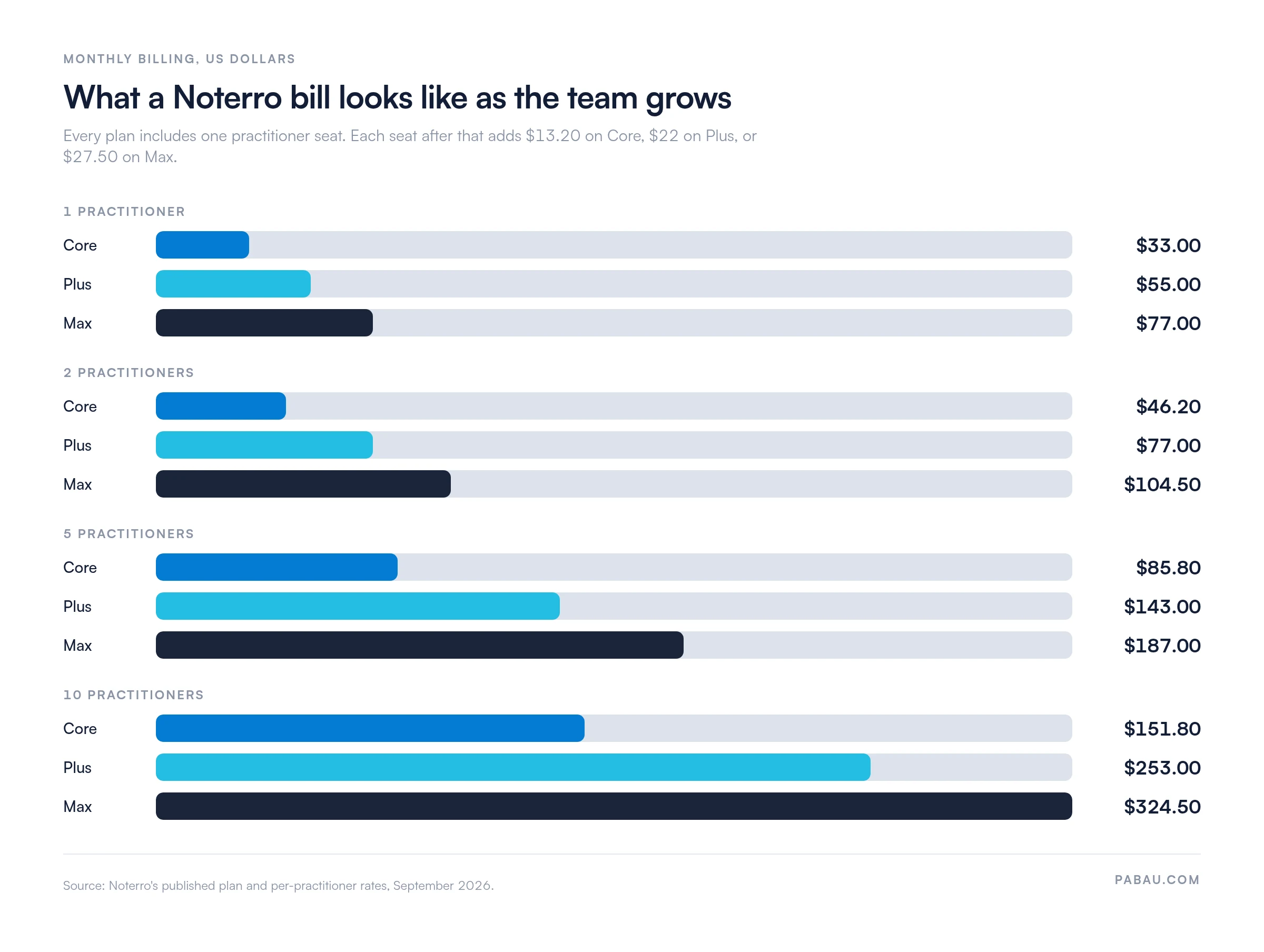
Your bill is the tier price plus a per-seat charge for every practitioner after the first. A three-physiotherapist practice on Plus pays $55 for the first seat and $22 each for the other two, so $99 a month. There are no published volume discounts, so the seat rate holds steady however large the team grows.
Deduct 15% from any figure above to get the annual-billing equivalent. The seat model stays competitive for solo and two-seat practices. Past five practitioners on Plus or Max, platforms that charge a flat rate per location start to look better on total cost.
Jane App pricing works the same way, charging per practitioner, so run any comparison at projected headcount rather than current headcount. The chart below plots the tier prices against headcount, and the spread widens with every seat.
Noterro retired its legacy plans on April 28, 2026 and moved every legacy practice onto a current tier. Some of those plans dated back to 2011, and running two pricing structures side by side had become a drag on development. Each practice was placed on the current plan that matched the features it already had switched on.
No one was charged on the migration date itself. Prices held at the old rate until each practice’s next renewal after that date, and billing frequency carried over unchanged. Practices on very low grandfathered rates saw an increase at renewal. That is where most of the frustration in massage therapy and chiropractic forums came from.
Noterro had already raised prices once before that, with new rates applying to renewals from August 12, 2025. If you are signing up now, none of this changes your bill. You start on a current tier at current rates, and the history matters only as a signal of how often pricing moves.
Yes. Noterro runs a 14-day free trial and asks for no credit card to start it. The trial gives you the platform so you can test SOAP charting, scheduling, and the booking widget before you commit to a tier.
Trial accounts also get 300 free AI credits for Scribe and Form Summary, which is enough to judge whether those tools save you time. When the 14 days end you pick a plan and a billing cycle. No free tier carries on afterwards.
User sentiment on Capterra’s Noterro reviews page is broadly positive for solo and small practices. Reviewers listed the product under its original SOAP Vault name. Praise clusters around ease of use, charting quality, and responsive support. The pricing complaint that recurs is cost growth once a practice adds seats.
A solo massage therapist running 25 to 30 sessions a week gets what they need from Core or Plus. A five-practitioner physiotherapy practice on Max is looking at $187 a month, which invites a harder comparison against flat-rate platforms.
ClinicSense is the most direct Noterro competitor in allied health. Both target massage therapists and manual therapy practitioners with SOAP charting, scheduling, and invoicing. Both sell three feature-gated tiers. The difference is what the tier boundary is drawn on. Noterro gates on features and charges per practitioner. ClinicSense caps monthly appointment volume as well.
The choice usually turns on how many appointments you book. A busy solo practitioner blows through ClinicSense’s Lite cap of 20 appointments and lands on Standard at $69, where Noterro’s Core sits at $33. A quiet or seasonal practice can sit on Lite and pay less than any Noterro tier.
Both cover the same charting and scheduling job, and neither reaches into aesthetics or surgical work. Our Noterro vs ClinicSense breakdown goes further on charting, booking, and no-show tools.
Practices that outgrow Noterro’s feature ceiling, or that balk at the Max tier once seats stack up, usually look at Jane App, ClinicSense, and Pabau. Jane App charges per practitioner too, in the Canadian and Australian markets, and covers slightly more ground including telehealth. Our Noterro vs Jane App comparison sets the two side by side.
Aesthetic clinics, medspas, and multi-specialty practices that employ allied health practitioners usually need a broader platform than any of the three. Pabau’s Jane App alternative page walks through where those two differ on scope and pricing.
On Noterro, your tier decides what the practice can actually do. Text reminders sit behind one upgrade, memberships behind another, and a second location brings no dashboard to run it from. Practices adding treatments or sites end up patching around those limits with spreadsheets and a separate marketing tool.
Pabau is practice management software built for aesthetic clinics, medspas, and multi-specialty healthcare practices. It covers scheduling and clinical documentation like Noterro, then adds marketing automation, multi-location management, before-and-after photo tools, inventory tracking, and integrated payments. Every subscription includes every feature, so nothing is locked behind a higher tier.
Pricing scales with your location count and team size rather than with functionality. Your bill grows when the practice does, not when you need one more tool. Pabau holds a 4.7 out of 5 rating from more than 600 verified reviews on Capterra. See Pabau’s pricing page for current plan details.
A solo massage therapist who only needs SOAP notes and a booking widget will find Pabau broader than their day demands. A practice adding aesthetics treatments, a second site, or a marketing function hits Noterro’s ceiling fast, and that is where the comparison changes.

Pabau gives aesthetic clinics and multi-specialty practices scheduling, clinical documentation, marketing automation, and reporting in one system. From $104/month with every feature included from day one.

Noterro pricing is straightforward once you accept that the tier, not just the headcount, sets your bill. Core at $33 covers a solo practitioner billing privately. Plus at $55 is the working tier for most practices, because text reminders and file uploads start there. Max at $77 earns its price only if you sell memberships or bill insurers directly.
Add $13.20 to $27.50 a month for every practitioner after the first, take 15% off for annual billing, and you have your number. Breadth is where the model strains. There is no marketing, no inventory, and no multi-location view at any price.
If your practice is growing, adding sites, or moving into aesthetics alongside allied health work, you need a platform with more runway. Multi-location management, automated workflows, and digital intake forms all sit inside Pabau, and Noterro leaves them out. To see how that handles your setup, book a demo and walk through your workflow with the team.

Comparing another per-practitioner platform? Nookal pricing breaks down another allied health platform that bills by practitioner seat.
Weighing two allied health systems head to head? Cliniko vs Nookal compares charting, booking, and billing across two common Noterro rivals.
Looking past Jane App as well? Best Jane App alternatives for allied health clinics ranks the platforms allied health practices move to most often.
Need a wider view of practice software pricing? SimplePractice pricing shows how a seat-based competitor structures its own tiers.
Choosing between Noterro and ClinicSense? Noterro vs ClinicSense sets the two platforms side by side on features, limits, and cost.
Noterro sells three feature-gated plans. Core costs $33 a month, Plus costs $55, and Max costs $77, and each price includes one practitioner seat. Extra practitioners cost $13.20, $22, or $27.50 a month depending on the tier. Annual billing takes 15% off both the plan price and the seat price.
Yes. Each plan includes one practitioner seat, and every practitioner after that carries a monthly charge. The seat rate is $13.20 on Core, $22 on Plus, and $27.50 on Max. There are no published volume discounts, so the rate stays flat however many seats you add. Assistant seats are included at no extra cost.
Core covers charting, scheduling, online booking, email reminders, and invoicing. Plus adds file uploads, text and call reminders, waitlists, insurance codes, and the Noterro GO mobile app. Max adds memberships, packages, automatic payments, and full insurance claims processing with CMS-1500 auto-fill. Each tier includes the one below it.
Yes. Noterro offers a 14-day free trial and no credit card is required to start. The trial includes 300 free AI credits for Scribe and Form Summary. When the 14 days end you choose a plan and a billing cycle. There is no ongoing free tier afterwards.
Yes. Paying for a year upfront saves 15% on every tier and on every extra practitioner seat. That puts Core at $28.05 a month, Plus at $46.75, and Max at $65.45. Extra seats drop to $11.22, $18.70, and $23.38. A year costs the equivalent of 10.2 monthly payments.
Both sell three feature-gated tiers, but they draw the line differently. Noterro starts at $33 and charges per practitioner with no appointment cap. ClinicSense starts at $39 and caps Lite at 20 appointments a month, with Standard at $69 and Premium at $99. A busy solo practitioner usually pays less on Noterro.
For most solo allied health practitioners, yes. Reviews rate it well for ease of use, charting quality, and support. At $33 on Core or $55 on Plus, a single seat pays for itself quickly in admin time saved. The value case weakens past two or three practitioners, where flat-rate platforms compete harder on total cost.
Noterro retired its legacy plans on April 28, 2026 and moved those practices onto current tiers. Each one was placed on the plan matching the features it already used. No charge was taken on the migration date, and prices held until the next renewal after it. No legacy plans remain available.