Health appraisal form
A health appraisal form is a record a licensed provider signs to document someon...

2
Last Updated: Oct 13, 2026

Noterro and ClinicSense both serve massage therapists and allied health practitioners with SOAP notes, online booking, and client management. They diverge sharply on insurance billing and mobile app features.
Noterro (formerly SOAP Vault) offers more insurance billing depth than ClinicSense, though full claims submission requires its $77/month Max plan. It also includes a clinic-branded client app, useful for practitioners who bill third-party insurers directly.
ClinicSense now matches Noterro’s Capterra rating at around 4.8/5, and reviewers still praise its clean interface and communication tools.
Practice management software like Pabau supports multi-disciplinary clinics and med spas with deeper clinical documentation, multi-location scheduling, and advanced reporting. It’s worth considering if your practice is growing beyond massage therapy.
The Noterro vs ClinicSense debate comes up constantly in massage therapy forums and practitioner communities. Both platforms were built specifically for bodywork professionals, and both cover the core bases: SOAP notes, online booking, client records, and payment processing.
But the details matter — especially when insurance billing, mobile apps, and multi-practitioner support are on your checklist. According to the American Massage Therapy Association (AMTA), 355,075 massage therapists practiced across the United States in 2025. That is a substantial market, and the software serving it has gotten competitive.
This comparison covers pricing, SOAP note tools, scheduling, insurance billing, payments, reporting, and the client-facing experience on each platform. It also introduces practice management software like Pabau as a broader alternative for clinics that have outgrown massage-specific tools.
Pricing is usually the first factor practitioners compare. Noterro’s Core plan starts at $33/month, about $6 a month less than ClinicSense’s solo plan, or roughly $72 a year. Both platforms use per-practitioner pricing, and costs increase as you add team members.
Always verify current pricing directly with each vendor before making a decision, as rates and plan inclusions change.
SOAP documentation is the heart of both platforms. Both were built with massage therapists in mind, so the defaults are tuned for bodywork rather than general medical charting. The differences are in workflow depth and customization.
Noterro (formerly SOAP Vault) grew directly out of SOAP documentation software, so its charting tools are well-developed. Practitioners get pre-built massage-specific templates, body diagrams, and intake form customization. The system supports multiple practitioners sharing chart access, and templates can be cloned and modified for different service types.
ClinicSense takes a clean, guided approach to documentation. The platform is built around a sequential intake and SOAP workflow where clients complete health history forms online before arriving. The practitioner then works through a structured charting flow during or after the session. It is straightforward enough that new practitioners rarely need training to get started.
Both platforms support digital intake forms as a core part of the documentation workflow. ClinicSense has the edge on guided simplicity; Noterro has the edge on flexibility and template depth. For clinics that also offer physiotherapy, osteopathy, or other allied health services, neither platform’s documentation tools are designed to stretch that far.
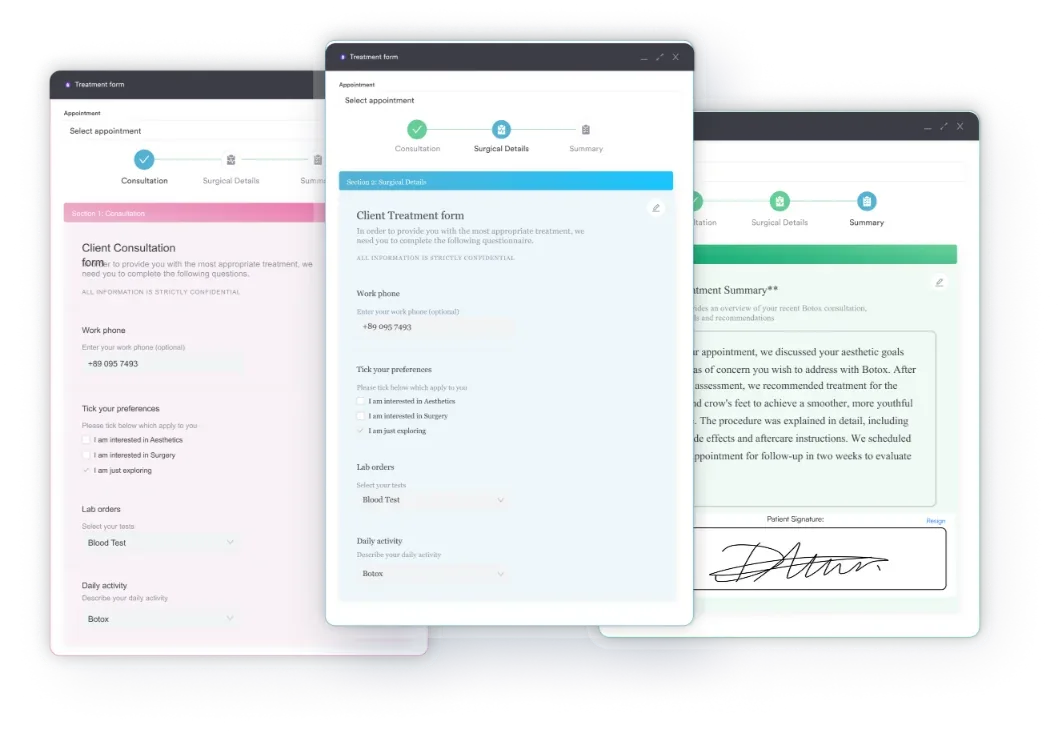
Online self-booking is table stakes in this market. Both platforms let clients book appointments 24/7 through a web portal. The differences show up in scheduling complexity and reminder workflows.
Noterro’s scheduling handles multi-practitioner setups reasonably well. Clients can book specific practitioners, select service durations, and receive automated appointment reminders. The platform supports online booking with deposit collection, which is useful for reducing no-shows in solo and small-team settings.
ClinicSense is widely praised for its booking experience, particularly the client-facing side. The booking portal is clean and mobile-friendly. Automated email and SMS reminders are built in, and the platform’s follow-up communications (including post-appointment feedback requests) are among the most polished in this category. For a solo massage therapist, the scheduling workflow is hard to fault.
When it comes to online booking tools, ClinicSense is the stronger choice for client experience; Noterro holds its own for multi-practitioner scheduling. Neither platform is built for complex multi-location or multi-resource scheduling (room management, equipment allocation, concurrent service streams).
This is the most meaningful differentiator between the two platforms. Insurance billing support is not equal here.
Noterro’s insurance billing depth depends on the plan. The $33/month Core plan includes Simple Insurance, covering basic policy tracking, but not claims submission.
Direct claims submission, along with TELUS eClaims for Canadian practitioners and Availity and CMS-1500 support for US practitioners, requires the $77/month Max plan. For massage therapists whose clients rely on extended health benefits or third-party insurance, that Max-tier tooling is a genuine operational advantage.
ClinicSense has more limited insurance billing functionality. The platform supports basic invoicing for clients to submit to their insurers independently. It lacks the claims submission and insurer integrations that Noterro’s Max plan provides.
Community feedback on forums like Reddit’s r/MassageTherapists consistently names this shortfall as a reason practitioners switch from ClinicSense to Noterro. Confirm current capability directly with ClinicSense before deciding, since this area keeps evolving.
The checkmarks above apply only to Noterro’s $77/month Max plan. Its $33/month Core plan includes just Simple Insurance policy tracking.
Both platforms handle standard payment collection well. Clients can pay online at booking, or at point of sale after their appointment. Both support packages and gift vouchers to some degree.
Noterro integrates with Stripe and other payment processors, supports deposits at booking, and handles refunds within the platform. The invoicing workflow connects directly to appointment records and SOAP notes, keeping financial and clinical data in one place.
ClinicSense also integrates Stripe for payment processing. Its strength is the client communication layer around payments. Automated invoice emails, pre-payment links, and post-session follow-up are cleaner and more polished than Noterro’s equivalents. For a solo practitioner who wants payments to feel frictionless without much configuration, ClinicSense delivers.
If you collect deposits at booking, check whether your platform processes them through its own payment flow or redirects clients to a third-party checkout. Noterro and ClinicSense both offer deposit collection, but the client experience differs. Run a test booking before committing to either platform.
The client-facing experience is where Noterro has a structural advantage: it offers a clinic-branded mobile app. Clients download an app that carries your clinic’s name and branding, rather than a generic Noterro-branded portal. This matters for brand consistency, particularly for clinics trying to build repeat client relationships.
ClinicSense takes a web-based approach to the client portal. There is no native branded app; clients book and manage appointments through a mobile-optimized web portal. For most solo practitioners, this is perfectly adequate. However, if branded app access is a priority for your client base, ClinicSense cannot match Noterro on this point.
ClinicSense makes up for this with superior client communication workflows. Automated appointment reminders, post-visit follow-up emails, and integrated review request sequences are all handled elegantly within the platform. Client retention features like rebooking prompts and birthday messages are also more developed on ClinicSense than on Noterro.
Neither platform is a reporting powerhouse, which is reasonable given their target market. Both provide the fundamentals a solo or small-team massage practice needs.
For a solo practitioner, both platforms give you enough to understand your revenue, client numbers, and appointment trends. Once you’re running a team of four or more practitioners, you’ll likely find both platforms’ reporting insufficient for the operational decisions you need to make.
Both platforms are known for strong customer support, which is a genuine differentiator in a market dominated by large platforms with slow response times.
Noterro offers live chat support and an active help center. The learning curve is moderate, since the platform has more configuration options than ClinicSense. First-time users sometimes need a session or two to get comfortable with the insurance billing and charting setup. Onboarding resources are available through the help center, and the team is responsive to questions.
ClinicSense is consistently praised for how quickly new users can get up and running. The interface is one of the cleanest in this category, and the onboarding flow guides practitioners through setup step by step. Support is available via chat and email, and reviewers on Capterra regularly call out the support team’s responsiveness as a standout quality.
According to Capterra reviewers, Noterro earns a 4.8/5 rating from around 626 verified reviews. Common themes include:
According to Capterra reviewers, ClinicSense holds a 4.8/5 rating from around 640 reviews. Common themes include:
Here is how the two platforms compare across the key feature categories that matter most to massage therapists and bodywork clinic owners.
Noterro and ClinicSense don’t share pricing data with Pabau’s live pricing tool, so the figures below come from each vendor’s published pricing page. Confirm current rates directly with each vendor before purchasing.
Check whether each platform charges for SMS reminders separately from the base plan. Both Noterro and ClinicSense include some automated messaging in their standard pricing, but SMS volume limits and additional costs vary. Confirm this directly before signing up if reminders are a key workflow for your clinic.
For most massage therapists, the decision comes down to two questions. Do you need insurance billing, and how much do you value a branded client app?
Review platform data tells a consistent story for both platforms. Noterro holds a 4.8/5 rating from around 626 verified reviews on Capterra.
Reviewers consistently highlight ease of use for solo practitioners, the quality of SOAP note templates, and the responsiveness of the support team as standout positives. The most common criticism is limited reporting depth and fewer integrations than larger platforms.
ClinicSense earns a 4.8/5 rating from around 640 reviews on Capterra, one of the strongest scores in this category. Reviewers consistently praise the intuitive interface and the quality of automated client communications. The main shortcomings noted are insurance billing limitations and the absence of a native branded app.
Noterro and ClinicSense are built for massage therapy. That is their strength and their ceiling. If your clinic is expanding into physiotherapy, osteopathy, aesthetics, or any other discipline alongside massage, both platforms will start to feel narrow.
Pabau is a broader clinical management platform designed for multi-disciplinary clinics, medical spas, and other spa and wellness businesses. The feature set goes considerably deeper on documentation flexibility, reporting, and operational management. Here is how it stacks up against both platforms on the dimensions that matter to growing practices.
Pabau’s client record management and reporting infrastructure are built for clinics managing multiple service lines, not just massage. If your practice is growing into facial treatments, physiotherapy, or osteopathy, Pabau’s documentation and operational tooling will scale in ways Noterro and ClinicSense cannot. See how Pabau compares to Jane App for another allied health comparison.
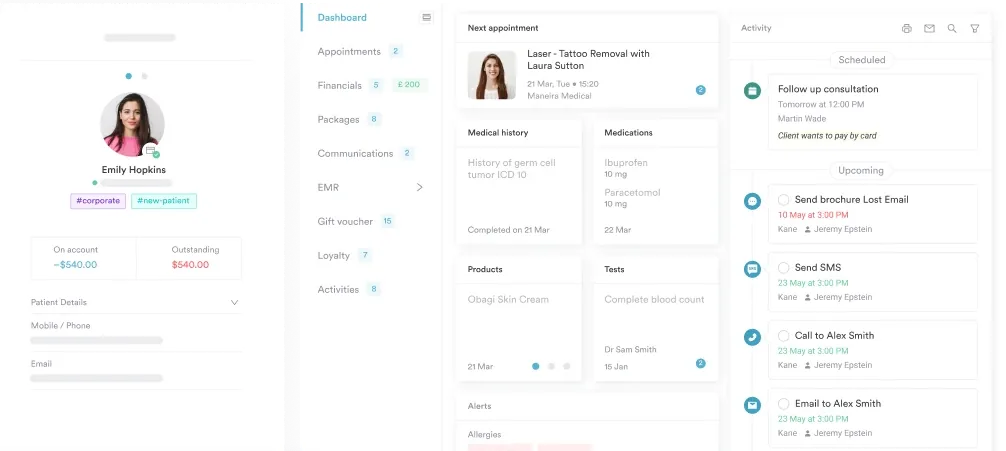

Pabau supports multi-disciplinary clinics, medical spas, and growing wellness practices with clinical documentation, multi-location scheduling, and advanced reporting built in from day one.

Fit decides this comparison more than any single feature. A solo therapist billing insurance directly saves hours a week with Noterro’s Max-tier claims tools, even at $77 a month. A therapist who mainly needs clients booked and reminded doesn’t need to pay for that depth.
Both platforms stay narrow once a practice adds disciplines beyond massage. At that point, the software becomes the ceiling on how far the practice can grow.
If that ceiling is already in view, Pabau’s multi-disciplinary documentation, multi-location scheduling, and advanced reporting are built for what comes next. Book a demo to see how Pabau handles clinical documentation and operations across every service line your practice offers.

Need to understand what makes clinic software work for allied health? Practice management software essentials covers the core features that growing clinics should evaluate.
Managing a spa or wellness clinic alongside massage services? Best software for spas breaks down the leading platforms for multi-service wellness businesses.
Curious how Pabau handles physiotherapy alongside other disciplines? Physical therapy EMR shows how Pabau supports allied health workflows.
Noterro is a practice management platform for massage therapists and allied health practitioners, formerly known as SOAP Vault. It differs from ClinicSense primarily in its stronger insurance billing tools and clinic-branded client app. ClinicSense focuses more on ease of use and client communication automation, and is widely regarded as the simpler platform to set up and run.
Noterro’s Core plan starts at $33/month, which is less than ClinicSense’s approximately $39/month solo plan. Both use per-practitioner pricing for team plans. Confirm current rates directly with each vendor, as prices and inclusions change.
Noterro offers tiered insurance billing. Its $33/month Core plan includes basic Simple Insurance tracking. Direct claims submission through TELUS eClaims (Canada), Availity, and CMS-1500 (US) requires the $77/month Max plan. ClinicSense offers basic invoicing but no direct billing or claims tracking.
ClinicSense offers a mobile-optimized web portal for clients but does not offer a native clinic-branded mobile app. Noterro includes a clinic-branded client app as part of its standard offering, which is a meaningful differentiator for practices focused on brand consistency.
ClinicSense is consistently faster to get up and running, with a guided onboarding flow and a simpler interface. Noterro requires more initial configuration, particularly for insurance billing and charting templates, but the additional setup time reflects greater flexibility.
Both platforms support multi-practitioner scheduling and chart sharing. Noterro is generally the stronger choice for team settings, thanks to its more developed role permissions and insurance billing workflow. For clinics managing three or more practitioners across multiple disciplines, Pabau is worth evaluating as a broader alternative.