Newborn head circumference chart
A newborn head circumference chart plots a baby’s head measurement against...

1
Last Updated: Oct 14, 2026

The NEXUS criteria are a five-point clinical decision rule that decides whether a blunt trauma patient needs cervical spine imaging.
All five low-risk criteria must be absent before imaging is safely skipped, and any single positive finding means imaging is indicated.
NEXUS reported 99.0% sensitivity in its original validation study, but only 90.7% in the head-to-head trial against the Canadian C-Spine Rule.
Specificity of 12.9% is the trade-off, so NEXUS sends far more uninjured patients to imaging than the Canadian rule does.
Practice management software like Pabau holds each criterion as its own field, so the assessment is documented criterion by criterion.
The NEXUS criteria are a five-point checklist that tells an emergency clinician whether a blunt trauma patient needs cervical spine imaging. All five low-risk findings must be absent before clinicians skip the scan. Hoffman et al. published the rule in the New England Journal of Medicine in 2000. In fact, it came out of a study of 34,069 patients, and it replaced case-by-case judgment with a validated method.
This guide covers how clinicians assess each of the five criteria, how the rule scores, and how NEXUS compares with the Canadian C-Spine Rule. It also covers where the rule’s performance drops, and what the record has to show once a clinician clears a patient.
The NEXUS criteria (National Emergency X-Radiography Utilization Study criteria) are a validated clinical decision rule for selective cervical spine imaging after blunt trauma. Before they existed, the decision to order C-spine imaging was mostly a judgment call. As a result, that variability produced both missed injuries and unnecessary radiation exposure.
The rule is binary. If all five low-risk criteria are absent, clinicians classify the patient as low risk and can safely omit cervical spine imaging. If any single criterion is present, clinicians order imaging. According to the American College of Emergency Physicians (ACEP), validated decision rules like NEXUS help standardize trauma assessment.
The rule applies to adult patients presenting after blunt trauma. Emergency departments and urgent care practices use it constantly, because the exam is fast and needs no equipment. Still, what varies between providers is how completely the exam reaches the record.
Clinicians assess each of the five criteria during the physical examination, and the rule holds only when they consider all five. Here is what each one means at the bedside:
The distracting injury criterion is the one that leans hardest on judgment. No agreed definition of “distracting” exists, which makes it the main source of disagreement between clinicians applying NEXUS. As a result, structured prompts inside digital intake forms built for practices keep each criterion in front of the examining doctor.
Alertness is the criterion most often recorded loosely. A structured level of consciousness check pins the GCS score and orientation to the time of the exam. That timestamp matters if the patient deteriorates two hours later.

The NEXUS criteria use a binary scoring system. Instead, there is no weighted scale and no point threshold. The rule works as follows:
Clearing the C-spine with NEXUS means documenting that clinicians assessed all five low-risk criteria and found them absent. So that step carries clinical and legal weight. A free-text line reading “no C-spine injury suspected” does not show which criteria the clinician checked. Structured patient records with templated exam fields hold each criterion separately.
NEXUS does not replace clinical judgment. Where a doctor has strong concern despite a negative NEXUS result, imaging still makes sense.
Document each of the five NEXUS criteria in the patient record, not just the conclusion. If a medicolegal question arises later, a criterion-by-criterion entry carries far more evidentiary weight. A note reading ‘NEXUS negative, imaging deferred’ leaves you defending a conclusion with no working shown.
Studies validate both rules for cervical spine clearance after blunt trauma, and emergency medicine programs teach both. They differ in who they apply to, how specific they are, and how doctors structure the decision.
Stiell et al. ran both rules over the same patients for the New England Journal of Medicine in 2003. That trial put NEXUS sensitivity at 90.7%, against 99.4% for the Canadian rule. The Canadian rule was also the more specific of the two, so it clears more patients without imaging. Instead, it does not apply to patients who are intoxicated, carry a distracting injury, or are not alert and cooperative.
Those head-to-head figures sit below the 99.0% NEXUS reported in its own validation study, which is the number most summaries quote. In practice, many emergency departments specify which tool to use in which context. NEXUS tends to win where acuity or co-morbidities put the Canadian rule out of scope.
Hoffman et al. validated the NEXUS criteria in the original 2000 study across 21 emergency departments, enrolling 34,069 patients. Of those, 818 had C-spine injuries. As a result, NEXUS identified 810 of them and missed 8, producing a sensitivity of 99.0% (95% CI 98.0-99.6%).
By comparison, specificity was 12.9%. Roughly 87% of patients with no C-spine injury still trip a criterion and get flagged for a scan. The rule is deliberately conservative, because its job is ruling injury out rather than confirming it. Sensitivity and specificity also move in opposite directions across the studies that have tested both rules.
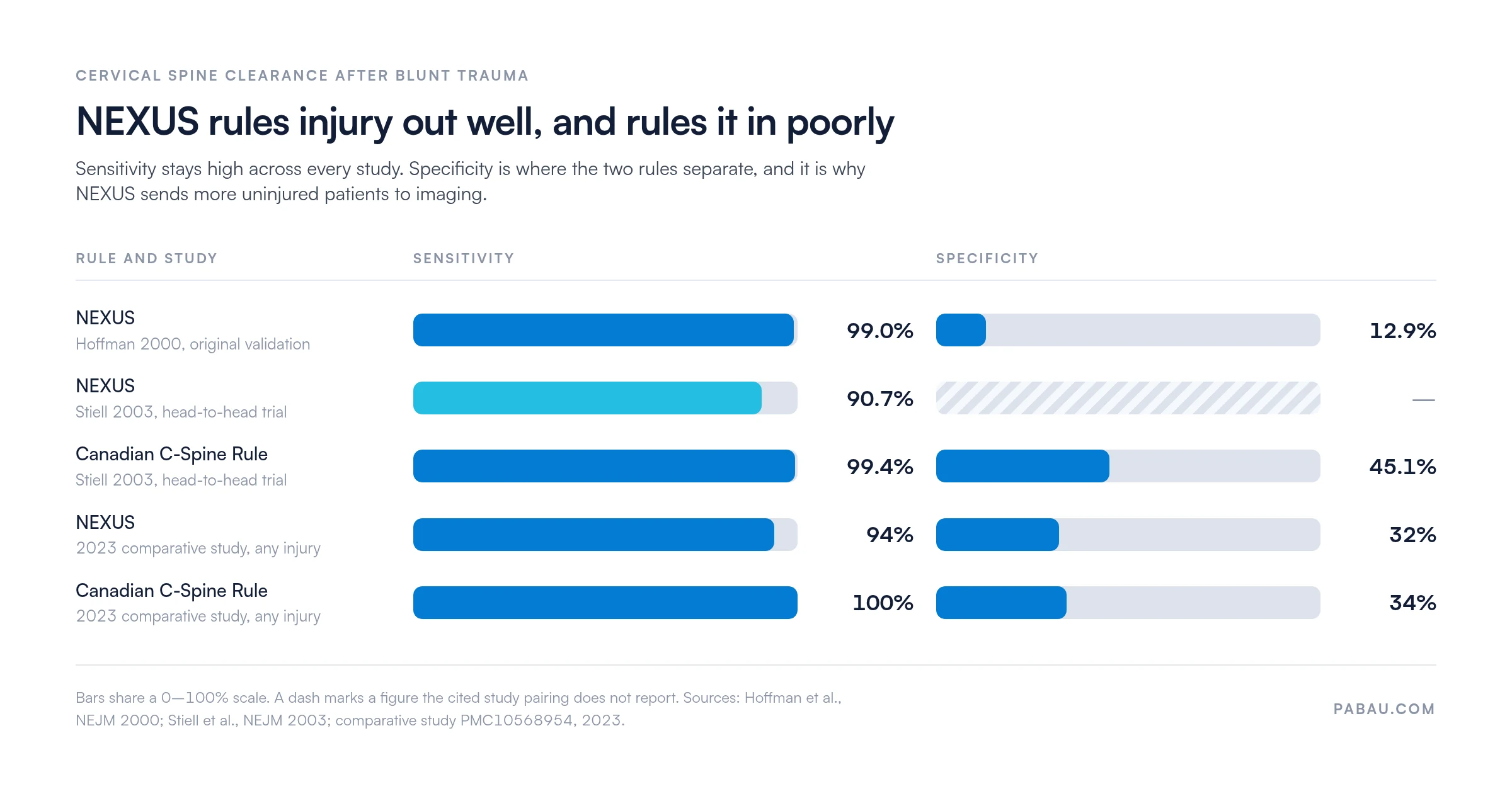
A 2023 study compared both rules over the same group of patients. It reported NEXUS sensitivity of 94% for any C-spine injury and 95% for a clinically important one, with specificity of 32% and 41%. The Canadian C-Spine Rule reached 100% sensitivity on both measures, with specificity of 34% and 37%.
As a result, the negative predictive value in the original study was 99.8%. When NEXUS classifies a patient as low risk, the chance of a missed clinically significant injury sits under 0.2%.
Researchers validated NEXUS mainly in alert, cooperative adults presenting after blunt trauma. Several groups need more caution than the rule alone provides.
Inter-rater agreement on what counts as a distracting injury is moderate at best, so training and local protocol carry weight the rule itself does not. Where a patient’s neurologic baseline is unclear, serial checks recorded on a neuro checks template give the next doctor something to compare against.
A CT cervical spine delivers roughly 6 millisieverts, about three times the annual background dose. For patients imaged repeatedly across several trauma presentations, the added-up dose starts to matter clinically.
The original NEXUS study estimated the criteria could safely cut C-spine imaging by about 12.6% against universal imaging rules. In an emergency department seeing 50,000 patients a year, that is several thousand scans avoided, with shorter throughput times and lower cost.
In addition, there is a staffing argument alongside the radiation one. Providers working from a validated framework spend less of a high-acuity shift re-arguing the same imaging decision. That counts most in urgent care practices seeing high volumes of blunt trauma without a trauma center’s radiology support.
A clinical decision rule works only as well as the record behind it. In high-volume emergency and urgent care settings, the exam usually happens correctly, but the write-up misses details. As a result, that leaves the practice defending a clinical judgment it cannot evidence.
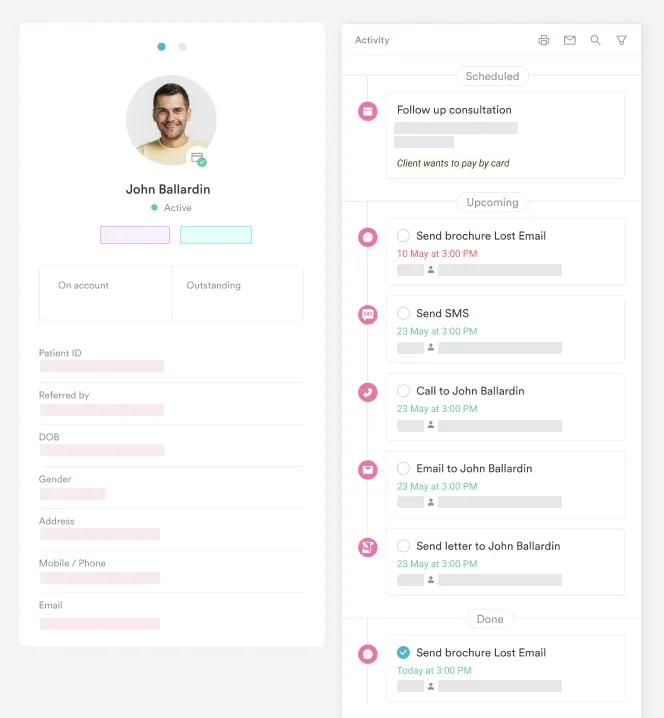
Practice management software like Pabau lets a practice build the five criteria into the form the doctor already completes. Each criterion becomes its own field. Incomplete exams get flagged before the visit closes, and the finished note attaches to the patient record without anyone rekeying it.
In addition, dictation is the other route into the record. Pabau Scribe, our AI medical scribe, captures the doctor’s reasoning during the visit, so criterion-by-criterion detail reaches the note without a second writing pass. Across multiple locations, the same fields apply on every shift, which is what stops criterion interpretation drifting between providers.
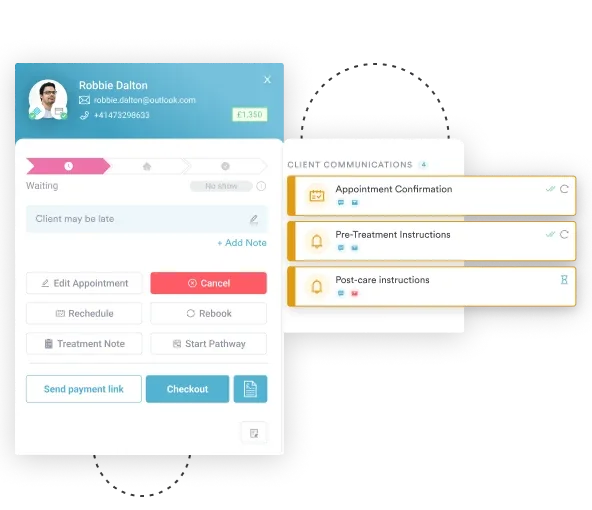

Pabau helps urgent care and multi-specialty practices structure assessments, automate workflows, and keep compliant records across every patient encounter. See how it works in a 30-minute demo.

NEXUS earns its place because it is fast, needs no equipment, and rules injury out well. The evidence underneath it is less uniform than the rule’s reputation suggests. A negative NEXUS in a patient you are still worried about is a reason to image, not a reason to stop thinking.
The bedside decision is usually the quick part. What separates a chart that holds up from a risky one is whether the record shows that a doctor checked all five criteria, by whom, and when. Practices that treat that as a form-design question rather than a memory question get the same kind of notes across every shift.
Pabau’s structured patient records and digital exam forms hold each criterion as its own field. Book a demo to see how your urgent care team can document a full NEXUS exam without adding a minute to the visit.

Need a format for recording a trauma assessment? Emergency nursing assessment template lays out the fields an emergency assessment has to capture before the patient moves on.
Documenting what arrives with the ambulance? EMT patient assessment template covers what the receiving clinician needs from the scene, in the order they need it.
Managing forms across your practice? Medical forms in healthcare practice covers how structured digital forms reduce errors and support audit-readiness.
The five NEXUS criteria cover midline cervical tenderness, level of alertness, evidence of intoxication, focal neurologic deficit, and painful distracting injury. A patient is low risk only when all five are absent, and imaging can then be safely omitted. If any single criterion is present, clinicians order cervical spine imaging.
NEXUS is a five-criterion binary checklist that covers a broad adult trauma population, including intoxicated patients. The Canadian C-Spine Rule (CCR) uses a stepped three-question algorithm, but excludes intoxicated and non-cooperative patients. CCR is the more specific of the two, at 45.1% in the 2003 head-to-head trial against 12.9% for NEXUS in its original validation study. It therefore clears more patients from imaging, while NEXUS applies to a wider range of patients.
The original validation study reported 99.0% sensitivity (95% CI 98.0-99.6%) for clinically significant cervical spine injury. That figure comes from Hoffman et al., who enrolled 34,069 patients and published in the New England Journal of Medicine in 2000. The 2003 head-to-head trial against the Canadian C-Spine Rule put NEXUS sensitivity lower, at 90.7%. Negative predictive value in the original study was 99.8%, so missed injuries in NEXUS-negative patients are rare.
Yes, clinicians can apply NEXUS to intoxicated patients, but intoxication is itself one of the five criteria. Any evidence of intoxication counts as a positive finding, which mandates cervical spine imaging. That includes alcohol smell, slurred speech, ataxia, or reported substance use. The Canadian C-Spine Rule excludes these patients altogether, while NEXUS keeps them in and requires imaging.
NEXUS has limited validation in children under 8 years old. The original study included pediatric patients, but the subgroup was too small to establish reliable performance data in young children. Most pediatric emergency medicine guidelines ask clinicians to supplement NEXUS with judgment under age 8. Developmental anatomy and communication barriers both complicate the assessment.
A distracting injury is any painful condition severe enough to stop the patient reporting cervical spine symptoms accurately. Common examples include long bone fractures, large lacerations requiring repair, significant abdominal or thoracic injuries, and severe burns. This criterion is the most subjective of the five, and the main source of disagreement between clinicians applying NEXUS.