Stroke impact scale: Free PDF, scoring and MCID by domain
The stroke impact scale (SIS) is a 59-item questionnaire in which stroke survivo...

2
Last Updated: Oct 13, 2026
The moving valgus stress test checks the ulnar collateral ligament (UCL) in a thrower’s elbow, without sending the athlete straight for imaging. You apply a steady valgus load, then sweep the elbow from full flexion toward extension. Medial pain between 70 and 120 degrees of flexion is the finding that counts.
Miss that arc, or let the shoulder drift out of position, and an injured ligament can test clean. That is how a pitcher gets cleared too early. Below is the technique in full, the accuracy numbers behind it, and what to record afterward.

The moving valgus stress test loads the anterior band of the UCL through a flexion-extension arc, which is what throwing does to it.
A positive result is medial elbow pain reproduced between 70 and 120 degrees of flexion, known as the shear range.
Start with the shoulder abducted 90 degrees and maximally externally rotated, and the elbow in full flexion near 145 degrees.
O’Driscoll’s 2005 study reported 100% sensitivity and 75% specificity against arthroscopy, in 21 overhead throwing athletes.
Record the onset and offset angles rather than a yes or no, so the next clinician can compare visits.
The test answers one narrow question. Does the anterior band of the ulnar collateral ligament hold up under a throwing-shaped load? That band is the primary valgus stabilizer of the medial elbow, so it is the structure that gives way first in pitchers.
Overhead sport is what makes the question urgent. Baseball pitchers, javelin throwers and tennis players build valgus torque at the elbow during late cocking and acceleration. Repeated often enough, that torque approaches the ligament’s tensile limit.
Static valgus testing loads the ligament and stops there. The moving version keeps the load on while the elbow travels, which is much closer to a throw. A ligament that feels solid at one angle can still fail across the arc, and this test is built to find that.
The anterior band carries almost the whole valgus load, which is why it fails first. It runs from the medial epicondyle of the humerus to the sublime tubercle of the ulna. It also stays taut through most of the elbow’s flexion arc.
The other two bands do less. The posterior band only tightens past 60 degrees of flexion. The transverse oblique band connects two points on the ulna, so it adds almost no valgus resistance.
That anatomy is what the shear range rests on. Between 70 and 120 degrees, valgus torque loads the anterior band hardest. Pain inside that window points at the band rather than at the joint in general.
How these tears arrive matters too. In throwers they rarely follow one bad pitch. The usual pattern is repetitive microtrauma: partial tearing at the ulnar attachment, calcification at the medial epicondyle, then full disruption if the load never eases. Pre-season screening therefore earns its place alongside acute assessment.
Use it whenever a thrower reports medial elbow pain, and whenever training load is about to go back up. These are the common triggers:
Context does a lot of the work here. In sports medicine practices, most people who reach this test already carry a high pre-test probability. A recreational lifter with medial pain after one heavy session does not. Run the maneuver without that history and false positives climb.
On its own, it clears nobody for sport either. Physical therapy practices tend to pair it with throwing-load testing, grip strength and a patient-reported outcome score. Treat the result as one input among several, not as a green light.
Two details decide whether the test works: where the arm starts, and whether the load ever lets go. Technique drift is the main reason a torn ligament tests clean.
The patient stands or sits. Abduct the shoulder of the tested arm to 90 degrees, then take it into maximal external rotation and hold it there. Bring the elbow into full flexion, roughly 140 to 145 degrees. You stand beside the patient on the tested side.
Speed matters as much as the grip. The whole arc should take one to two seconds. Any slower and the patient guards, which can hide pain in a ligament that is genuinely insufficient. Keep the speed even, keep the torque constant, and repeat on the other arm for a baseline.
A positive test is medial elbow pain reproduced between 70 and 120 degrees of flexion during the extension sweep. That window is the shear range, sometimes called the impingement zone. It is where valgus shear on the anterior band peaks, as O’Driscoll and colleagues described in 2005.
Set against the other two medial elbow tests, that window is narrower than most clinicians remember.
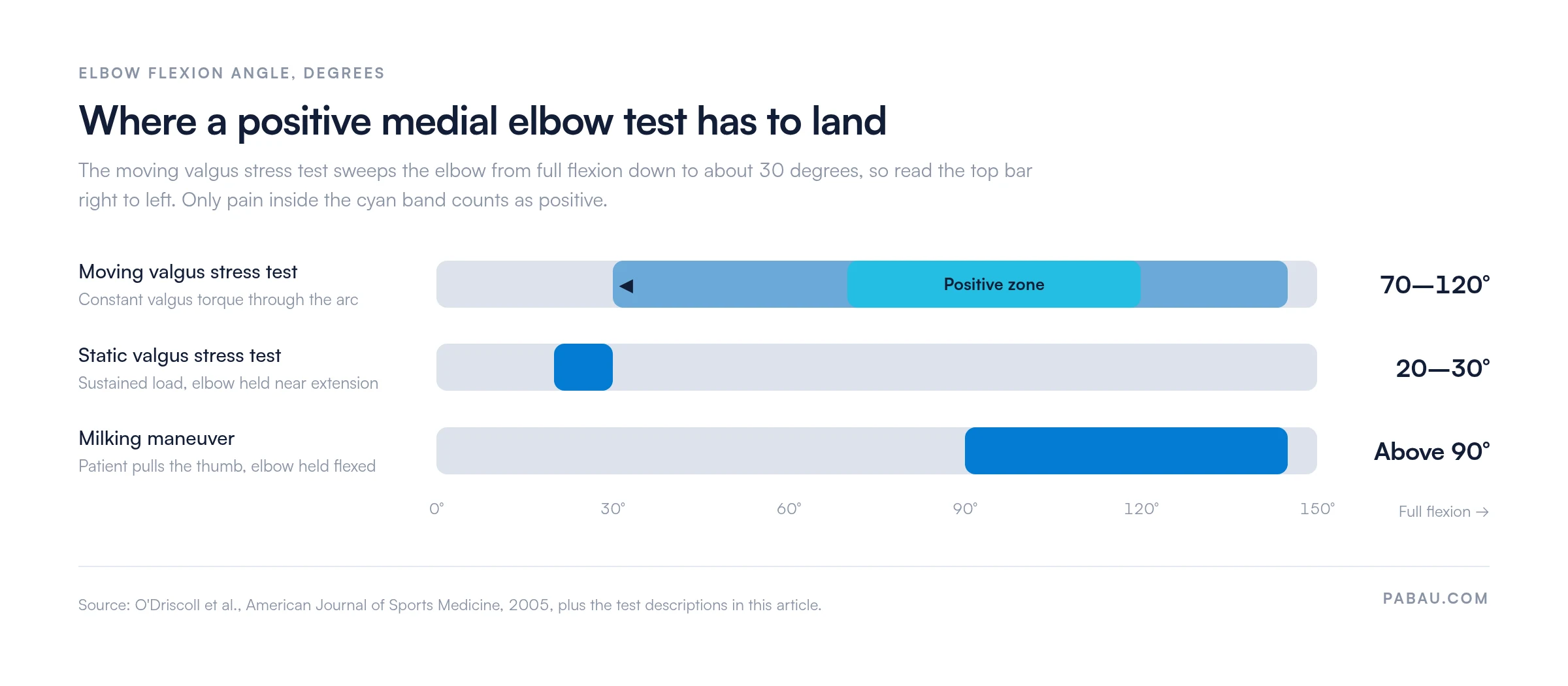
Pain outside that arc, or pain that is not clearly medial, does not make the test positive. A few distinctions keep the interpretation honest:
Take a worked example. A 19-year-old college pitcher reports medial pain that builds through an outing. On testing, pain appears at 112 degrees, peaks near 95, and has gone by 65. He says it is the pain he gets on the mound. That is a positive test in a high-probability patient, and it is worth imaging.
Now change one detail. The same arc of pain turns up in a swimmer with no throwing history, and it is diffuse rather than ulnar-sided. Same maneuver, far weaker finding.
In the original study the test caught every torn ligament, and wrongly flagged one healthy elbow in four. O’Driscoll and colleagues tested 21 overhead throwing athletes against arthroscopic findings.
The headline figures are strong and the cohort is small, so read them alongside the Physiotutors diagnostic summary of the evidence since.
Two practical readings come out of that table. A negative test in a symptomatic pitcher moves you toward other diagnoses, such as medial epicondylitis, flexor-pronator strain or ulnar neuritis. If the pain sits posteromedially near full extension, the valgus extension overload test checks for olecranon impingement instead.
A positive test buys you less, because a quarter of uninjured elbows also test positive. Confirm it with imaging before anyone raises surgery.
Write down the angle where medial pain starts and the angle where it stops, not just a positive or negative result. Pain peaking at 80 degrees reads differently from pain peaking at 110, and that detail is what the next clinician needs.
Five limits are worth knowing before you lean on a single positive finding:
The moving test screens, the static test checks endpoint stability, and the milking maneuver covers you when a patient cannot tolerate the sweep. Choosing between them works like any other bedside rule.
The Ottawa ankle rules narrow imaging decisions at the ankle. These three do the same at the elbow.
Most thorough medial elbow exams use two of the three. The moving test screens, because its sensitivity is the highest of the group. The static test adds endpoint information when you suspect a complete rupture. The milking maneuver is the fallback when pain or positioning makes the sweep impractical.
Write down the arc, not the verdict. A note that says positive tells the next clinician very little, and it tells you even less at the six-week review.
Athletes move between physical therapists, strength coaches and team physicians, and each handover loses whatever nobody wrote down. A thin note also reads badly if an outcome is ever questioned.
Before you close the record, check you have captured:
The common mistakes are easy to spot once you look for them. The note says positive but gives no angles. Nobody recorded whether the pain matched what the athlete feels on the mound. The test never gets repeated after rehabilitation, so there is nothing to compare against.
Keeping the exam on the same structured patient records as the rest of the episode is what makes that comparison possible later.
In plenty of practices the record of this exam is still split across tools. The exam goes in a paper note or a free-text box, the intake history sits in an email, and the follow-up lives in someone’s diary.
Practices looking for something better often start by comparing sports medicine software, then check whether the note templates fit how they assess.
Practice management software like Pabau keeps the whole episode in one patient record. You can build a note template for the medial elbow exam.
Give it fields for the side tested, the shoulder position, and the onset and offset angles. Digital intake forms collect throwing load, symptom duration and prior imaging before the athlete walks in.
The payoff shows up at the second visit. Last month’s arc sits next to today’s, so you can see whether 112 to 65 degrees has narrowed or disappeared. When an athlete transfers to a colleague, the handover is the record itself.


Pabau gives sports medicine and physical therapy practices structured note templates, digital intake forms and one record per athlete. Findings stay comparable from visit to visit.

The moving valgus stress test is quick, costs nothing, and is unusually good at ruling UCL insufficiency out. Ruling it in is another matter. Treat a negative result in a symptomatic thrower as a strong signal, and a positive one as a reason to image.
Most of its value comes down to discipline. Use the same shoulder position every time, keep the torque on, and write the angles down. Do those three things and the result stays comparable across clinicians and across a season.
If your notes on assessments like this one live in three different places, that is worth fixing before the next season starts. Book a demo to see how Pabau keeps an athlete’s exam findings, intake history and follow-ups on one record.

Need to rule out lateral elbow pain in the same session? Cozen’s test for tennis elbow walks through the assessment and gives you a form to record it on.
Reloading an elbow after injury? The elbow stiffness exercises handout gives patients a printable progression to work through between appointments.
Screening athletes before a season? The sports physical form template covers history, clearance and the fields most leagues ask for.
Setting up a practice of your own? How to open a physiotherapy clinic runs through the operational and compliance steps in order.
Yes. Clinicians use it during a return-to-throwing progression, to see how the reconstructed elbow handles valgus load. The original validation did not include reconstructed elbows. Compare the result with the athlete’s pre-surgery finding and with the other arm, rather than with the published accuracy figures.
No. A positive test points at the ligament. It does not set the treatment plan. Many partial tears settle with rest and a graded throwing program. Imaging, symptom history and the athlete’s competitive level decide what happens next.
Explain that you will straighten the elbow quickly while pushing the forearm outward, and that it may reproduce their pain. Ask them to say when it starts and when it eases, as it happens. A patient who braces can mask the finding.
Re-test at the points where load changes. That means before pre-season throwing starts, after any jump in volume or velocity, and at each stage of a return-to-sport progression. Re-testing after rehabilitation is what tells you whether the painful arc has narrowed.
Palpate the flexor-pronator mass and the medial epicondyle, and test the ulnar nerve for irritation. All three can produce medial pain under valgus load. Checking them keeps you from crediting the UCL with someone else’s symptoms.