Botox reconstitution chart
A Botox reconstitution chart shows how much saline to add to a vial and how many...

1
Last Updated: Oct 6, 2026

Med spa valuation is adjusted EBITDA multiplied by a market multiple, not a share of revenue.
EBITDA multiples typically run from 3x to 8x, depending on size, membership revenue, and provider independence.
The two biggest valuation suppressors are owner dependency and undocumented financials. Both are fixable before a sale.
Start 12 to 24 months out, because recurring revenue and clean books take time to show up.
Practice management software like Pabau keeps membership data and financial records in the shape buyers ask for.
A med spa is worth its adjusted EBITDA multiplied by a market multiple, and that multiple usually lands between 3x and 8x. Total cost of ownership, which our comparison of med spa management software covers, is one way to see what software takes out of EBITDA. Revenue feels like the obvious number to anchor to, but buyers do not buy revenue. They buy profitability, predictability, and the odds that revenue holds up after the owner walks out the door.
Get the number wrong and you either leave six or seven figures on the table, or you struggle to raise capital. A valuation also earns its keep well before any transaction. It informs partnership talks, equity financing, succession planning, and the plain question of whether the business is building value or just generating cash.
This guide covers how med spa valuation works and what EBITDA multiples to expect. It also covers the drivers that move your multiple, and what to fix before you speak to a buyer.
Adjusted EBITDA (earnings before interest, taxes, depreciation, and amortization) is the currency of med spa valuation. Industry consensus among M&A advisors treats revenue multiples as a secondary sanity check. A practice generating $800K in revenue but $80K in EBITDA is worth far less than one at $600K revenue and $200K EBITDA.
The calculation has three steps. Start with net income from your P&L. Add back non-cash items such as depreciation and amortization. Then add back owner-specific costs a new buyer would not incur. The result is adjusted EBITDA, and applying a market multiple to it gives you your valuation range.
Add-backs are the items that lift adjusted EBITDA above what appears on your tax return. They are legitimate, widely accepted by buyers, and can meaningfully shift your valuation. The most common categories are below.
Work with a qualified valuator or M&A advisor when you set your add-backs. Buyers scrutinize every line, and a contested add-back can stall a deal. The cleaner your financial records, the fewer arguments there are.
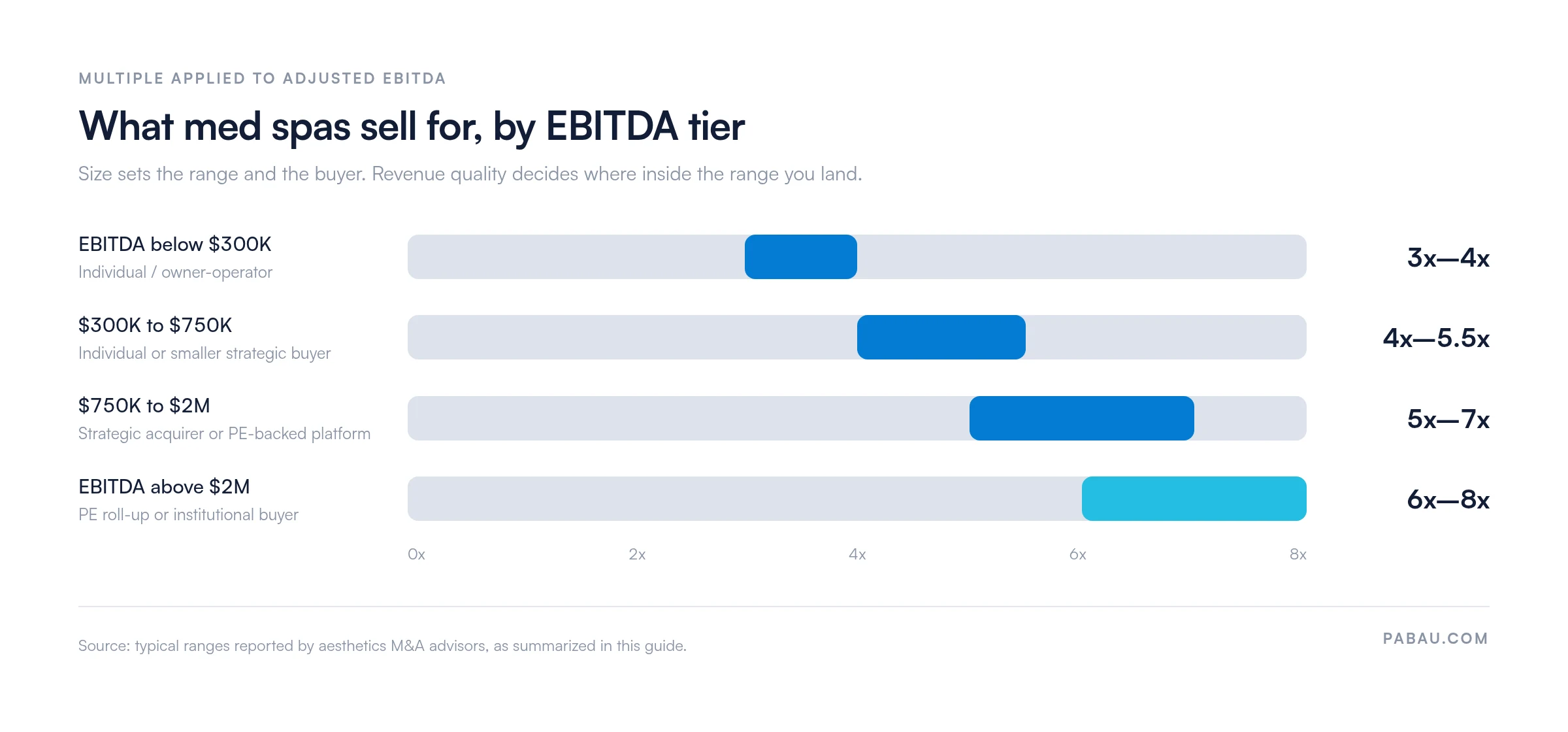
Most med spas trade between 3x and 8x adjusted EBITDA. Practice size and revenue quality are the primary inputs, while buyer type and market conditions shape the final number. The ranges below step up with size, and they overlap at the edges.
Revenue multiples of 0.5x to 1.5x of top-line revenue are sometimes used as a quick sanity check. Buyers do not underwrite deals on revenue alone. A revenue multiple on a low-margin practice produces a number that no serious buyer will pay.
Two practices with the same adjusted EBITDA can receive very different multiples. The difference comes down to revenue quality, operational independence, and how predictable the income stream looks to a buyer. Tracking your med spa KPI benchmarks gives you the data to see where you sit on each one.
Recurring membership revenue is the single most powerful variable in med spa valuation. According to FOCUS Investment Banking’s research on aesthetics M&A, practices where memberships make up 30 to 40 percent or more of revenue command higher multiples. Buyers value predictability.
A practice where 35 percent of revenue arrives automatically each month looks very different from one that lives on fee-for-service appointments. The first has a floor under it. The second starts every month at zero.
Tiered membership structures let a practice capture different client segments while keeping the recurring base diverse. Whatever structure you pick, the operational side matters as much as the pricing. Renewal rates, lapsed members, and revenue per member are the membership numbers a buyer asks for in due diligence.
Provider independence is the second most-cited valuation driver in med spa M&A. The question buyers ask is simple. Does revenue hold up if the owner stops treating patients? If the answer is no, the multiple compresses, and advisors consistently name owner dependency as a leading valuation suppressor.
Reducing dependency is partly a hiring decision and partly an operational one. Documented workflows, automated recall systems, and standardized patient journey steps all reduce the sense that the business revolves around one person. A buyer paying 6x EBITDA needs to believe the income survives a leadership transition.
Owner dependency, messy financials, and revenue concentrated in one treatment are what pull a valuation down. Buyers run their own due diligence, and they look for exactly these. The good news is that each red flag is fixable before a formal sale process begins.
Most of these are operational problems rather than structural ones. A practice that spends 12 to 18 months working through them arrives at market in far better shape, and the offer reflects it. A medical spa compliance checklist is a useful starting point for the regulatory side.
Run a shadow audit before you hire an M&A advisor. Pull your last three years of P&Ls and separate personal from business expenses. Then calculate your owner salary against market-rate replacement cost and tally your membership renewal rate. These numbers reveal your adjusted EBITDA and your biggest valuation vulnerabilities before anyone else sees them.
Three buyer types dominate med spa deals, and each pays a different range. Buyer type shapes the deal structure too, so knowing which one you are courting tells you what they need to see before they commit. Med spa MSO structures matter here if you are weighing a PE-backed sale, since most institutional platforms use one for regulatory compliance.
PE-backed platforms usually pay the highest multiples, because a portfolio of practices lets them capture cost synergies. They are also the most demanding on due diligence. Their investment committees want documented financials, clean membership data, and evidence of provider independence. Practices that cannot show these end up negotiating with individual buyers at lower multiples.
The headline multiple is only part of the deal. How the payment is structured determines how much you receive and when. The four most common structures are:
Deal structure is where legal and financial counsel becomes essential. The nominal multiple matters less than the net present value of what you receive. Always work with an M&A attorney and a CPA who understands healthcare transactions before you sign a letter of intent.
The best time to start is 12 to 24 months before you want to sell. Most of what buyers care about cannot be changed quickly. Recurring revenue takes months to build, and provider independence needs documented processes and a developed team. Clean financials need two full years of consistency before buyers trust them.
The priority order is concrete. Build a membership program that generates consistent recurring revenue. Document every treatment protocol, hiring process, and patient journey step so the business runs without your direct involvement. Then clean up your financial records so adjusted EBITDA is easy to calculate, support, and explain.
Get one at least 18 to 24 months before a planned sale, then repeat it every year. A valuation earns its keep long before you list the practice. Treated as an operating metric, it tells you whether the past year built enterprise value or only revenue.
Owners who know their number make better decisions about where to invest, when to hire, and whether last quarter’s changes moved the multiple. Owners who first find out during a sale process have run out of time to act on the answer.
In most med spas, the owner is the system. Treatment protocols live in their head, membership renewals get chased by hand, and the financial picture only comes together when the accountant asks for it. Buyers read all three as risk.
Practices running on integrated medical spa software can show a buyer that operations do not depend on one person. Practice management software like Pabau runs appointment workflows, digital consent forms, treatment records, and recall messaging without the owner touching them.
Pabau’s reporting tools produce the auditable revenue data a buyer’s accountant works through in due diligence. Membership management tracks renewal rates, lapsed members, and revenue per member automatically, so your recurring-revenue story rests on records rather than recollection. Treatment-mix breakdowns come out of the same system that runs the day.
Treat that as an infrastructure investment in your exit value rather than an operating cost. A buyer paying 6x EBITDA for a $500K-EBITDA practice is paying $3 million. If documented, systemized operations justify even a half-multiple improvement, from 5.5x to 6x, that is $250,000 on the sale price.

Pabau’s membership management, reporting, and automated workflows give buyers the documented operations and clean recurring-revenue data they underwrite. See it in a 30-minute demo.

The valuation you can defend matters more than the one you hope for. Buyers underwrite adjusted EBITDA and the quality of the revenue behind it. A practice that runs on documented systems and recurring income prices above one that runs on its owner.
So start early. Building memberships, documenting protocols, and cleaning up the books takes 12 to 24 months to show up in numbers a buyer will trust. Starting the year you decide to sell is starting too late.
Want the operational record and membership data that support a higher multiple? Book a demo and we will walk you through how Pabau tracks both.

Want the metrics behind your valuation baseline? Med spa KPI guide covers the operational numbers that feed straight into adjusted EBITDA.
Building recurring revenue before a sale? Building a med spa membership program walks through the structure, pricing, and retention tactics buyers value most.
Ready to think about your next location or exit? Scaling a med spa business outlines the decisions that build enterprise value alongside revenue growth.
Pricing your memberships from scratch? Med spa membership packages breaks down the tiers, inclusions, and price points that keep members renewing.
Running more than one location? Financial management for med spa franchises covers the reporting discipline multi-site owners need before an exit.
A med spa valuation estimates what your practice is worth to a buyer or investor. It applies a market multiple to your adjusted EBITDA. Revenue alone will not get you there, because buyers pay for profitability and predictability.
Most med spas sell for 3x to 8x adjusted EBITDA. Practices with EBITDA below $300K typically attract 3x to 4x. Those above $2M with strong membership revenue and provider independence can reach 6x to 8x from PE-backed buyers.
Your med spa is worth its adjusted EBITDA multiplied by a market multiple, usually between 3x and 8x. Size, membership revenue share, provider independence, and the quality of your financial records decide where you land. A practice with $400K adjusted EBITDA and strong recurring revenue could be worth $1.6M to $2.2M.
Membership revenue improves valuation by making income more predictable. FOCUS Investment Banking’s aesthetics M&A research finds that practices where memberships are 30 to 40 percent of revenue attract higher multiples. Recurring income reduces the buyer’s risk. A practice with no membership revenue depends entirely on appointment volume, which can drop overnight.
Yes. Provider dependency is one of the two most commonly cited valuation suppressors in med spa deals. If a buyer believes revenue will decline when you stop treating patients, they will lower the multiple or walk away. Documented protocols, a capable clinical team, and automated systems all reduce that risk.
The most accepted add-backs are owner salary normalization, personal expenses run through the business, and one-time non-recurring costs. Depreciation on equipment is added back by definition. Each add-back raises adjusted EBITDA and therefore the valuation, so a contested add-back can slow or derail a deal.