GLP-1 diet plan
A GLP-1 diet plan is a structured eating framework for patients taking semagluti...

2
Last Updated: Oct 13, 2026

Maudsley’s test is a clinical orthopedic special test for lateral epicondylitis, also known as tennis elbow. The examiner resists middle finger extension with the patient’s elbow fully extended.
A positive result is pain felt at the lateral epicondyle during resisted extension of the middle finger, not general elbow pain.
A 2021 systematic review in the Journal of Hand Therapy puts Maudsley’s test sensitivity at roughly 70%. Cozen’s test reaches about 91% and Mill’s test about 76%. Specificity data are sparse and mixed, so never read a positive result on its own.
Maudsley’s test can return a false positive in radial tunnel syndrome. Work through that differential before you settle on a diagnosis.
Structured digital assessment forms in practice management software like Pabau let clinicians record special test findings, pain location, and differential diagnoses on one patient record.
Maudsley’s test checks for tennis elbow by resisting middle finger extension with the elbow straight. Pain at the lateral epicondyle is a positive result. It points to the common extensor origin as the source of the patient’s lateral elbow pain.
The test takes seconds, needs no equipment, and brings on pain in most patients who have the condition. What it cannot do is confirm the diagnosis on its own. This guide covers the technique, the interpretation, the published accuracy figures, and the differential that catches clinicians out most often.
Lateral epicondylitis affects 1% to 3% of the general population each year, so clinicians in physical therapy and sports medicine practices see it regularly. Lateral elbow pain has many causes, and the exam has to tell them apart quickly and reliably.
Maudsley’s test is an orthopedic special test that selectively loads the extensor digitorum communis (EDC) at its origin on the lateral epicondyle. By isolating middle finger extension against resistance, the test loads that attachment site while sparing most of its neighbors. It narrows the picture rather than settling it, because other causes of lateral elbow pain can hurt on the same maneuver.
The test belongs to a broader set of lateral epicondylitis special tests that includes Cozen’s test, Mill’s test, and the chair test. Accuracy data for these tests are limited and highly variable. Standard practice combines at least two of them with a structured history before treatment starts. The American Physical Therapy Association (APTA) maintains the clinical practice guideline library for the wider musculoskeletal evidence base.
The lateral epicondyle of the humerus serves as the common extensor origin, the attachment point for five forearm extensor muscles. Lateral epicondylitis is a degenerative tendinopathy of this common extensor origin. It most prominently affects the extensor carpi radialis brevis (ECRB), and to a lesser extent the extensor digitorum communis.
Maudsley’s test targets the EDC for an anatomical reason. The middle finger’s extensor tendon originates from the most superficial and laterally exposed portion of the common extensor origin. Resistance applied to middle finger extension loads this tendon while placing minimal stress on adjacent structures, which makes it a precise, selective way to stress that tendon.
The test is simple, but precise patient positioning and examiner technique are critical for a reliable result. Sloppy positioning or poorly applied resistance generates inconclusive findings and increases the risk of false negatives.
Document the findings in the patient’s clinical record right after the exam. Digital assessment forms let you capture the result, the pain location, and a numeric pain score in named fields rather than free text. That makes the next comparison quick.

Interpretation hinges on where pain shows up, not simply whether pain is present. A positive Maudsley’s test requires pain localized to the lateral epicondyle during resisted middle finger extension with the elbow in full extension.
Always read a positive result along with the clinical history. Activity-related onset, point tenderness over the lateral epicondyle, and grip weakness all support the diagnosis. Confirm the finding with at least one more test, such as Cozen’s test. The diagram below routes the three findings you can get, including the one that points away from the tendon.
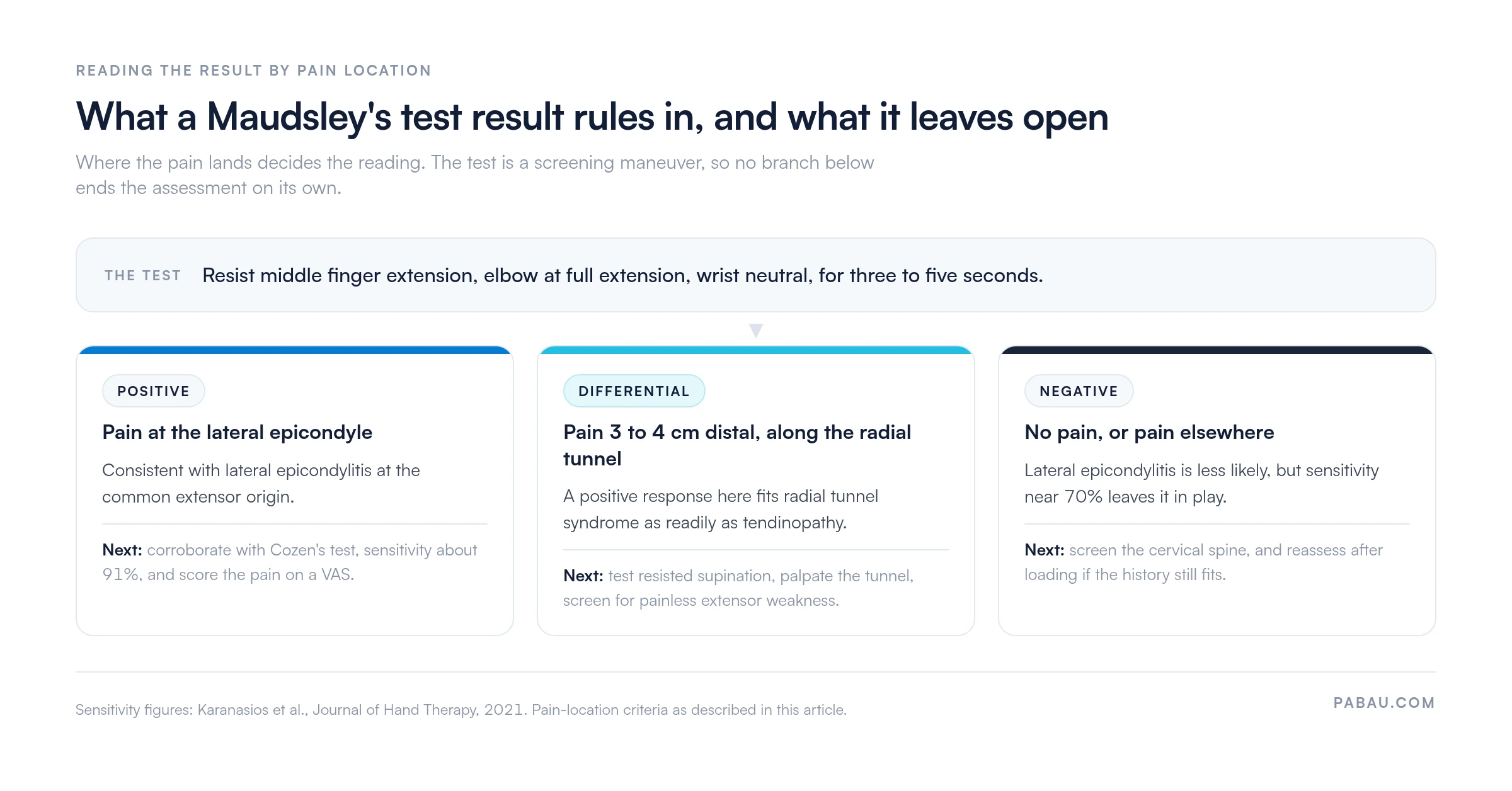
Always ask the patient to localize their pain with one finger right after performing Maudsley’s test. Point pain at the lateral epicondyle reinforces the positive finding. Pain diffusing along the radial tunnel or posterolateral forearm points elsewhere. Suspect radial tunnel syndrome or posterior interosseous nerve entrapment rather than simple lateral epicondylitis.
Published accuracy data for Maudsley’s test are thinner than most textbook summaries suggest. The current evidence synthesis is a systematic review by Karanasios and colleagues in the Journal of Hand Therapy (2021). Of the 24 diagnostic studies it included, only two looked at physical exam tests at all. Across that small evidence base, Cozen’s test recorded the highest sensitivity at roughly 91%. Mill’s test followed at about 76%, and Maudsley’s test at about 70%.
Specificity is where the evidence almost runs out. The same review reports that guideline-recommended exam tests span sensitivity of 53% to 91% and specificity of 0% to 100%. It also graded 97% of the included studies at unclear or high risk of bias. One 30-patient validation study by Saroja and colleagues (2014), scored against ultrasound, recorded 88% sensitivity and 0% specificity for Maudsley’s test. Mill’s test recorded 53% sensitivity and 100% specificity in that same sample.
Read practically, that pattern makes Maudsley’s test a screening maneuver rather than a confirmatory one. A negative result argues against lateral epicondylitis, since most affected patients do report pain on the test. A positive result settles far less, because patients with other causes of lateral elbow pain often report pain as well. Treat any single published specificity figure for this test as provisional.
Sensitivity figures come from the Karanasios et al. (2021) systematic review. Specificity figures come from a single 30-patient study by Saroja et al. (2014), scored against ultrasound. That same study reported sensitivities of 88% for Maudsley’s, 84% for Cozen’s and 53% for Mill’s. Both evidence bases are small, so read every figure as indicative rather than settled.
Each test in this group loads the common extensor origin a different way, which is why they are used together. Clinicians running a complete lateral elbow assessment often combine two or three of them.
Cozen’s test, also called the resisted wrist extension test, is the most widely used clinical test for lateral epicondylitis. It is often paired with Maudsley’s test. The patient makes a fist and extends the wrist against the examiner’s resistance, with the elbow in full extension. A positive result is pain at the lateral epicondyle. Cozen’s test loads the ECRB and EDC together, which makes it a broader provocation than the single-finger stress of Maudsley’s test. Our Cozen’s test template gives you a printable form for recording both results side by side.
Mill’s test uses passive stretch rather than resisted contraction. With the elbow extended and the forearm pronated, the examiner passively flexes the wrist fully while palpating the lateral epicondyle. A positive result is pain at the lateral epicondyle during this passive stretch. Mill’s test loads the common extensor origin through tensile stretch rather than the contractile stress used in Maudsley’s and Cozen’s tests. That makes it a useful complement, because it assesses a different tissue response.
The chair test is a functional provocation test. The patient attempts to lift a chair from behind with a pronated grip and an extended elbow. Pain at the lateral epicondyle is a positive finding. It is useful for assessing functional loading capacity, and for tying the clinical findings to the patient’s work or sporting demands.
Maudsley’s test brings on pain in most patients who have lateral epicondylitis, but two limits determine how much weight the result carries in practice.
The posterior interosseous nerve (PIN), a branch of the radial nerve, passes through the radial tunnel just anterior and lateral to the lateral epicondyle. Radial tunnel syndrome involves entrapment or irritation of the PIN at this site. The resulting lateral elbow pain closely mimics lateral epicondylitis on clinical exam. Maudsley’s test can be positive in both conditions.
The key differences are as follows.
Do not rely on Maudsley’s test alone to tell these two conditions apart. A neurological screen, a palpation map, and a sequence of provocative tests are all required whenever the clinical picture is unclear.
Maudsley’s test is appropriate as part of a structured lateral elbow assessment in the following clinical scenarios.
Maudsley’s test is not a standalone diagnostic test. Guidelines across physical therapy and sports medicine support combining a few tests with a structured clinical history. Build a standardized elbow assessment into your digital intake forms from the outset. That keeps records the same across clinicians and makes it easy to review outcomes over time.
Most physical therapy and sports medicine practices still record special test results as free text in a note. Others use a paper assessment sheet that gets scanned in later. Each clinician writes it up differently, so comparing a follow-up test against the baseline means reading three narratives and guessing.
Practice management software like Pabau replaces that with structured digital assessment forms. Test results, pain location, pain scores, and differential diagnosis notes sit in named fields on the patient record. The next clinician to see the patient reads the same baseline you recorded, in the same format.
The payoff shows up at review. A physical therapy EMR holds the finding in a fixed field. You can see at a glance whether pain on resisted middle finger extension has changed since the first visit. When a case is audited or handed over, you can show a documented assessment protocol instead of a paragraph of prose.


Pabau gives physical therapists and sports medicine clinicians structured digital forms for special test findings, injury histories, and treatment plans. It all links to one patient record, so there is no paper and no double entry.

Lateral elbow pain is common, and the differential is not always simple. Maudsley’s test gives you a precise way to load the common extensor origin, and it brings on pain in most patients with lateral epicondylitis. It confirms much less than that on its own. Use it along with Cozen’s, Mill’s, and the chair test rather than on its own, and keep radial tunnel syndrome in the differential.
Recording the finding matters as much as performing the test correctly, because the next clinician reads your note rather than repeating the exam. If you are weighing up systems, our guide to physiotherapy clinic management software compares what each one does with assessment data. Book a demo to see how Pabau handles elbow assessments, from the first test through to discharge.

Assessing an elbow that feels unstable rather than sore? Posterolateral drawer test covers the technique for posterolateral rotatory instability, which sits next to tendinopathy in the lateral elbow differential.
Want a printable form for the paired wrist extension test? Cozen’s test template gives you a structured sheet for recording positioning, pain location, and the result.
Running a physical therapy practice and need compliance guidance? Mandatory compliance for physiotherapy clinics covers the records, data protection, and regulatory requirements every practice must meet.
Planning to open a new practice? Opening a physiotherapy clinic walks through the operational, staffing, and setup decisions that affect clinical quality from day one.
Maudsley’s test is a clinical orthopedic special test used to assess lateral epicondylitis (tennis elbow). The examiner applies resistance to middle finger extension with the patient’s elbow in full extension. Pain felt at the lateral epicondyle is a positive result, and it suggests pathology at the common extensor origin.
A positive Maudsley’s test indicates pain localized to the lateral epicondyle during resisted middle finger extension, which matches lateral epicondylitis (lateral elbow tendinopathy). It does not confirm the diagnosis alone; clinical correlation with history, palpation findings, and additional special tests is required.
Yes. Maudsley’s test can produce a false positive in radial tunnel syndrome, because resisted middle finger extension also loads the posterior interosseous nerve. Telling the two conditions apart requires assessing pain location, epicondyle versus 3 to 4 cm distal. You also need a neurological screen and provocative tests specific to the radial tunnel.
Use Maudsley’s test as part of a structured lateral elbow assessment for activity-related lateral elbow pain. It is especially relevant with a history of repeated gripping or forearm rotation. It is most useful combined with Cozen’s test and Mill’s test. Reach for it when Cozen’s test produces an unclear or diffuse pain response.