Healthcare workforce planning: a practical guide for practice leaders
Healthcare workforce planning is the structured process of matching clinical cap...

Last Updated: Oct 13, 2026

Difficult encounters affect up to 15% of primary care visits, so every practice team needs a systematic response.
The most effective response combines staying calm, active listening, and identifying the root cause before setting boundaries or escalating.
Documentation after every difficult encounter is a medico-legal requirement. Record facts objectively and avoid interpretive language.
Practice management software like Pabau flags a patient record, so your whole team can prepare before the appointment starts.
The fastest way to defuse a difficult patient encounter is to stay calm and listen without interrupting. Find the reason behind the behavior before you set any limits.
Difficult encounters are common enough to plan for. According to the American Academy of Family Physicians, they account for up to 15% of all primary care visits. Left unmanaged, they drain clinician energy, create liability exposure, and wear down team morale.
This guide covers why patients become difficult, the communication and patient care management strategies that work, what to document, and when to escalate. It also covers how your practice systems prevent many of these encounters before they start.
These work in sequence during a live encounter. Jump to the full breakdown below for how to apply each one.
A patient is usually labeled difficult when their expectations, distress, or circumstances collide with what the appointment can deliver.
A peer-reviewed study found that patients labeled difficult most often present with unmet expectations, complex psychosocial needs, or underlying mental health conditions. The behavior itself is rarely the root problem.
Common underlying drivers include:
Understanding these drivers changes how you respond. A patient who seems demanding may simply be frightened. One who appears non-adherent may be facing barriers nobody has asked about.
Mental health conditions drive a large share of these encounters. Practices running a mental health EMR can record that context at intake, so the next clinician sees it before the patient walks in.
The same reframe helps with patient compliance challenges. When a patient repeatedly misses instructions or refuses treatment, the instinct is to label them non-compliant. The better question is what makes adherence hard for them.
Recognizing a patient’s behavioral pattern helps you respond with the right strategy. Below are the most common types of difficult patients in clinical practice.
Where hostility keeps recurring, a structured tool helps. The clinical anger scale gives you a repeatable way to record severity instead of a subjective note.
These seven strategies reflect the consensus across clinical literature. They work in sequence during a live encounter.
Holding your composure with an angry patient is harder than it sounds. Three techniques help:
These are moves you can rehearse in a team meeting long before you need them.
Research consistently shows that empathic communication is the most effective strategy for difficult encounters. Active listening means holding appropriate eye contact and using brief verbal affirmations such as “I see” or “go on”. Summarize what the patient has said before you respond.
Building rapport also reduces how often these encounters happen. Patients who feel known and respected by their care team are less likely to become confrontational. Consistent patient communication between visits does much of that work for you.
Limits land better when you communicate them as practice policy rather than personal rejection. Opening with “Our practice has a policy of…” takes the adversarial edge off the conversation.
Be specific about consequences. If a patient continues to be abusive, the appointment will be paused. If a prescription request falls outside clinical guidelines, explain why. Vague limits invite negotiation, and specific ones are easier to enforce consistently.
Document any limit-setting conversation in the patient record immediately after the encounter. Note what was said, how the patient responded, and any agreed next steps. This protects your team and creates a clear record if the situation recurs.
De-escalation is the core clinical skill for managing a difficult appointment. The six techniques below reflect the evidence base and work in any clinical setting, including video visits, where a secure videoconferencing setup keeps tense conversations private.
Physical aggression is a different situation entirely. If a patient becomes physically threatening, staff safety comes first. Leave the room and involve security or emergency services. Do not try to manage physical aggression through communication alone.
Write up a difficult encounter the same day, in objective language, naming what was said and who was present. The Medical Defence Union advises that thorough, objective records are the primary protection for clinicians in complaints and legal proceedings.
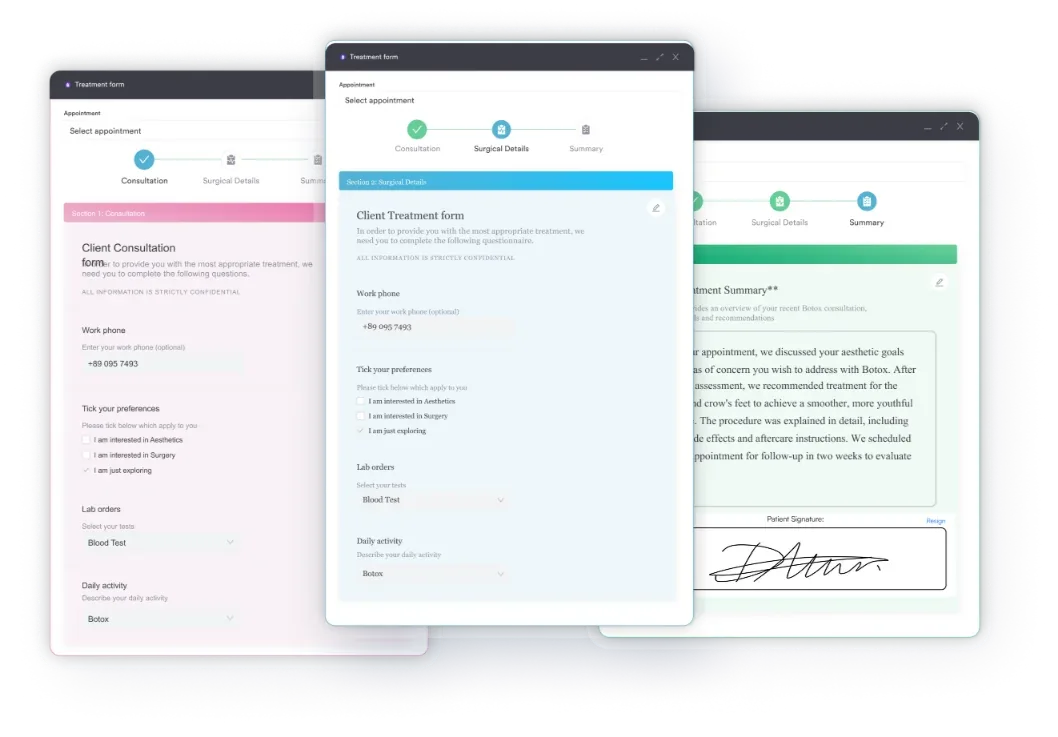
Digital intake forms and structured clinical notes reduce the risk of incomplete records. A new patient questionnaire captures history and expectations before the first appointment, which often surfaces friction early.
Key documentation principles:
Good documentation also supports continuity. When a difficult patient returns, any clinician reviewing the record can see what happened before and prepare. Capturing patient feedback alongside clinical notes shows patterns over time.
Escalate when the situation exceeds your clinical scope, threatens staff safety, or has stopped responding to de-escalation. Not every difficult encounter can be resolved inside the immediate clinical relationship. In pediatric encounters where inattention drives the friction, scoring the Vanderbilt ADHD rating scale turns behavior complaints into referable data. Appointment booking handled by phone alone caps how many appointments a practice can take in a day. Appointment booking handled by phone alone caps how many appointments a practice can take in a day.
Refer or escalate when:
For mental health crises, crisis intervention strategies offer a structured clinical framework. These are distinct from general de-escalation and need specific training and protocols.
In the UK, practices may remove a patient from their list under GMC and NHS guidelines. This is a last resort with specific procedural requirements. The MDU publishes jurisdiction-specific guidance on the process. Consult a medical defense organization before you take this step.
A hostile appointment does not end when the patient leaves. Healthcare provider burnout is closely linked to repeated exposure to hostile or distressing patient interactions without support or debrief.
Three practices meaningfully reduce the cumulative toll:
Practice owners and managers have a direct role here. Building debrief time into the team schedule, normalizing requests for support, and making sure no clinician faces a known high-risk patient alone are operational decisions.
The American Medical Association’s guidance on physician burnout makes the same point. Institutional support is what sustains healthcare staff long term, and individual resilience alone does not.
Communication technique is only half the job. The other half is what your practice does before the patient arrives, and that half is operational.
Operational friction creates patient frustration. Long waits without updates, unclear pre-appointment instructions, and missed reminders all arrive at reception as irritation. Reducing patient no-shows with automated reminders also removes the frustration of patients who waited and were then deprioritized.
Practice management software like Pabau closes the loop between the encounter and the record. Here is what that looks like day to day:
The result is a consistent approach to difficult patients rather than individual clinicians remembering, improvising, and coping alone. Measuring patient satisfaction alongside these tools surfaces patterns before they turn into recurring encounters.

Pabau’s patient flagging, internal notes, and automated workflows give your team the context they need before a challenging appointment starts. See how it works.

Difficult patients will keep arriving. What you control is whether your team meets them with a rehearsed response or improvises every time.
Pick one change and make it stick. For most practices that is same-day documentation, because it protects the clinician and gives the next colleague something to work from.
The trade-off worth remembering is time. Debriefs, flags, and careful notes cost minutes now and save hours of complaint handling later. Book a demo to see how Pabau keeps difficult patient history visible to your whole team.

Want fewer no-shows and more rebookings? Patient retention software compares tools by whether their automation reads the clinical record or a separate system.
Want to catch problems before they escalate? Patient satisfaction survey software gives your practice a structured way to hear about friction early.
Need a ready-made list of survey questions? Patient survey template gives you 15 questions across scheduling, communication, care, and facility.
Five patterns cover most cases. Demanding patients are usually anxious or feeling out of control. Non-adherent patients often face practical or belief-based barriers. Aggressive patients are frequently responding to pain or fear. Manipulative patients may have unmet pain management needs. Anxious or distressed patients can be overwhelmed by a diagnosis or a mental health condition. Identifying the pattern guides your response.
De-escalate by staying calm, slowing your speech, and giving the patient uninterrupted time to speak. Then validate their emotional experience without necessarily agreeing with their position. If the situation keeps escalating, move to a private room, bring in a colleague, or offer a short break. Physical threats require security or emergency services, not communication techniques alone.
Respond by staying calm, lowering your voice, and keeping a composed posture. Do not match the patient’s energy. Acknowledge that they are upset without agreeing with any abusive behavior. State your limits clearly once. If the situation becomes physically threatening, leave the room and involve security. Document the encounter in detail immediately afterward.
Show empathy by naming the patient’s emotional experience aloud: “I can see this has been really difficult for you.” Maintain eye contact, avoid interrupting, and summarize what the patient has told you before you respond. Empathy does not require agreeing with the patient’s demands. It requires acknowledging their experience and showing that you are listening. Clinical evidence rates this as the single most effective de-escalation technique.
Use the same principles: stay calm, listen without interrupting, and validate the concern before explaining what you can and cannot do. Front-desk staff should know in advance which patients have flags on their records. That way they can prepare the interaction. If a situation becomes unsafe, contact clinical staff or management rather than managing it alone.
Escalate when the patient presents a clinical complexity beyond your scope, such as acute suicidal ideation. Escalate also when there are threats toward staff or other patients, or when repeated encounters are causing significant team distress. The same applies when the patient-clinician relationship has broken down completely. In the UK, removing a patient from a practice list is a regulated process requiring GMC and NHS compliance. Consult your medical defense organization before taking this step.
Practices can introduce patient flagging so all staff are alerted before a known difficult patient’s appointment. Building debrief time into team schedules helps, as does making sure no clinician faces a high-risk patient alone. Practice management software that shares clinical notes across the team supports both. Institutional support protects staff from cumulative burnout more reliably than individual resilience.