Professional development record
A professional development record is a structured log of a healthcare practition...

8
Last Updated: Oct 8, 2026

Healthcare inventory management covers tracking, ordering, and distributing supplies across medications, consumables, and equipment.
Stockouts and expired stock are the two most damaging failures, and par levels plus disciplined rotation prevent both.
Practices differ from hospital supply chains in team size, storage space, and the product types tied to each treatment.
Practice management software like Pabau links stock consumption to treatment records, so cost-per-treatment reporting is automatic.
Healthcare supply chains break down quietly. A stockout of syringes delays a procedure.
An expired batch of dermal filler gets written off. A receptionist orders double the consumables because no one updated the spreadsheet. Individually, these failures look minor. Together they drain practice finances and, at worst, create a patient safety risk. The Association for Health Care Resource and Materials Management (AHRMM) puts supply chain costs second only to staffing among healthcare expense categories.
Most guidance on this subject is written for hospital supply chain departments. This guide is written for the scale that has none. It covers what healthcare inventory management is and where stock control usually breaks down. It also sets out the handling rules that keep waste and emergency ordering in check.
Healthcare inventory management is the systematic process of ordering, tracking, storing, and distributing medical supplies across a healthcare facility. It covers every physical input used in patient care:
A printable medical office supplies list turns those categories into a stocking checklist, with a reorder trigger against each consumable.
At practice scale, the job usually falls to a practice manager, lead clinician, or receptionist alongside their other duties. At hospital scale, dedicated supply chain teams handle procurement, vendor management, and distribution across departments. The core challenge is identical at both scales. You need the right product, in the right quantity, in the right place, at the right time.
The consequences reach well beyond a cluttered supply cupboard. The operational stakes fall into four categories:
The Joint Commission requires accredited facilities to maintain documented inventory controls under its environment-of-care standards. Practices operating outside formal accreditation carry the same financial and patient-care risks, without the audit that would surface them.
Five problems appear consistently across practices of every size:
The practices below are sequenced by impact, not alphabetically. Each one can be put in place by a small team without a dedicated procurement role.
A par level is the minimum quantity of a supply that must be on hand at all times. When stock falls to the par level, a reorder is triggered. Getting the number right takes two inputs: average weekly consumption from historical usage data, and supplier lead time. A product that takes five days to arrive needs a higher par level than one you can order same-day.
Par levels prevent both stockouts and overstocking. Set one too low and the practice runs dry. Set it too high and cash sits in stock that may expire before use. Review par levels quarterly, or whenever treatment volume changes significantly.
Real-time tracking means stock levels update the moment a product is used, received, or transferred. Barcode scanning is the practical standard at practice scale. Items are scanned at intake and again at the point of use, which gives you a continuous audit trail. RFID extends this by allowing batch scanning without line-of-sight, which helps larger facilities with high-volume supply rooms.
For most independent practices, barcode scanning through an integrated practice management system delivers the same visibility at a much lower implementation cost. RFID earns its price only where scanning items one at a time has become the bottleneck.
First-in, first-out (FIFO) means the oldest stock is used before newer arrivals. In practice, that means moving existing product to the front of the shelf when you restock, and placing new deliveries behind it. This matters most for pharmaceuticals, injectables, and any consumable with a printed expiry date.
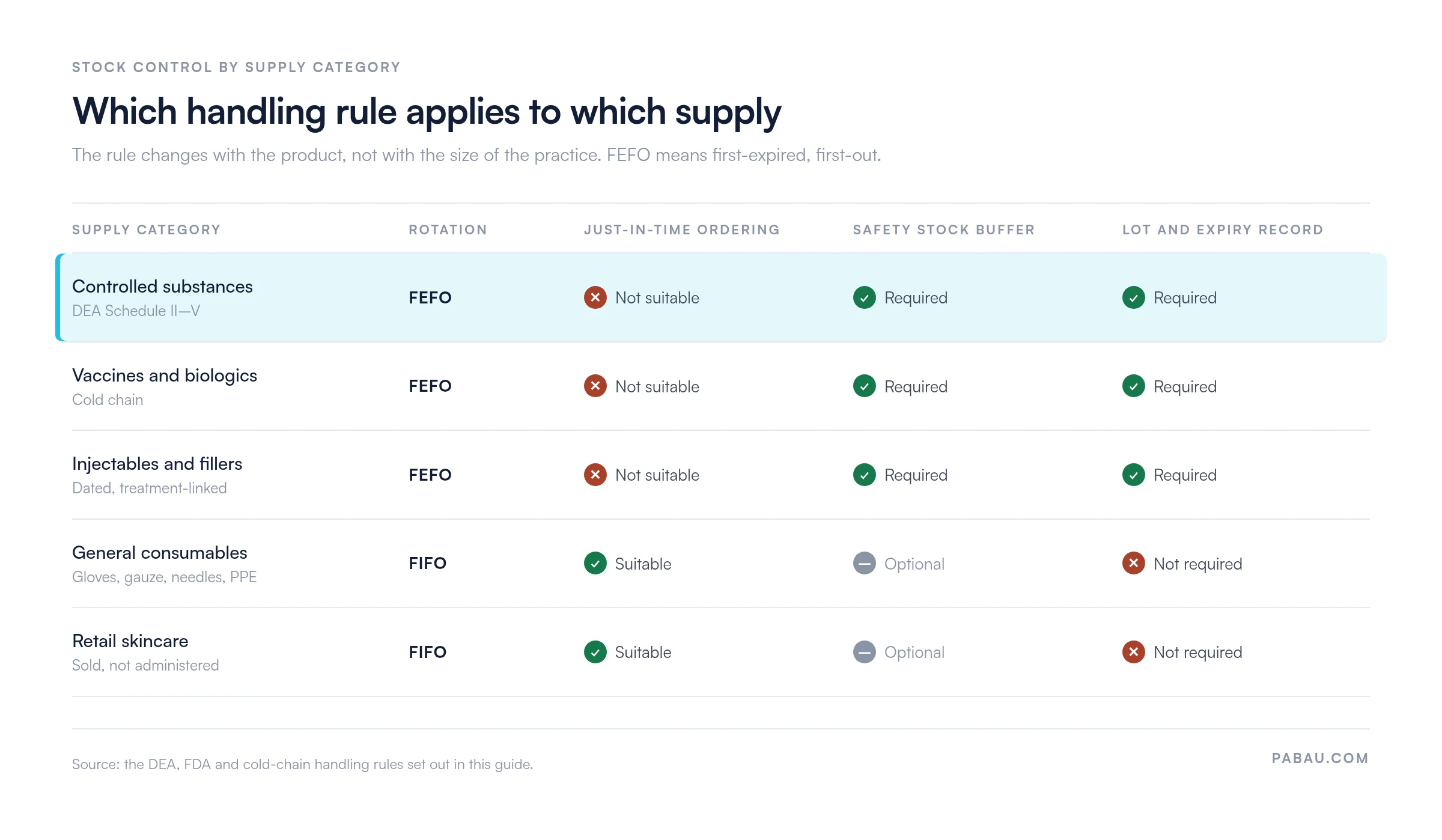
FIFO is standard practice for pharmaceutical and consumable storage. For anything carrying a printed expiry date, the sharper version is FEFO, or first-expired, first-out. Delivery order and expiry order are not always the same, and a newer box can easily hold the earlier date. LIFO, or last-in, first-out, is never appropriate for perishable medical supplies.
Just-in-time inventory keeps stock levels minimal by ordering only what will be used in the near term. The benefit is a lighter storage burden and less cash tied up on the shelf. The risk is exposure to supply disruption, because a practice running JIT has no buffer when a supplier is backordered.
JIT works well for non-critical consumables with reliable lead times and multiple approved sources. It is inappropriate for controlled substances, cold-chain products, or any supply where a stockout would halt patient care. Keep safety stock buffers for high-criticality items even when you apply JIT elsewhere.
Which rule applies depends on the supply category, not on the size of the practice. The split is sharper than most stock policies allow for.
Two audit approaches are standard in healthcare settings:
Audits surface shrinkage, expiry losses, and process failures that real-time systems miss when staff skip scanning steps. Schedule them, assign accountability, and document what you find.
Demand forecasting uses historical usage data to predict future consumption. A practice running a regular botulinum toxin session on Tuesdays will see a predictable weekly pattern. Seasonal treatments such as laser hair removal spike in spring and fall away in winter. Reporting and analytics that tie treatment data to stock consumption make those patterns visible, so ordering becomes pre-emptive rather than reactive.
Approved vendor lists with at least two sources per critical supply category provide a buffer against disruption. Track supplier performance: lead time accuracy, order fill rates, and product quality. When a primary supplier runs short, a pre-qualified secondary supplier can be activated without a new procurement process.
Review your approved vendor list every six months. For any critical supply with only one approved source, identify and qualify a backup supplier before you need one. A distributor backorder can cost you a full day of canceled appointments. Onboarding an alternative supplier takes about 30 minutes.
Pharmaceutical inventory operates under stricter requirements than general medical supplies. The key obligations for US-based practices:
Recording the lot number at the point of use takes a few seconds. During a recall, that record is the difference between contacting three patients and contacting every patient treated that month.
Most healthcare inventory guidance is written for hospital supply chain teams with dedicated procurement roles. Practice inventory looks different in every meaningful way:
The practical answer at this scale is stock control built into the practice management app that already holds the appointment and the treatment note. A standalone inventory tool bolted onto a separate booking or EMR system leaves you reconciling two records by hand.
Practice management software like Pabau takes that route. Its inventory management software deducts stock the moment a service is marked complete, so there is no separate scan step for staff to skip.
Retail products sold alongside treatments need the same discipline. Skincare sitting on a shelf is working capital, and a slow-moving line ties up cash exactly the way an over-ordered consumable does.
Five capabilities separate software that solves the stock problem from software that moves it to a different screen:
Inventory is one line on a longer evaluation, since the same shortlist has to satisfy scheduling, records, and billing. A general guide to practice management software covers those other axes. Our roundup of the best practice management software ranks the platforms practices actually run on.
Supply waste falls into three categories: expiry losses, over-ordering, and shrinkage. All three are reducible with structured processes.
Expiry losses are prevented by FEFO rotation and expiry-date visibility in your stock system. If staff can see which batches expire soonest at the point of use, they will reach for those first without being told.
Over-ordering comes from using instinct rather than usage data to set reorder quantities. Pull a stock report covering the past 30, 60, or 90 days. Those consumption figures give you a defensible baseline for the next order.
Shrinkage is addressed through audit frequency and access controls. Restrict stock room access to designated staff. Cycle counts surface discrepancies between logged usage and quantities on hand. A discrepancy that repeats for one product signals a process breakdown, or something more serious.
In most practices, stock and clinical records live apart. The treatment note goes into the patient file. The stock count gets updated later, from memory, a paper log, or a spreadsheet one person owns. That lag is where discrepancies come from.
Pabau, our practice management software, deducts stock from the record when the service is completed. Products are attached to the treatments that consume them, so a finished appointment updates the count without anyone opening a second system.
That linkage is also what makes cost-per-treatment reporting possible. You can see what a treatment consumed, what the product cost, and what it billed, all in one place. Low-stock alerts fire against your own par levels, and every subscription includes reporting and analytics as standard.

Pabau’s built-in inventory management links stock consumption to treatment records automatically. See real-time stock levels, get low-stock alerts, and run cost-per-treatment reports without a separate system.

Stock control is not a clerical task that waits for a slow afternoon. Stockouts cancel appointments, expired product is money already spent, and unlogged consumption becomes an audit problem long after the cause is traceable.
The practices that stay ahead of it are not the ones with the most storage or the biggest budget. They are the ones where consumption is recorded as it happens, par levels come from usage data, and one person owns the count.
Start with the two supplies that hurt most when they run out. Set honest par levels for those, then extend the same discipline outward. To see how stock deductions and treatment records stay in step, book a demo.

Want the wider operational picture? Medical practice operations covers the routines and systems that keep a practice running day to day.
Need better numbers behind your ordering decisions? Medical practice management reports explains which reports to run and what each one tells you.
Comparing platforms feature by feature? Practice management software features breaks down the capabilities worth paying for.
Running a small practice on separate tools? Clinic management software looks at what consolidating onto one platform changes.
Healthcare inventory management is the systematic process of ordering, tracking, storing, and distributing medical supplies within a healthcare facility. It works by setting minimum stock levels, or par levels, for each item and monitoring consumption in real time. Reorders trigger when stock falls below that threshold. Physical counts are then audited against system records to catch discrepancies.
The most common are stockouts from inadequate par levels or poor visibility, and expiry waste from overstocking or weak rotation. Manual tracking errors in spreadsheet-based systems come next. Regulatory complexity around controlled substances and cold-chain products completes the list. At practice scale, the added challenge is handling all of it with staff who already have competing responsibilities.
A par level is the minimum quantity of a supply that must be on hand at all times. When stock falls to the par level, a reorder is triggered. Par levels are calculated from average weekly consumption, plus a buffer covering supplier lead time. That way the practice never runs out before the next delivery arrives.
FIFO (First-In, First-Out) means the oldest stock is used before newer arrivals, preventing expiry. LIFO (Last-In, First-Out) means newer stock is used first, leaving older products at risk of expiring unused. LIFO is not appropriate for perishable medical supplies and is never recommended for pharmaceuticals or injectables.
Practices typically use either a standalone inventory management system or, increasingly, a practice management platform with inventory built in. The second option is more practical at small-to-mid scale. It links stock consumption directly to treatment records, so no separate integration between clinical and inventory systems is needed.
Three tactics do most of the work. Apply FEFO rotation, so the earliest-expiring stock is always used first. Use consumption data from past treatments to set reorder quantities, instead of ordering by instinct. Run regular cycle counts to catch shrinkage or logging failures before waste builds up. A practice with integrated inventory and treatment records already holds the data all three tactics need.