GLP-1 diet plan
A GLP-1 diet plan is a structured eating framework for patients taking semagluti...

2
Last Updated: Oct 13, 2026
A gastroparesis test is any diagnostic study that measures how quickly food leaves the stomach.
It confirms delayed gastric emptying and rules out mechanical causes of the same symptoms. Gastric emptying scintigraphy is the gold standard, and retention above 10% at four hours confirms the diagnosis. A peer-reviewed review in Cureus lists several other modalities, though availability and protocol standardization vary widely between centers. This guide covers every major option: when it is ordered, how to read the results, and how to choose.

A gastroparesis test measures gastric emptying rate; gastric emptying scintigraphy (GES) is the gold standard used in clinical practice.
Normal GES thresholds are less than 60% retention at 2 hours and less than 10% retention at 4 hours, per SNMMI consensus protocol.
Radiation-free alternatives include the gastric emptying breath test and the Atmo Gas Capsule, the wireless motility capsule that replaced the discontinued SmartPill in 2025.
Accurate results depend on strict preparation: prokinetics, opioids, and certain other medications must be held before any gastric emptying study.
Gastroparesis is a chronic motility disorder in which the stomach empties more slowly than normal in the absence of any mechanical obstruction. The stomach’s muscular contractions, coordinated by the vagus nerve, slow or fail. Food then sits in the stomach far longer than it should.
The hallmark symptoms overlap with several other GI conditions, which is one reason diagnosis is often delayed. Clinicians see patients with a combination of:
These symptoms mirror gastroesophageal reflux disease, peptic ulcer disease, and functional dyspepsia. A gastroparesis test confirms that delayed emptying, not another cause, is driving the clinical picture. Mechanical obstruction must be ruled out first, before any motility study is ordered. Metabolic health practices managing diabetic patients see this condition often, since diabetic autonomic neuropathy is the most common identifiable cause.
A gastroparesis test is ordered when a patient has persistent unexplained nausea, vomiting, early satiety, or bloating for more than three months. Upper endoscopy must already have excluded structural or mucosal causes.
Three patient profiles drive the majority of referrals:
Gastroparesis frequently goes unrecognized for years, because patients describe the symptoms as ordinary indigestion. Clinicians who ask directly about meal-related nausea and early satiety at routine visits shorten that diagnostic journey considerably.
Several diagnostic modalities can confirm delayed gastric emptying. They differ in accuracy, radiation exposure, invasiveness, availability, and patient burden. The table below summarizes the landscape before each test is covered in detail.
Gastric emptying scintigraphy (GES) is the gold standard diagnostic test for gastroparesis. The patient eats a technetium-99m radiolabeled solid meal, and a gamma camera images the stomach at 0, 1, 2, and 4 hours. Cleveland Clinic gastroenterologists note that GES remains underutilized despite being the most accurate test available.
The Society of Nuclear Medicine and Molecular Imaging (SNMMI) publishes the standardized protocol. It defines normal gastric emptying as less than 60% retention at 2 hours and less than 10% retention at 4 hours. Values above these thresholds confirm delayed emptying. The 4-hour scan is the most diagnostically reliable single time point.
The effective radiation dose from a standard GES is approximately 1 mSv, broadly comparable to a series of chest X-rays. That is generally acceptable for adults, but clinicians typically avoid GES during pregnancy. Availability is the bigger practical barrier.
The test needs a nuclear medicine department, a standardized meal protocol (usually a technetium-99m egg white meal), and gamma camera equipment. Many facilities have none of it. Practices that rely on clinical record management systems can document GES orders, results, and severity grading in one place. Borderline results are then less likely to be lost to follow-up.
The gastric emptying breath test (GEBT) uses a meal labeled with 13C-Spirulina platensis, an edible blue-green algae. Once the meal empties into the small intestine, the isotope is absorbed and metabolized. That releases 13CO2 into exhaled breath, which is sampled at intervals over four hours.
The GEBT correlates well with GES in patients without small intestinal malabsorption. Its main practical advantage is that it needs no nuclear medicine facility, so office-based GI practices can run it. Cairn Diagnostics markets the FDA-cleared version, the 13C-Spirulina Gastric Emptying Breath Test.
A wireless motility capsule (WMC) is an ingestible sensor that records conditions inside the gut as it travels from the stomach through to the colon. It is swallowed like a tablet and transmits to a recorder worn on the body. That setup captures gastric, small bowel, and colonic transit in one ambulatory study rather than imaging a single organ.
This category needs a caveat that most published guidance still misses. The original WMC, Medtronic’s SmartPill, was discontinued in July 2023 after the supply of a critical component failed. The remaining inventory was exhausted that September. For roughly two years afterwards, US practices had no FDA-cleared wireless motility capsule to order at all.
The Atmo Gas Capsule System from Atmo Biosciences received FDA 510(k) clearance on June 26, 2025 and reached the US market the following month. Its cleared indication covers aiding the diagnosis of gut motility disorders, including gastroparesis and slow transit constipation. It reports regional and whole-gut transit times.
Clearance rested on a study of 209 patients across 12 sites in the US and Australia, each of whom swallowed both capsules. The Atmo capsule agreed closely with the SmartPill on gastric emptying time and colonic transit time. That is why it counts as a successor rather than an unproven new modality.
Treat any order set, referral protocol, or patient handout that still names the SmartPill as out of date. The reference ranges carry across, but the device, the recorder, and the vendor workflow do not.
Three additional tests support, but do not replace, the primary gastric emptying study.
Records from these sequential tests need to stay together. The endoscopy report, the motility study, and the medication history that qualifies both should sit in one patient file. Collecting medication lists and symptom timelines before the first consultation also cuts the back-and-forth that delays testing.
Choosing between GES, GEBT, and WMC depends on clinical context, facility resources, and patient characteristics. This side-by-side guide translates the evidence into practical decision criteria.
Preparation failures are the most common source of unreliable gastroparesis test results. Medications that affect gastric motility alter emptying rates whether or not gastroparesis is present, producing false-negative or false-positive findings. Clear written instructions, sent well before the appointment, prevent most of them.
The following should be held before any gastric emptying study, subject to clinician-specific guidance for each patient:
Those windows do not line up, which is what makes the booking call awkward. One hold needs a week of notice and the rest need two or three days.
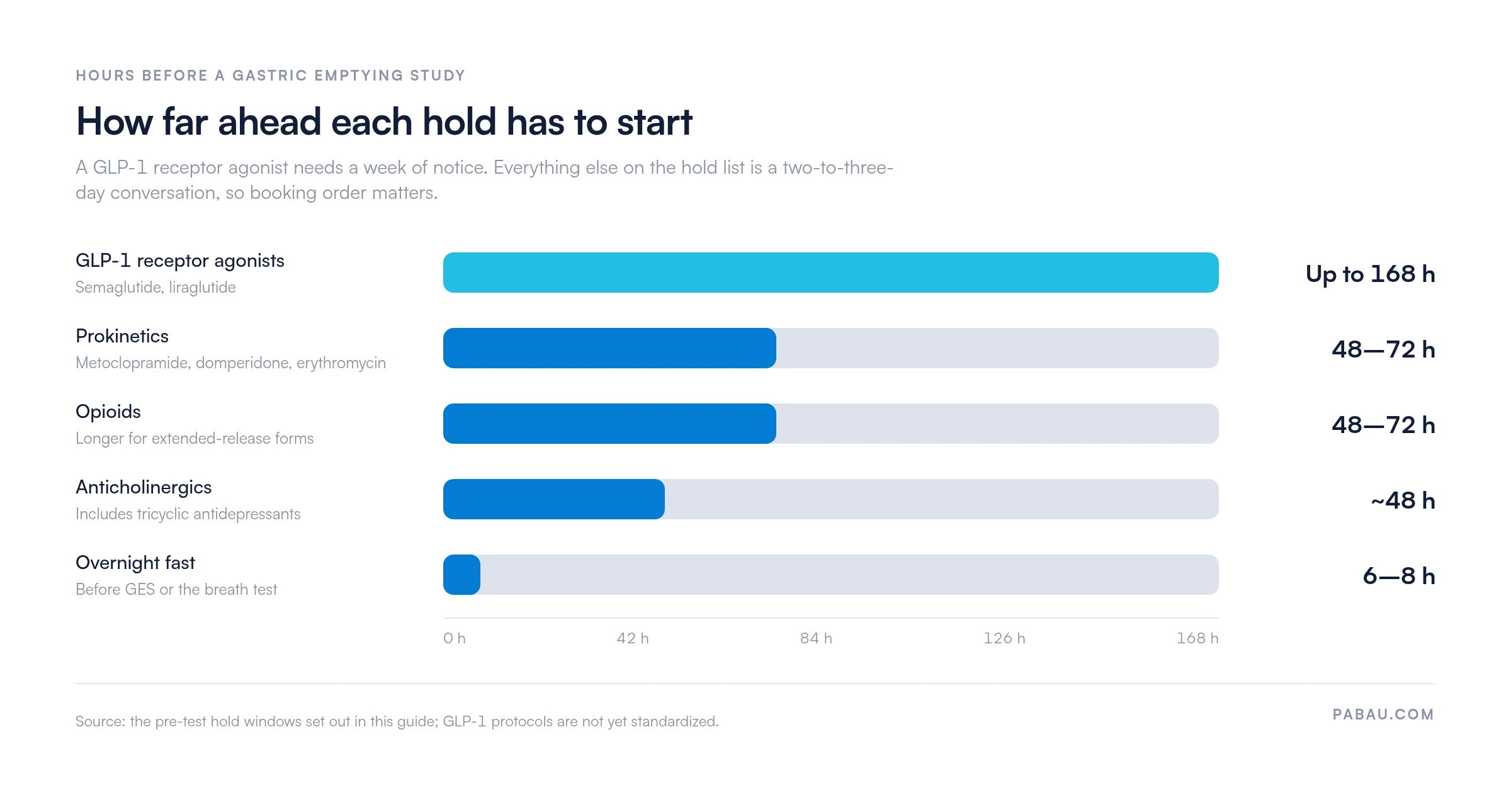
GLP-1 prescribing has pushed this hold list well beyond diabetes care. Practices running weight loss programs on dedicated weight loss clinic software should flag semaglutide and tirzepatide at booking. Leaving it to the day of the test wastes the slot.
Patients typically fast overnight (6-8 hours) before GES or GEBT. Diabetic patients present an additional consideration. Blood glucose above 270 mg/dL slows gastric emptying on its own, regardless of underlying motility. Defer testing if glucose is elevated on the day of the study, and aim for a reading below 200 mg/dL at the start.
Ask diabetic patients to bring a blood glucose log covering the week before the appointment. One high reading on the day is far easier to interpret against a fortnight of context.
Wireless motility capsule preparation works differently. The patient eats the standardized meal supplied with the capsule kit rather than fasting through the study, because the capsule needs normal peristalsis to transit. Use the current manufacturer protocol: the meal and recorder instructions changed when the Atmo Gas Capsule replaced the SmartPill.
Automated pre-test reminders reduce last-minute cancellations and invalid runs. Send the medication-hold instructions and fasting guidelines at 72 hours, then repeat them 24 hours before the appointment.
A gastric emptying study report states the percentage of the meal remaining in the stomach at each imaging time point. The 4-hour result is the most clinically meaningful number for GES, and severity is graded on how much retention remains at that point.
The grading framework below comes from the Abell et al. 2008 consensus statement in Gastroenterology, which defines four grades of delayed emptying. It is widely cited in clinical practice, though it is not a regulatory standard:
Borderline results, meaning 4-hour retention of 10-15%, warrant clinical correlation. Symptom burden, nutritional status, and response to empirical dietary changes should all inform whether the study is repeated or treatment begins despite equivocal numbers.
Even the gold standard has meaningful limitations that clinicians rarely discuss explicitly with patients.
Two modalities are gaining traction in research settings. MRI gastric emptying uses three-dimensional volumetric imaging to track emptying without radiation or a radioactive tracer, and it gives excellent anatomical detail. It is not yet widely available outside academic centers.
SPECT (single-photon emission computed tomography) adds three-dimensional reconstruction to standard scintigraphy, which improves detection of regional emptying abnormalities. Neither approach has displaced GES as the first-line test, but both may become more accessible as scanner availability grows. Practices that log which modality each patient had will find that record useful once referral patterns start shifting.
A gastroparesis workup rarely fits into one visit. Endoscopy comes first. The motility study is booked weeks later at a different site, and the medication-hold instructions have to reach the patient days before either appointment. Many practices hold that sequence together with reminder calls, a shared inbox, and a spreadsheet.
Practice management software like Pabau keeps the whole pathway in one record instead. Automated reminders go out at 72 and 24 hours with the correct medication-hold list attached. Referral letters and result reports file against the patient, and structured notes keep the severity grade easy to find at follow-up.
The payoff is fewer invalid studies, fewer repeat scans, and a diagnostic timeline the patient can follow.

Pabau helps GI and specialist practices coordinate diagnostic workups, track test results, and automate pre-test reminders. Nothing is lost between referral and result.

Suspicion alone does not confirm gastroparesis. The diagnosis rests on the right study, prepared for properly and read against the correct thresholds. Order GES where a nuclear medicine department is reachable, because its reference ranges are the best validated. Reach for the breath test when radiation is the obstacle, and the Atmo Gas Capsule when the question covers the whole gut.
The trade-off worth remembering is that preparation, not modality, decides whether a result is usable. A perfectly executed scan on a patient who took their prokinetic that morning tells you nothing.
Pabau’s automated workflows and structured patient records coordinate referrals, pre-test reminders, and result tracking from one system. To see how Pabau handles multi-visit GI diagnostic pathways, book a demo.

Screening a patient with new metabolic symptoms? Glucose tolerance test: What it is, preparation, and results covers how to confirm or rule out the diabetes that drives most gastroparesis cases.
Coordinating medications before a gastric emptying study? Diabetes medication list for safe patient care gives a ready-made record for the hold-and-resume conversation with diabetic patients.
Seeing more GLP-1 patients come through the door? GLP-1 statistics: 65 numbers on usage, results and cost in 2026 puts the scale of GLP-1 prescribing, and the pre-test hold it requires, in context.
A gastroparesis test is a diagnostic study that measures how quickly the stomach empties food into the small intestine. The most common form is gastric emptying scintigraphy (GES). It uses a radiolabeled solid meal and gamma camera imaging to calculate retention percentages at 1, 2, and 4 hours. A result above 10% retention at 4 hours confirms delayed gastric emptying.
Gastric emptying scintigraphy (GES) is the gold standard for gastroparesis diagnosis. The Society of Nuclear Medicine and Molecular Imaging and major gastroenterology societies all recognize it. It uses a technetium-99m radiolabeled solid-phase meal and produces quantitative emptying percentages at standardized time points. No other available test has better-validated normal reference ranges.
Preparation requires an overnight fast, typically 6-8 hours. Medications that affect motility are held for 48-72 hours before the study, including prokinetics (metoclopramide, domperidone), opioids, and anticholinergics. Diabetic patients should have blood glucose below 200 mg/dL at the time of testing. GLP-1 receptor agonist users may need a longer hold period, up to one week, though this varies by clinical protocol.
For GES, the 4-hour retention percentage sets the severity grade. Under 10% is normal, 11-20% is mild, 21-35% is moderate, 36-50% is severe, and above 50% is very severe. Each grade roughly maps to a treatment escalation step, from dietary changes alone through to enteral feeding. Borderline results between 10-15% should be read alongside symptom burden and nutritional status rather than in isolation.
No validated home gastroparesis test exists. GES and the gastric emptying breath test both require a supervised clinical setting, a standardized meal, and calibrated equipment. The Atmo Gas Capsule is ambulatory, so the patient goes about a normal day once it is swallowed. A clinician still orders it, starts the study, and interprets the transit data. Food and symptom diaries kept at home can support a referral decision, but they cannot measure gastric emptying rate.
No, it is not. Medtronic discontinued the SmartPill wireless motility capsule in July 2023 after the supply of a critical component failed. The remaining stock ran out that September. No cleared replacement existed until the FDA cleared the Atmo Gas Capsule System on June 26, 2025, and it reached the US market that July. Any order set or patient handout still naming the SmartPill needs updating.
A standard gastric emptying scintigraphy study takes 4 hours from meal ingestion to the final scan. Patients eat the radiolabeled meal, then have imaging at 1, 2, and 4 hours, with rest periods in between. The gastric emptying breath test also takes approximately 4 hours of breath sampling. The wireless motility capsule study is ambulatory, with transit data recorded over 24 to 120 hours.