Anemia nursing care plan
An anemia nursing care plan is a structured document that guides a nurse from as...

2
Last Updated: Oct 9, 2026
A blood pressure test measures the force of blood pushing against your artery walls, and it takes under two minutes. The result is two numbers, systolic over diastolic, recorded in mmHg. Below 120/80 mmHg is normal, stage 1 hypertension begins at 130/80 mmHg, and anything above 180/120 mmHg needs emergency care.
Those thresholds only help when the measurement itself is sound. A full bladder, or a patient who hurried in from the parking lot, can add 10 mmHg or more. Getting the technique right, at home or in the exam room, is what turns a number into a decision.

A blood pressure test records two numbers, systolic over diastolic, both measured in mmHg.
Normal sits below 120/80 mmHg, stage 1 hypertension starts at 130/80 mmHg, and above 180/120 mmHg is an emergency.
Five minutes of seated rest, a correctly sized cuff, and silence during the reading decide whether the number is usable.
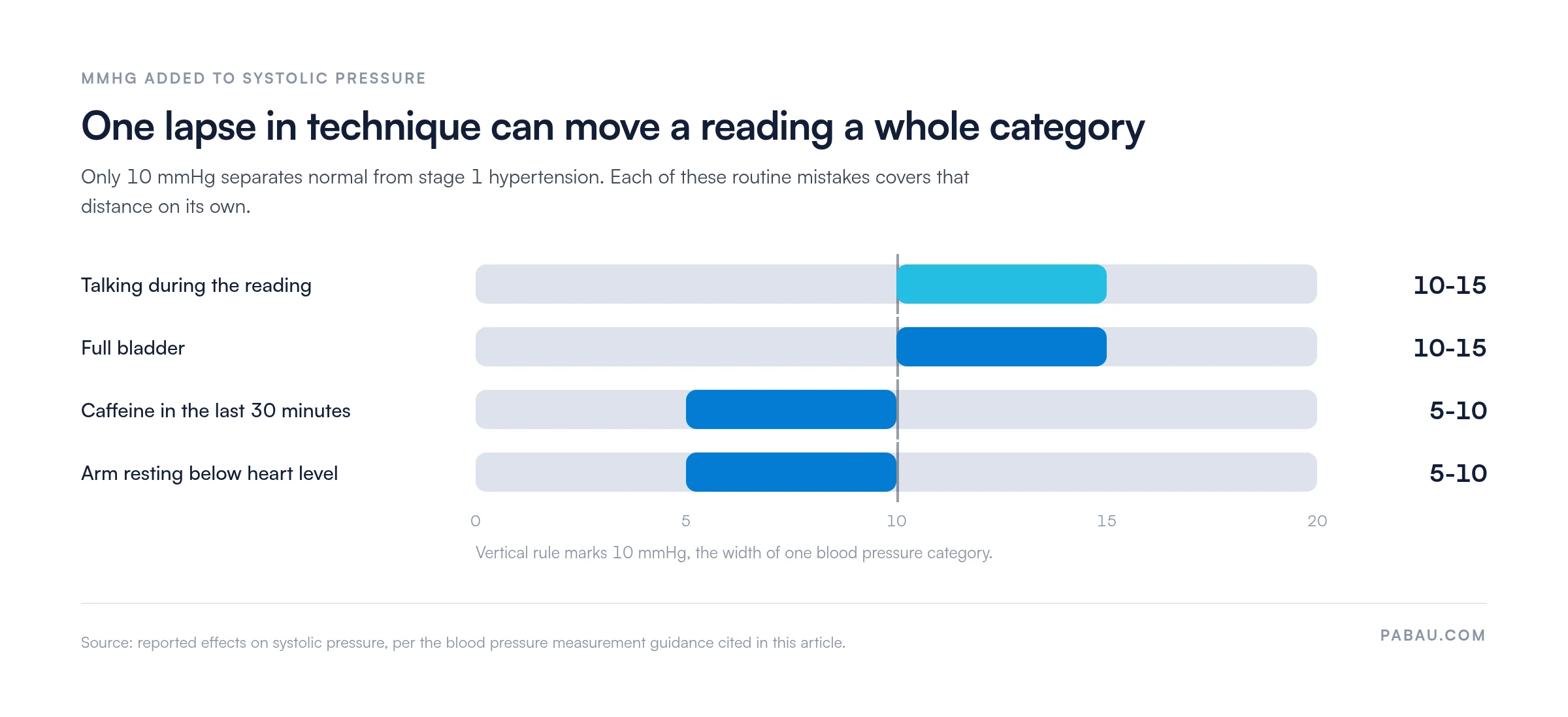
Talking during a reading or a full bladder can each add 10 to 15 mmHg, the width of a whole category.
A week of twice-daily readings on a validated upper-arm monitor tells you more than any single office test.
A blood pressure test is a non-invasive check of the pressure inside your arteries as your heart pumps. It produces two numbers in millimeters of mercury (mmHg). Together they describe how hard your heart and vessels are working at that moment.
The test itself is quick. A clinician wraps an inflatable cuff around your upper arm and inflates it until blood flow stops. Pressure is then released slowly while a stethoscope picks up pulse sounds, or an automatic device reads the oscillations.
In practices running connected GP clinic software, each reading drops straight into the patient record. The clinician then reads a trend across visits instead of one isolated moment.
Hypertension is largely asymptomatic. A patient can carry elevated pressure for years without a single symptom. A routine appointment is often the only chance to catch it early. Adding a cuff check to every check-in is among the cheapest screening steps a practice has.
Systolic pressure is the pressure in your arteries when the heart contracts and pushes blood out. Diastolic pressure is what remains between beats, while the muscle relaxes and refills. Both numbers carry weight on their own, and together.
A reading is always written as systolic over diastolic, so 120/80 mmHg is the benchmark for normal. An elevation in just one of the two still counts. StatPearls notes that isolated systolic hypertension is the most common pattern in adults over 60, even when diastolic pressure stays in range.
The AHA and ACC revised the categories in 2017, lowering the hypertension threshold from 140/90 to 130/80 mmHg. The table below uses those current classifications. Many practices also keep a normal blood pressure chart in the exam room so patients can see where their own result sits.
Source: AHA/ACC 2017 Hypertension Guidelines.
Arterial walls stiffen over time, so average readings climb across age groups. The 120/80 mmHg goal does not move with them. The table below shows commonly cited population averages from epidemiological data, not diagnostic thresholds.
A result inside the average band for a patient’s age is still not a clean bill of health. Age averages describe what is common, not what is healthy.
Accurate measurement depends on standardized technique. Drifting from the protocol below can move a reading by 5 to 10 mmHg, which is enough to misclassify a patient.
Measure both arms on a patient’s first visit. If one arm reads more than 10 mmHg higher across repeated readings, use that arm from then on and investigate the difference.
Most inaccurate readings trace back to the same handful of lapses. Run through this list while the cuff is going on, and the number will hold up under review.
Two mistakes cause most of the trouble in a busy practice. The first is starting the reading while the patient is still describing their journey in. The second is reaching for whichever cuff is already on the trolley instead of measuring the arm.
Home testing gives a truer picture of a patient’s cardiovascular status than one appointment can. Readings taken across a week, in the patient’s own environment, smooth out the noise a single visit adds. Ongoing blood pressure monitoring also gives the clinician something to compare each new result against.
Consumer devices vary widely. A validated upper-arm monitor is the right choice for home testing, and a wrist device is not. The British and Irish Hypertension Society (BIHS) and the Dabl Educational Trust both publish validated device lists that clinicians can point patients toward.
The American Heart Association recommends two readings in the morning and two in the evening, across seven consecutive days. Day one is discarded. What the clinician reviews is an average of 24 readings rather than a snapshot.
A reading captures one moment under one set of conditions. Several routine factors shift the result far enough to change its interpretation. That is why a single number rarely drives a treatment decision on its own.
The scale of that shift is what surprises people. Each error below moves systolic pressure by at least as much as the 10 mmHg separating one category from the next.
White coat hypertension describes a patient whose pressure runs high in the exam room but normal in daily life. The setting itself triggers a stress response that lifts the number above threshold. Masked hypertension runs the other way, with normal office readings and elevated pressure at home.
Either pattern can send treatment in the wrong direction when a diagnosis rests on office readings alone. NICE guideline NG136 recommends ambulatory blood pressure monitoring (ABPM) before treatment starts. The point is to confirm the diagnosis and rule out a white coat effect.
Ambulatory blood pressure monitoring means wearing an automatic cuff for a full day. It records every 15 to 30 minutes while the patient is awake, and every 30 to 60 minutes overnight. The output is a day-night profile that no single office test can produce.
Reading a result means matching the two numbers to the categories above, then adding context. Was this the patient’s first reading of the day, are they symptomatic, and what does their baseline look like? Measurements tracking software inside a practice management platform removes the manual cross-referencing and flags a trend heading the wrong way.
One high reading rarely means a new diagnosis. Standard practice is to confirm an elevated result across at least two separate visits before diagnosing hypertension. Severe elevation and accompanying symptoms are the exception, and both call for action the same day.
A reading above 180/120 mmHg is a hypertensive crisis and needs immediate action. Call emergency services if the patient also has chest pain, breathlessness, a sudden severe headache, visual disturbance, confusion, or signs of stroke.
Without those symptoms, the same reading still needs same-day urgent review rather than a routine slot.
A log turns scattered numbers into a pattern. Most guidelines ask patients to bring at least a week of home readings to any appointment about blood pressure.
Handing them a printed blood pressure log on the way out removes the excuse of not knowing what to write down.
Ask patients to log readings at the same time each day, before breakfast and before any morning medication. Standardizing the conditions is what makes the week’s trend worth reading.
Knowing when to escalate matters as much as knowing how to take the reading. The decision turns on the number itself, whether symptoms are present, and how consistent the elevation has been.
The Mayo Clinic and the NHS both advise patients with consistently high home readings to book an appointment even when they feel well. Hypertension rarely announces itself before damage is done.
In most practices, blood pressure data sits in three separate places. The office reading goes in the clinical note, the home log arrives on paper, and the ABPM report is filed as a PDF. Comparing them means opening all three.
Practice management software like Pabau keeps them together. Each reading is recorded against the patient’s file as a tracked measurement. Systolic and diastolic values then build a chart over time, instead of sitting as loose text inside a note.
Digital forms can collect a patient’s home readings before they arrive, so the clinician opens the appointment already looking at a week of data. Automated recalls handle the retest interval, which is where a three-month lifestyle review most often gets lost.
The result is a record the clinician can read at a glance. The patient also avoids repeating information they already sent in.

Pabau records blood pressure alongside every other clinical measurement in the patient’s file, so trends stay visible without chasing paper logs. See how it fits your own review workflow.

The number on the monitor is only as good as the five minutes before it. Get the rest, the cuff, and the silence right, and the reading earns the decision you make from it.
Then keep the readings together. A patient with a week of home results, an office reading, and a clear category is easy to advise. A patient with one high number and no history is not.
The trade-off worth remembering is a small one. A few extra minutes of protocol buy a result you can act on. Book a demo to see how Pabau keeps blood pressure readings, notes, and recalls in one patient record.

Treating older patients? Elderly blood pressure chart sets out the reference ranges that apply once arterial stiffening takes hold.
Seeing children in your practice? Pediatric blood pressure chart covers the age and height based ranges that replace adult thresholds.
Need the whole set of vitals in one place? Abnormal vital signs chart sets the escalation thresholds for pulse, respiration, and temperature too.
Screening for peripheral arterial disease? Ankle brachial index explains how the same cuff compares ankle and arm pressures to flag reduced blood flow.
Measure both arms at a patient’s first visit, then use the arm with the higher reading from then on. A consistent difference of more than 10 mmHg between arms is worth investigating on its own.
Adults with normal readings are usually screened at least every two years. Anyone in the elevated range, or living with diabetes, kidney disease, or a family history of hypertension, needs a check at least annually.
No. The cuff squeezes the upper arm firmly for 20 to 30 seconds, which feels tight rather than painful. Some people notice brief tingling in the fingers, and it fades seconds after the pressure releases.
Pulse pressure is the systolic number minus the diastolic number, so 120/80 mmHg gives 40 mmHg. A widening pulse pressure above roughly 60 mmHg suggests stiffening arteries and is watched closely in older patients.
Not meaningfully, and trying to defeats the point. Resting quietly for five minutes, emptying your bladder, and skipping caffeine simply removes artificial spikes. That produces an honest reading rather than a flattering one.