GLP-1 diet plan
A GLP-1 diet plan is a structured eating framework for patients taking semagluti...

2
Last Updated: Oct 13, 2026

An allergy blood test measures allergen-specific immunoglobulin E (IgE) antibodies in the blood to show what triggers your immune system.
Results are reported in kU/L and graded in classes 0 to 6. A positive result alone does not confirm a clinical allergy unless it matches the patient’s symptoms.
Unlike skin prick testing, you do not need to stop antihistamines before an allergy blood test, which makes it suitable for more patients.
Practice management software like Pabau links the test order, the incoming result, and the follow-up appointment inside one client record.
Most people assume stopping antihistamines before allergy testing is required. For skin prick tests, that’s true. For an allergy blood test, it isn’t, and the confusion delays testing for patients who could be tested today.
The American College of Allergy, Asthma and Immunology (ACAAI) notes that allergy blood tests measure specific IgE antibodies in a blood sample. They can be run without stopping antihistamine therapy. This guide covers how the test works, what the results mean, and when a blood test is the better diagnostic choice.
An allergy blood test measures the level of immunoglobulin E (IgE) antibodies in your blood that are specific to each allergen. When your immune system flags a substance as harmful, it produces IgE antibodies as part of an inflammatory response. The allergy blood test measures those antibodies to help pinpoint exactly which substances trigger a reaction.
A standard blood draw is all that’s required. As MedlinePlus (NIH) describes, the sample goes to a lab and is exposed to specific allergen extracts. Results come back in kilounits per liter (kU/L). Labs then grade them on the ImmunoCAP class scale, from 0 (none found) to 6 (extremely high).
The test cannot cause an allergic reaction. You’re testing blood outside the body rather than putting an allergen on the skin. That matters most for patients with a history of anaphylaxis.
IgE is one of five antibody classes produced by the immune system. In most people, IgE levels stay very low throughout life. Some people have atopic tendencies, meaning their genes make allergic conditions more likely. Their immune systems produce far more IgE on meeting allergens such as pollen, peanuts, or pet dander.
On repeat exposure, these allergen-specific IgE antibodies bind to mast cells and basophils. That binding releases histamine and other inflammatory mediators. The result is the symptoms we recognize as an allergic reaction: sneezing, hives, swelling, or anaphylaxis in severe cases.
The allergy blood test measures how much IgE is moving through the blood. In the past, this was done using radioallergosorbent testing (RAST), which used radioactive labels to detect IgE binding.
Modern labs use ImmunoCAP, developed by Thermo Fisher Scientific and Phadia, or enzyme-linked immunosorbent assay (ELISA) methods. Both are more sensitive and better standardized, and neither needs radioactive materials.
Three main test formats are in clinical use today. Understanding the differences helps clinicians and patients read the result in front of them.
Allergy panels group common allergens by category: respiratory, food, insect venom, and latex. They’re sometimes sold as multi-allergen screening. Panels help when the trigger is unknown, though a positive panel result still needs to be checked against the patient’s symptoms.
Specific IgE testing shows sensitization across a wide range of allergen categories. It is especially useful for checking food allergies, where skin testing carries a higher reaction risk.
One point matters here. A gluten allergy blood test using specific IgE measures an immune response to wheat proteins. Celiac disease serology is a different test, looking for tissue transglutaminase IgA (tTG-IgA) antibodies. Patients often confuse the two, but the AAAAI treats them as separate conditions with separate diagnostic pathways.
Histamine intolerance is not an IgE-mediated allergy either. It comes from reduced diamine oxidase (DAO) enzyme activity, so a standard allergy blood test cannot diagnose it. Patients with histamine-related symptoms may need a separate DAO activity test.
The procedure is straightforward. A clinician or phlebotomist takes a venous blood sample, usually from the arm. No special prep is needed for most patients.
Practices that send digital consent and history forms beforehand cut down on paperwork at each step. A standardized blood test request form also keeps the allergen list and clinical details consistent when the order reaches the lab. Automated pre-test instructions reduce the number of patients who stop their antihistamines for no reason.
IgE results are reported in kU/L (kilounits per liter) and assigned to a class from 0 to 6. Higher classes show greater levels of allergen-specific IgE. They do not predict how severe a reaction will be on exposure.
A high number raises the chance that the allergy is genuine. It does not show how severe a reaction will be, and no specific IgE level guarantees that a serious one is coming.
A class 3 peanut result in a patient who has never reacted to peanuts is one clinical picture. The same class 3 result in a patient with documented anaphylaxis is another. Symptom history and clinical context are what give these numbers meaning. The result is a data point, not a diagnosis.
False positives are the main limitation of specific IgE testing, especially for food allergens. Two mechanisms drive them.
Cross-reactive proteins: Many plant-based foods share similar protein structures. A patient sensitized to birch pollen may show low-positive IgE results for apple, carrot, or hazelnut. The proteins look enough alike to register on the test. Component-resolved diagnostics (CRD) can then separate genuine sensitization from cross-reactive IgE that carries little clinical risk.
Elevated total IgE: Atopic dermatitis, parasitic infections, and some malignancies raise total IgE without pointing at any one allergen. That can push a borderline specific IgE reading over the threshold. Where a parasitic cause is possible, an ova and parasite test answers a different question than the allergy panel does.
For these reasons, an allergy blood test alone is never enough for a diagnosis. Results need clinical correlation against three things:
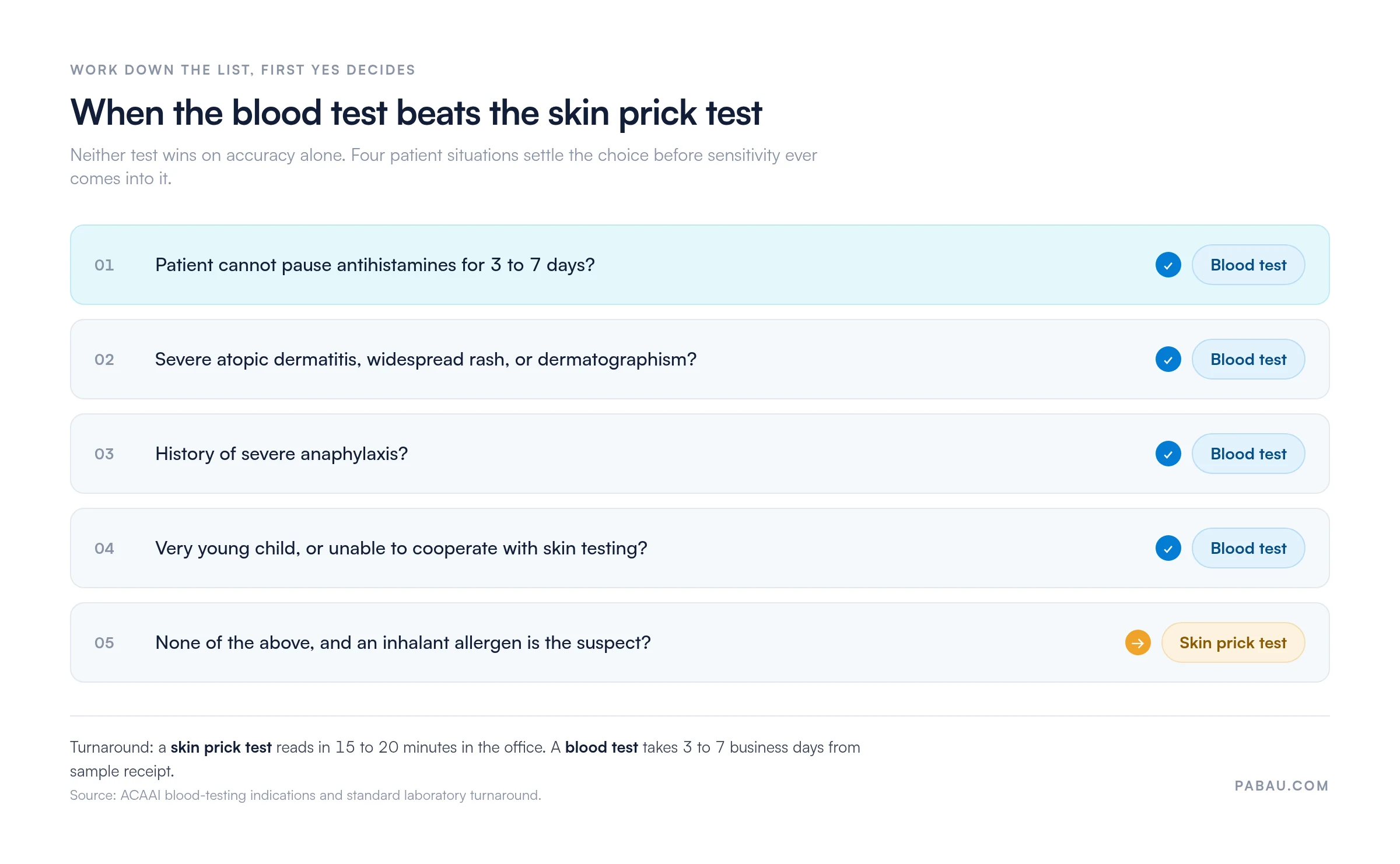
Neither test is always better. The right choice depends on the patient’s situation. Skin prick testing (SPT) gives faster results, usually 15 to 20 minutes in the office. It is generally seen as slightly more sensitive for inhalant allergens. The blood test has clear advantages when SPT isn’t suitable.
For patients on long-term antihistamines, those with dermatographism, or anyone with a history of severe anaphylaxis, the blood test is the safer option. It is also the more practical one, because no skin challenge is involved.
The ACAAI recommends blood testing when skin testing is contraindicated or impractical. Specific indications include:
In practice the decision rarely needs all six criteria. The first one that applies usually settles it.
Patients whose eczema rules out skin testing are often tracked visually as well. Dated before and after photos on the record show whether the skin is settling between visits.
Functional medicine and integrative practices more often order allergy panels as part of a broader immune health assessment. That’s most common for patients with chronic inflammation or unexplained digestive symptoms. Either way, panel numbers only mean something next to a detailed clinical history.
Document the patient’s antihistamine and medication history before ordering any allergy test. Blood testing removes the antihistamine withdrawal barrier that often delays skin prick testing by weeks. Recording this in the patient’s notes at the point of referral saves a follow-up call and speeds up the diagnostic pathway.
Ordering an allergy blood test is only the first step. Practices with higher volumes of allergy patients face the same four workflow problems:
Delays build up at those steps. A result lands in a generic inbox, sits unreviewed for days, and the patient calls to chase it. Practice management software like Pabau handles this differently. Its lab test management links the order to the patient’s record, alerts the clinician when results arrive, and opens the follow-up task.
Intake and consent benefit from the same system. Digital intake forms sent before the appointment capture allergy history, current medications, and symptom timelines. The data lands in the client record. So the clinician reading a class 3 IgE result sees the full medication list and reaction history on one screen.

Automated follow-up can schedule the results visit as soon as a result is filed. That replaces a manual task list nobody owns. Timely follow-up after an allergy blood test is one of the highest-impact touchpoints in the whole pathway.
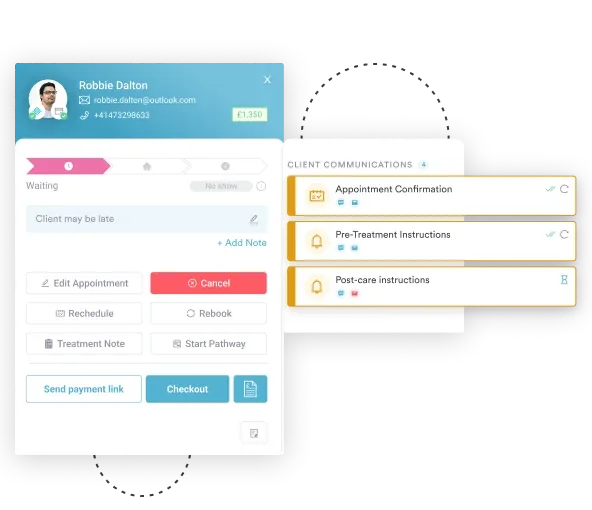
For multi-practitioner allergy practices, connecting test ordering, filing results, and follow-up scheduling in one workflow removes most of the handover risk. Patients who can view their own results in a portal ask fewer chase questions. They also arrive at the review visit better informed.

From digital intake forms to automated result follow-ups, Pabau helps allergy and integrative practices track every step of the diagnostic journey in one place.

If a patient can’t pause their antihistamines, has widespread eczema, or has reacted badly before, order the blood test and stop debating sensitivity. The class number then tells you how likely the sensitization is, not how badly the patient will react.
Treat the number as one input to a clinical judgment you still have to make. The more common problem in practice is delay rather than misreading. A result that sits unread for a week costs the patient more than a borderline class 2 does.
The diagnostic pathway is only as fast as the system behind it. Where the order, the result, and the follow-up sit in one record, nobody chases a lab report by email. Book a demo to see how Pabau handles allergy test ordering and results follow-up for your practice.

Investigating an immune-mediated condition rather than an allergy? C4 complement blood test explains what low and high complement levels point to.
Ruling out inflammatory arthritis alongside allergy symptoms? Rheumatoid arthritis test covers what RF and anti-CCP results establish.
Standardizing how your practice orders bloods? Blood test lab request form is a free template covering the fields a lab needs.
Need a refresher on reading gas and pH results? Arterial blood gas test walks through normal values and interpretation.
An allergy blood test is a lab test that measures the level of allergen-specific immunoglobulin E (IgE) antibodies in a blood sample. A standard venous blood draw is taken and sent to a lab, where the sample is exposed to specific allergen extracts. The lab measures how much IgE binds to each allergen, reporting results in kU/L classified across a class 0 to 6 scale. Higher classes show greater sensitization, though results always require clinical correlation with symptom history.
The RAST (radioallergosorbent test) is the original method for measuring specific IgE, using radioactive labels to detect antibody binding. ImmunoCAP is the modern replacement, using fluorescent enzyme immunoassay technology. ImmunoCAP is more sensitive, more standardized across labs, and needs no radioactive materials. Most labs no longer perform RAST. When you see RAST referenced today, the test being run is almost always ImmunoCAP or a similar ELISA-based method.
No. Antihistamines do not affect IgE antibody levels in blood, unlike their effect on skin prick testing. You can keep taking them right up to the draw. This is one of the key advantages of blood testing over skin testing for patients on long-term antihistamine therapy.
No. Histamine intolerance is not an IgE-mediated allergic condition. It results from reduced diamine oxidase (DAO) enzyme activity, which impairs the body’s ability to break down dietary histamine. Standard allergy blood tests measure IgE antibodies and cannot diagnose histamine intolerance. Patients suspected of histamine intolerance usually require separate DAO activity testing and a low-histamine dietary trial assessed by a specialist.