Health appraisal form
A health appraisal form is a record a licensed provider signs to document someon...

2
Last Updated: Oct 13, 2026

AdvancedMD suits multi-specialty practices that want deep EHR customization and in-house billing control across 1,400+ app integrations.
CareCloud’s Concierge service outsources the whole revenue cycle for a percentage of collections, so billing leaves your team entirely.
Both platforms sit below 4.0 on Capterra and G2, with complaints about pricing complexity, support, and implementation timelines.
Aesthetic, wellness, and multi-service practices that skip insurance billing often fit practice management software like Pabau better than either.
Choosing between AdvancedMD vs CareCloud comes down to one question. Do you want to run your own billing, or hand it to someone else? AdvancedMD gives you the tools and the control. CareCloud Concierge takes the whole revenue cycle off your team’s hands for a cut of your collections.
Neither approach wins outright, and for the wrong practice type each carries costs that only surface after you sign. This comparison covers EHR depth, billing models, practice management features, pricing, integrations, and user reviews. It also covers the case where neither platform is the answer.
Here is how the two platforms line up across the dimensions that decide most purchases.
AdvancedMD is a cloud-based EHR and practice management platform built for independent medical practices across a wide range of specialties. Founded in 1999, it is headquartered in South Jordan, Utah. The platform targets small and midsize practices that want deep clinical customization alongside in-house billing infrastructure.
Its product suite covers EHR with specialty-specific templates, practice management, medical billing, patient scheduling, and telehealth. According to AdvancedMD, the platform connects to over 1,400 third-party apps and 50+ billing partners. Its integrations directory lists patient communication tools such as Zocdoc and Weave.
The platform is ONC certified for interoperability, supports ePrescribing, and is designed for the HIPAA compliance requirements of US medical practices. It appeals most to practices that keep billing in-house and have the staff to manage claims workflows.
CareCloud is a healthcare IT platform offering EHR, practice management, and its flagship Concierge managed revenue cycle management service. It was acquired by MTBC, which then rebranded as CareCloud and consolidated both businesses under one name. The platform serves practices from primary care to multi-specialty groups.
CareCloud Concierge is the platform’s most distinctive offering. CareCloud’s billing team handles claims, follow-up, denials, and collections for the practice. The charge is typically a percentage of collections rather than a flat software fee.
Practices that want billing off their plate entirely often find this model compelling. Those that want more control, or that run lower claim volumes, may find the percentage expensive for what it returns.
CareCloud’s EHR pairs a modern interface with AI-assisted documentation and specialty templates. Its integration ecosystem covers lab and imaging connectors plus selected third-party platforms. That list is narrower than AdvancedMD’s.
EHR depth is the clearest difference between the two platforms. ONC certification means both meet baseline interoperability requirements, but what each one builds on top of that differs.
AdvancedMD’s EHR strength is breadth and configurability. It carries a large library of specialty-specific templates, supports extensive workflow customization, and was built to serve diverse multi-specialty practices. Reviewers cite the comprehensive feature set as a strength, even while noting the learning curve that comes with it.
CareCloud’s EHR leans on interface quality and AI-assisted documentation. The interface is widely considered more modern and intuitive, which cuts training time. Reviewers do note fewer customization options than AdvancedMD offers, which frustrates practices with non-standard workflows.
This is where the two platforms separate most sharply. The choice is control versus convenience, and the financial consequences are substantial either way.
AdvancedMD provides a self-managed billing toolkit: clearinghouse connections, claims scrubbing, denial management workflows, and reporting. Your billing team, or an outside biller of your choosing, works inside the platform.
With 50+ billing partner integrations, billers get flexibility in how they build their claims management software stack.
CareCloud Concierge removes your billing team from the picture. CareCloud’s staff handle claims submission, follow-up, denial resolution, and collections. The cost is a percentage of collections rather than a flat fee.
That aligns incentives on paper, but it gets expensive for high-volume practices where the percentage outruns a fixed billing cost. Practices with lower volumes or thin billing staff may see genuine savings. High-revenue practices should model both scenarios before committing.
Neither platform should be picked on billing model alone. Stress-test the numbers against your collection volume and your current billing overhead first.
Practice management covers the daily operational layer: scheduling, front-desk workflows, patient communication, and administrative automation. Both platforms are built for high-volume medical practices, but they emphasize different parts of it.
For practices running multiple providers across varied specialties, AdvancedMD’s depth wins. For single-specialty or smaller groups that prize ease of use, CareCloud’s cleaner interface is the advantage.
Both platforms include native telehealth, so integration quality and virtual-visit billing are what separate them.
Practices with a high share of telehealth appointments should confirm current billing support with each vendor directly, since capabilities shift with CMS reimbursement policy. Pabau also offers integrated telehealth tools for practices that don’t bill through insurance. Wellness and aesthetic providers running virtual consultations should take a look.
Integration breadth matters most to practices that already run specialist tools for patient communication, lab ordering, imaging, or referrals. Those practices need the EHR to connect cleanly with what they have.
AdvancedMD claims over 1,400 app integrations and 50+ billing partner connections, figures the vendor publishes rather than an audited count. The list covers patient engagement platforms, pharmacy networks, and clearinghouse partners. For practices with an established tech stack, that breadth lowers the odds of hitting a compatibility wall.
CareCloud’s integration ecosystem is narrower, weighted toward lab and imaging partners plus selected third-party connectors. Under the Concierge model the priority shifts, because a practice outsourcing billing doesn’t need the same clearinghouse breadth.
If your practice depends on specific point solutions, verify compatibility with both vendors before you sign a contract. Integration counts from vendor marketing can mislead when many of the listed connections are rarely used or one-directional.
Pricing is the most opaque part of this comparison. Neither platform publishes per-seat or per-provider figures, so both require a sales conversation. The structural differences between the two models are well established, though.
| Plan | Price | What it covers |
|---|---|---|
| Core platform | Contact sales, no published pricing | EHR, practice management, and scheduling, priced per provider |
| Add-on modules | Contact sales, quoted per module | Billing tools, telehealth, and further modules layered on the core |
AdvancedMD publishes no prices, so every figure arrives in a quote shaped by your provider count and module list.
AdvancedMD pricing is modular. Practices pay for the core platform plus add-on modules covering EHR, practice management, billing tools, and telehealth. Costs scale with provider count and the features chosen.
Reviewers flag that the total climbs quickly once several add-ons are in play. The complexity also makes the price hard to benchmark against alternatives without a detailed quote.
| Plan | Price | What it covers |
|---|---|---|
| Software subscription | Contact sales, no published pricing | EHR, practice management, and patient engagement tools |
| Concierge managed RCM | A percentage of collections, quoted per practice | Claims submission, denial management, follow-up, and collections |
CareCloud publishes no prices either, and the Concierge percentage is negotiated against your collection volume.
CareCloud’s Concierge model adds a percentage of collections on top of the base software fee. For a practice collecting $500,000 a year, a 4-6% concierge rate costs $20,000 to $30,000 annually. That sits on top of the software fee.
That may still beat maintaining an in-house billing team, depending on your salary and overhead costs. The math shifts once collection volumes rise, so model your own revenue against the quoted percentage. Only then is it comparable to AdvancedMD’s add-on structure.
Before you accept a quote from either vendor, build a simple spreadsheet. Put annual collections multiplied by the Concierge percentage on one side. On the other, list AdvancedMD’s module fees plus estimated staff billing hours. Small practices often find CareCloud Concierge surprisingly cost-effective. High-volume practices usually find the percentage model expensive fast.
Based on Capterra reviewers (3.6/5 from 466 reviews) and G2 reviewers (3.6/5 from 63 reviews), the themes around AdvancedMD are consistent.
Based on Capterra reviewers (3.6/5 from 112 reviews) and G2 reviewers (3.3/5 from 15 reviews), CareCloud’s themes reflect its different positioning.
Neither platform earns high marks from its users. Both sit below 4.0 on the major review sites, which is notable for products often positioned as premium.
The two platforms tie on Capterra at 3.6/5, and CareCloud edges ahead only on G2. Its review volume is far smaller, at 112 against 466 on Capterra. That makes the G2 lead a weaker signal than it looks.
The negative themes converge on the same underlying issue. These are complex, expensive systems whose implementation and support experiences don’t always match the sales promise.
The decision comes down to your billing model, your specialty mix, and how much operational complexity your team can absorb. There is no universally correct answer, but the signals point clearly one way or the other.
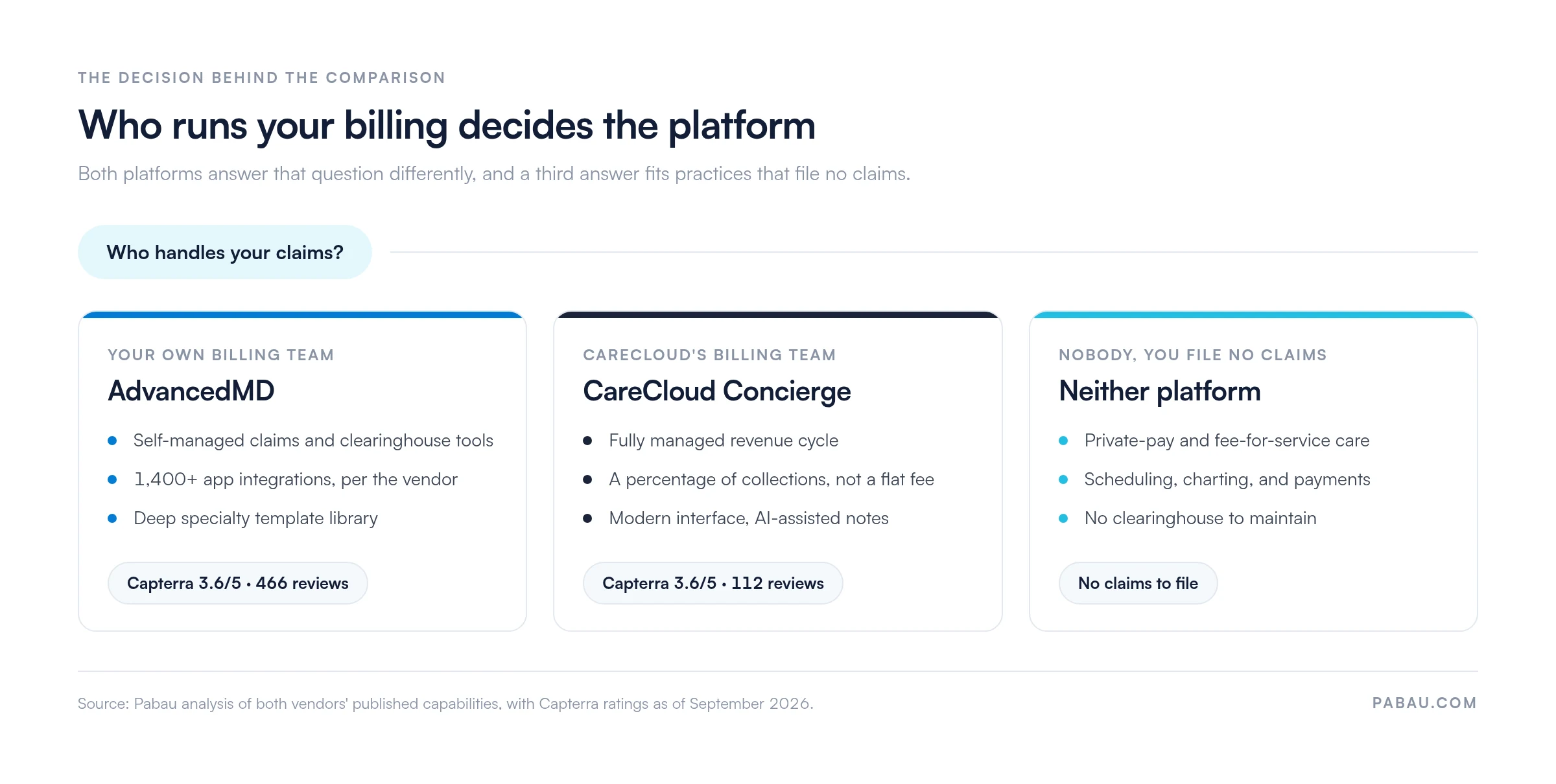
Both shortlists assume insurance billing is central to your revenue. If you are still widening the search, Tebra vs DrChrono compares two other platforms built for independent medical practices.
This comparison assumes your practice runs insurance-based billing. For a large slice of the market, that assumption doesn’t hold. Aesthetic practices, wellness centers, IV therapy providers, and multi-service private-pay operations need no clearinghouse and no outsourced RCM service.
What those practices need is scheduling, clinical documentation, consent management, and payment processing built around procedure-based care. Practice management software like Pabau is built for that shape of business. Its clinical tools cover before-and-after photos, consent forms, treatment records, injection plotting, and patient recall automation.
Our practice management software comparison pages line Pabau up against other platforms side by side. The pricing model is different too. Pabau charges a flat subscription based on location and user count, with no percentage of collections.
Every subscription includes every feature, so nothing sits locked behind a higher tier. Optional Plus add-ons, such as Marketing Plus and Care Plus, sit on top for practices that want additional depth in one area.
For fee-for-service practices, that structure is usually easier to forecast than AdvancedMD’s module stack or CareCloud’s Concierge percentage. Pabau holds a 4.7/5 rating from 600+ verified reviews on Capterra, with onboarding and automation drawing particular praise.
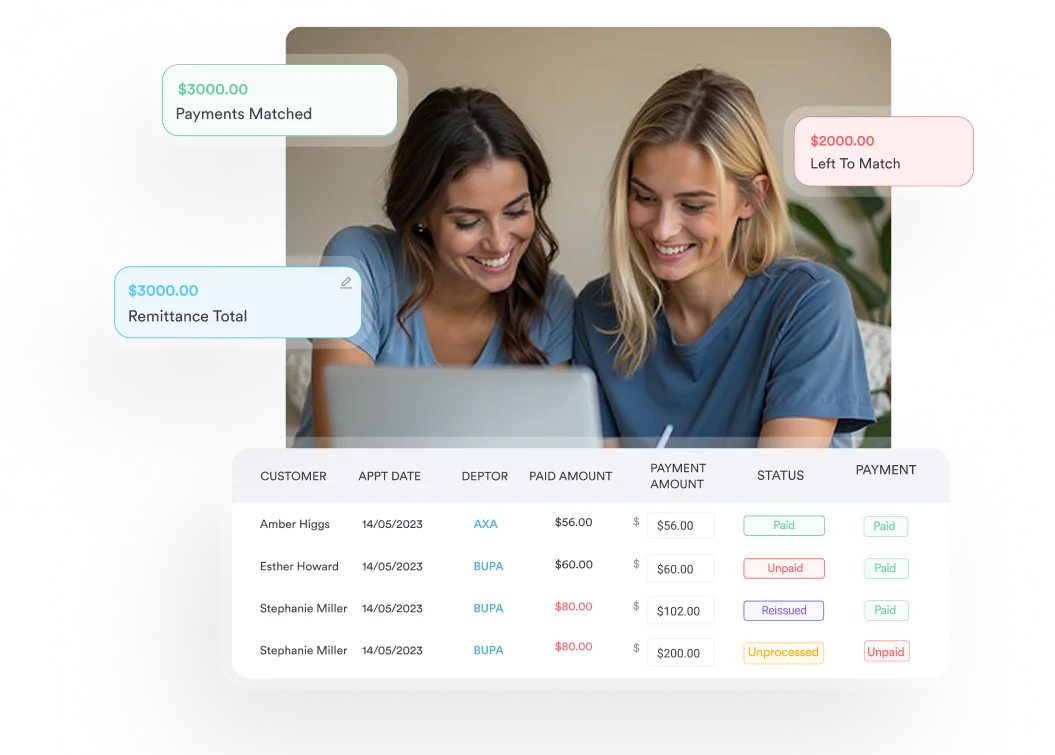

Pabau gives aesthetic, wellness, and multi-service practices scheduling, clinical documentation, and payment tools in one platform, with no insurance RCM to manage. See how it compares.

The AdvancedMD vs CareCloud choice is a choice about who owns your revenue cycle. Pick AdvancedMD if that is your own team, and budget for the training and the module fees. Pick CareCloud Concierge if you would rather buy the outcome, then check the percentage against your collections.
Both platforms sit below 4.0 with their own users, so expect a demanding implementation whichever you sign. Ask each vendor for reference calls with practices your size, in your specialty, and on your billing model.
And if the honest answer is that you never file a claim, neither platform is worth the overhead. Book a demo to see how Pabau handles scheduling, records, and payments for a private-pay practice.

Need a specialty-first EHR instead? ModMed vs DrChrono sets built-in specialty workflows against a more configurable platform.
Watching the software budget? DrChrono vs Practice Fusion compares two cloud EHRs on cost, features, and fit.
Leaving Kareo or Tebra behind? Kareo alternatives lists the platforms medical practices move to, and why.
The main difference is the billing model. AdvancedMD provides self-managed billing tools with a large clearinghouse ecosystem, giving practices full in-house control. CareCloud’s Concierge service outsources the revenue cycle to CareCloud’s billing team for a percentage of collections. AdvancedMD suits practices that already have billing staff. CareCloud Concierge suits practices that want billing managed for them.
For small practices, CareCloud usually edges out AdvancedMD. Its interface is easier to learn, and the Concierge model lifts billing complexity off a small team. AdvancedMD’s deeper customization and wider integration ecosystem matter more to midsize or multi-specialty practices with dedicated billing staff. A small single-specialty practice with no billing infrastructure often finds Concierge the more practical starting point.
Yes. CareCloud Concierge is a fully managed RCM service. CareCloud’s billing team handles claims submission, denial management, follow-up, and collections for the practice. The practice pays a percentage of collections instead of a flat software fee. It keeps oversight, but it does not run day-to-day billing operations internally.
AdvancedMD uses modular per-provider pricing, so costs scale with the features and add-ons you select. CareCloud combines a base software fee with a Concierge percentage of collections for managed RCM clients. Neither publishes public pricing, so a fair comparison needs quotes from both vendors. Model your own collection volume and billing overhead against each one.
Both offer native telehealth with integrated video visits and billing support for virtual appointments. AdvancedMD runs telehealth billing through its self-managed claims workflow. CareCloud handles it through the Concierge model for managed RCM clients. The functional difference is modest for most practices, so the billing workflow is the more meaningful distinction.