How to open a peptide clinic: 7 steps for licensed practices
How to open a peptide clinic: run peptide therapy as a prescribed service inside...

Last Updated: Nov 19, 2026
The 503A compounding pharmacy tirzepatide pathway means a state-licensed pharmacy compounds for one identified patient on a prescription, overseen by the state board of pharmacy. A 503B outsourcing facility registers with FDA, works under current good manufacturing practice (CGMP) and FDA inspection, and may supply office stock.
As of FDA’s April 2026 compounding statement, neither tirzepatide nor semaglutide is on FDA’s drug shortage list or the 503B bulks list.
We checked that page on November 24, 2026, and its content is current as of April 1, 2026. In short, a 503A may fill only narrow, patient-specific prescriptions, and a 503B may not compound either drug from bulk ingredient. Check the FDA page for changes before every order.
This guide sets out each pathway’s limits and a supplier check. It ends with the compounded GLP-1 sourcing file, the records that show your source was lawful on the day you ordered.

A 503A pharmacy compounds for an identified patient on a prescription. A 503B outsourcing facility registers with FDA, follows CGMP and may supply office stock.
FDA’s page, checked November 24, 2026, says tirzepatide and semaglutide are on neither the shortage list nor the 503B bulks list.
Enforcement discretion ended for tirzepatide in February and March 2025, and for semaglutide in April and May 2025.
FDA proposed keeping semaglutide, tirzepatide and liraglutide off the 503B bulks list in 2026, and no final decision was found by November 24, 2026.
Keep a compounded GLP-1 sourcing file for every source, and confirm office-stock and recordkeeping rules with counsel and your state board of pharmacy.
A 503A pharmacy compounds for an identified patient on a prescription, under state board oversight. A 503B outsourcing facility registers with FDA, follows CGMP and may supply office stock.
The difference between 503A and 503B compounding pharmacy rules comes from two sections of federal law: section 503A (21 U.S.C. 353a) and section 503B (21 U.S.C. 353b), both in the 2024 edition of the U.S. Code. A 503B outsourcing facility “is not required to be a licensed pharmacy” and may or may not obtain patient prescriptions.
In 503A vs 503B terms, the two lines that matter to a practice are CGMP and office stock. The table sets each requirement against the FDA source it comes from, checked November 24, 2026.
Checked November 24, 2026 against FDA’s page (content current as of April 1, 2026). Check the FDA page for changes before you order.
Tirzepatide and semaglutide are off FDA’s drug shortage list and absent from the 503B bulks list. FDA’s enforcement discretion has ended for both drugs, under 503A and 503B.
FDA’s own wording is direct: “Tirzepatide and semaglutide do not currently appear on the 503B bulks list or on FDA’s drug shortage list.” FDA resolved the tirzepatide shortage on December 19, 2024 and the semaglutide injection shortage on February 21, 2025.
FDA’s drug shortage database, updated November 20, 2026, lists neither drug as in shortage. That status drives FDA’s rules on compounded tirzepatide, because “when a drug shortage is resolved, FDA generally considers the drug to be ‘commercially available.'”
Every compounding limit below follows from that one line. Copies of a commercially available drug face the essentially-a-copy rules, and a 503B loses its shortage-list route to bulk ingredient.
Compounded tirzepatide is still available, but only narrowly. A 503A pharmacy may fill a patient-specific prescription that documents a significant difference, and a 503B may not compound it from bulk ingredient.
So whether a practice can still get it depends on the pathway. On the 503A side, the prescriber’s documented reason and FDA’s volume limits decide it, covered in the 503A section below.
On the 503B side, an April 2026 FDA warning letter to an outsourcing facility is explicit. The April 7, 2026 letter says tirzepatide-bulk products “are not eligible for the exemptions provided by section 503B.” The reason given: tirzepatide is not on the 503B bulks list or the shortage list.
The rules changed in stages, and the stages differ by drug and by pathway. The timeline shows which dates apply to which order.
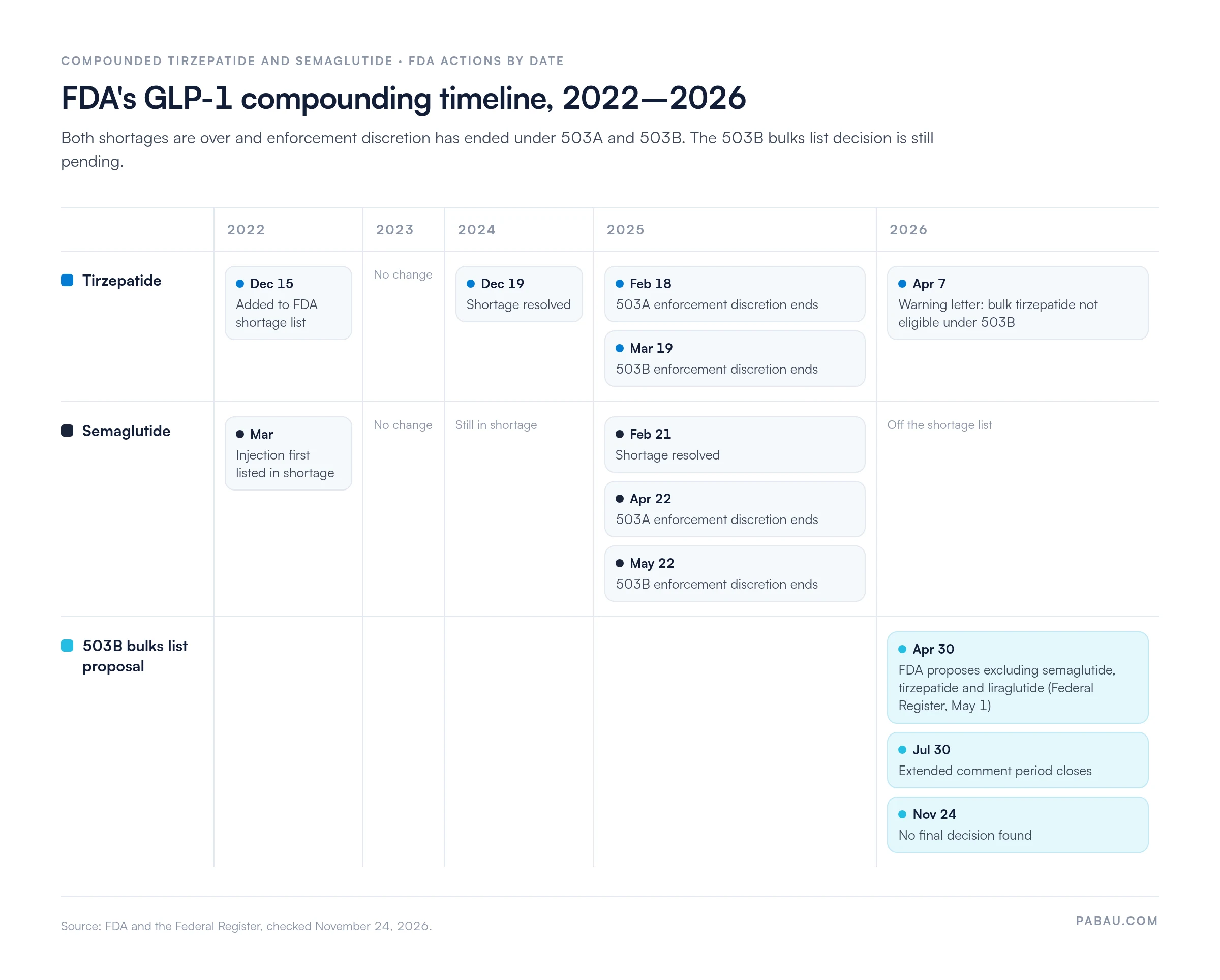
FDA’s proposal to keep semaglutide, tirzepatide and liraglutide off the 503B bulks list is still pending. No final decision was found on FDA or the Federal Register as of November 24, 2026.
FDA announced the proposal on April 30, 2026, and the Federal Register notice of May 1, 2026 opened docket FDA-2018-N-3240. In that notice, FDA says shortages and backorders do not count as “clinical need,” and neither do convenience or cost.
Comments were first due June 30, 2026, and a June 26, 2026 extension moved the deadline to July 30, 2026. FDA’s 503B bulks list page has not changed since May 16, 2024, and lists no GLP-1.
For a practice, the day-to-day effect is the same either way. A 503B already cannot use bulk tirzepatide or semaglutide, because neither drug is on the list.
A 503A compounding pharmacy can supply tirzepatide only on a prescription for an identified patient, never as office stock. Each prescription must also stay within FDA’s essentially-a-copy limits.
We hear one question from owners setting up GLP-1 programs more than any other: can a 503A ship a box for the treatment room? FDA’s 2016 prescription requirement guidance answers no, because prescriptions without patient names “do not meet the requirement.”
A pharmacy that offers providers unnamed tirzepatide vials for office use is describing a 503B product. A semaglutide order from a 503A pharmacy faces the same limits. These are the rules each prescription has to clear:
FDA also sets the clinical bar: “Compounded drugs should only be used in patients whose medical needs cannot be met by an FDA-approved drug.” The approved products and their generic names sit in our GLP-1 medication list.
A 503B outsourcing facility cannot compound tirzepatide from bulk ingredient today. Tirzepatide is on neither the 503B bulks list nor FDA’s drug shortage list.
A 503B compounding pharmacy tirzepatide product hits two statutory walls. Under 21 U.S.C. 353b, a 503B may use a bulk ingredient only if it is on the 503B bulks list or the shortage list. A 503B also may not make essentially a copy of an approved drug unless that drug is on the shortage list.
FDA’s shortage compounding page (August 8, 2025) adds the timing rule. Once a shortage ends, FDA may act on new orders, or on old orders filled more than 60 days after the shortage ended.
Office stock from a 503B is still lawful for products that clear those walls. When you receive one, section 503B requires the label to carry these items:
Only the outsourcing facility may sell or transfer the drug, though the practice may still administer it in a health care setting. FDA’s January 2018 503B guidance also says an office-stock order should state the change and the clinical difference. An order “that only identifies the product formulation” is not enough.
To verify a GLP-1 supplier, match its claimed pathway to an official record. Check FDA’s registered outsourcing facilities list for a 503B, and a state board license for a 503A.
These checks exist because of the disadvantages FDA lists for compounded drugs. FDA’s October 2026 concerns page says “compounded drugs are not FDA approved.” The agency does not review them for safety, effectiveness or quality before they are marketed. Run the six steps below before the first order and again each order cycle:
FDA’s list does not show state actions. For those, FDA says to “check with the State Board of Pharmacy for the state in which the facility is located.” Confirm your supplier checks with counsel and your state board of pharmacy.
Keep a compounded GLP-1 sourcing file for every source. It holds the prescription or order wording, dated FDA checks, supplier verification, label check, consent, and lot and expiry records.
We found no FDA checklist for practices that receive compounded GLP-1s, so the compounded GLP-1 sourcing file is built from FDA’s own guidance. Each item answers a question an inspector or a lawyer could ask about one order:
If you are still starting a weight loss clinic, build the compounded GLP-1 sourcing file before the first order rather than after. Rules on office stock and recordkeeping vary by state, so confirm yours with counsel and your state board of pharmacy.
Most of the compounded GLP-1 sourcing file belongs to a patient, so it works best inside the patient record. Pabau is a practice management platform for practices offering aesthetics, hormone therapy, weight loss and longevity care. It runs booking, charting, consent forms, payments and memberships in one system.
In Pabau, consent forms go out before the visit and patients sign them digitally. The completed form lands in the patient record rather than sitting as a loose PDF. Practices can adapt a tirzepatide consent template to name the product as compounded.
Stock in Pabau carries a batch number and an expiry date. The lot is recorded against the patient and the appointment, and the injection face chart requires it. That ties each vial’s lot to the visit where the dose was given.
Practices can also switch on the GLP-1 tab, which shows dose over time, the current dose and weight for each patient. See how this fits a full program in our guide to EMR for weight loss clinics, or browse our weight loss and metabolic health guides.

Pabau sends GLP-1 consent forms before the visit and records the lot and expiry against the patient and the appointment. Your compounded GLP-1 sourcing file stays in one chart.

Choosing a compounded GLP-1 source is now a documentation decision as much as a purchasing one. Pick the pathway FDA allows for how your practice uses the drug: patient-specific prescriptions through a 503A, office stock only through a 503B.
Then keep the compounded GLP-1 sourcing file, so the record proves the choice on the day you made it. Re-check the FDA page before each order cycle, because the pending 503B bulks decision could land at any time.
Book a demo to see how Pabau keeps GLP-1 consent, lot and dose records in the patient chart.

Treating patients with Medicaid coverage? Does Medicaid cover GLP-1 explains how coverage works for the approved drugs.
Need the approved drugs side by side? GLP-1 medication list lists each approved product with its generic name.
Prescribing tirzepatide? Informed consent for tirzepatide treatment template gives you a consent form to adapt for your practice.
Planning where to grow your program? GLP-1 usage by state maps GLP-1 use across the US.
Pricing a weight loss program? How weight loss clinics make money breaks down the revenue models practices use.
A 503B outsourcing facility is a compounder that elects to register with FDA and follows CGMP. It may compound with or without patient prescriptions, including office stock. FDA inspects it on a risk-based schedule, per FDA’s compounding laws page (December 17, 2024).
A 503A compounding pharmacy is a state-licensed pharmacy that compounds for an identified patient on a valid prescription, under 21 U.S.C. 353a. In 503A vs 503B pharmacy terms, it answers to the state board rather than FDA inspection, and CGMP does not apply.
Federal law sets two compounding pathways: section 503A for patient-specific prescriptions, and section 503B for FDA-registered outsourcing facilities. Only a 503B outsourcing facility may supply office stock without patient names.
Only within narrow limits. A 503A may fill patient-specific prescriptions that document a significant difference, within FDA’s copy limits. A 503B may not use bulk tirzepatide, per FDA’s April 2026 statement.
Compounded tirzepatide has already narrowed sharply since enforcement discretion ended in early 2025. FDA’s 2026 proposal to keep it off the 503B bulks list had no final decision as of November 24, 2026, per the Federal Register.
No. FDA says “compounded drugs are not approved by FDA,” while approved drugs go through its premarket review for safety, effectiveness and quality. FDA’s compounding policy treats them as different products, per FDA’s April 2026 statement.