Mental health self-care checklist
A mental health self-care checklist is a structured daily tool for tracking the ...

5
Last Updated: Oct 20, 2026

The Zung Self-Rating Depression Scale is a 20-item self-report questionnaire developed by Dr. William W.K. Zung in 1965.
Patients rate each item on a 4-point scale, and the raw score of 20 to 80 converts to an SDS Index of 25 to 100.
Four severity bands read off that index: Normal below 50, mild 50 to 59, moderate 60 to 69, and severe from 70 up.
The 20 items cover affective, cognitive, and somatic symptoms, so the scale documents symptom burden rather than diagnosing depression.
Practice management software like Pabau lets patients complete the scale digitally, so the score is calculated and filed in the record automatically.
A print-ready copy of all 20 items with the 4-point response scale, the SDS Index formula, and the four severity bands on one sheet. Hand it to the patient in the waiting room or send it before the appointment.
Download templateThe Zung Self-Rating Depression Scale (SDS) is a clinician-facing screening tool that records depressive symptoms in a structured, validated format. Published in 1965, it remains one of the most widely used instruments in mental health, primary care, and psychology practice.
This page walks through the 20 items, the scoring formula, the cut-off thresholds, and where the scale is worth using in a caseload.
The Zung SDS is a 20-item self-report questionnaire that measures how severe a patient’s depressive symptoms are. Dr. William W.K. Zung developed it in 1965 as a brief, standardized measure clinicians could administer in routine practice. It has since been widely validated and used across mental health and primary care settings.
The scale measures three dimensions of depression. Affective items cover mood, motivation, and life satisfaction. Cognitive items cover decision-making, worthlessness, and outlook. Somatic items cover sleep, fatigue, and appetite changes.
Depression rarely arrives as a single emotional state. It shows up as a mix of emotional, cognitive, and physical changes, and the scale is built to pick up all three. That is also why it captures patient-reported severity in a form you can compare across visits. Psychology practice software can store those scores securely and show the trend across appointments.
The scale presents 20 statements about emotional, cognitive, and physical experiences. Each one is rated on a 4-point scale, from never or rarely (1 point) to most or all of the time (4 points). The two middle options are sometimes (2 points) and good part of the time (3 points).
Half the questionnaire is physical. That weighting reflects clinical evidence that bodily complaints often dominate how depression presents, particularly in older adults. It also holds in cultures where emotional symptoms are discussed less openly.
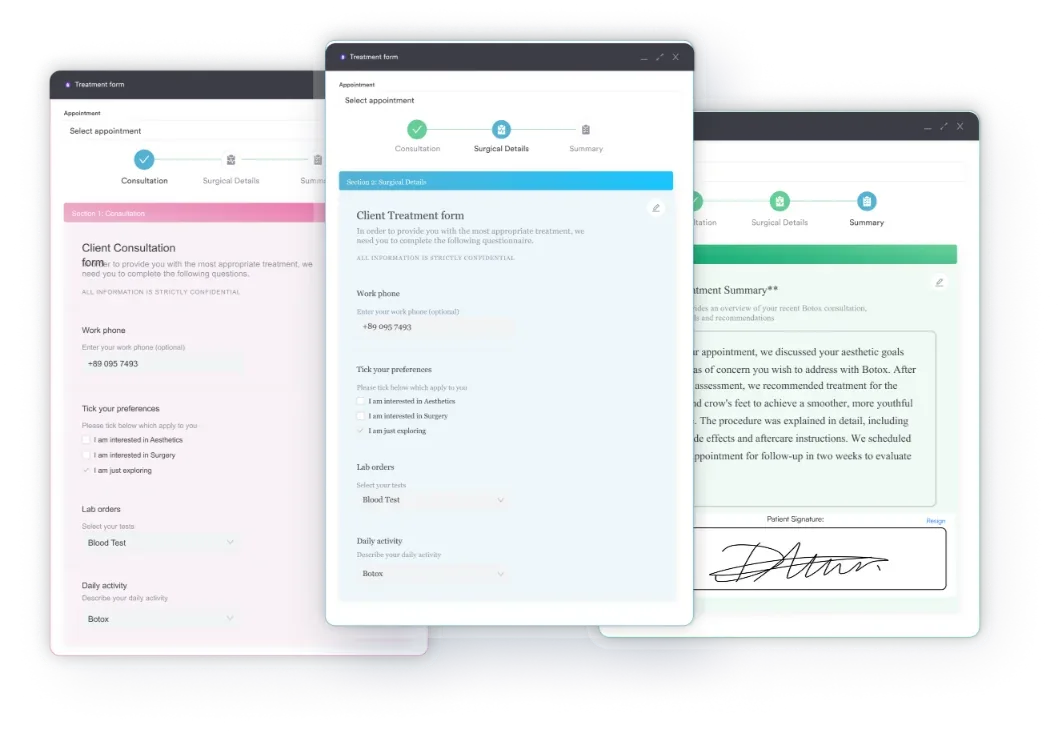
Patients can work through the 20 items on paper in the waiting room, or on a digital form before they arrive. A digital form scores itself, which takes the arithmetic out of the first few minutes of the appointment.
Scoring takes three steps: Add up the raw score, convert it to the SDS Index, and map the index to a severity band.
Example: A patient who scores 48 on the raw scale has an SDS Index of 60. That sits in the moderate range, which warrants clinical follow-up and a look at whether treatment needs stepping up.
The conversion is also where the scale’s floor catches people out. Because every item scores at least one point, the lowest possible result is an index of 25, not zero.
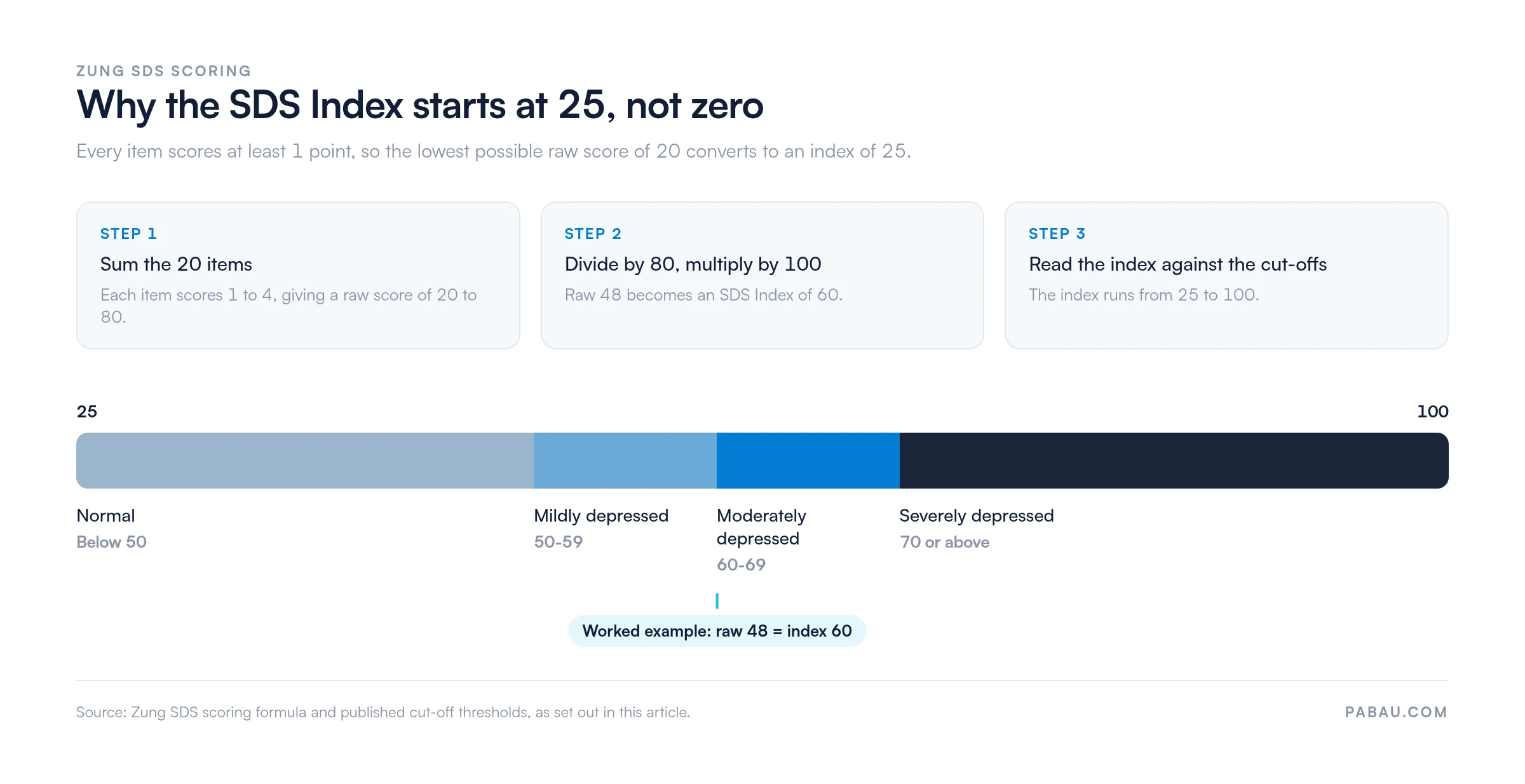
The SDS Index maps to four severity categories. They guide the next clinical decision and give you plain language for explaining symptom burden to the patient.
Important caveat: Cut-off thresholds vary slightly across published studies and clinical populations. The ranges above represent the consensus from major validation studies. Apply clinical judgment alongside the score, and weigh cultural context, chronicity, and functional impact before you act on it.
The Zung SDS has been through extensive validation, and its psychometric properties support its use as a screening instrument.
Repeat administration is where those properties pay off. Scores collected the same way each time show whether symptoms are actually moving, which a clinical impression on its own cannot settle.
The Zung SDS does three jobs. It screens for undiagnosed depression, records baseline severity at the start of treatment, and tracks symptom change during care.
Screening: Mental health clinicians, primary care physicians, nurses, and physician assistants use it with patients who present with non-specific complaints. Fatigue, pain, and disrupted sleep are the common ones. An index of 50 or above prompts a fuller diagnostic evaluation.
Baseline assessment: Scored at the start of treatment, the scale fixes a reference point that later results are measured against. That makes the consent conversation about expected timelines concrete, and it gives you a treatment goal in a number.
Progress monitoring: Repeating the scale monthly or quarterly shows whether medication or therapy is reducing symptom burden. Scores that flatten or climb are the trigger to adjust treatment or refer on. Sharing the number with the patient turns it into a conversation about what changes next.
None of that works if the scores live in a paper folder. Most practices now keep them in software built for therapists, so any clinician seeing the patient can pull up the last three results in seconds.
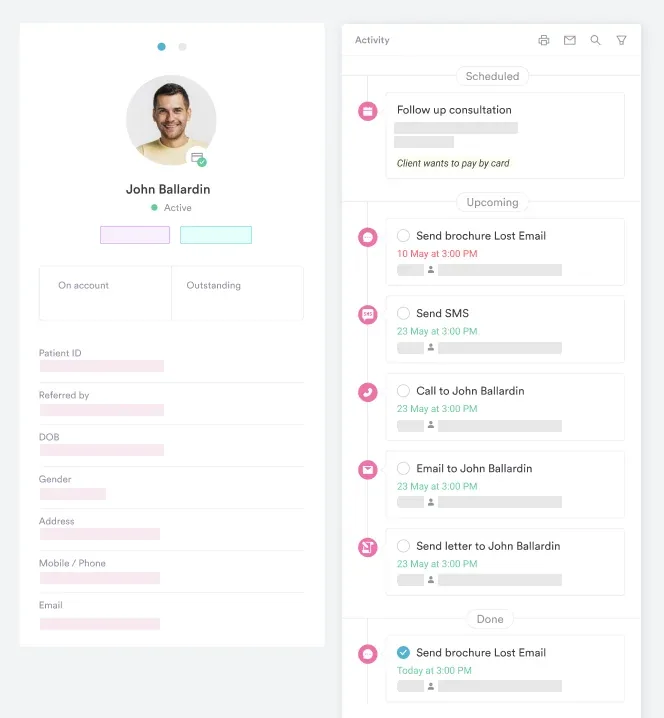
Keep baseline and follow-up scores in the same place in every patient’s chart. Patterns then stand out, such as seasonal worsening or somatic symptoms rising after a medication change. It also lets you show the patient their own progress, which strengthens the therapeutic alliance.
The Zung SDS is one of four instruments clinicians reach for. The others are the Patient Health Questionnaire (PHQ-9), the Beck Depression Inventory (BDI), and the Hamilton Rating Scale for Depression (HAM-D). Knowing what each one is good at makes the choice quicker.
Selection logic: Use the Zung SDS for routine screening and monitoring in primary care, general practice, and early mental health assessment. Reach for the shorter PHQ-9 template when speed matters and the workflow is already built around it.
Prefer the BDI-II or HAM-D when cognitive symptoms dominate, or when you are running psychotherapy research. Mental health EMR software that holds several instruments lets you pick the right one per patient and appointment type.
When the aim is tracking response to antidepressant medication, the Montgomery-Åsberg scale is the clinician-rated option built to pick up symptom change.
The Zung SDS is well validated, but it has limits that shape how far you can push a score.
Clinical implication: Treat the Zung SDS as one part of a full mental health assessment, alongside the interview, functional history, and physical examination. Where anxiety symptoms dominate the picture, running the Zung anxiety scale alongside it helps separate the two symptom sets.
On paper, the SDS costs more than the five minutes the patient spends on it. Someone adds up 20 numbers, writes the total into the notes, and files the sheet. The next clinician to see that patient has no quick way of telling whether the score has moved.
Practice management software like Pabau replaces that with a digital form the patient fills in before the appointment. The 20 items and the 4-point scale sit in the form builder. The raw total and the SDS Index calculate themselves, and the result lands in the client record.
Because the scores sit in the record, you can pull up a patient’s last three results during a review without hunting for paperwork. Repeat screening becomes a scheduled task rather than something to remember, and the client portal sends the form out ahead of the visit.
The outcome is a shorter appointment start and a cleaner record. You open the chart with the score already there, so the time goes on what the number means for this patient.

Pabau captures Zung SDS responses digitally, calculates the SDS Index, and files the result in the client record. Your team can see every past score without opening a paper chart.

The Zung SDS earns its place because it is quick, free, and sensitive enough to surface depression a patient has not put into words. Use it to open the conversation and to measure what happens next, not to settle the question.
The trade-off is precision. An index of 62 tells you the burden is moderate. It does not tell you whether the cause is a depressive episode, an anxiety disorder with somatic symptoms, or an untreated thyroid problem. The clinical interview still decides that.
So score it the same way every time, repeat it on a schedule, and keep the results where the next clinician can find them. Book a demo to see how Pabau collects, scores, and stores depression screening across a whole caseload.

Comparing depression instruments before you commit to one? Beck Depression Inventory template covers the 21-item alternative used most in psychotherapy.
Need the shorter screener your primary care colleagues use? PHQ-9 and GAD-7 template pairs a 9-item depression screen with an anxiety measure.
Tracking mood between appointments? Daily mood chart gives patients a simple record to bring to the next session.
Did an item flag suicidal thoughts? Suicide safety plan sets out the steps to agree with a patient before they leave.
Documenting the full assessment? Psychiatric evaluation template structures history, mental status, and formulation in one document.
The Zung SDS is used to screen for depression severity and to monitor symptom change during treatment. Clinicians score it at baseline to document initial burden, then repeat it monthly or quarterly to see whether therapy or medication is working. A single score cannot diagnose depression, so it is read alongside the clinical interview.
Add the values (1-4) from each of the 20 items to get a raw score between 20 and 80. Divide that raw score by 80 and multiply by 100 to get the SDS Index, which runs from 25 to 100. An index below 50 is normal, 50-59 is mild, 60-69 is moderate, and 70 or above is severe.
An SDS Index below 50 indicates normal mood and minimal depressive symptoms. Scores of 50-59 reflect mild depression that warrants monitoring. Scores of 60-69 indicate moderate depression requiring intervention, and 70 or above suggests severe depression needing urgent evaluation.
Yes, the Zung SDS is in the public domain and free to use in clinical practice. Unlike some proprietary instruments (BDI-II, HAM-D), there are no licensing or permission fees, making it accessible for all practice settings.
The Zung SDS (20 items, 5-10 minutes) gives balanced coverage of affective, cognitive, and somatic symptoms. The PHQ-9 (9 items, 3-5 minutes) is faster and maps directly to DSM-5 criteria, making it ideal for high-volume primary care. Both are valid screening tools; choice depends on clinical context and time availability.
Yes, the Zung SDS is widely used in general practice, primary care, mental health clinics, and psychiatric services for screening and monitoring. It is particularly valuable for tracking treatment response over time and generating objective documentation of depressive symptom severity for clinical records and care coordination.