Trauma response test: Free template for clinicians
A trauma response test is a structured screening questionnaire that helps clinic...

6
Last Updated: Oct 15, 2026
The Yale addiction scale (YFAS 2.0) is a 35-item self-report questionnaire that measures addictive-like eating against the 11 DSM-5 substance use disorder criteria. Scoring returns a symptom count out of 11 plus a severity band of mild, moderate, or severe. Mental health, obesity, and behavioral health services use it to turn a vague presentation into a number they can repeat.
The count alone never settles the band, because impairment or distress is scored separately. Below you can download a clinician record for scoring the scale and filing the result. The sections after it cover the criteria, the scoring decision, administration, and where the licensed items come from.
Four pages for scoring an administered YFAS 2.0 and filing the result in the patient record. You get the 11 DSM-5 criteria as a checklist, the impairment check, the symptom count, the severity bands, and an administration log.
Download template
The Yale addiction scale (YFAS 2.0) is a 35-item self-report questionnaire. It measures addictive-like eating against the 11 DSM-5 substance use disorder criteria.
Scoring counts how many of the 11 criteria the patient endorses, which gives a symptom count from 0 to 11. Impairment or distress is scored separately, and a classification needs both.
Severity runs mild at 2 to 3 criteria, moderate at 4 to 5, and severe at 6 or more. Every band also requires the impairment or distress criterion.
The scale screens and measures severity. It does not diagnose, so the result belongs alongside the history, the clinical interview, and any other measures you use.
Practice management software like Pabau can send the questionnaire before the appointment and file the scored result in the patient record.
The scale places addictive-like eating on a continuum rather than sorting patients into a yes or a no. Each of the 11 criteria is scored as met or not met, which gives you a symptom count. That count then maps onto a mild, moderate, or severe band.
Gearhardt, Corbin, and Brownell published the original YFAS in 2009, built on the DSM-IV substance dependence criteria. The 2016 revision realigned all 11 criteria with the DSM-5 substance use disorder criteria. That change is why the current version reports severity at all, and why obesity and eating disorder programs adopted it.
Both versions still turn up in the literature, so it pays to know which one you are holding before you score anything.
Use YFAS 2.0 for every new assessment. The larger item set and the DSM-5 alignment give you stronger psychometrics and a severity band you can defend in a note. Treat an older YFAS score as historical context, never as a baseline a 2.0 score can be compared against.
The 35 items roll up into 11 criteria. Each one mirrors a DSM-5 substance use disorder criterion, applied to food rather than a substance:
A classification needs 2 or more of the 11 criteria, plus clinically significant impairment or distress. The impairment answer sits outside the count, so both have to be present. That keeps an occasional dietary struggle below the line, exactly as DSM-5 handles a substance use disorder.
Scoring runs in two steps, and the order matters. First you count the criteria met. Then you check whether the patient reported clinically significant impairment or distress. A count of six with no impairment is not a severe presentation.
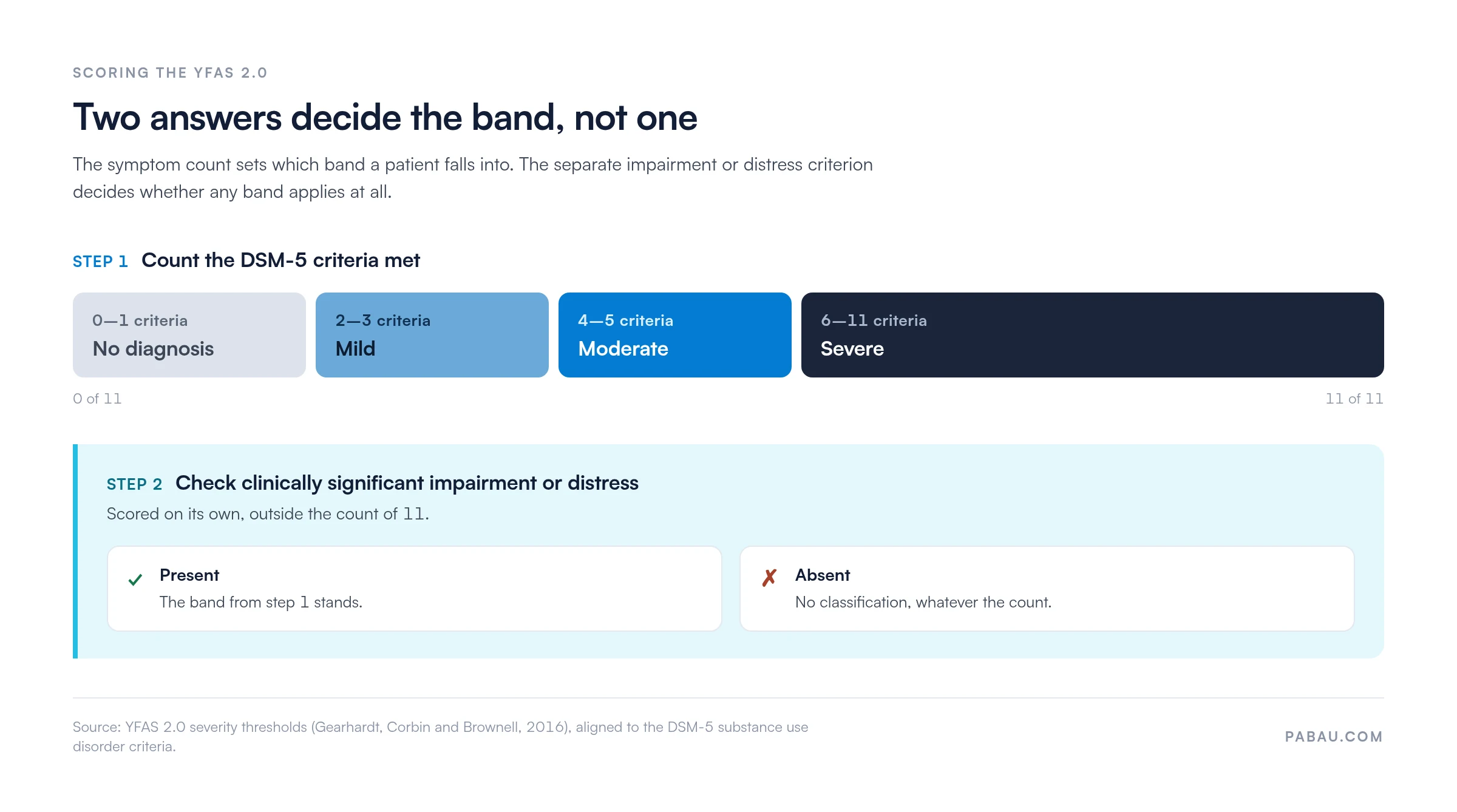
Record the count and the band together, every time. That pairing is what makes the next administration comparable.
The download is a four-page clinician record for scoring an administered YFAS 2.0 and filing the result. It does not reproduce the 35 questionnaire items, which stay with the research lab that holds the instrument.
Name, date of birth, record number, the date the patient completed the questionnaire, and the date you scored it. There is a line for the version used, because scores from the 35-item YFAS 2.0 and the 13-item short form are not interchangeable.
The checklist gives one row per DSM-5 criterion, with a met or not met box and space to note which items reached threshold. A plain-language summary sits beside each criterion, ready for the conversation with the patient.
This page holds a box for the count out of 11, a separate box for the impairment or distress answer, and the classification table. Keeping the two apart stops a count of six with no impairment being read as a severe presentation.
The last page carries tick-box actions for referral and review, a free-text plan, and a log with a row per administration. The log records the count and the classification together. A drop from six criteria to four then shows up, even when the band has not moved.
The Food and Addiction Science & Treatment Lab at the University of Michigan distributes the questionnaire itself. Its short forms, the translated versions, and the scoring spreadsheets come from the same place. Request them from the lab, then use this record to score and file what comes back.
Any clinician running a behavioral health assessment can use the scale. It earns its place fastest in five settings:
Psychiatrists, therapists, and registered dietitians all administer it. So do physician assistants, nurse practitioners, and health coaches running patient intake.
The scoring is identical in every setting, and what changes is the follow-up. It helps to keep the scale inside the same therapy practice management system that holds the chart.
The YFAS 2.0 is self-report and takes a patient five to 10 minutes. Five steps keep it from becoming another form to hunt down:
The YFAS 2.0 has been tested across a large body of peer-reviewed work. These are the headline figures:
Reliability holds up well, then, but it is not uniform. The individual test-retest figures span a wide range, so read a single retest against the sample it came from. You can work through the primary studies in PubMed’s YFAS 2.0 validation literature.
One caveat worth repeating: the scale screens and measures severity. It does not diagnose. Read the result alongside the history, the clinical interview, and whatever other measures you already use.
Four limitations are worth knowing before you quote a band to a patient:
Run through this before the questionnaire goes out. It takes a minute and saves a rescore:
Three mistakes come up again and again. Reading a high count as severe when no impairment was reported is the first. Comparing a 2.0 score against an older YFAS score is the second. Third is treating the band as a diagnosis, which it was never designed to be.
Handing out paper questionnaires, chasing them back, scoring them, and filing them eats hours across a caseload. The clinician loses time and so does the front desk.
Pabau runs that sequence for you, and a mental health EMR keeps the scored result beside the chart it belongs to.
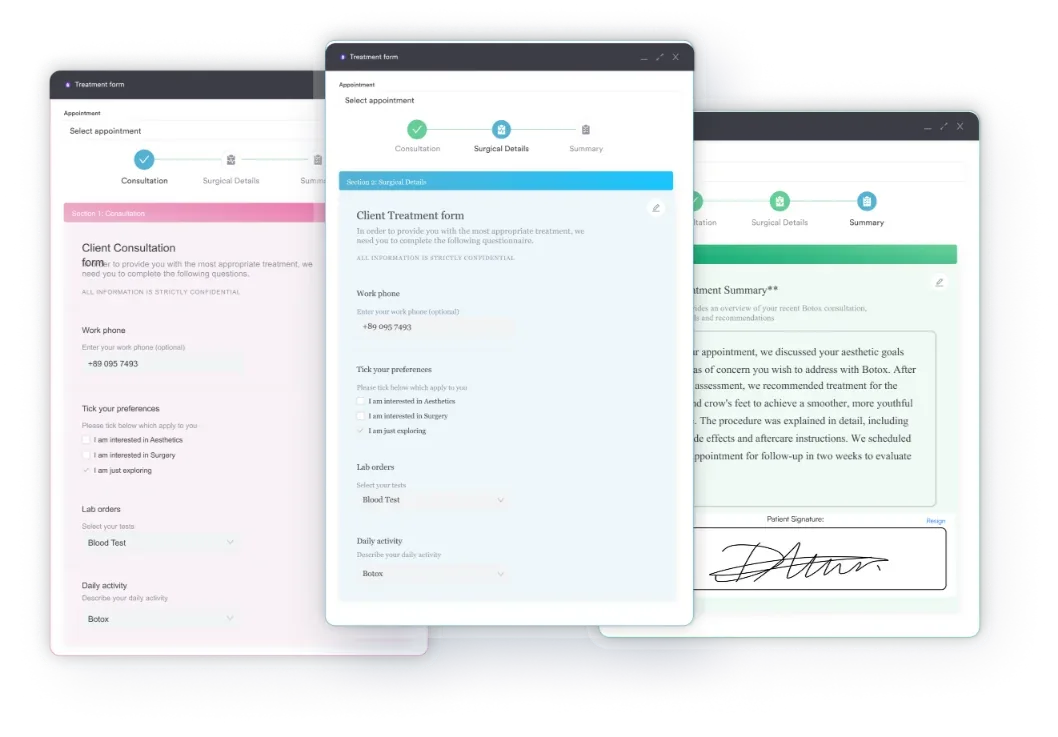
You upload or recreate the questionnaire as an interactive form, and patients receive it at booking time through the Client Portal. Their answers save straight to the clinical record. Automated workflows then fire the follow-up, so a moderate or severe band books the nutrition consultation on its own.
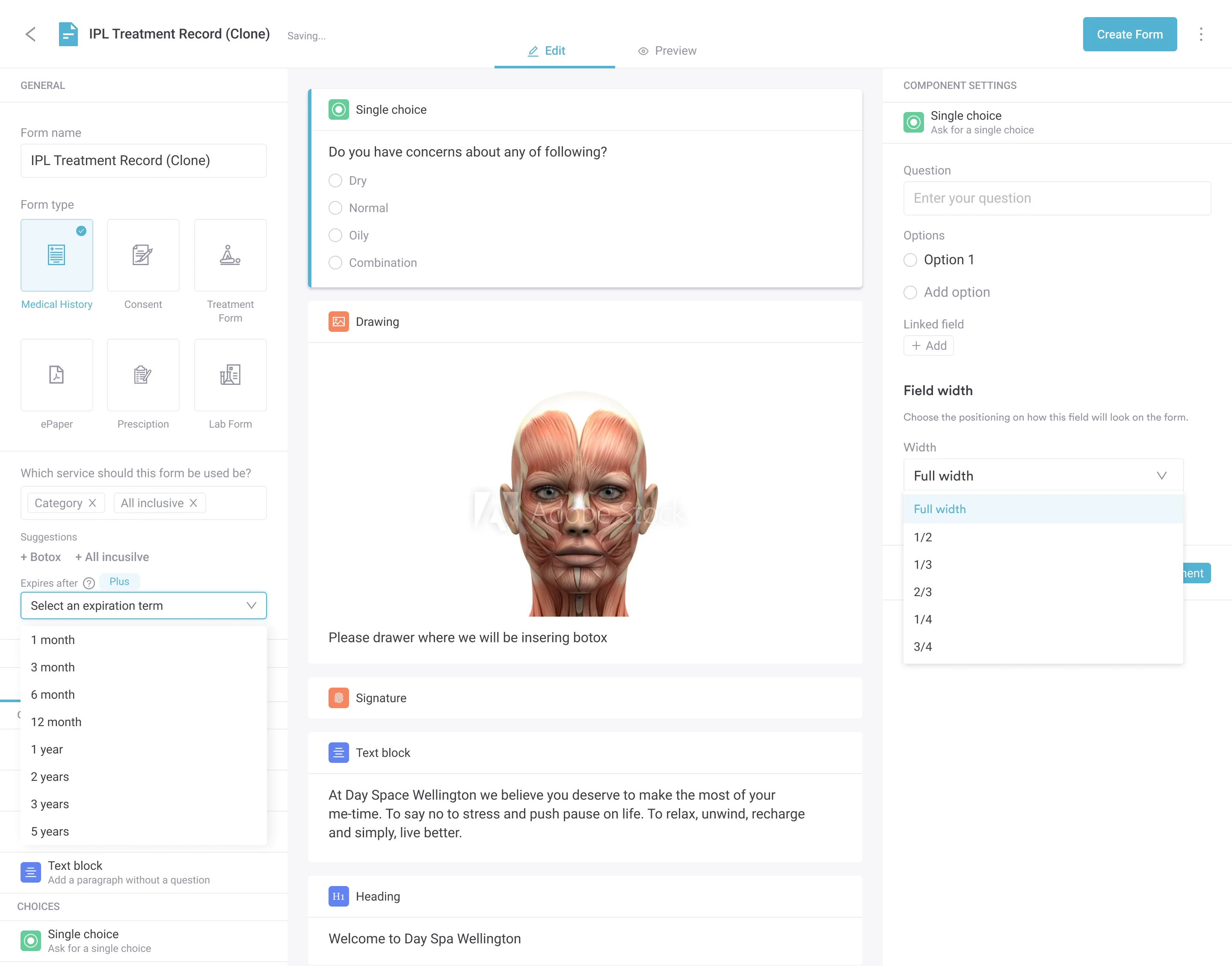
The paper disappears, the wording stays consistent between administrations, and every food addiction assessment sits in one searchable record. That is what makes outcome tracking across a treatment episode workable.

Pabau’s digital forms and Client Portal send the Yale addiction scale before the appointment. Automated workflows collect the responses and store the scored result in the patient record.

The Yale addiction scale earns its keep because it turns a vague presentation into a number you can act on and then repeat. Score it, log the impairment answer beside the count, and the next administration tells you whether the plan is working.
One trade-off is worth remembering. A band is a measurement the plan gets checked against, and it does not replace the history or the clinical interview. Download the record above for the checklist, the bands, and the log, then request the questionnaire itself from the FAST Lab.
Book a demo to see the send, the score, and the follow-up run in one system.

Screening for binge eating alongside it? Binge eating disorder quiz gives you a short screener to run before the full assessment.
Need something for the therapy room? Eating disorder worksheet turns the assessment findings into structured work with the patient.
Looking for a behavioral intervention for a mild band? Mindful eating worksheet suits early-stage addictive-like eating that responds to behavioral work.
Seeing food-seeking patterns in substance use recovery? Cross-addiction worksheet helps you map how one dependence shifts into another.
Planning the follow-up after a severe band? Relapse prevention plan worksheet gives the patient triggers, warning signs, and a written plan.
The questionnaire does not name one food. It opens with examples of highly processed foods, such as sweets, salty snacks, fatty foods, and sugary drinks. Patients then rate their own eating against those examples over the past 12 months.
Yes. A children’s version of the Yale Food Addiction Scale was published in 2013, with the wording adapted for younger respondents. Request it from the same lab, and never hand an adult form to a child.
Yes, once the lab has agreed to it. Keep the published item wording and the response options exactly as written, because the scoring depends on both. A reworded item makes the count incomparable to the published bands.
No. Food addiction carries no ICD-10-CM code of its own. Practices code the condition being treated instead, such as binge eating disorder or obesity. Some payers accept CPT 96127 for a scored behavioral assessment, so check the plan’s policy.
No standard interval is published. Test-retest studies used windows of two to four weeks, so anything shorter risks measuring recall rather than change. In practice, re-score at the review points your treatment plan already sets.