Waist-to-hip ratio chart: Risk bands for women & men (free PDF)
A waist-to-hip ratio chart sorts a patient’s waist-to-hip ratio (WHR) into...

3
Last Updated: Oct 14, 2026
A weight loss tracker is a weekly log of a patient’s weight, calories, and exercise that shows whether a weight management plan is working. This free printable fits one week on a page. It has fields for starting weight, the weekly goal, exercise minutes, calories consumed and burned, weight change, and total loss.
It suits weight loss programs, metabolic health practices, and functional medicine providers that want a weekly check-in without an app. Patients fill in a fresh copy each week and bring it to their visit. The clinician then reads the trend across the pages.
A one-page weekly log with start and end dates, starting weight, the weekly goal, exercise minutes, and calories consumed and burned. It also tracks weight change and total loss, with space for remarks and additional notes.
Download template
A weight loss tracker logs weight, calories, and exercise week by week, so progress is judged on the trend instead of a single weigh-in.
This template covers one week per page, with fields for starting weight, the weekly goal, exercise minutes, calories consumed and burned, and total loss.
Weekly weigh-ins suit most patients, and a typical safe rate of loss is 0.5 to 2 lbs per week.
The sheet has no fields for body measurements or macros, so pair it with a measurement chart and a food log when you need them.
Practice management software like Pabau stores tracker data in Client records and measurements tracking, next to the clinical notes.
A weight loss tracker is a structured log where patients record the numbers their clinician uses to judge a weight management plan. Consumer fitness apps collect dozens of data points. A clinical tracker keeps to the few that change treatment decisions: weight, the weekly goal, calories in and out, and activity.
It does two jobs. For weight loss clinics and practices, it turns patient self-report into weekly data the clinician can review. For the patient, it is a written record of effort that helps them stay with the plan when the scale stalls.
A complete weight loss record covers five data categories. This printable’s weekly page handles weight, calories, activity, and notes. Measurements and macros need a companion form.
Pair the sheet with a daily food log when a patient tracks macros. Take waist and hip measurements at each visit and note them in the remarks.
The tracker works when patient and clinician follow the same routine every week. Five steps take you from the first visit to each weekly review.
Consistency matters more than completeness. A few days of calorie logs plus a weekly weigh-in still give the clinician enough to spot a trend.
Once a week suits most patients. A weekly weigh-in captures meaningful change without the swings of daily readings, which reflect water retention, digestion, and hormonal cycles more than fat loss.
A calorie tracker for weight loss shows whether intake stays below expenditure. The clinician checks the log against the prescribed calorie range. The calories burned field shows how much activity adds to the deficit.
Calorie targets: A typical starting deficit is 500 to 750 calories below maintenance, or roughly 1 to 1.5 lbs a week. A 200-lb patient who maintains at 2,500 calories might start at 1,750 to 2,000 calories a day.
Macro targets: A common starting split is 40% carbs, 30% protein, and 30% fat, adjusted for each patient. Protein should be at least 0.8 g per pound of target body weight to preserve muscle in a deficit. Metabolic health practices may adjust these ratios based on insulin sensitivity or metabolic testing.
The printable has no macro fields, so patients who track macros keep them in a food log or app. They can note daily averages in the remarks. Low protein speeds up muscle loss, and very low carbs tend to sap energy and adherence.
A workable goal has three parts: a target weight, a goal date, and weekly milestones. Write all three in the tracker’s notes at the first visit, so patient and clinician work from the same numbers.
Choose a realistic target weight. Base it on BMI or a body composition assessment, not scale weight alone. A 200-lb patient aiming for 150 lbs over 12 to 18 months is realistic. Aiming to lose 100 lbs in three months is not, and it risks muscle loss and metabolic harm.
Calculate weekly milestones. Losing 50 lbs in 50 weeks means 1 lb a week, a safe and sustainable rate. Break it into monthly checkpoints of about 4 lbs, so progress gets checked every four weeks. If recorded loss trails the plan by more than 2 to 3 lbs, adjust calorie or activity targets before motivation drops.
The worked example below runs one patient through that math, from baseline to the first checkpoint.
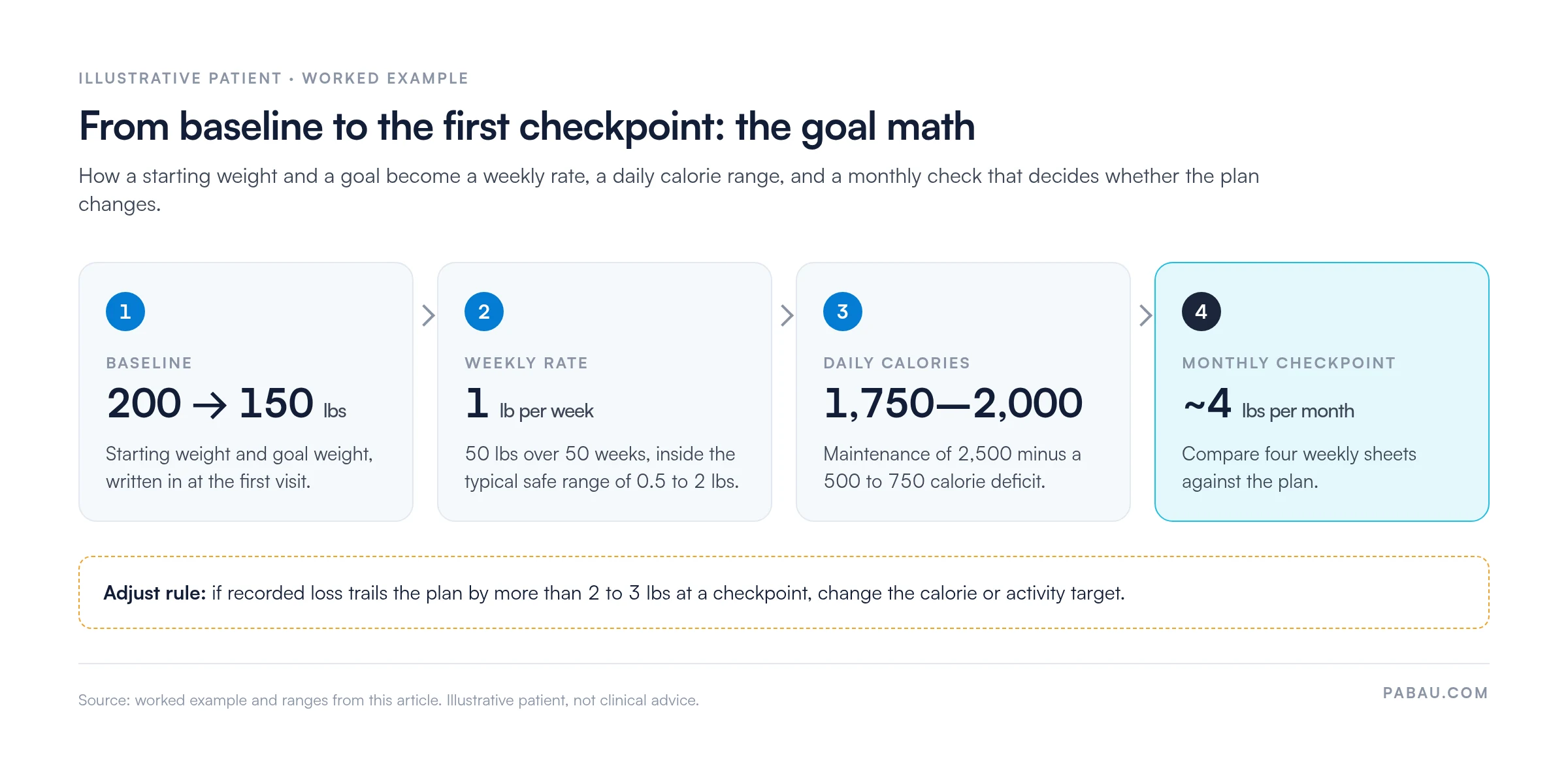
Writing the targets down turns a vague intention into a number both sides can check. Each weekly sheet then shows whether the patient is on pace.
In a practice, the tracker becomes part of the visit. It gives the clinician a structured review, a record for the patient chart, and evidence for adjusting the plan.
Pick the format the patient will fill in every week. A printable needs no login and works offline. A digital tracker totals the numbers automatically and is easier for the clinician to open and annotate. Many practices offer both.
On paper, the weekly routine has a lot of handling. The patient fills in the sheet at home, the front desk scans it, and someone retypes the numbers into the chart. Weeks of logs end up in a folder where the trend is hard to see.
Practice management software like Pabau lets you set this tracker up as one of your digital intake forms. Patients complete it online before each appointment, and the answers land in their Client record. Nobody has to print, scan, or re-enter a number.
The weekly weight then sits in measurements tracking, where you can chart it across the whole program. During the review, Pabau Scribe, our AI scribe, drafts the consultation note so the clinician can talk through the plan instead of typing. Each visit starts with the week’s numbers already in the chart.

Pabau’s digital forms collect each patient’s weekly weight, calories, and exercise before the appointment and file them in the patient record. Your team stops retyping paper logs.

Start with the printable if your program is new or your patients prefer paper. Hand it out at the first visit with the baseline and goal written in, and review a completed sheet at every appointment.
Judge progress at the monthly checkpoint, not the single weigh-in. That’s where the plan should hold or change, and four sheets give you the evidence either way.
The trade-off is the retyping. Once paper logs start piling up, moving the tracker into a digital form saves front desk time and keeps every weigh-in in the chart. Book a demo to see how Pabau collects weekly tracker data before each weight loss visit.

Tracking inches as well as pounds? Weight loss measurement chart gives patients a sheet for waist, hip, and other body measurements to pair with the weekly log.
Need daily intake detail? Food log template sheet covers the meals and macros this weekly tracker leaves out.
Setting macro targets? Macro diet plan lays out a protein, carb, and fat plan you can track against.
Starting a new patient on a program? New patient weight loss intake form collects the history and baseline you need before the first weigh-in.
Choosing a realistic target weight? Body mass index assessment explains the BMI formula, the ranges, and where BMI falls short.
A weight loss tracker should include body weight, a weekly goal, calorie intake, physical activity, and space for notes. Clinicians often add waist, hip, and chest measurements and a macronutrient breakdown. Together, these show whether the plan is working and where it needs adjusting.
Weigh in once a week on the same day and at the same time, ideally in the morning, and log the result. Record daily calorie intake from food labels or a tracking app, plus exercise and notes on mood, stress, or sleep. Judge progress on the weekly trend, and adjust calorie or activity targets if it lags behind the goal.
Neither is better for every patient. A printable is tactile, needs no app, and works offline. An app calculates macros and syncs data, but some patients find it a chore. Choose the format your patient will use every week, and offer both where you can.
Yes. A calorie tracker makes intake visible, so the clinician can confirm the patient is eating within the prescribed deficit. That deficit is typically 500 to 750 calories below maintenance. The log also gives the clinician something concrete to adjust when progress slows.