Impaired skin integrity nursing care plan
An impaired skin integrity nursing care plan is a structured document that recor...

2
Last Updated: Oct 16, 2026
A vital signs chart is a clinical form for recording a patient’s blood pressure, heart rate, respiratory rate, and temperature over time. Serial entries show each change against the patient’s own baseline, which is what makes a borderline reading meaningful.
In adults, normal blood pressure runs from 90/60 to below 120/80 mmHg, and a normal resting heart rate from 60 to 100 bpm. Respiratory rate sits at 12–20 breaths per minute, oral temperature at 36.5–37.3°C (97.8–99.1°F), and oxygen saturation at 95–100%.
Children run faster on nearly every measure, so this guide pairs the adult values with age-specific pediatric ranges. The free printable chart below is a one-page adult form covering the four core vital signs, with an interpretation summary and a notes box.
A one-page adult form with fields for patient details, height, weight, and BMI, plus temperature, blood pressure, pulse, and respiratory rate results. It also carries an adult normal-range table, an interpretation summary, and a notes box for lifestyle, symptoms, and medical history.
Download template
A vital signs chart records blood pressure, heart rate, respiratory rate, and temperature over time, so a change stands out against the patient’s own baseline.
Normal adult values are blood pressure 90/60 to below 120/80 mmHg, heart rate 60–100 bpm, respiratory rate 12–20 breaths per minute, and temperature 36.5–37.3°C (97.8–99.1°F).
Children’s normal ranges shift sharply with age, so check every pediatric reading against the band for that child’s age.
The printable chart is an adult form with no oxygen saturation field, so add SpO2 to the notes box whenever you measure it.
Pabau’s digital forms and integrated client records let your practice capture vital signs electronically and review each patient’s trend in one place.
A vital signs chart turns single measurements into a running record. Instead of scattering readings through progress notes, it lines them up by date. A rising blood pressure or a climbing heart rate is then visible at a glance.
The chart does three jobs for a practice:
Aesthetic and wellness practices rely on it too. Recording heart rate, blood pressure, and oxygen saturation before IV therapy or sedation gives the prescriber a baseline. If the patient reacts during treatment, that baseline is the reference point.
Most clinical settings track five core vital signs. Some add pain scoring and neurological checks as extended measures.
Acute care and post-anesthesia recovery often add two more. Pain is scored on a 0–10 numeric scale, and neurological vital signs cover the Glasgow Coma Scale and pupil response.
The adult ranges below reflect American Heart Association blood pressure categories and standard clinical reference values for the other four measures.
Readings below 90/60 mmHg count as low blood pressure (hypotension), particularly when the patient feels dizzy or faint. The printable chart lists respiratory rate as 12–18 breaths per minute, but most clinical references use 12–20.
Adult blood pressure categories follow the 2017 ACC/AHA guideline:
Confirm a high reading with repeat measurements on separate occasions before labeling anyone hypertensive. If you track blood pressure on its own, the normal blood pressure chart gives you a dedicated form for it.
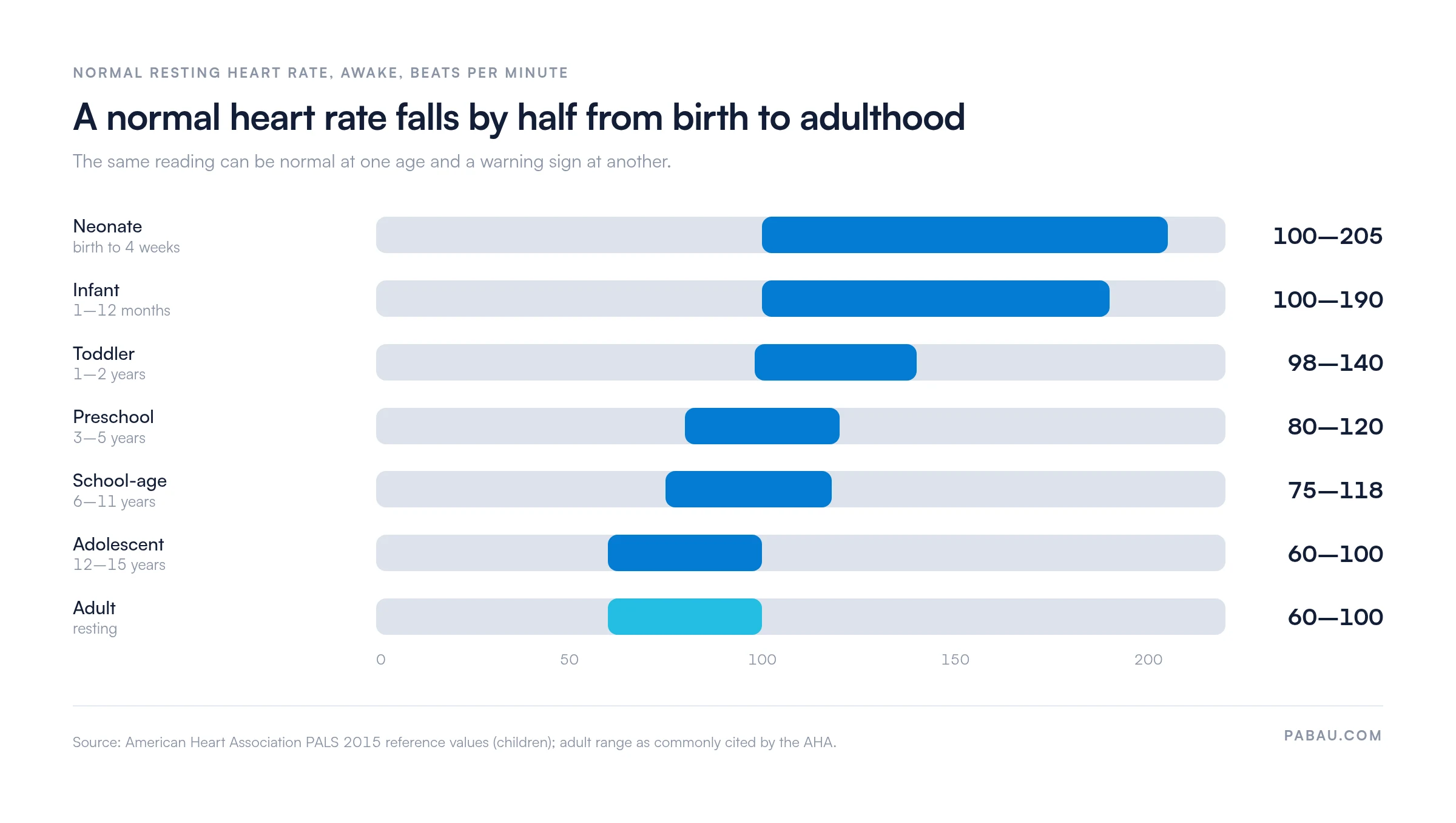
Children’s normal ranges change fast with age. A resting heart rate of 120 bpm is normal in a six-month-old but tachycardic in a teenager. The table below uses the American Heart Association’s Pediatric Advanced Life Support (PALS) 2015 reference values.
Heart rates during sleep run lower than the awake ranges shown, and the neonatal blood pressure range reflects a baby about four days old. The printable chart is an adult form, so use our pediatric vital signs chart when you record readings for children.
The heart-rate ceiling falls from 205 bpm in a newborn to 100 bpm by adolescence, as the chart below shows. Respiratory rate follows the same curve. An infant breathing 45 times a minute is normal, while a school-age child at that rate is far above the 18–25 range.
The chart pays off when it becomes routine. Five habits keep the readings comparable from one visit to the next.
The form’s Summary of Interpretations box is the place to note what each reading means for the plan. The next clinician then sees your reasoning as well as the numbers.
No single rule sets these requirements for every setting. Federal regulations, state law, payer contracts, and your own policies each play a part, so build your policy around three questions.
Frequency is set by clinical policy and the patient’s condition rather than one national rule. Common baselines look like this:
Vital signs are part of the medical record, so they follow your record retention schedule. HIPAA does not set a retention period for medical records, but state law does. Most states require five to 10 years for adult records, and longer for minors.
Medicare-participating hospitals must keep records for at least five years under 42 CFR 482.24. Medicare Advantage contracts generally require 10 years. In England, the NHS Records Management Code of Practice sets eight years after treatment ends for most adult records.
Anyone trained and authorized under your policy and state scope-of-practice rules can take vital signs. That usually includes physicians, nurses, medical assistants, and nursing assistants. Each entry should be:
The licensed clinician responsible for the patient still reviews abnormal readings and documents the response, even when an assistant took them.
Paper charts get misfiled, handwriting gets misread, and spotting a trend means leafing back through months of pages. Practice management software like Pabau keeps each patient’s readings in their patient record, so the full history is one click away.
Primary care teams that run Pabau as their GP clinic software capture vital signs in the same system that holds appointments, notes, and invoices. You can rebuild this chart as a digital form and have staff complete it on a tablet during the visit.
With Care Pathways, patients complete intake forms before they arrive, so the appointment starts with measurements instead of paperwork. Pabau Scribe, our AI scribe, drafts the consultation note from the conversation, so readings you say aloud reach the note without retyping.

Pabau’s digital forms and patient records let your team capture vital signs at every visit and review each patient’s history in seconds. See how it would work in your practice.

Use the printable chart for adult visits, and keep the pediatric table beside it whenever children come through the door. Measure at a consistent site, write down the context, and agree your action thresholds before a borderline reading turns up.
Paper’s weakness is retrieval. Writing a reading down takes seconds, but spotting a six-month drift means pulling every sheet. If your practice monitors blood pressure across many patients or runs IV therapy, moving the chart into a digital record repays the setup time quickly.
Book a demo to see how Pabau keeps each patient’s vital signs, notes, and forms in one record your whole team can read.

Charting children? Pediatric vital signs chart gives you a printable form with normal ranges for every age band.
Tracking blood pressure on its own? Normal blood pressure chart sets out each blood pressure category on a dedicated form.
Taking axillary temperatures? Underarm temperature chart covers normal ranges and fever thresholds by age for the armpit method.
Want a better blood pressure technique? Blood pressure monitoring: a complete clinical guide walks through cuff sizing, positioning, and follow-up.
Assessing a patient’s neurological status? Neurological vital signs explains GCS scoring, pupil checks, and when to escalate.
Vital signs are the core physiological measurements that show a patient’s immediate health status: blood pressure, heart rate, respiratory rate, body temperature, and oxygen saturation. Together they show whether the cardiovascular, respiratory, and temperature-regulating systems are working within safe ranges.
There is no standard set of seven vital signs. Clinical practice recognizes five core measures: blood pressure, heart rate, respiratory rate, temperature, and oxygen saturation. Some acute and post-anesthesia settings add pain scoring and neurological checks such as the Glasgow Coma Scale, which brings the count to six or seven.
Normal adult vital signs are blood pressure from 90/60 to below 120/80 mmHg, a resting heart rate of 60-100 bpm, and 12-20 breaths per minute. Normal oral temperature is 36.5-37.3°C (97.8-99.1°F), and oxygen saturation is 95-100%. Individual baselines vary, so compare each reading with the patient’s own history.
Children’s bodies are smaller and their metabolic rate is higher, so their hearts beat faster and they breathe more quickly than adults. A heart rate of 120 bpm is normal in an infant but high for a teenager. Age-specific ranges stop normal childhood physiology from being misread as illness.
Seek emergency care for systolic blood pressure above 180 mmHg with symptoms, or a resting heart rate below 40 or above 120 bpm. A respiratory rate above 30 or below 8 is also an emergency sign. A temperature above 40°C (104°F) or below 35°C (95°F) and oxygen saturation below 90% also need urgent attention. Always weigh a single reading against the patient’s baseline and symptoms.