Journal prompts for mental health
Journal prompts for mental health are guided questions that help people process ...

2
Last Updated: Oct 13, 2026

The twenty statements test (TST) asks a person to write 20 answers to the question ‘Who am I?’ in 12 minutes.
Score it with the five categories from Kuhn’s 1960 study: social groups and classifications, ideological beliefs, interests, ambitions, and self-evaluations.
Those five categories are what the downloadable template asks you to use, and they are what this guide teaches.
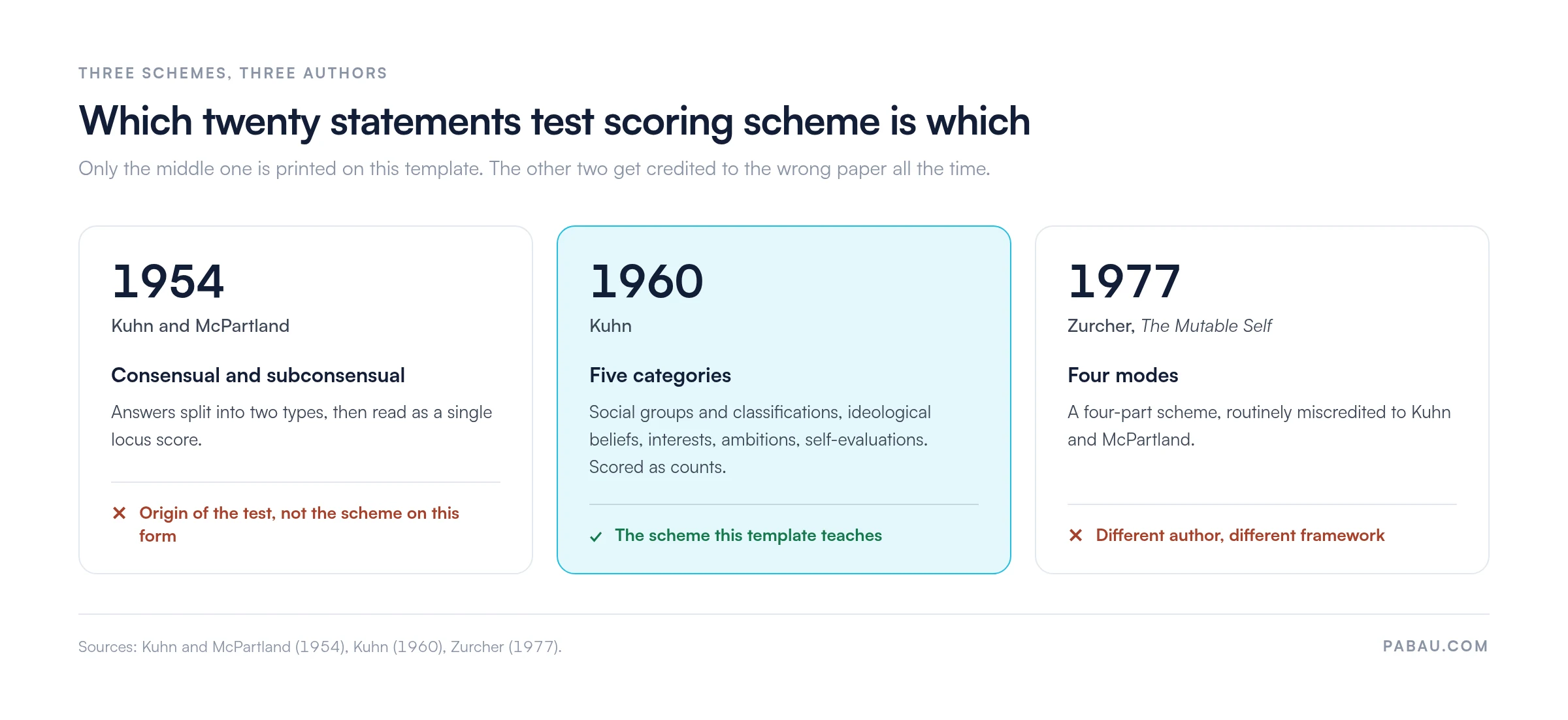
Kuhn and McPartland’s original 1954 method was different. It split answers into consensual and subconsensual responses to produce a single locus score.
Category counts show where a person places the weight of their identity, but the TST has no cut-off scores and is not diagnostic.
A printable clinical form with name, age, date and examiner fields, the ‘Who am I?’ prompt, and 20 numbered ‘I am:’ response lines. It closes with a practitioner note on sorting the answers into Kuhn’s five scoring categories.
Download templateThe twenty statements test asks the same question 20 times over. Who am I? Hand someone 12 minutes and 20 blank lines, and their answers tell you more than a tick-box intake form ever will.
Sociologists Manford Kuhn and Thomas McPartland introduced the test at the University of Iowa in 1954. Kuhn later reworked the scoring into five categories, and that 1960 scheme is the one this template uses. The two traditions get mixed up constantly, which is how two sheets from the same psychology practice stop being comparable.
The scoring table, the worked example, and the admin script below all follow that 1960 scheme.
The twenty statements test, or TST, is a free-response assessment of self-concept. The respondent answers “Who am I?” 20 times inside a 12-minute limit, writing whatever comes to mind.
A fixed-choice questionnaire hands people a list of traits to rate. The TST hands them a blank line instead, so what lands on the page is what the person reached for first. Kuhn and McPartland designed it that way to catch self-description before the respondent starts editing themselves.
The American Psychological Association catalogs the TST as a standard instrument, and it is still in use across psychology, sociology, and social work. The American Sociological Association hosts a copy of the prompt sheet with its introductory sociology materials.
Administration takes 12 minutes plus a short briefing. Read the prompt out as written, start the clock, and stay quiet. The same script works for an intake appointment, a classroom exercise, or a research session. Consistency is what makes two sheets comparable later.
Store the completed form with the rest of the clinical record, not in a loose folder behind the front desk.
Two common mistakes are worth naming. Do not read the answers back to the respondent mid-test, and do not fill in a blank line on their behalf. Unused lines are data, and a sheet with nine answers tells you something a full sheet does not.
Scoring means sorting each answer into one of five categories, then counting how many answers land in each. The categories are social groups and classifications, ideological beliefs, interests, ambitions, and self-evaluations.
Those five come from Kuhn’s 1960 follow-up study in The Sociological Quarterly. He found that TST answers reduce to those groupings, and that the mix shifts with age, sex, and professional training. This is the scheme printed on the downloadable template, so it is the one taught here.
The 1954 paper worked differently. Kuhn and McPartland sorted answers into consensual and subconsensual responses, then read the split as a single locus score.
That earlier method is the historical origin of the test, not the scheme on this form.
One warning, because it trips people up. Some sources describe a four-part scheme for the TST and credit it to Kuhn and McPartland. That scheme comes from Louis Zurcher’s 1977 book The Mutable Self. It is not in the 1954 paper, and it is not what this template asks you to use.
Side by side, the three schemes are easy to keep straight.
Two questions come up on almost every sheet.
What if an answer fits two categories? Pick the closer one, then write down why you chose it. “I am a struggling student” carries both a role and a judgment, and your note is what stops a second scorer reading it differently.
What about the blank lines? Count them and leave them empty. Percentages come out of the answers actually given, so nine answers is a profile of nine, not a failed sheet of 20.
The table below scores a composite answer set from a therapy client in her thirties. The wording is illustrative, but the category calls are the part worth copying.
Across all 20 answers she wrote 6 social groups and classifications, 2 ideological beliefs, 2 interests, 3 ambitions, and 7 self-evaluations.
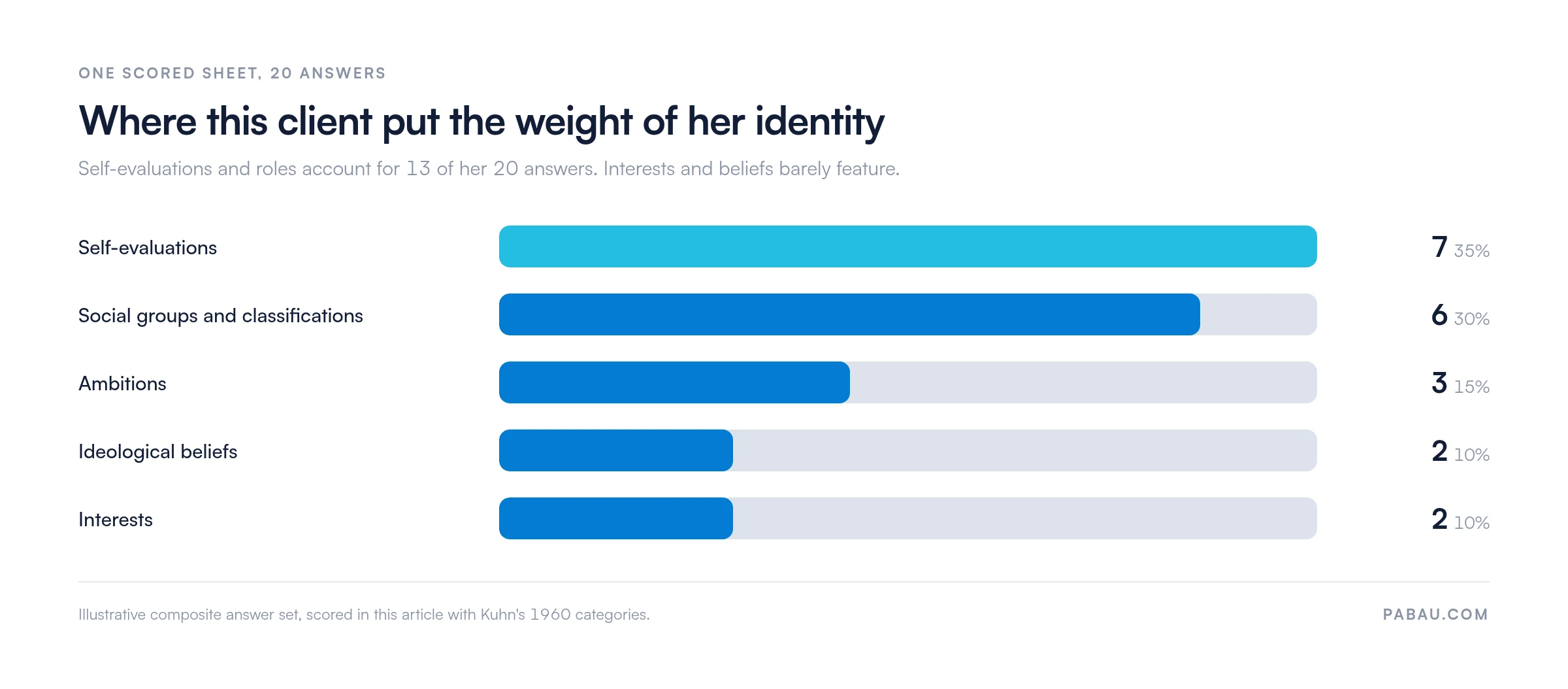
Self-evaluations lead, so she mostly describes herself by judging her own qualities. Roles come next, and both of her opening answers name one, which puts those positions at the front of her self-concept.
A scored sheet shows where a person puts the weight of their identity. No profile is healthier than another, and the TST publishes no cut-offs, so treat the pattern as a description and a prompt for conversation.
Before you read a profile as a personality trait, check where the respondent grew up. Comparative research finds a consistent split.
People in individualist countries such as the US, the UK, and Australia write more personal-attribute answers, the sort that score as self-evaluations. People in collectivist countries such as Japan, China, and India write more social groups and classifications.
That difference reflects two cultural models of selfhood, not a deficit in either. A client whose sheet is full of roles may be showing healthy interdependence rather than rigidity. Read the profile against the respondent’s background before you draw any conclusion from it.
The same 12-minute form does different jobs in different rooms. In therapy it opens up self-concept without the defensiveness that direct questioning invites. In teaching it doubles as the lesson and the demonstration.
Pro tip: treat a completed sheet like a clinical note. It names beliefs, ambitions, and self-judgments, so it deserves secure storage and proper access controls. In a well-run therapy practice, that filing decision gets made once and then applies to every assessment you run.
The TST has been in use for more than 70 years and travels well between practices, classrooms, and research settings. It still has limits worth stating plainly before you rely on it.
Use the TST as a conversation starter or a teaching tool, never as a standalone diagnostic instrument. Pair it with a clinical interview and a scored questionnaire such as the Rosenberg self-esteem scale. Then watch how the profile moves over several months before you draw firm conclusions.
Most practices still run the TST on paper. The sheet gets filled in the waiting room, scored in the margin, and filed in a cabinet. Six months later nobody can put the second sheet next to the first, and the test’s main strength quietly disappears.
Pabau moves that loop into the client record. You send the twenty statements test as a digital form before the appointment, and the answers save straight to the record. Your category tallies sit alongside them in the same file.
Because the record also holds the appointment history, a repeat administration lines up against the original without any searching. Access controls keep the sheet with the staff who need it.
Every subscription includes the forms and records tools, so no feature sits behind a higher tier.

Pabau’s digital forms and client records let you send, score, and store assessments like the TST in one place. Every result lands in the client’s file, ready to compare.

Score the twenty statements test with Kuhn’s five categories, the ones printed on the template. What you get back is a profile you can explain to a colleague and repeat next quarter.
Mix in the older consensual and subconsensual language, or a four-part scheme borrowed from another author, and the sheets stop being comparable.
Remember what the profile is for. It describes emphasis, not diagnosis, and it earns its 12 minutes when you run it twice and watch where the weight shifts.
Book a demo to see how Pabau sends, scores, and stores assessments like the TST inside the client record.

Working on identity head-on? Identity worksheet template gives you a structured follow-up for the roles and labels a TST sheet surfaces.
Self-evaluations dominating the sheet? Self-esteem worksheet for adults turns those self-judgments into something a client can work on between sessions.
Want the values sitting behind the answers? Core values exercise template draws out the commitments that score as ideological beliefs.
Need a trait measure to sit alongside it? Big five personality test covers the same territory with a fixed set of items and a numeric result.
Following up on a run of critical answers? My strengths and qualities worksheet gives clients a way to name what they do well.
It is the number of consensual answers on a sheet. Kuhn and McPartland’s 1954 method sorted responses into consensual and subconsensual, then used that count as a single locus score. The 1960 five-category scheme replaced it on this template.
A self-esteem scale gives you a number against a fixed set of statements. The TST gives you the person’s own words, so it describes emphasis rather than level. Neither one replaces the other.
Yes. A digital form works as long as the respondent still sees a countdown and 20 separate fields. Keep the prompt wording identical, because a reworded instruction changes what people write.
Yes, with two adjustments. Younger respondents often stop well before line 20, so shorten the list and relax the clock. Score whatever they write with the same five categories.
Compare your notes, not just the totals. Most disagreements come from mixed answers like “a struggling student”, so agree a rule for those before you start. Record the rule with the sheet.
Writing takes 12 minutes, plus a minute to brief the respondent. Scoring one sheet takes about five to ten minutes once you know the categories. Group administration adds no extra writing time.