Trauma response test: Free template for clinicians
A trauma response test is a structured screening questionnaire that helps clinic...

3
Last Updated: Oct 15, 2026

A thought stopping worksheet walks a client through four sections: identify the thought, interrupt it, replace it, then rate how well that worked.
The interruption menu covers the STOP technique, a rubber band snap, visualization, mindfulness observation, and a pre-written coping statement.
Thought stopping works best next to cognitive restructuring or mindfulness, and it can backfire on clients with OCD.
Ask for one completed sheet per intrusive thought over a week, then review the 1 to 10 scores together in session.
Practice management software like Pabau shares the worksheet through the client portal and files completed copies in the client record.
A printable CBT form with four sections. The client logs the thought and its trigger, picks one of five interruption techniques, writes a replacement, then scores the result. Sized for one intrusive thought per sheet, so clients can complete it between sessions.
Download templateA thought stopping worksheet is a structured CBT tool that helps clients interrupt an intrusive thought and replace it with a balanced one. The form has four sections. The client records the thought and its trigger, picks an interruption technique, writes a replacement thought, then rates how much it helped.
You will use it in two places. Introduce it in session with a thought the client raised that week, then send them home with blank copies. The sheets they bring back become the material for the next appointment.
Below is the template itself, how to teach it in a session, and the clients it is the wrong tool for. That last part matters as much as the method, because suppressing a thought can make it louder.
Thought stopping interrupts automatic negative thoughts before they escalate into rumination, anxiety, or low mood.
J.A. Bain introduced the method in 1928, and Joseph Wolpe adapted it for behavior therapy in the late 1950s. The term cognitive behavioral therapy arrived later, with Aaron Beck’s work in the 1960s and 1970s.
The principle is simple. Intrusive thoughts are common, but dwelling on them amplifies distress, and treating them as facts amplifies it further.
Thought stopping creates a deliberate pause. In that pause the client applies one interruption technique and makes room for a steadier thought.
Every clinically useful version of this form carries the same four sections, and each one has a single job. The diagram below shows what the client writes at each step.
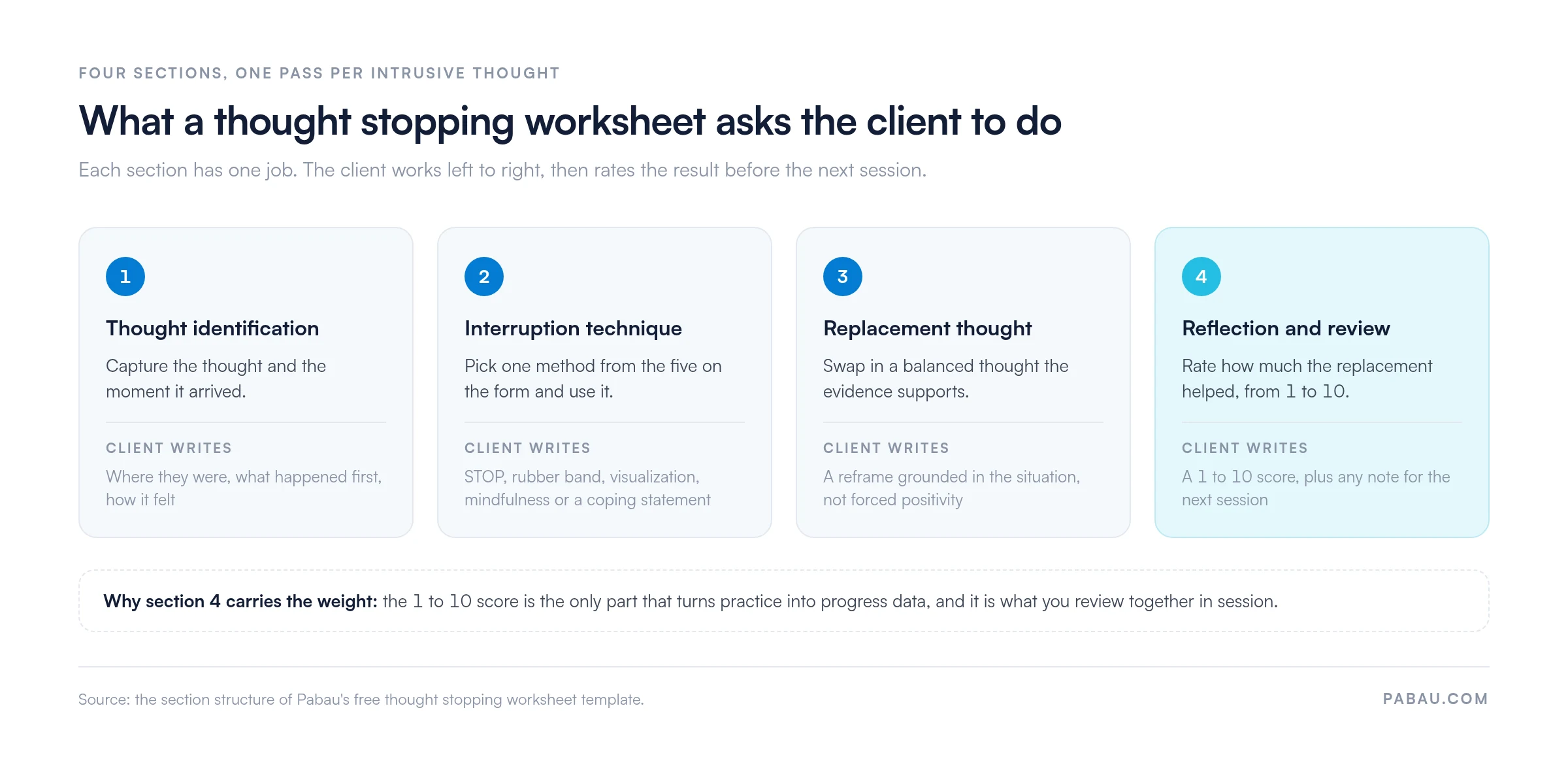
Clients record the triggering thought and its context: where they were, what happened just before, and how the thought felt in the body. This trains awareness, and it gives you both something concrete to look at when patterns start repeating.
The form lists five methods. The client picks the one that feels most natural and uses it the moment the thought appears. Sending the form digitally helps here, because the menu sits on the client’s phone rather than in a folder at home.
After interrupting, the client writes a replacement thought that the evidence actually supports. This is a balanced reframe, not forced positivity. Guide the first one yourself, so the replacement stays credible and does not brush off a concern that deserves attention.
The client closes each sheet by rating how much the replacement helped, on a scale of 1 to 10, and adding any observation. Those scores are the part you can track. Watching them climb over a month tells the client the work is paying off.
Teaching the form in session is what makes the home practice work. Six steps cover the first introduction and the review that follows it:
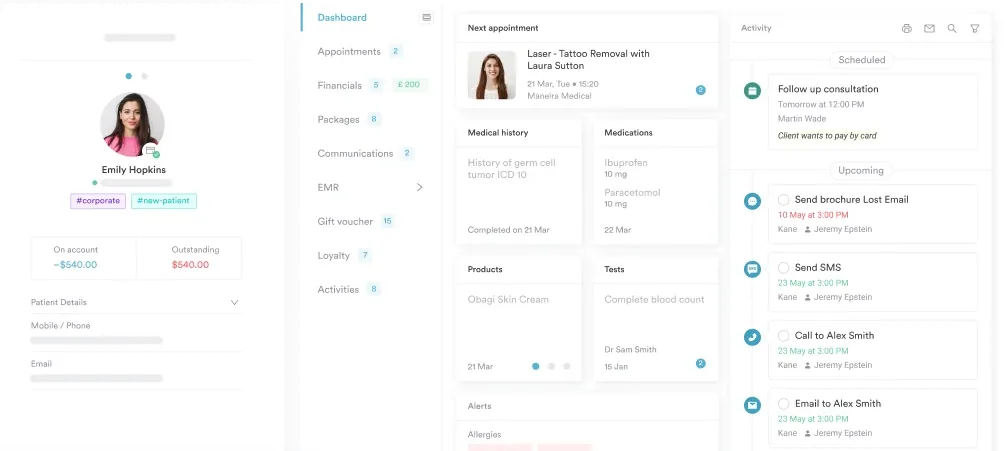
Store the completed sheets with the session notes rather than in a separate folder. A mental health EMR keeps them attached to the client record, so the scores and the notes tell one story.
Anxious clients get more from a version that makes the worry cycle explicit. The intrusive thought usually arrives dressed as an emergency, such as “what if I collapse in public?”. Add an evidence-testing line where the client lists facts that contradict the prediction.
Adherence is the other half of the job. A weekly prompt to practice normalizes the routine and cuts avoidance, and an automated reminder saves you from chasing it by hand.
A structured form pays off clinically and administratively:
Thought stopping is not a stand-alone treatment, and for some clients it makes things worse. Deliberate suppression can rebound, a pattern known as ironic process theory.
Clients with OCD are the clearest example, because pushing an intrusive thought away tends to increase how often it returns.
Screen for that before you assign the form. Where suppression backfires, pair the worksheet with mindfulness observation, so the client watches the thought instead of fighting it. Exposure and response prevention remains the evidence-based route for OCD itself.
Ask one more question before the client takes the form home. Does this thought need interrupting, or does it need challenging?
A thought with a shaky logic behind it belongs in a cognitive restructuring worksheet. Rumination rooted in depression usually needs behavioral activation alongside it.
Download the template and adjust the wording to suit your caseload. Upload your version into your software for therapy practices so any clinician can send it in one click, rather than hunting for the newest file.
Cover the technique in supervision so everyone introduces it the same way. Then watch completion rates. A client who returns blank sheets week after week is telling you something about the fit, not about their effort.
Most practices hand out worksheets on paper and hope they come back. The completed sheets end up in a drawer, the scores never reach the notes, and chasing the homework falls to whoever answers the phone. Practice management software like Pabau closes that loop.
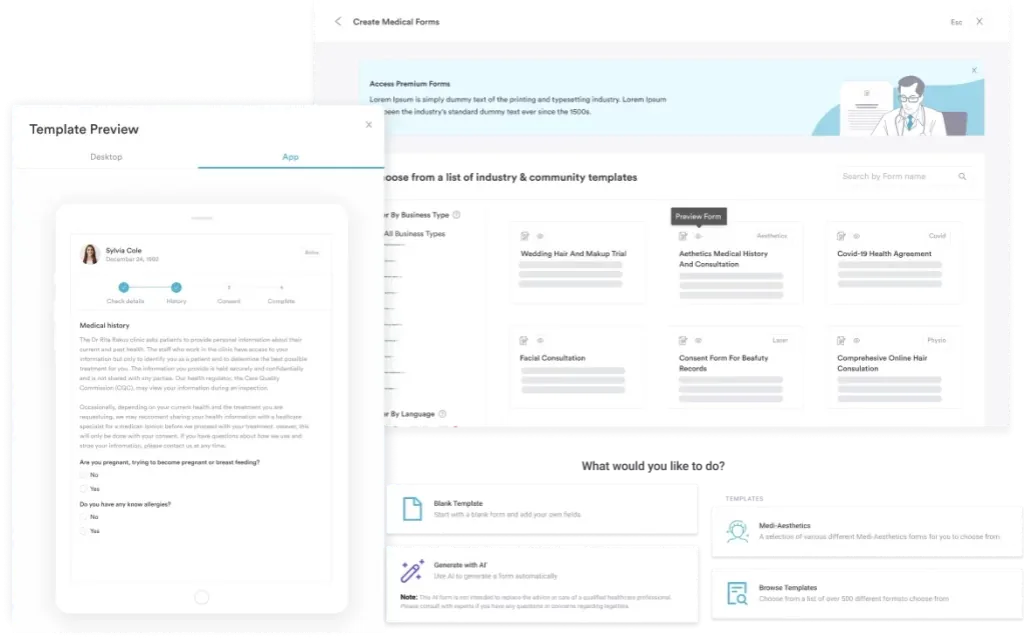
Send the worksheet as one of your digital intake forms and it lands in the client’s portal, where they can complete it on a phone. The finished form attaches to the client record automatically. Reminders go out on a schedule you set, so nobody has to prompt each client by hand.
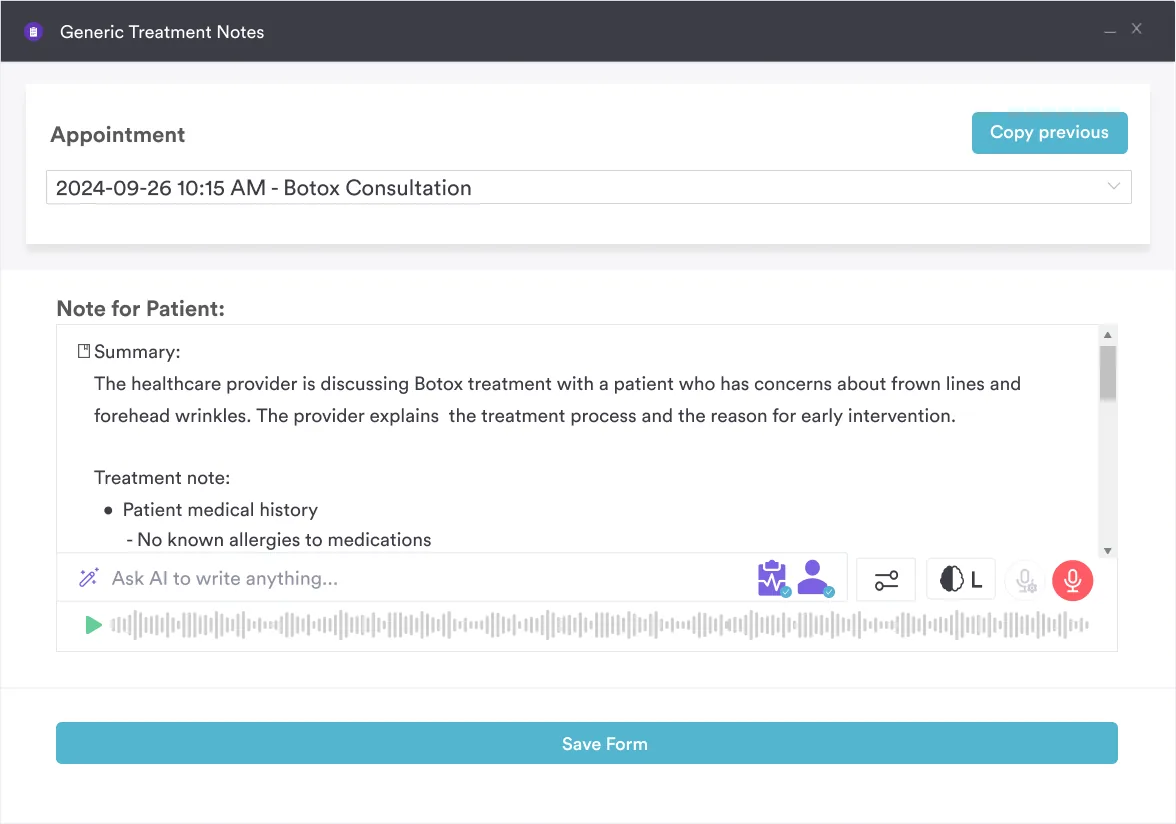
Pabau Scribe, our AI medical scribe, drafts the session note while you talk. That gives you a few minutes to read the week’s sheets properly before the client sits down. You spend them on the review, not on typing up the last appointment.

Send thought stopping worksheets to the client portal, track who completed them, and file the results in the client record with the session notes.

The value of this form is not the interruption. It is the 1 to 10 score at the bottom, which gives a client something to point at when they say the week went badly. Progress in CBT is hard to feel and easy to measure, and this sheet does the measuring.
So take the download, try it with one client who ruminates, and read the scores with them next session. Skip it for anyone whose intrusive thoughts point toward OCD, and reach for mindfulness or cognitive restructuring instead. The trade-off worth remembering is that a technique this quick to teach still needs the right client.
Handing out worksheets and chasing them back eats admin time. Book a demo to see how Pabau shares forms and files the results against each client record.

Need the step that comes after interrupting a thought? Cognitive restructuring worksheet takes the client past the pause and into testing the evidence behind the thought.
Want clients tracking thoughts across a whole week? Thought record worksheet logs the situation, the thought, the feeling, and the response in one grid.
Same thinking traps showing up session after session? Cognitive distortions worksheet names the pattern behind the thought, which makes the replacement step easier to write.
Looking for a pocket version of the coping statement? Coping cards put the line the client wrote in session somewhere they can reach it quickly.
Comparing systems to run a therapy practice on? Top mental health software reviews the platforms therapists use for notes, scheduling, and client records.
It is a structured CBT form that guides a client through four steps. They identify the intrusive thought, apply an interruption technique such as the STOP method, write a healthier replacement thought, then rate how much it helped. Therapists use it in session and as between-session homework.
Daily or near-daily practice for the first two to four weeks gives the best results. Ask for one sheet each time an unwanted thought occurs. As the technique becomes automatic, clients can drop the paper and run the steps mentally.
Use it with caution. Pure suppression often backfires with OCD and increases how often the thought returns. Pair the form with mindfulness observation, where the client notices the thought without fighting it, and treat exposure and response prevention as the primary route. The International OCD Foundation publishes guidance on this.
Thought stopping breaks the loop straight away with a physical or verbal cue. Cognitive restructuring examines the logic and evidence behind the thought and teaches the client to challenge it. The strongest outcomes combine both: interrupt the intrusion, then restructure the belief underneath it during session work.
Yes, from around age eight, using a shorter version with fewer sections. The stop sign image, the physical cue, and a simple replacement line are concrete enough for younger clients. Model the technique several times and match the wording to the child’s developmental level.