EHR ROI: How to calculate and maximize your return
EHR ROI is the financial return a practice earns on its electronic health record...

Last Updated: Oct 15, 2026

A termination of appointment letter formally ends an employment relationship or a patient care relationship, and it leaves a documented record.
Every letter needs the name, the effective date, the reason, the final pay details, the benefits information, and the property to return.
Four scenarios come up in practice: for-cause dismissal, layoff, immediate termination, and patient discharge. Each one changes the notice and the tone.
Delivery matters as much as wording, so hand the letter over in person where you can and keep proof of how it was sent.
Practice management software like Pabau handles the operational side, from revoking system access to redistributing a departing member’s schedule.
A ready-to-use letter covering employee termination, layoff, immediate dismissal, and patient discharge. Fill-in fields cover the effective date, the reason, final pay, benefits, property return, and the follow-up steps after sending.
Download templateEnding a contract or a course of care is one of the few practice tasks where the paperwork can cost more than the decision.
A termination of appointment letter is the record that proves what you decided, when it took effect, and what the other person was told. Without it, you are relying on memory months later, in a conversation where memory is exactly what gets disputed.
Healthcare practices deal with two versions of this letter. One ends a staff member’s employment. The other discharges a patient from care, which carries continuity-of-care duties an ordinary HR letter never touches. The wording overlaps in places, but the obligations behind the two documents do not.
This guide covers what every termination letter has to contain and the four scenarios that need different wording. It also walks through a five-step drafting process, how to deliver the letter, and what to keep on file afterward. The free template above is built for all four scenarios.
A termination of appointment letter is a formal document telling an employee or a patient that the relationship is ending. It is the official record of the decision, and it states the effective date, the reason, and the next steps. In a healthcare practice it also carries the handoff, naming who takes over the care or the caseload.
Termination letters in a practice fall into two categories. Employment termination ends a staff member’s contract. Patient discharge ends a care relationship. Both need a neutral tone, an unambiguous date, and attention to the obligations sitting behind them.
Termination letters create an official employment or care record. In many jurisdictions, written notice is treated as best practice, and employment law or professional standards may require it.
The letter documents the reason, the effective date, and any severance or benefit continuation. That record is what answers a wrongful termination claim, and what shows an inspector you followed the rule that applies.
Nine items belong in every termination letter. Leave one out, and that item is usually what the dispute is about later. Here is the checklist:
The post-employment clauses are the ones practices most often paraphrase from memory. Quote the wording from the signed contract instead. It is also worth checking whether a physician non-compete is still enforceable in your state before you restate it.
Four scenarios come up in a practice, and each one needs a different letter. Three of them end an employment relationship, and the fourth discharges a patient. What changes most is the notice you give, whether severance is on the table, and what the file behind the letter has to hold.
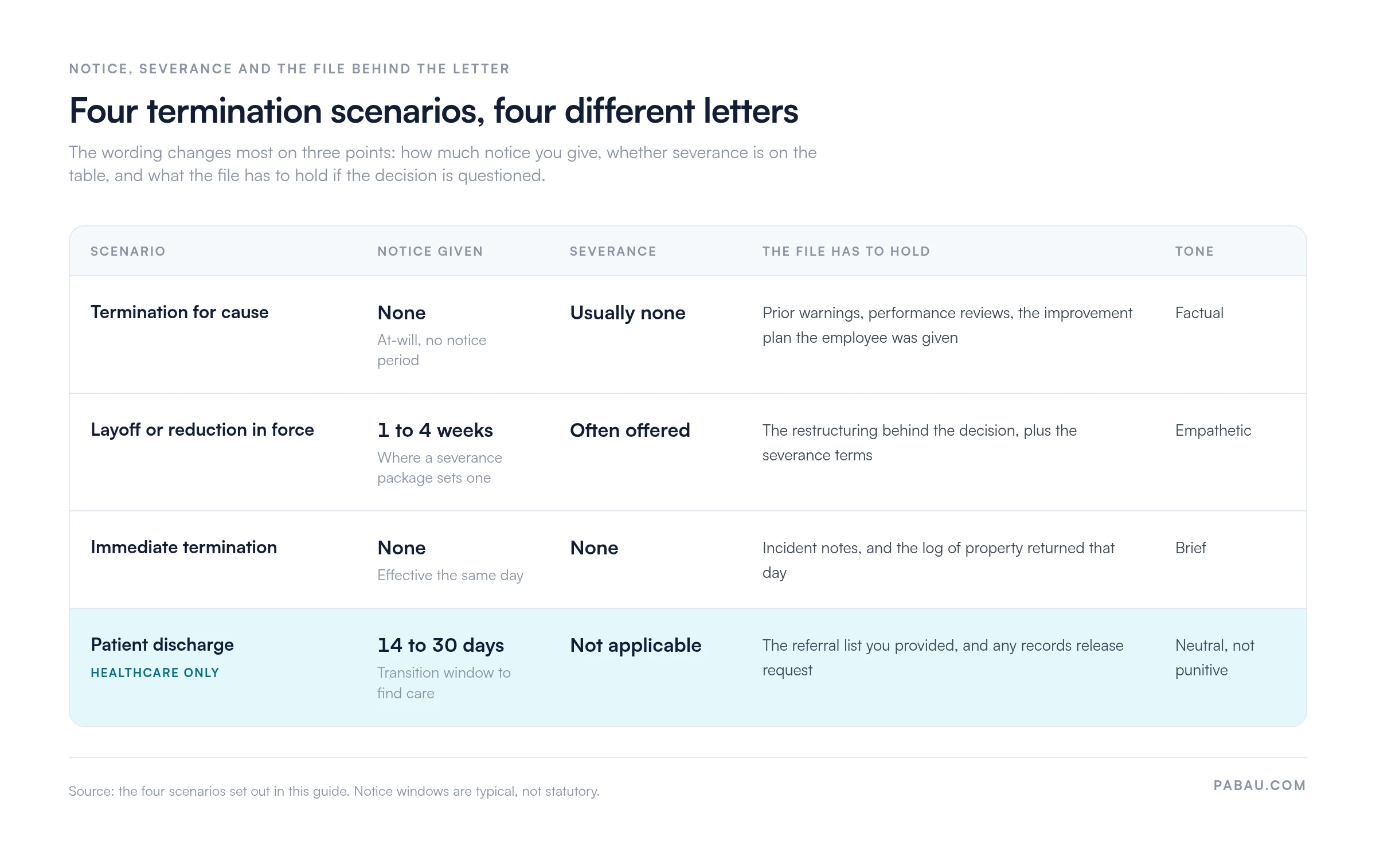
This letter ends an employment relationship over performance, misconduct, or a breach of policy. Keep it factual and unemotional, and name the specific behavior or the standard that was missed. Reference the prior warnings too, including any performance improvement plan the employee was working to.
Key tone: professional and factual, with no accusatory language. Example opening: “This letter confirms the termination of your employment effective [date]. The decision follows repeated failure to meet the standards documented in your review dated [date].”
A layoff letter covers business-driven terminations that have nothing to do with conduct. A practice closure, a service line being cut, or a reduction in headcount all sit here. Keep the tone compassionate, include the severance terms if there are any, and name the restructuring so the decision reads as structural.
Key tone: empathetic, clear, and forward-looking. Example: “Due to the practice’s transition to a new operational model, your position as [title] is being eliminated effective [date]. We recognize your contributions and are offering severance of [amount] plus [X] weeks of continued health coverage.”
An immediate termination letter ends employment without notice, for serious misconduct, a safety violation, or comparable cause. Keep it brief and direct, and hand it over or mail it the same day. No notice period applies.
Key tone: brief and final, with no room for negotiation. Example: “This letter confirms your immediate termination effective today, [date], due to [specific reason]. Please return all practice property by end of business today.”
Sometimes a practice has to discharge a patient from care. The duties behind that letter differ from an employment letter, because continuity of care still applies. The letter has to state the reason, set a transition period, and point the patient toward care elsewhere.
Legal obligation: the patient must still be able to access emergency care. You also owe a reasonable transition window, typically 14 to 30 days, so they can find another provider. Say both in the letter rather than assuming they are understood.
Five items belong in every discharge letter:
Follow these five steps to compose a professional, legally sound letter.
Poorly written termination letters expose practices to legal risk, disputes, and reputational damage. Watch out for these pitfalls:
Two of these are fixable before the letter is ever written. Run the earlier conversation through an employee counseling form, so the warning exists on paper. Then check your state’s final-paycheck deadline while there is still time to meet it.
Beyond the letter’s content, the delivery method and timing matter legally and ethically. Sending a termination letter by email with no conversation first is impersonal, and it can escalate a situation that was manageable. It also removes your chance to answer the questions that always follow.
Deliver the letter in person where you can, with a witness present for legally sensitive cases. Explain the decision briefly, answer the immediate questions, then follow up with a copy by mail for the employee’s own records. For a patient discharge, mail the letter and call ahead. That gives the patient time to process the news and arrange alternative care.
The letter is only half the record. If the termination is ever questioned, what you can produce matters more than what you remember.
File the supporting documents the same day you send the letter, rather than reconstructing them later. Storing them in your practice management app keeps the letter attached to the staff or patient record it belongs to.
Retention periods for employment and patient records vary by state and by professional body. Confirm the rule that applies to your practice before you archive or delete anything.
Once the letter is delivered, the operational work starts. Access has to be removed, the schedule reworked, and the departing person’s appointments reassigned. Practice management software like Pabau holds those steps in one place. Its team management software centralizes staff schedules and access permissions.
So a manager can revoke a departing member’s system access the same day. Their calendar opens up for redistribution, and their upcoming appointments go to another practitioner. Patients keep their slot, and nobody has to work out later who was covering which day.
The outcome is a shorter list of loose ends on the week you least want one. The calendar reflects who is covering, the access list matches who still works there, and the letter sits with the record it belongs to.

Pabau’s team management and scheduling tools handle the access, schedule, and coverage changes a departure creates. Book a demo to see the handover end to end.

The decision is the hard part of a termination. The letter has a narrower job. It makes the decision legible: the date it took effect, the reason, the money owed, and the steps that followed. A practice that writes that down consistently rarely has to argue about it later.
The trade-off worth remembering is that a template protects you only if you fill it in honestly. Softening the reason to spare someone’s feelings is the most common way a well-formatted letter becomes useless in a dispute. State the reason plainly, in neutral language, and keep the evidence behind it.
Download the free termination of appointment letter template above, adapt it to your situation, and file the supporting record the same day. Book a demo to see how Pabau handles the operational side of a departure, from revoking access to reassigning a clinician’s patients.

Documenting performance before it reaches a termination? Annual review template gives you the structure for the conversation that should come first.
Working out final pay and PTO payouts? 9 best healthcare payroll software compares the tools that run a last paycheck correctly.
Discharging patients over missed appointments? How to improve patient no-show rate covers the reminders and policies that keep it from getting that far.
A complete termination letter must include the name and position, the effective termination date, and the specific reason for termination. It also needs the final paycheck details, benefits continuation information such as COBRA, and instructions for returning practice property. Add a contact person for questions. For a patient discharge, also include a transition period of 14 to 30 days, referrals to other providers, and an emergency care statement.
US federal law does not require one universally, but written termination is treated as best practice. State employment law or company policy often mandates it. Many states require written notice of final paycheck timing and benefits rights, which makes a formal letter the safest approach. Always check with your state’s labor department or an employment attorney.
Notice periods vary by state and by contract. At-will employment in most US states allows immediate termination without notice. Severance packages often include a notice period of one to four weeks to allow knowledge transfer. For a patient discharge, provide 14 to 30 days’ notice so the patient can find another provider, unless safety concerns justify an immediate discharge.
Email is legally valid but professionally risky. Deliver the letter in person where you can, with HR or a manager present, then provide a printed or mailed copy for the employee’s records. Email gives you no chance to explain or answer questions, and it can escalate conflict or be misread. For a patient discharge, a mailed letter with a phone call first is more humane.
A termination for cause letter cites specific performance or conduct issues, and it usually includes no severance. A layoff letter is business-driven and not the employee’s fault, so the tone is more sympathetic. It frequently includes severance, benefits continuation, and sometimes job placement help. Both must be clear, factual, and delivered professionally.