GLP-1 diet plan
A GLP-1 diet plan is a structured eating framework for patients taking semagluti...

2
Last Updated: Oct 13, 2026
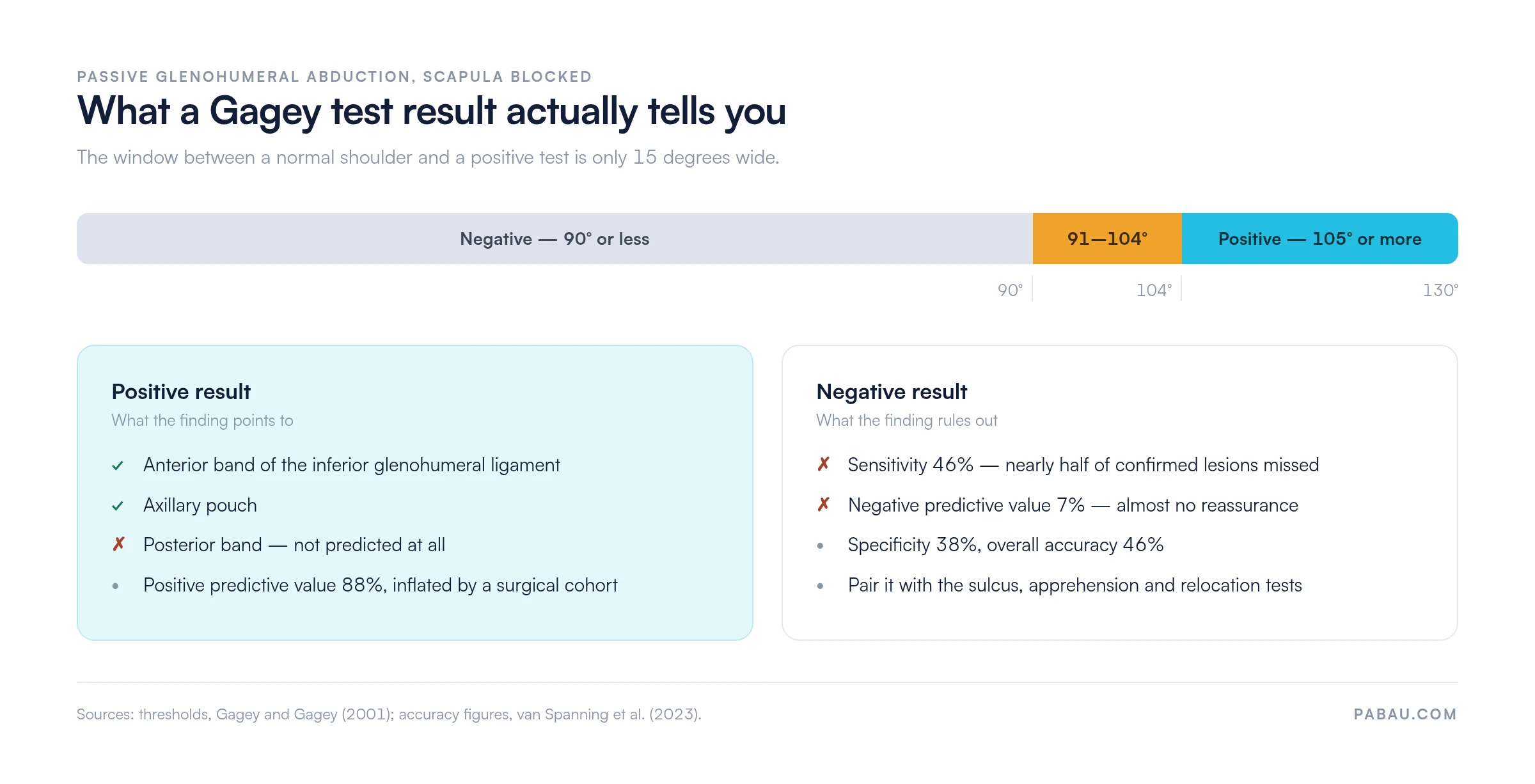
The Gagey test is a seated shoulder examination that measures passive glenohumeral abduction while the scapula is held still. A reading above 105 degrees counts as positive and points to laxity of the inferior glenohumeral ligament (IGHL). Normal shoulders stop at 90 degrees or less.
Gagey and Gagey first described the test in 2001. It takes about 30 seconds per shoulder and needs no equipment beyond a stable chair. Clinicians reach for it when inferior instability is on the differential, alongside the sulcus sign.
One caveat shapes how you read the result. The single published accuracy study reports sensitivity of 46% and specificity of 38%. Treat a positive finding as supporting evidence rather than a diagnosis. This guide covers the anatomy, the technique, the thresholds, and how to record what you measure.

The Gagey test detects laxity of the inferior glenohumeral ligament (IGHL) by measuring passive arm abduction with the scapula stabilized.
A positive Gagey test is passive glenohumeral abduction above 105 degrees. Normal shoulders do not exceed 90 degrees.
The one published accuracy study found low sensitivity (46%) and low specificity (38%), so the test supports other instability tests rather than replacing them.
A positive result points to anterior band and axillary pouch lesions, and it does not predict posterior band lesions at all.
Practice management software like Pabau turns the assessment into structured fields, so serial measurements stay comparable across a team.
The glenohumeral joint leans heavily on passive restraints, because its bony architecture offers limited stability of its own. The glenoid covers only about 25-30% of the humeral head surface area. That leaves the capsuloligamentous complex to control translation in every direction.
The IGHL is the primary static restraint against inferior translation of the humeral head when the arm is abducted. It has an anterior band, a posterior band, and an axillary pouch. Between 45 and 90 degrees of abduction the IGHL becomes progressively taut. It then takes over from the subscapularis as the main inferior stabilizer.
Laxity of the IGHL lets the humeral head translate inferiorly beyond normal limits. Traumatic injury can cause it, including inferior dislocation and traction events. So can repetitive overhead loading in throwers and swimmers, or constitutional hyperlaxity. The Gagey test stresses this structure in a controlled, reproducible way.
Correct technique decides whether the result is worth recording. Letting the scapula rotate upward inflates the abduction range and produces a false positive. Block the scapula throughout the movement.
Scapular stabilization is what separates glenohumeral abduction from total shoulder elevation. Without blocking the scapula you measure shoulder complex motion, which says nothing specific about ligament laxity. A general shoulder mobility test measures that combined motion on purpose, with 180 degrees of abduction as the normal benchmark.
Record the figure the same way every time. A printable shoulder range of motion chart gives you one place to log the angle, the side tested, and the contralateral comparison.
Gagey and Gagey (2001) set normative thresholds from cadaveric and clinical study data. Those thresholds remain the standard reference across the literature.
A positive Gagey test does not confirm a diagnosis on its own. It identifies one mechanical finding, which is excessive inferior glenohumeral laxity. Read that finding against the symptom pattern, the mechanism of injury, and the activity demands.
Asymptomatic people can also sit above the threshold. Throwing athletes and competitive swimmers often show elevated abduction angles without clinically significant instability.
Always document the exact angle measured, the side tested, and whether the finding was symptomatic. Vague wording such as “positive instability test” is useless for tracking progression or briefing a surgical colleague.
Diagnostic accuracy data for the Gagey test comes from a single published study. Van Spanning and colleagues (2023) tested the hyperabduction test against lesions confirmed at arthroscopy, reported in Orthopaedics & Traumatology: Surgery & Research, indexed as PubMed PMID 36470371.
That study reports sensitivity of 46%, specificity of 38%, and overall accuracy of 46%, with a positive predictive value of 88% and negative predictive value of 7%. The authors call both sensitivity and specificity low, supporting the test as an adjunct rather than a standalone diagnostic.
These numbers do not support using the Gagey test as a rule-in tool: specificity of 38% is too low for a positive result to confirm inferior instability alone. The 88% positive predictive value instead reflects how many shoulders in that surgical cohort already had a lesion before examination.
What a positive result does carry is location information: it best predicts lesions in the IGHL’s anterior band and axillary pouch, and does not predict posterior IGHL lesions at all. Both halves of that picture, and how narrow the equivocal window is, appear below.
Check where a diagnostic accuracy figure came from before you apply it to a patient. The Gagey test figures come from a surgical cohort with a high rate of confirmed lesions. Those predictive values do not transfer cleanly to a general outpatient caseload. Applying population-level statistics to one patient takes clinical judgment, not just arithmetic.
The Gagey test belongs in a shoulder assessment whenever inferior glenohumeral instability is on the differential. That covers a wider patient population than the classic instability presentation suggests.
Bilateral findings are worth scoring formally. A Beighton score template records the nine hypermobility sites next to the shoulder angles, so constitutional laxity is easy to separate from a structural injury.
Practices that see a mix of sports and general orthopedic referrals benefit most from a standard approach here. Athletes whose main complaint is anterior pain are the ones whose inferior component gets missed.
The Gagey test and the sulcus sign both assess inferior glenohumeral instability, but through different mechanisms and patient positions. Knowing what each one tells you makes the assessment more complete.
Using both tests in one session is common. A positive sulcus sign with a positive Gagey test gives converging evidence for clinically significant inferior instability.
Discordant results need care. Check examiner technique and patient guarding first. Then ask whether either test position stresses the structure driving this patient’s symptoms.
The American Academy of Orthopaedic Surgeons (AAOS) clinical practice guidelines set out evidence-based recommendations on test selection and management pathways. They are a useful reference when you build a shoulder instability decision pathway.
Objective musculoskeletal results lose their value fast when documentation drifts. One clinician records “shoulder laxity noted” and the next records “positive hyperabduction”. Nobody can then tell whether the finding changed or only the wording did.
Structuring the way you record a shoulder instability assessment matters for four reasons:
Practices running on a physical therapy EMR can store the angle as a discrete field instead of free text. Serial comparison then becomes a query rather than a hunt through old notes.
Structured records also support audit readiness. Pre-designed templates cut the risk of incomplete notes and make it straightforward to show that an assessment protocol was followed.
Plenty of practices still capture this assessment as free text. The angle, the side, and the bilateral comparison end up phrased differently by every clinician. The next appointment then starts with a reading exercise instead of a comparison.
Pabau replaces that with fields. Teams build the shoulder assessment template once in Pabau’s patient intake software, then every clinician completes the same goniometric values, test outcomes and bilateral comparisons. A completed form attaches to the patient record, so last visit’s angle is on screen at the next one.
Practices carrying a mixed sports caseload can run the same templates through Pabau’s sports medicine software. Assessment history, appointments and treatment notes stay on one record, so you can chart a shoulder across a season without opening a second system.


Pabau’s digital clinical forms and structured patient records help physical therapy and sports medicine teams capture goniometric measurements, bilateral comparisons and test outcomes consistently. Build the shoulder assessment template once and apply it across your whole team.

The Gagey test earns its 30 seconds because the 105-degree threshold is unambiguous and easy to apply the same way across a team. What it cannot do is settle the question on its own. With sensitivity at 46% and specificity at 38%, one reading only adds weight to the rest of the examination.
So the practical move is to standardize how you take and record the angle. Then read it next to the sulcus sign and the apprehension, relocation and surprise tests. A quantified, comparable number does more for the next clinician than any confident interpretation of a vague one.
Get the documentation right and the test starts paying off across appointments rather than within one. Book a demo to see how Pabau keeps shoulder assessment measurements structured, comparable and easy to share with a referring surgeon.

Working through the rest of the shoulder examination? Infraspinatus test walks through a rotator cuff test that pairs naturally with an instability screen.
Need another subscapularis and cuff check? Lift-off test covers the technique, the positive finding, and what the result rules in.
Setting up a physical therapy practice and unsure what records to keep? Mandatory compliance for physiotherapy clinics outlines the documentation standards you have to meet.
Looking for a return-to-sport framework to pair with instability testing? Return to running protocol shows how sequential objective measurements drive the decision.
Comparing systems to hold all this assessment data? Best physiotherapy practice management software tests and ranks the main options for allied health teams.
The Gagey test assesses laxity of the inferior glenohumeral ligament (IGHL). It detects inferior glenohumeral instability by measuring how far the arm can be passively abducted with the scapula stabilized. Clinicians use it most often in athletes, in patients with a history of dislocation, and where multidirectional instability is suspected.
Seat the patient with the arm at the side. Stabilize the scapula with one hand pressing down on its superior border to prevent upward rotation. With the other hand, passively abduct the arm in the coronal plane while watching for scapular movement. Record the angle reached with a goniometer, then repeat on the opposite side for comparison.
A positive Gagey test means passive glenohumeral abduction exceeds 105 degrees with the scapula stabilized. That indicates significant laxity of the inferior glenohumeral ligament and suggests inferior instability. Correlate it with clinical history, symptom pattern and other instability tests before reaching a diagnosis.
Van Spanning and colleagues (2023) report sensitivity of 46% and specificity of 38%, with overall accuracy of 46%. Positive predictive value was 88% and negative predictive value was 7%. Both sensitivity and specificity are low, so the test cannot confirm or exclude inferior instability on its own. A positive result is most predictive of anterior IGHL and axillary pouch lesions, and it does not predict posterior lesions.