Maja Popovska

VI Peel aftercare instructions
How VI Peel aftercare works VI Peel aftercare follows a set order: leave the pee...

1
Last Updated: Nov 16, 2026
Free PDF 2 pages, print-ready Clinician-reviewed
A spousal assault risk assessment is a structured clinical review that estimates the risk of future violence by one intimate partner against another. The Spousal Assault Risk Assessment (SARA) guide, developed by Kropp, Hart, Webster and Eaves, is the best-known instrument of this kind. It uses structured professional judgment. The assessor rates a set list of risk factors, then reaches a reasoned judgment of low, moderate or high risk. SARA-V3 is the current version. Without a shared framework, two clinicians reviewing the same history can reach different ratings, and the SARA gives them one structure to work from.
This two-page form rates 20 risk factors, 10 for general violence and 10 for spousal violence, on a 0 to 2 scale. It closes with a total score box, a scoring note and space for additional notes.
Start from scratch, or upload this PDF or any form you already use, and Pabau's AI Form rebuilds it with tick boxes, text fields and a signature. Attach it to the treatment once, and every patient gets it on time.
AI Form rebuilds the consent, history and aftercare forms you already use. You review each one, then publish.
Patients complete forms on their phone before they arrive, so the front desk stops retyping paper.
Every signed form is versioned and attached to the treatment record, ready when you need it.
Set how long a consent stays valid. Returning patients skip forms they have already signed.
Supports HIPAA and GDPR compliance AES-256 encryption 4.8 on G2 4.7 on Capterra Trusted by 4,000+ practices worldwide

The SARA is a structured professional judgment tool, so clinicians use it to guide judgment rather than to produce a score-based prediction.
The original SARA grouped its risk factors into four domains: criminal history, intimate partner violence history, psychosocial adjustment and the index offense. SARA-V3 groups its items differently.
SARA-V3 is the current version, and B-SAFER is a briefer tool designed for frontline use.
Results should inform safety planning, and every rating needs documented reasoning.
Pabau, the practice management platform we build, can store the completed assessment in the patient record so the rationale stays with the file.
The spousal assault risk assessment (SARA) is a structured professional judgment guide for assessing the risk of violence against an intimate partner. Kropp and Hart’s 2000 validation study found high interrater reliability for SARA ratings across six samples of adult male offenders.
Kropp, Hart, Webster and Eaves developed the original SARA, published by Multi-Health Systems (MHS). It was built to assess physical violence by a male partner against a female partner. SARA-V3 (Kropp and Hart, 2015) revised the item list and wording, so confirm its scope and publisher in the V3 manual.
The assessor rates each risk factor, then weighs them together to reach a reasoned judgment about risk. Clinicians in criminal justice, forensic mental health and social services use the SARA for its consistent structure. Without it, the process would rely on memory and impression. It also prompts the evaluator to look at history, current stressors and protective factors together.
SARA-V3 is the current version of the instrument, and most practitioners now work from it. Check the manual supplied with your license before you use a specific item list, because the item count and wording can differ between versions. The domains described in this guide follow the original SARA.
The original SARA grouped its risk factors into the four domains below. Each domain asks the assessor to consider both past behavior and present conditions. SARA-V3 groups its items differently, so check the current manual before you map a case to these domains.
Clinicians should not treat any single factor as decisive. A factor that looks minor in isolation can matter a great deal when it appears alongside escalation or recent separation.
SARA scoring follows a structured professional judgment approach, so the output is a rated risk level supported by written reasoning rather than a single number. Assessors rate each item and then weigh the whole picture. Proprietary item scores and cut-off thresholds come from the official manual for your version, so this guide does not reproduce them.
Forensic evaluators, probation officers, social workers and mental health clinicians all use structured risk tools in this area. Use depends on training and on the rules of your jurisdiction. In many settings, the assessor must hold the qualifications and training the publisher requires.
Clinical, legal and law enforcement contexts differ in what they ask of the result. A treatment team may use the output to plan support, while a court may ask for it as part of a wider evaluation. Confirm how your local courts treat structured risk assessments before relying on one in a legal setting.
The Danger Assessment, developed by Jacquelyn Campbell, is a separate tool that focuses on the risk of lethal or near-lethal violence. The SARA is broader in scope and is built around structured judgment about future violence. Many services use both, with each answering a different question. Our domestic violence assessment guide sets the other validated screening tools side by side.
A risk rating only helps if it changes what happens next. The rating should feed directly into the safety plan, including contact arrangements, referral to specialist services and monitoring intervals. Record the link between the rating and each action so the reasoning can be reviewed later, as the flow below shows.
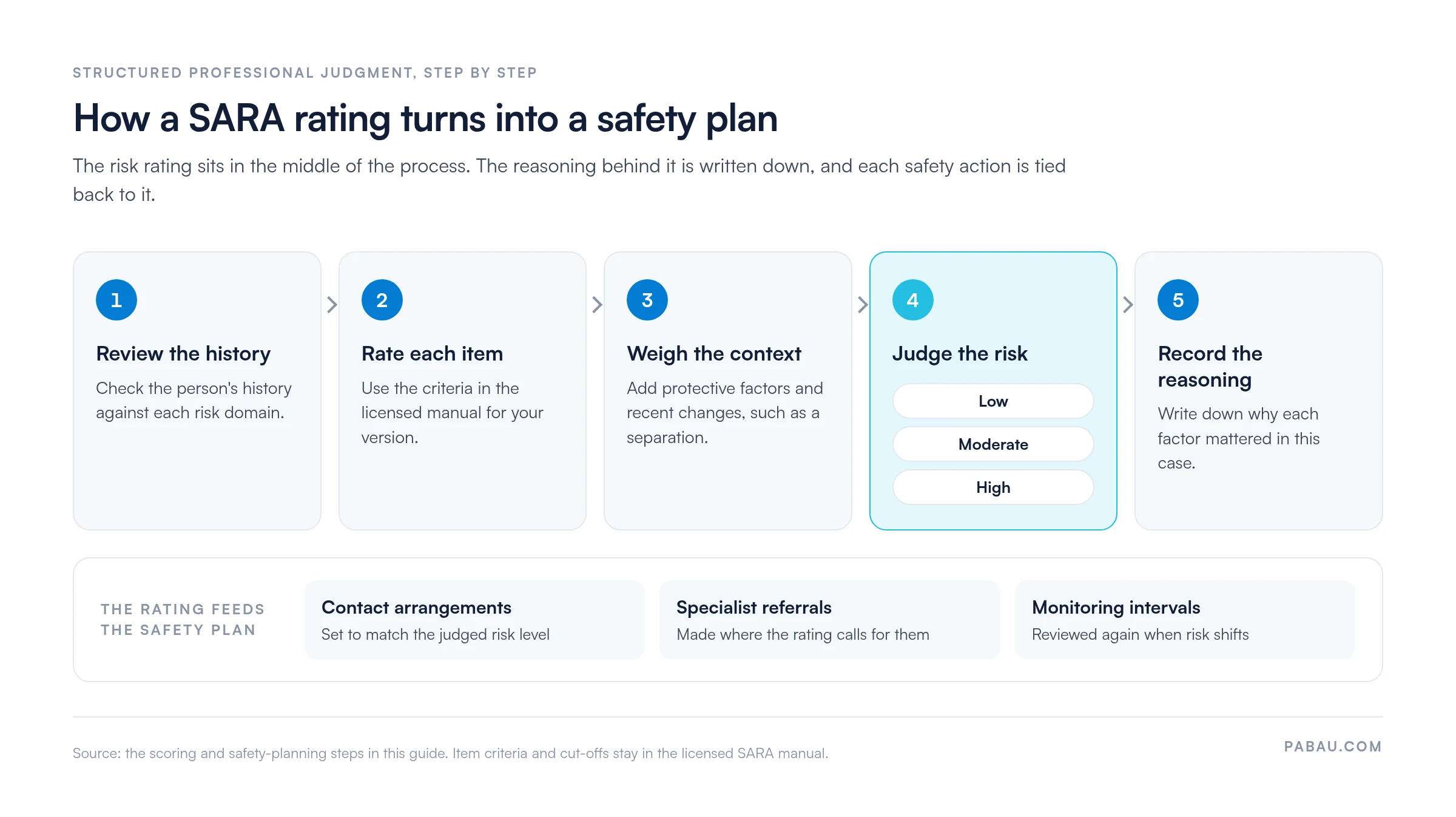
Published validation studies report that the SARA has predictive validity for intimate partner violence recidivism. Reliability and validity findings appear in the peer-reviewed literature, and the authors and publisher describe the instrument’s structure in their manuals. Read the primary studies before you draw conclusions about a specific population.
The original SARA was validated mainly on male perpetrators, so its use with female or same-sex partners needs careful justification. SARA-V3 revised the item list and wording, so check its manual for the populations it covers before you apply it.
Cultural background, gender and language can also shape how a person describes their history and how an assessor interprets it. Training matters as well, because ratings drift when assessors apply items differently.
Risk tools estimate probability. They do not predict with certainty that violence will occur. Mandatory reporting duties and duty-to-warn obligations vary by jurisdiction, so check local law before acting on a rating.
Use the template as a working reference when you plan an assessment. It is an educational document, not the proprietary MHS instrument, and it does not replace the official manual or formal training. Adapt it to your service’s policies before use.
The file lists 20 risk factors in two groups, general violence and spousal violence, each rated 0, 1 or 2. Its scoring note follows SARA Version 2, so check each item against the manual for the version you are licensed to use.
Audit your assessment template once a year against the current manual. Check that the item wording, version number and scoring guidance match the instrument your team is licensed to use. Log each change with its date.
On paper, the assessment, the rating rationale and the safety plan often end up in three different places. A reviewer then has to rebuild the reasoning from all three, and a change in risk can go unrecorded.
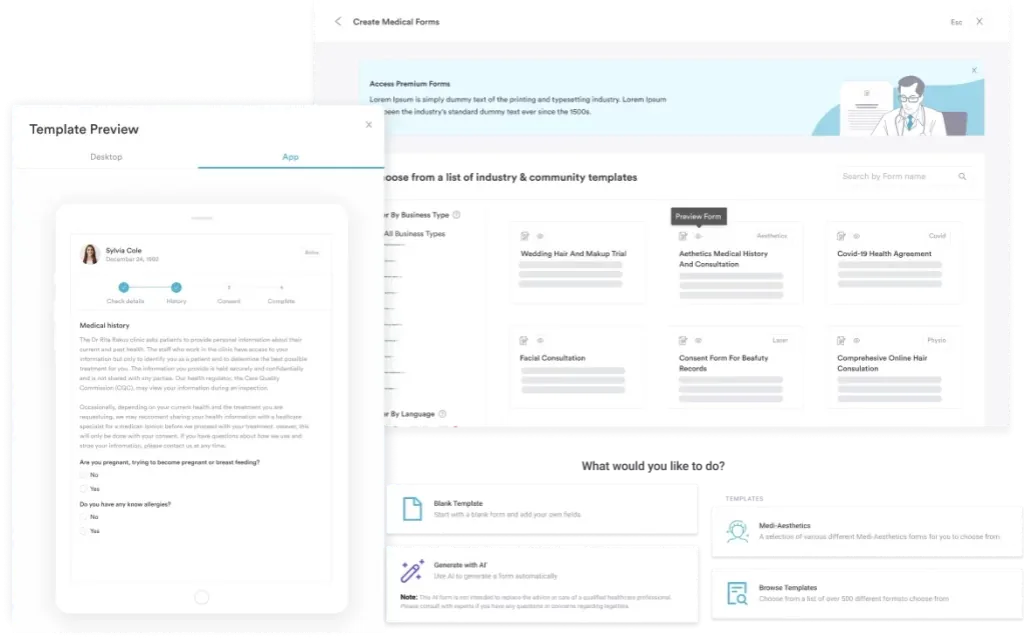
Pabau’s clinical notes and digital forms keep the assessment, the rating rationale and the safety plan together in one patient record. A form built once also standardizes how every practitioner captures the assessment, so the team reviews the same structure each time.
Teams that run Pabau as their therapy practice management software can book each review interval in the same calendar. Reassessments then happen on schedule, and the next assessor opens the record with the earlier reasoning already there.

See how Pabau keeps risk assessments, safety plans and case notes in one secure record your whole team can follow.

A SARA rating is only as useful as the reasoning written beneath it. Two assessors can reach the same “high risk” call for very different reasons. The written rationale is what shows a reviewer, a court or the next clinician which factors drove that call.
Treat the template as a planning aid. Confirm your license and training cover the version you use, then rate each item against the official manual. Record why each factor mattered in this case, and tie every safety action to the rating behind it.
The trade-off is time. Structured judgment takes longer than a checklist score, and it asks more of your notes.
That effort pays off when risk shifts after a separation or a new incident. A documented baseline lets you show what changed and why the plan moved with it. Where a case falls outside the male-perpetrator samples the original SARA was validated on, write that justification down too.
Pabau keeps the completed assessment, the rating rationale and the safety plan together in one record. Your team can then review all three at every scheduled check-in. Book a demo to see how Pabau keeps your risk assessment records consistent and ready for review.

Weighing lethality alongside future-assault risk? Danger Assessment template and scoring guide explains how the score sorts risk into four categories and when the DA-5 short form fits better.
Need to compare screening instruments first? Domestic violence assessment sets the validated intimate partner violence tools side by side and covers what a court-ordered evaluation involves.
Opening the conversation with a survivor? Domestic violence worksheet gives you a trauma-informed checklist across five categories of abuse.
Need to map patterns of coercive control? Power and control wheel breaks down the eight Duluth Model tactics and how to screen and document them.
Explaining why risk rises and falls over time? Cycle of abuse wheel walks through the four phases and how clinicians teach the model, with its limits.
The SARA is a structured professional judgment tool for assessing the risk of violence against an intimate partner. The original version, developed by Kropp, Hart, Webster and Eaves and published by Multi-Health Systems, covered violence by a male partner against a female partner. SARA-V3 revised the items, so confirm its scope in the V3 manual.
The SARA produces a rated professional judgment of risk, supported by written reasoning, rather than a single statistical score. Item criteria and cut-offs come from the official manual.
Assessors need training and qualifications that meet the publisher’s requirements and the rules where they work. Practice varies by jurisdiction, so confirm local requirements before use.
Yes. The SARA focuses on the risk of future spousal assault. The Danger Assessment focuses on the risk of lethal or severe injury to the victim.