HIPAA compliance checklist for medical spas
If you run a medical spa or healthcare practice, you’ve probably heard of HIPA...

Last Updated: Sep 23, 2026

A domestic violence assessment is a structured clinical evaluation that identifies intimate partner violence, scores risk, and guides safety planning.
The Danger Assessment fits healthcare and advocacy, while SARA, ODARA, and DVSI are validated for criminal justice and correctional settings.
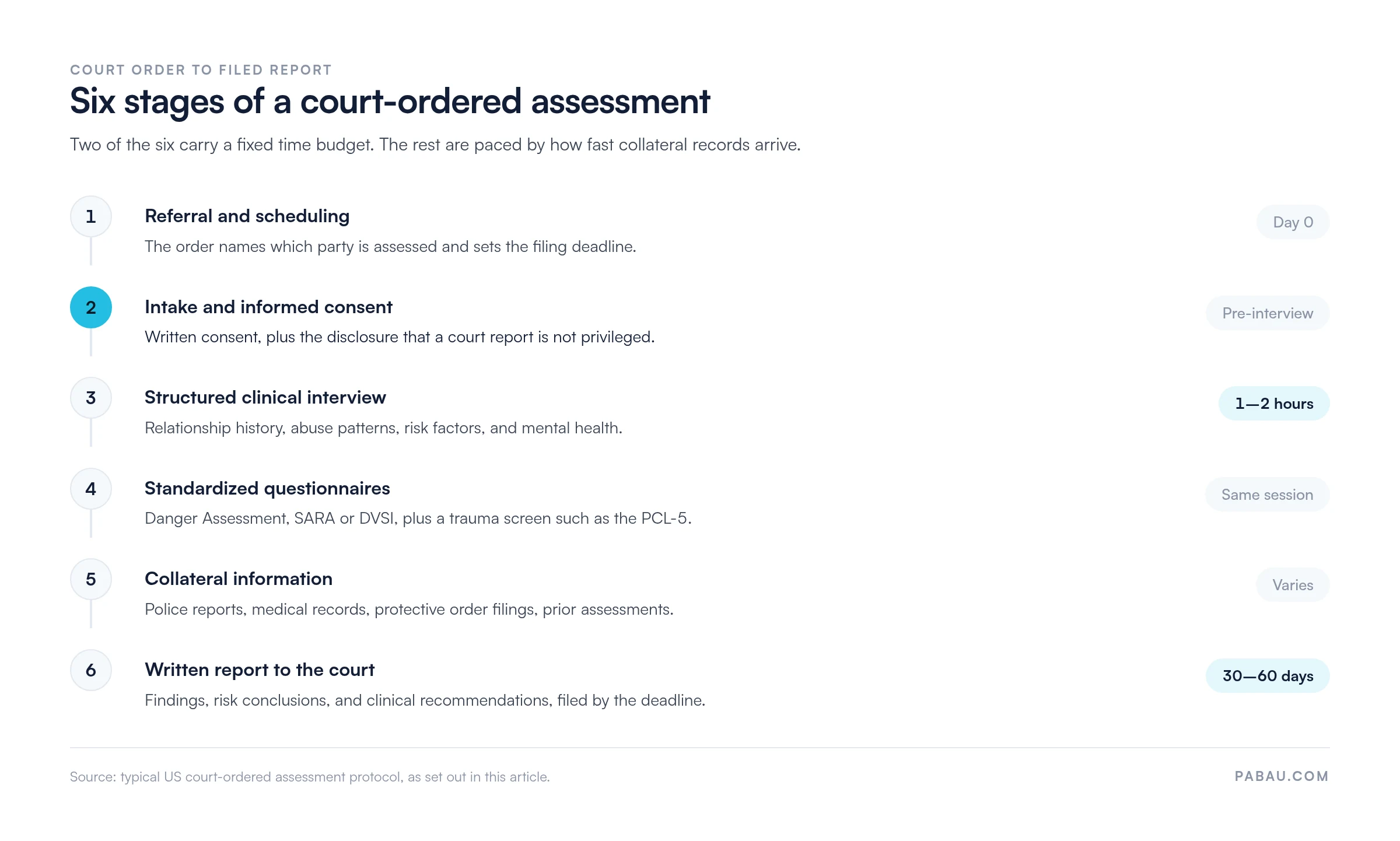
A court-ordered evaluation runs six stages, from the referral to a written report filed within 30 to 60 days.
A court report is not protected by therapist-client privilege, so explain that limit in writing before the interview begins.
Practice management software like Pabau keeps assessment forms, referrals, and follow-up reminders inside one HIPAA-compliant client record.
A five-section screening form covering patient details, incident history, risk indicators, safety planning, and clinician notes. Print it, or load the fields into your intake system.
Download templateScreening for intimate partner violence (IPV) belongs to every clinician who sees patients alone. Primary care, emergency medicine, mental health, and occupational therapy all encounter it. A psychology practice, or any setting that works with trauma survivors, needs a repeatable way to ask the question and record the answer.
A structured domestic violence assessment turns that recognition into a documented risk picture and a safety plan. This guide covers the definition, the validated instruments, and what a court-ordered evaluation involves. The form above standardizes the screening itself.
A domestic violence assessment is a structured clinical evaluation that identifies the presence, severity, and risk of intimate partner violence in a client’s life. A licensed mental health professional, physician, nurse, or social worker conducts it.
The evaluation gathers incident history, injury patterns, behavioral red flags, and the strategies the client already uses to stay safe. That material becomes a risk score and a set of treatment recommendations.
The purpose is threefold:
According to the CDC, about 1 in 4 women and 1 in 9 men experience severe intimate partner violence in their lifetime. That figure also counts contact sexual violence and stalking with a significant impact. Screening and documentation therefore belong in every clinical setting.
Clinicians run three distinct evaluation types. Each one has a different focus population and a different purpose.
Several validated instruments guide a systematic evaluation. Which one you reach for depends less on the client in front of you and more on where you practice.
The Danger Assessment, developed by Dr. Jacquelyn Campbell at Johns Hopkins University, is the most widely used tool in healthcare and victim advocacy. It weighs the lethal risk factors that predict severe outcomes, including firearm access, estrangement, and escalating substance use. Many mental health practices and emergency departments administer it at intake.
The split between these instruments is jurisdictional rather than clinical. Healthcare and advocacy settings use the Danger Assessment because it speaks to the survivor’s own safety decisions. Courts, probation, and police use SARA and ODARA because those tools score the person who caused the harm. Administering the wrong one produces a report the recipient cannot act on.
A thorough assessment works through several domains to build a complete clinical picture.
Work through this checklist during the session to screen for lethal risk factors. Several indicators together raise the overall risk profile and justify more intensive safety planning.
Licensed clinicians across several professions are trained for this work. The list includes clinical social workers, professional counselors, psychologists, psychiatric nurse practitioners, family medicine physicians, and emergency medicine doctors.
The requirement is training in trauma-informed care, IPV screening protocols, and the mandatory reporting rules of the state you practice in. Many clinicians work from a standardized digital form built into their software for therapy practices, so the questioning stays consistent and the record stays secure.
A court-ordered evaluation follows legal protocols the clinical version does not. Orders usually arrive out of custody disputes, protective order hearings, or criminal proceedings.
Six stages run from the order to the filed report, and only two of them carry a fixed time budget.
The downloadable form follows a five-section structure aligned with clinical best practice. Work through each section in order so the documentation comes out complete.
Complete the form during the interview or straight after it, while the detail is fresh. Store it under HIPAA-compliant controls and never leave assessment documents unattended. Most practices keep the form inside the EHR, where access is encrypted and audit-logged.
The assessment is the first step, not the outcome. Once it is complete, document the findings securely and start safety planning with the survivor.
Survivors often need something structured to work through between appointments. A client-facing domestic violence worksheet gives them prompts to use outside the session. It also gives you a record of what changed since the last visit.
How you document the findings carries legal weight as well as clinical weight. Use clinical language, stay on observable facts such as injury locations and client statements, and avoid judgment-laden terms. Record the risk factors that drove your clinical decisions.
Maintain strict HIPAA confidentiality, and understand where the mandatory reporting exceptions override it. If a minor, an elder, or a dependent adult faces imminent serious harm, you must report it even when the client objects.
Court-ordered assessments are the second exception. Findings go to the judiciary, and therapist-client privilege does not protect them. Either way, assessment records should be encrypted, access-logged, and retained for seven years or more, depending on your state.
Most practices still run this on paper. The clinician prints the form, completes it by hand, files it in a locked cabinet, then writes the referral letters and diary reminders separately. The client record holds none of it.
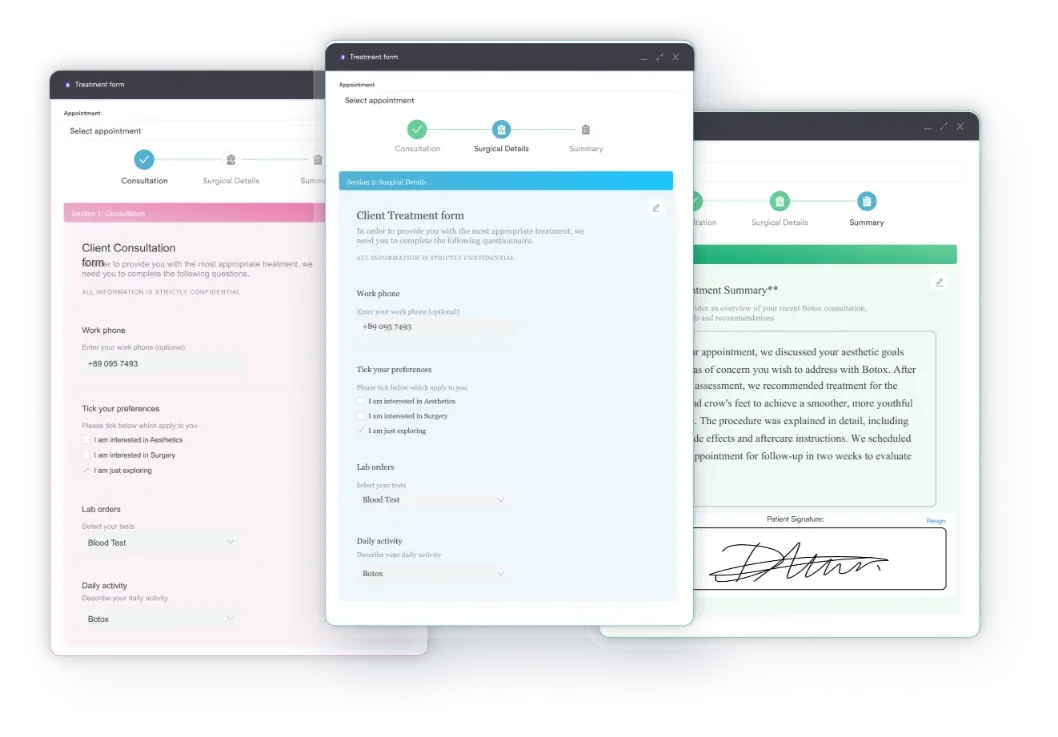
Pabau is practice management software for clinical practices, and it replaces that with one structured digital form. Its capture forms software lets you build the assessment once, with mandatory fields, checkbox risk indicators, a body map, and a signature block. Client demographics populate automatically, so the session time goes on the interview.
Completed assessments save straight into the client record. From there you can book the follow-up, send the referral message, and pull a court-ready report out of the stored answers. Preparing that report becomes a matter of reviewing structured fields rather than deciphering handwriting.
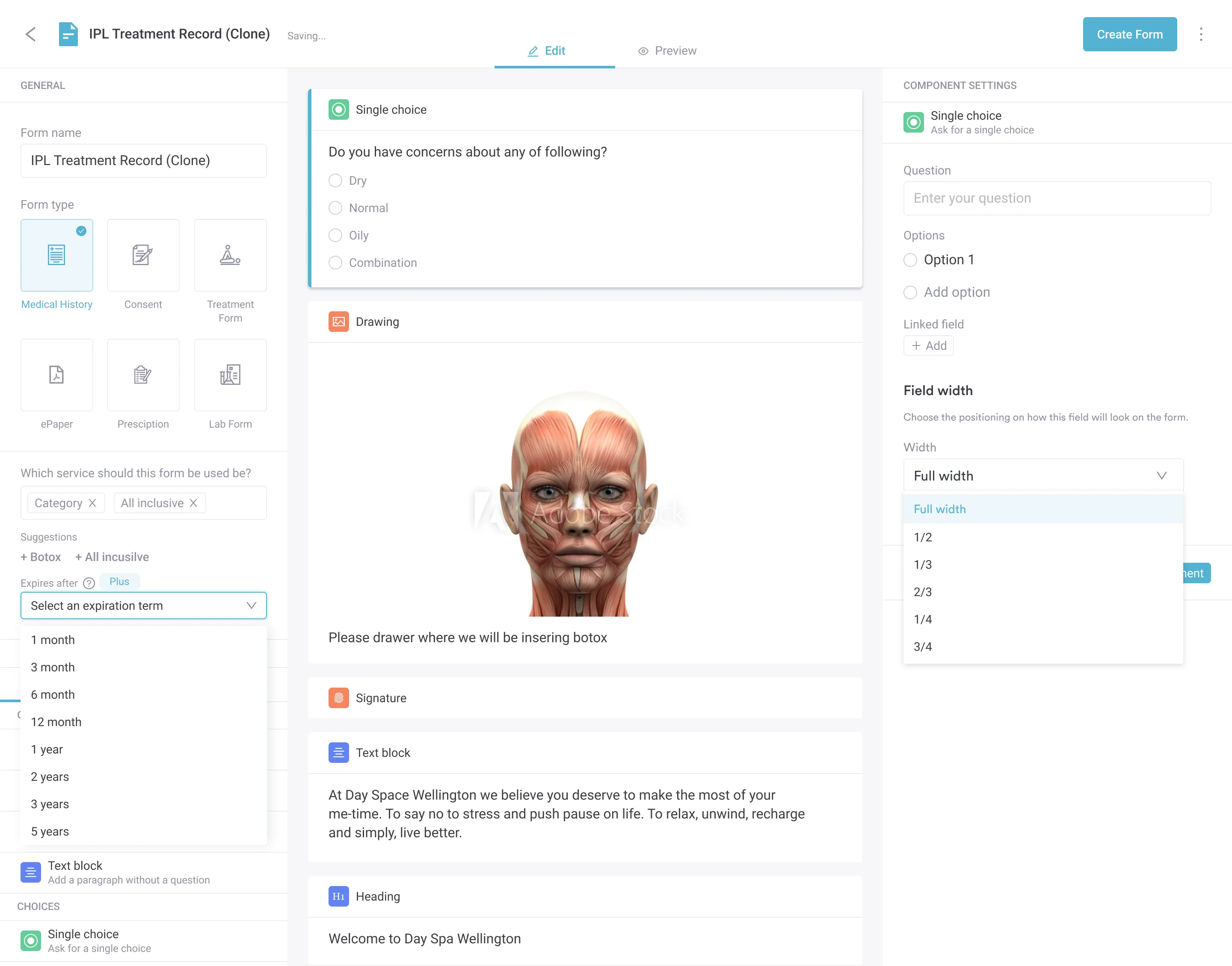

Pabau keeps the assessment form, the referral, and the follow-up reminder in the same HIPAA-compliant client record. Clinicians screen consistently, and the documentation is ready when a court asks for it.

The instrument matters less than the habit. A practice that asks the same questions of every client, in the same order, will surface cases that an unstructured conversation lets pass.
The trade-off worth remembering sits in stage two of a court-ordered evaluation. Telling a client that the report is not privileged will change what some of them say. Explain it anyway, in writing, before the first question. A report resting on consent the client never understood will not survive the hearing.
Download the form above, decide which instrument your setting calls for, and put both in front of every clinician who screens. Book a demo to see how Pabau stores completed assessments, triggers the referrals, and keeps follow-up appointments on schedule.

Need a framework for documenting sensitive sessions? SOAP notes for social work sets out how to write clinical notes that hold up on review.
Looking for a structured mental health evaluation? Psychiatric evaluation template covers the assessment domains that also apply to trauma and abuse.
Standardizing what you ask at the first visit? Mental health intake form gives you the baseline questions to run before any risk screening.
Mapping a client’s support network? Ecomap social work template helps you chart the safe people and services a safety plan can lean on.
Screening is a brief, standardized set of questions asked at intake to find out whether abuse is present. Examples include “Are you ever afraid of your partner?” and “Has your partner hit, kicked, or physically hurt you?”. An assessment goes further. It is a full clinical evaluation covering incident history, risk factors, injury documentation, mental health impact, and safety planning. A licensed clinician conducts it and documents it in detail for treatment or legal use.
Mandatory reporters vary by state and by profession. Most states require healthcare providers, mental health professionals, teachers, and social workers to report when a minor or dependent elder faces imminent serious harm. Some states mandate reporting of all identified abuse. Verify your own state’s law, because clinicians who fail to report when required can face criminal and civil liability.
The Danger Assessment was developed for trained clinicians, advocates, and healthcare providers. Formal certification training exists, but many clinicians use the tool after self-study and consultation with experienced practitioners. If you administer it for a court-ordered evaluation, document your training and any supervision you received.
Respect the survivor’s autonomy and do not force a plan. Provide written resources, acknowledge how hard leaving is, offer ongoing support, and raise safety planning again at future appointments. Many survivors are not ready to leave, but they benefit from knowing the options exist. Document your recommendations and the client’s response in the clinical record.
Obtain explicit consent before photographing or examining injuries. Use clinical language such as “bruising consistent with blunt trauma” rather than a narrative description of the abuse. Store photos securely, with access restricted to authorized clinical staff. Explain the process beforehand and let the client stop at any point.
The Danger Assessment uses a point system, and a higher score indicates greater risk of severe intimate partner violence. A score above 7 signals substantial danger. Risk tools are probabilistic rather than definitive. Some high-risk individuals never re-offend, and some low-risk individuals do. Treat the score as one clinical indicator among several.