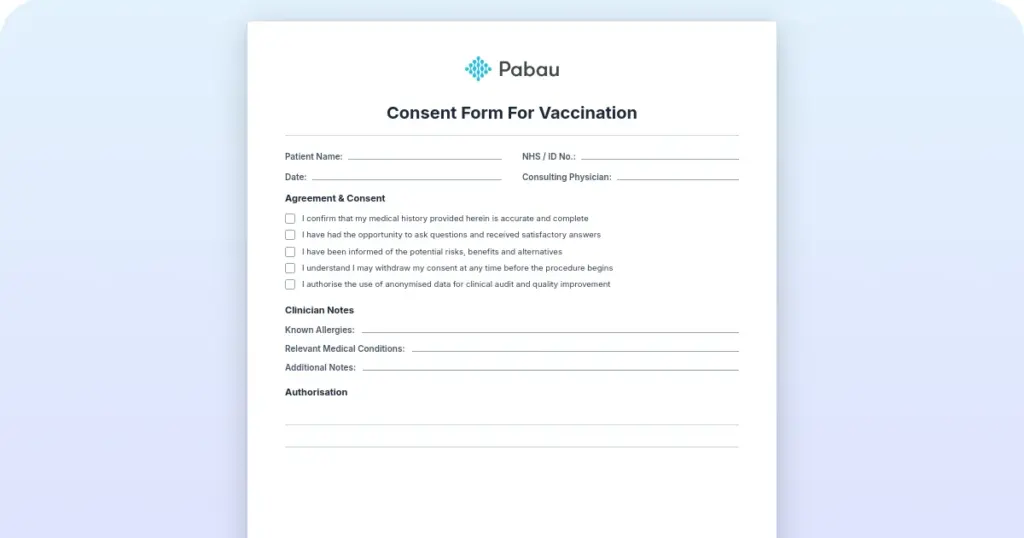
Consent form for vaccination: Free PDF template
A consent form for vaccination proves the patient understood the vaccine’s...

18
Last Updated: Sep 18, 2026

The downloadable sex frequency by age chart is a blank patient self-report form, not a table of published averages.
Patients tick their own age band, from 18-24 through 65 and over, then record weekly frequency, satisfaction, and contributing factors.
Published survey research puts the adult average near 54 times a year, and frequency falls as age rises.
Reported happiness rises with frequency up to about once a week, then levels off, so agreement matters more than the count.
A completed form gives you a documented starting point for a sexual health conversation, in the patient’s own words.
A single-page fillable form the patient completes before the consultation. It captures their age group, weekly frequency, change over the past year, contributing factors, satisfaction, comments, and signed consent.
Download templateMost sex frequency by age charts hand you population averages. This one hands you a form. The patient ticks their own age band, records how often they have sex, and says whether that suits them. If your practice also offers aesthetic treatments, our comparison of the best med spa software ranks eight platforms for charting and checkout.
The satisfaction answer is the one to read first. Published research ties relationship happiness to frequency only up to about once a week. Above that point the benefit levels off, so agreement between partners matters more than any target number.
Ask for the number without the satisfaction answer and you can end up treating a couple who were content. So start with what the patient sees on the page, then read the averages against it.
The most widely cited source for sex frequency by age group is the General Social Survey (GSS), which has tracked sexual behavior among U.S. adults since the 1970s. Its data is analyzed regularly in the Archives of Sexual Behavior.
U.S. adults report sex roughly 54 times a year, close to once a week. Frequency then falls with each decade after the twenties.
The size of that decline is easier to see than to describe.
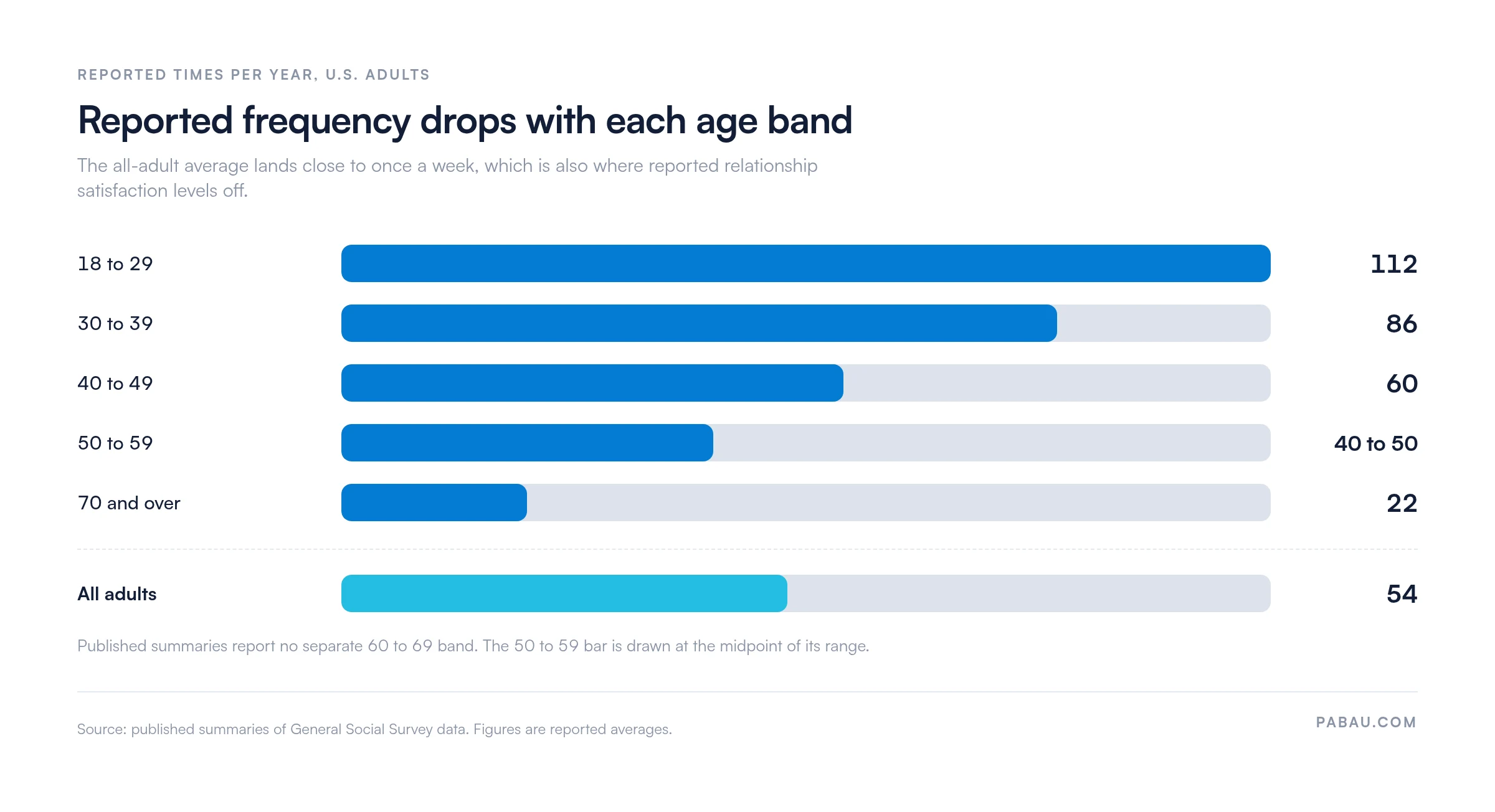
These figures come from the published survey research above, not from the downloadable form. The bands also follow the groupings those summaries report, which are not the bands printed on the form.
Frequency and satisfaction do not rise together forever. A 2016 study by Muise, Schimmack and Impett, published in Social Psychological and Personality Science, tracked both across three samples.
Happiness climbed with frequency up to about once a week, then leveled out, and more frequent sex brought no further benefit.
Age on its own never sets frequency. Several factors overlap, and most of them can move in either direction.
Knowing which factor is in play changes how you answer. A patient on an SSRI with reduced libido needs normalization first, and possibly a word with their prescriber.
The form does most of its work before you speak. Send it ahead as a digital intake form and it arrives completed, which leaves the appointment for the conversation.
Three checks stop the form going to waste:
The form suits any practice where sexual health comes up but rarely gets written down. That covers:
Setting shapes how the form gets used. A team on sexual health clinic software can send it out with the appointment reminder. A therapist may prefer to hand it over as the session opens.
It earns its place fastest with patients who are anxious about what counts as normal. Men’s health and hormone practices meet that patient constantly. Anyone comparing men’s health clinic software should check it can store a signed form against the record.
A written self-report changes what you have to work with. The patient answers in private, which lowers the cost of admitting a number they are unhappy about.
You also get consistency. Every patient answers the same questions in the same order, so a change between visits carries meaning.
It hands the conversation a starting point that came from the patient. You respond to what they wrote, rather than opening with a question they may not want asked.
Set alongside the published averages, the form also takes the alarm out of a decline the data already predicts. Patients who see where their band sits usually stop reading the change as a personal failure.
File the completed form with the patient’s other annual review documents, rather than as a loose scan. A note such as ‘reports 1-2 times weekly, satisfied, unchanged from last year’ turns one form into a trend you can act on.
Most changes in frequency need no intervention. But four patterns on a completed form deserve a closer look:
Most practices print the form, hand it over, and file the paper. The answers then sit in a folder where nobody compares this year’s form with last year’s.
Practice management software like Pabau turns the same form into a digital intake form the patient completes before arriving. Their answers land in the client record, so the frequency, satisfaction, and factor responses stay searchable, and the signed consent is stored with them.
Sensitive notes get the same handling as the rest of your medical records. Pabau Scribe, our AI scribe, can capture the discussion as well, so you are not typing through it.
That changes what happens at the next appointment. You open the record, see what the patient reported last time, and pick the conversation up where it stopped.

Pabau’s digital intake forms collect the completed sex frequency form before the appointment, then file every answer in the client record. Your team gets a consistent history to review, with no paper to chase.

The file is a one-page form for the patient to complete. It carries no pre-filled averages and no chart graphic.
The form covers seven areas:
No question asks the patient to measure themselves against a population average. That comparison comes from the research below, and only if you decide it will help.
If you are assembling a wider sexual health intake pack, the Kinsey scale covers orientation rather than frequency.
The download is a form, and that is what makes it worth handing out. It asks the patient for their own frequency, satisfaction, and reasons, which no population average can give you.
Use the published figures the way they were meant to be used, as context for a patient who fears being unusual. The number on their form matters less than whether they are content with it.
Print the form, add it to the pre-consultation pack, and give the answers somewhere permanent to live. Book a demo to see how Pabau files sexual health self-reports in the patient record.

Building out a wider sexual health intake pack? Kinsey scale explains the 0 to 6 orientation scale that practices use in intake and research.
Documenting a genitourinary assessment? Genitourinary physical exam covers the kidneys, bladder, urethra, and genitalia, then maps findings to a diagnosis.
Reading a midlife change in frequency? Menopause hormone levels template records FSH, estradiol, and LH across each stage of menopause.
Starting a patient on hormone therapy? Bio identical HRT template covers history, symptoms, blood results, and the treatment plan in one form.
Patients tend to round, and some under-report. A written form pulls less than a face-to-face question, so read the number as an estimate and the trend across visits as the stronger signal.
Yes, and it is worth doing in couples work. Two completed forms show whether the mismatch sits in frequency, in satisfaction, or only in what each partner assumed about the other.
Once a year suits most practices, filed with the annual review. Repeat it sooner after a new prescription, a new diagnosis, or a life change that makes a shift likely.
No. The lowest band on the form starts at 18, so a younger patient needs an age-appropriate tool and your local safeguarding process instead.
It records the patient’s agreement to healthcare and research use. Formal research still needs ethics approval and its own consent process, so treat the box as a starting point.
A blank answer is information too. Raise it gently in the room, then note the refusal rather than pressing for a number the patient would rather not give.
No. It opens the conversation and leaves a written baseline. A full sexual history still needs to cover partners, practices, risk, and screening.