Antipsychotic medication list
An antipsychotic medication list is a structured reference that organizes psychi...

2
Last Updated: Oct 13, 2026

The Sexual Compulsivity Scale (SCS) is a 10-item self-report questionnaire from Kalichman and Rompa (1995) that screens for hypersexual behavior.
Each item scores 1 to 4, so totals run from 10 to 40. A total of 24 or above flags higher-risk sexual behavior.
Internal consistency is strong, with Cronbach’s alpha between 0.86 and 0.92, and the scale measures compulsivity on a single dimension.
Practice management software like Pabau captures SCS responses at intake, scores them automatically, and stores results in HIPAA-compliant client records.
A ready-to-use copy of all 10 SCS items with the 4-point response anchors and space for the client’s answers. Scoring and band-interpretation instructions sit on the same sheet. Print it for the waiting room, or attach it to a digital intake form.
Download templateCompulsive sexual behavior is awkward for a client to raise and slow for a clinician to document. The Sexual Compulsivity Scale (SCS) handles both jobs with 10 items, one total, and about five minutes of the client’s time.
This guide covers every item, how to score them, and how to read the result in a clinical conversation. It also shows how practice management software takes the admin work out of running the scale at intake.
The SCS is a 10-item self-report questionnaire developed by Kalichman and Rompa in 1995. It measures how far sexual thoughts, urges, and behaviors interfere with daily functioning and cause distress. The scale reports compulsivity on a single dimension rather than sorting clients into diagnostic categories.
Clinicians usually run it at intake, often inside their mental health assessment software, so the topic is already open before the first full session. It takes five to 10 minutes and needs no specialized training to administer.
Validation began with men who have sex with men (MSM) during HIV prevention research. The scale has since been used with therapy clients, substance use treatment populations, and sexual medicine patients.
The SCS is not a diagnostic instrument. It grades symptom severity and screens for concern. A positive screen should start a fuller assessment and a conversation, never stand in for a diagnosis.
Below are the 10 validated items, worded as the client sees them. Each statement is rated on the same 4-point scale.
Responses score 1 for not at all like me and 2 for somewhat like me. A 3 means mostly like me, and a 4 means very much like me. No item is reverse-coded, so the answers are summed as they stand.
Scoring takes under a minute by hand. It also drops neatly into a structured clinical assessment template if you already run one at intake.
Step-by-step scoring:
There is no transformation step and no weighting. The raw sum is the score used for clinical interpretation and for research analysis.
Bands help you frame a result in conversation. They are not equal in width, which matters most when a total lands just past the threshold.
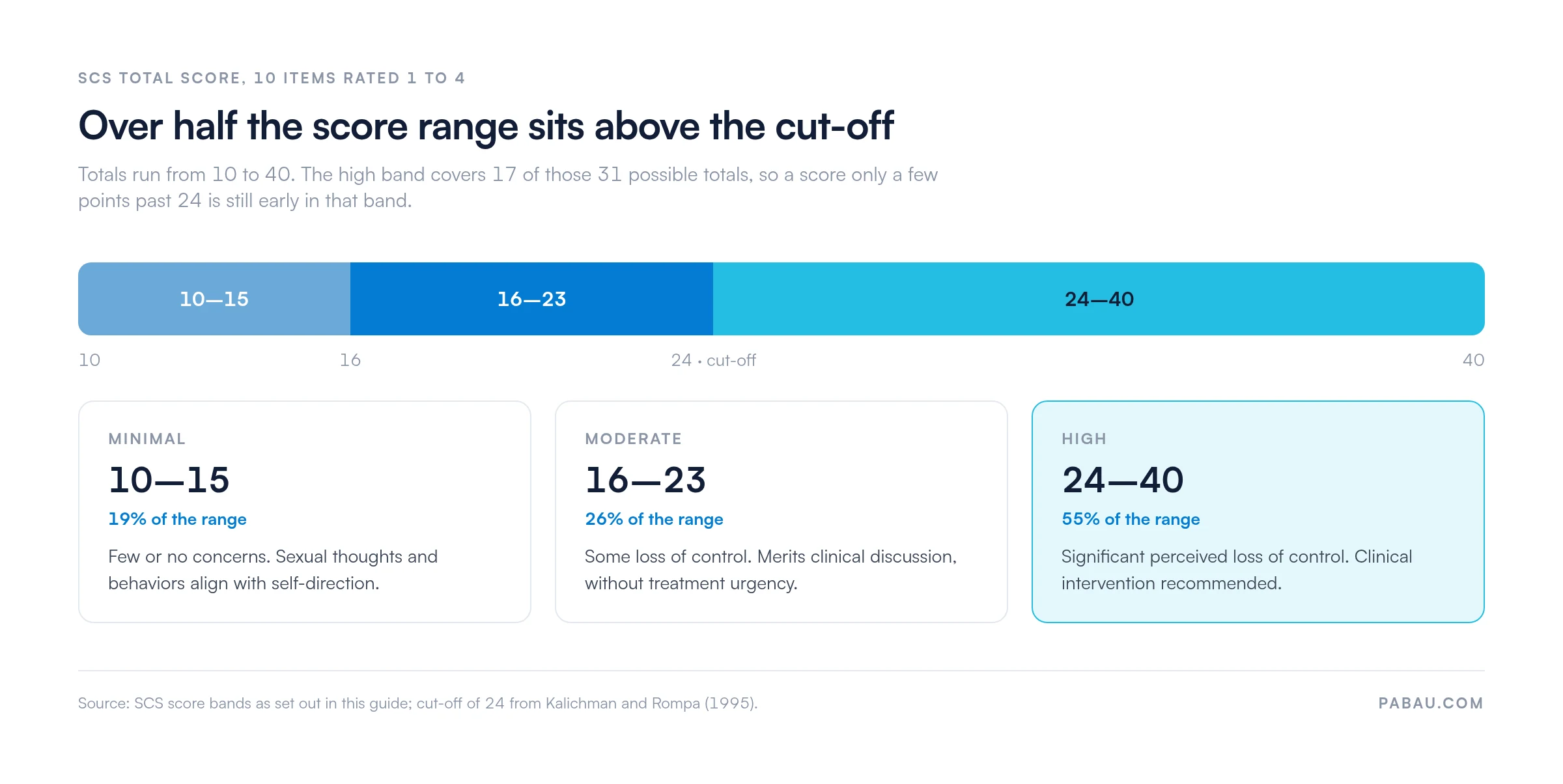
The cut-off of 24 comes from the original validation study, where it marked higher risk of behavioral and health consequences. Clinical judgment still outranks a single total. A client scoring 23 who describes significant distress deserves the same response as one scoring 26.
The SCS carries strong psychometric support across independent studies. These are the properties worth knowing before you lean on a score.
Those findings replicate across samples that differ in ethnicity, sexual orientation, and clinical setting. Among compulsivity screeners in the sexual health literature, the SCS is one of the most heavily validated.
Practices put the SCS to work in a few different places. Therapy practices use it at intake to make sexual concerns easier to raise. Sexual medicine consultations use it as a screening gate before treatment planning. Researchers use it to compare compulsivity levels across populations and interventions.
Sexual health practices: Administer the SCS at the first visit, then repeat it quarterly to track treatment response. That works during sex therapy, and alongside care for substance use or mood disorders.
Addiction treatment settings: Score sexual compulsivity as a co-occurring behavioral addiction alongside substance use. A patient management software that tracks several addiction domains keeps the whole treatment plan in one record.
HIV prevention and care: The scale was built in this setting. It still helps identify clients at behavioral risk and measure what a prevention program changes.
General therapy and counseling: Psychology practice management systems let therapists run the SCS as routine sexual health screening. Scores are stored securely, so you can watch them move over time.
The Hypersexual Behavior Inventory (HBI) is a related but distinct measure. It scores hypersexual behavior on three factors: control, consequences, and coping. Both instruments assess compulsive sexual behavior, though they differ in scope and in the populations they suit.
Choose the SCS for a busy practice that needs a fast screen, and for populations where the validation data is strongest. Choose the HBI when you want to see which factor is driving the problem, such as control versus coping. Both are defensible, and clinical fit decides it.
No screening tool fits every client, and the SCS carries a few known constraints.
Population specificity: The scale was developed in MSM samples during HIV prevention research. Use with heterosexual samples, women, and non-Western populations calls for careful interpretation, and local validation data helps.
Social desirability bias: Self-report measures invite under-reporting of sensitive sexual behavior. Anonymous administration and a clear word about confidentiality reduce that, but they do not remove it.
Not diagnostic: The SCS grades symptom severity. DSM-5 does not list hypersexual disorder as a diagnosis, and ICD-11 defines Compulsive Sexual Behavior Disorder against its own criteria. A score on its own diagnoses neither.
HIPAA compliance: Answers about sexual behavior are highly sensitive protected health information. Digital administration needs HIPAA-compliant data storage behind it.
Copyright and reproduction: The items are published in peer-reviewed literature, and clinicians may reproduce the scale for direct clinical use. Distributing it, or including it in published research materials, calls for a copyright check first.
Run the scale on paper and the work stacks up. Someone prints the form, the client fills it in, a clinician adds up the total, and the sheet gets filed. Practice management software like Pabau takes those four steps down to none.
Digital intake forms put the SCS inside client onboarding, so clients answer on a tablet or through the portal. Pabau totals the score on submission and flags anything at or above 24, so the clinician reads the result before the session starts.
Secure client records hold each score next to notes and treatment plans, so comparing three visits takes no file retrieval. Automated workflow management then triggers the follow-up, whether that means booking a review, flagging a case for supervision, or sending psychoeducational material.
Scheduling for clinical assessments carries intake data into the appointment, so the score is on screen when the client sits down. Practices running AI-assisted clinical documentation can have session notes reference the SCS result too, which keeps charting consistent without extra typing.

Pabau’s digital intake forms, automatic scoring, and secure client records make the SCS faster to run and easier to trust. Mental health practices use Pabau to scale assessment workflows without losing accuracy.

The SCS earns its place because it is short, well validated, and quick to read. Ten items and one total give you a defensible way into a subject most clients will not open by themselves.
Treat the number as a prompt rather than a verdict. A total of 24 tells you where to look, and the client’s own account of distress tells you what to do next. Repeating the scale every few months is what turns one reading into evidence of change.
The remaining question is whether scoring and filing stay manual. Book a demo to see how Pabau collects SCS responses at intake, scores them on submission, and keeps every result in the client record.

Need a structured clinical assessment workflow? Psychiatric Evaluation Template provides a step-by-step guide for comprehensive mental health assessments that integrate screening tools like the SCS.
The Sexual Compulsivity Scale (SCS) is a 10-item self-report questionnaire developed by Kalichman and Rompa in 1995. It measures how far sexual thoughts, urges, and behaviors feel out of control and interfere with daily functioning.
Each of the 10 items is rated on a 4-point scale, from 1 (not at all like me) to 4 (very much like me). Sum the responses for a total between 10 and 40. A total of 24 or above indicates elevated sexual compulsivity that warrants clinical attention.
A total of 24 or above counts as high. Scores in that band are associated with higher-risk sexual behavior, relationship interference, and effects on work. Clinical intervention is usually recommended.
Seth Kalichman and David Rompa developed the Sexual Compulsivity Scale in 1995 during HIV prevention research. It was validated first in men who have sex with men (MSM), and has since been used with diverse clinical populations.
The SCS is a 10-item unidimensional measure of sexual compulsivity. The Hypersexual Behavior Inventory (HBI) is a 19-item measure covering three factors: control, consequences, and coping. The SCS screens faster, and the HBI gives a more detailed picture.
Yes. The SCS has been validated in more than 30 independent peer-reviewed studies. It shows strong internal consistency (Cronbach’s alpha 0.86 to 0.92), a single-factor structure, and good convergent validity with sexual behavior outcomes.
Yes. A downloadable PDF of the scale sits at the top of this page. Clinicians may reproduce it for direct clinical use, but distribution in published materials needs a copyright check with the original authors.