Maja Popovska
Nursing care plan for aggressive behavior
A nursing care plan for aggressive behavior is a structured clinical document fo...

3
Last Updated: Oct 26, 2026
Free PDF 11 pages, print-ready Clinician-reviewed
A self-awareness worksheet is a structured set of prompts that walks a client through their values, strengths, emotions, behavioral patterns, and goals. Most clients finish it in 20 to 30 minutes, either in session or as homework.
Download the free version below and use it at intake to set a baseline. Hand the same form back at three and six months, and the change in a client’s answers becomes documented evidence of progress.
The prompts suit adults and teens aged 14 and up, in individual therapy, group work, and coaching. This guide covers what each section asks, how to introduce it, and where the completed copy belongs in your records.
A ready-to-use worksheet covering reflection prompts, values exploration, strengths identification, emotional awareness, and goal-setting exercises for individual or group therapy sessions.
Start from scratch, or upload this PDF or any form you already use, and Pabau's AI Form rebuilds it with tick boxes, text fields and a signature. Attach it to the treatment once, and every patient gets it on time.
AI Form rebuilds the consent, history and aftercare forms you already use. You review each one, then publish.
Patients complete forms on their phone before they arrive, so the front desk stops retyping paper.
Every signed form is versioned and attached to the treatment record, ready when you need it.
Set how long a consent stays valid. Returning patients skip forms they have already signed.
Supports HIPAA and GDPR compliance AES-256 encryption 4.8 on G2 4.7 on Capterra Trusted by 4,000+ practices worldwide

A self-awareness worksheet guides a client through their values, strengths, emotions, behavioral patterns, and goals in one structured pass.
Most clients complete it in 20 to 30 minutes, either in session or as homework between appointments.
The prompts suit adults and teens aged 14 and up, in individual therapy, group work, and coaching.
Repeating the worksheet at three and six months turns self-awareness from an impression into a documented outcome.
Practice management software like Pabau stores each completed copy in the client record, alongside the notes that reference it.
A self-awareness worksheet is a structured assessment tool that guides a client through self-reflection across five dimensions. Those dimensions are thoughts and emotions, values, strengths, behavioral patterns, and goals. Open-ended journaling covers whatever surfaces that day. A worksheet covers the same territory with every client, every time.
Therapists, counselors, and life coaches use the form to:
The worksheet also produces an artifact. The completed document joins the client record and gives you a reference point for later sessions. That matters most in cognitive behavioral therapy, dialectical behavior therapy, and strengths-based coaching, where insight is both the goal and the mechanism of change.
Stored in mental health practice software, the completed form evidences informed consent, baseline functioning, and client engagement. HIPAA-covered practices need that trail on file rather than in a drawer.
Self-awareness does measurable work in therapy. It underpins emotional regulation, values-led decision making, and behavior change that survives the end of treatment. Organizational psychologist Tasha Eurich studied roughly 5,000 people and found that about 95% believe they are self-aware. Only 10 to 15% actually met her criteria.
For clients, that shortfall shows up as patterns they repeat but cannot name. A structured set of prompts gives them the vocabulary and the order to name them.
Key benefits of self-awareness work:
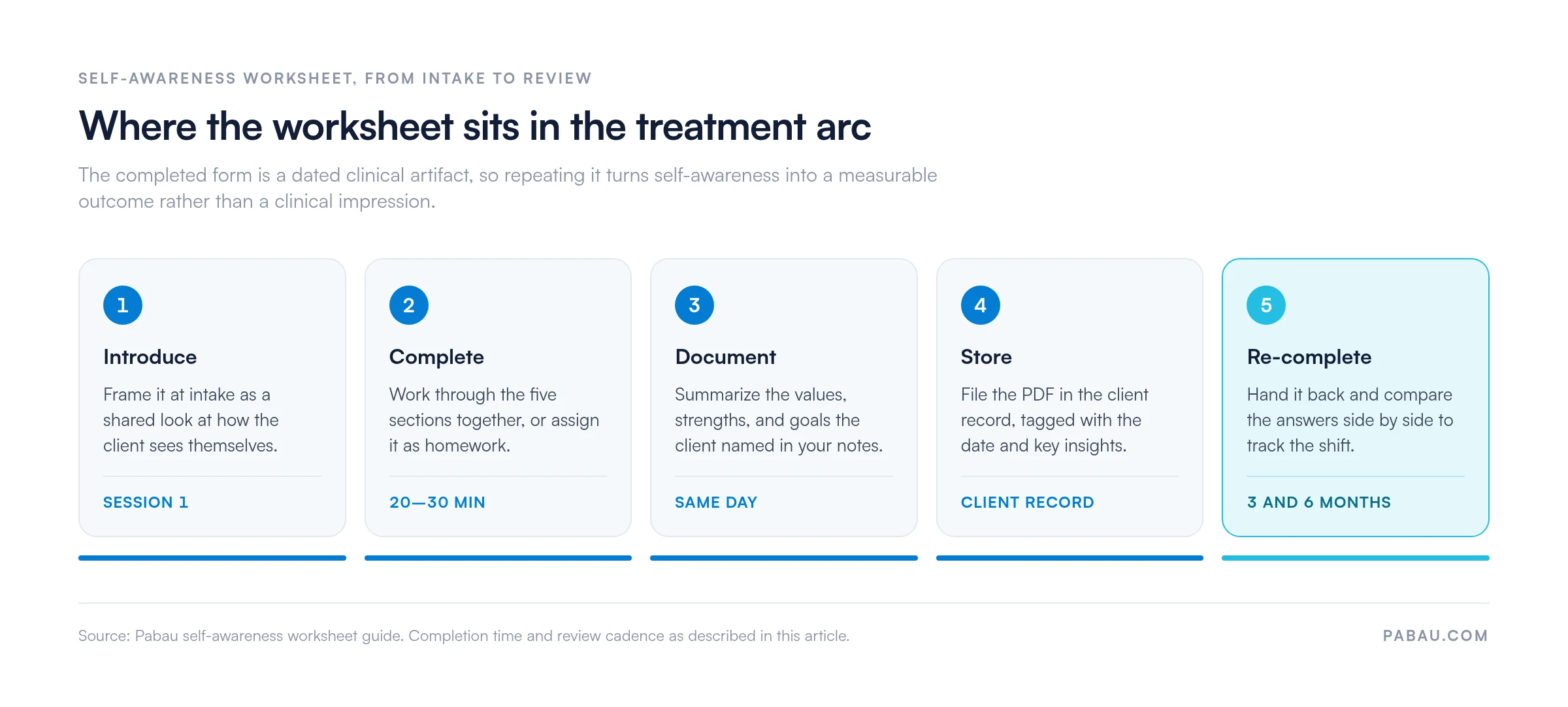
The worksheet works best inside a fixed clinical workflow. Five steps take it from intake to a documented outcome.
Software for therapy practices stops the last two steps from becoming a filing job. Upload the completed PDF to the client’s record, flag the key insights in your case notes, and pull them up before each session.
Laid out end to end, those five steps span a treatment arc rather than a single appointment.
The prompts travel well across mental health and coaching settings:
The worksheet is written for ages 14 and up. For children under 14, work through the prompts out loud or with a caregiver present, rather than asking for independent written reflection.
Faster treatment planning: Clients who arrive with a clear sense of their values and strengths need fewer sessions to agree on goals. The worksheet front-loads that conversation.
A documented baseline: The completed form evidences informed consent, initial functioning, and client engagement. That matters for treatment plan reviews, and for continuity when a client returns after a break.
Compliant documentation: Stored securely, the worksheet satisfies requirements for baseline assessment and treatment planning. It also reduces how much your team has to hold in memory between sessions.
Less note-taking under pressure: The client self-reports across five dimensions, so you spend the session listening rather than transcribing.
Measurable change: Repeat the worksheet at three and six months, and the answers track shifts you can point to. Self-awareness stops being an impression you have to defend to a reviewer.
Pair the worksheet with a journaling task one week later. Ask the client what surprised them about their own answers. The second pass often surfaces what the first one missed. File both documents together in the client record.
The worksheet organizes its prompts across five dimensions. These are the questions worth working through together:
The dimensions overlap by design. Values inform goals, strengths inform coping strategies, and emotional awareness supports behavior change. Reading the five answers together tells you more than any one section does alone.
Assign these prompts once the worksheet is complete. They extend the reflection past the structured exercise and give the next session material to work with:
Clients who journal between sessions come back with richer material. If you want a second structured pass rather than free writing, a self-reflection worksheet covers similar ground with tighter prompts.
A completed worksheet is a clinical document and needs the same handling as a note. Today that usually means a downloaded PDF, an email, and a returned copy filed where the next clinician will not find it.
Pabau keeps the loop inside the client record. Upload the completed form to the client’s file and tag it with the date and the insights worth remembering. It then surfaces whenever you open the chart.
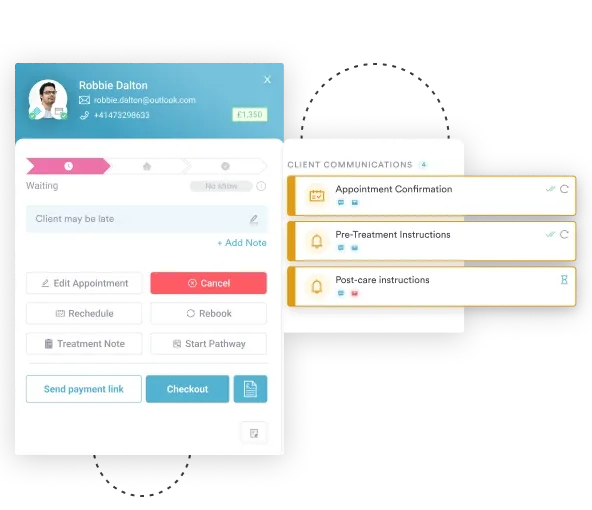
Documentation follows the same path. Insights from a completed worksheet can be written straight into the session note and the client letter, without retyping them from a PDF.
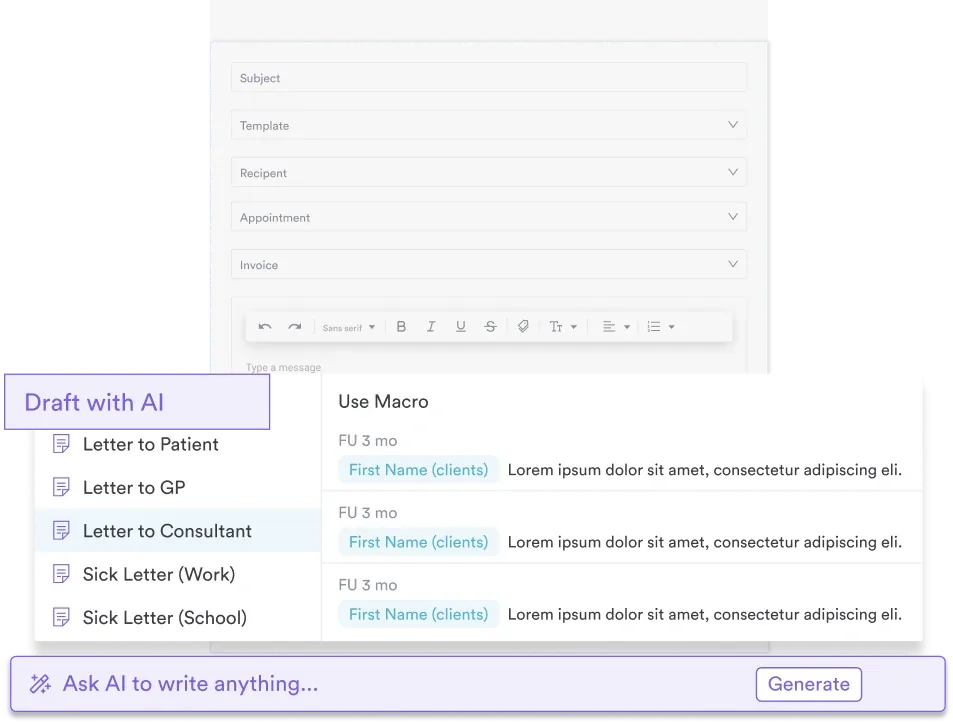
Self-awareness work then behaves like the rest of the chart. It is dated, searchable, and available to whoever the client sees next.

Pabau stores completed worksheets in each client’s file, automates the three-month re-completion reminder, and keeps the answers next to the session notes that reference them.

Self-awareness work only compounds when it is written down and revisited. One completed worksheet tells you where a client started. Two of them, three months apart, tell you whether treatment is moving.
Download the template above, introduce it at your next intake, and diary the three-month repeat while you still remember why it matters. Clients find their own side-by-side answers more persuasive than any summary you could write for them.
Book a demo to see how Pabau files completed worksheets and their follow-up reminders alongside your client notes.

Ready to turn insight into a plan? Change plan worksheet helps clients commit to specific steps once they know what they want to change.
Working with low self-esteem? Self-worth worksheet focuses on how clients value themselves, which pairs well with the strengths section here.
Need to target impulse patterns? Self-control worksheet gives clients structure for the behaviors they identified but could not interrupt.
Seeing clients under 14? Therapy worksheet for kids covers similar ground with age-appropriate prompts and simpler language.
Self-awareness is the ability to recognize your own thoughts, emotions, values, strengths, and patterns, and to see how they shape your behavior. Clients with higher self-awareness regulate emotions better, cope more effectively, and progress faster in therapy. A worksheet structures that reflection so you and the client cover it systematically.
Most clients finish it in 20 to 30 minutes, either in session or as homework. Working through it together produces deeper answers. Assigning it is faster, but it needs a follow-up review the week after.
Yes, for ages 14 and up. With younger teens, simplify the language or split the sections across several sessions. For children under 14, use clinician-led exploration or caregiver co-completion instead of independent written work.
A self-awareness worksheet covers the whole internal picture: Values, strengths, emotions, behaviors, and goals. A self-esteem checklist measures how a client judges themselves. The worksheet is broader and comes earlier in treatment, because it builds insight rather than measuring existing confidence.
Upload the completed PDF to the client’s digital record in a HIPAA-compliant system such as Pabau, which encrypts and audit-logs every file. Tag it with the completion date and the key insights, so it is easy to find in a later session.
Yes. Self-reflection and strengths identification are core mechanisms in cognitive behavioral therapy, dialectical behavior therapy, positive psychology, and strengths-based coaching. A worksheet operationalizes those mechanisms with structured prompts and creates a record of baseline self-perception.
Yes. Group facilitators use it as an opening exercise. Clients complete it individually, then share whatever they choose with the group. That builds cohesion and helps members understand each other’s motivations and strengths.