CRM for chiropractors: how to manage patients, bookings and marketing
A CRM for chiropractors is a patient relationship management system built around...

Last Updated: Oct 13, 2026

A referred pain map shows where pain from a muscle, joint, or organ is felt somewhere else on the body.
Referred pain happens because nerves from different regions meet at the same spinal cord segments, so the brain mislocates the source.
Somatic referral from trigger points and joints is reproducible on palpation, while visceral referral from organs brings nausea, sweating, or skin changes.
Work backward: read the zone the patient reports, palpate the structures that refer there, then treat the source.
Practice management software like Pabau stores the source structure and the referral zone on one patient record, so the reasoning survives the visit.
The chart maps somatic trigger point referrals, visceral organ referrals, and cardiac patterns by body region. Each zone lists the structures to palpate first, with the anatomical landmarks to work from.
Download templatePatients point to where pain is felt, not to where it starts. A referred pain map closes that distance. It shows which structures send pain to which zones, so you palpate the source instead of chasing the symptom.
This guide covers what the chart shows, the five assessment steps that use it, and the patterns clinicians most often read backward.
It also says where those findings belong. A source structure noted on paper rarely reaches the next appointment. Recording it inside software for physical therapists keeps the reasoning attached to the patient.
A referred pain map is a chart that pairs pain sources with the zones where patients feel them. Referred pain is pain perceived away from the structure generating it. The source can be a trigger point, a joint, a nerve root, or an organ.
Radiating pain travels along one nerve pathway. Referred pain instead appears in zones set by spinal cord convergence, where nerves from separate regions synapse on the same segments. Press a tender point in the upper trapezius and the patient may report a sharp sensation in the temple.
That is what makes the chart usable in reverse. You start from the pain the patient reports and narrow down the structures that could be sending it. Physical therapy, chiropractic, osteopathy, and functional medicine all lean on this, because pain rarely matches the local findings.
The chart earns its place in five steps, from the patient’s first description to the treatment you choose.
Step one decides how much the rest is worth. Handing the patient a body pain chart at intake gives you a drawing to compare against, rather than a remembered description. Patient intake software captures the same drawing digitally, so the zone reaches the note without being retyped.
Step four is the one clinicians skip. A source structure that never reaches the record cannot be checked at the next visit. Medical records management keeps both locations on the same patient file, where the next clinician will look.
Any clinician who treats musculoskeletal or visceral pain reads referral patterns, whether or not they call it that.
The record matters as much as the reading for the manual therapies. Chiropractic practice software stores the structure you adjusted next to the zone the patient reported, so the pattern is visible across a course of care.
Fewer wasted sessions. Treating the reported location leaves the source untouched, and the pain returns between visits. Mapping first shortens the course of care.
Documentation an inspector can follow. Regulators expect a written rationale for assessment and treatment decisions. The Care Quality Commission in England, the Health and Care Professions Council, and the American Physical Therapy Association all look for it. A mapped source and zone show that differential diagnosis happened.
Fewer referrals that go nowhere. A map-guided assessment narrows the hypothesis in the room. That saves an imaging request and a wait the patient did not need.
A patient who understands the plan. Showing someone that their temple pain starts in a shoulder muscle changes what they expect from treatment. The goal moves from curing a headache to releasing a trigger point.
Pain perception runs through three components.
Convergence-projection theory explains most of what the chart records. Nerve fibers from separate regions, such as the shoulder and the neck, enter the spinal cord at overlapping segments. The brain receives a signal on a shared root and can attribute it to the wrong region.
Somatic and visceral referral follow the same principle and present differently. Somatic referred pain comes from muscles, joints, and ligaments, and it is well localized and reproducible on palpation or movement. Visceral referred pain comes from organs and arrives with autonomic features.
Nausea, sweating, a change in skin temperature, or a sense of dread all point that way. Cardiac pain into the left arm or jaw is visceral referral rather than a trigger point, and that distinction carries the red flags.
Sympathetic involvement adds another layer. Referral through the sympathetic system can bring vasomotor changes, temperature dysregulation, and swelling in the referred zone. Complex regional pain syndrome is the clearest example, with patterns that outlast the original injury.
Referred pain and radiating pain get conflated, and the distinction decides which structure you treat.
The distinction only helps if it is written down. Note which one you concluded and what provoked it, so the next clinician does not restart the reasoning.

Trigger points are hyperirritable nodules inside taut bands of skeletal muscle. They are the most common source of referred pain in practice, and compression produces pain in a predictable zone away from the nodule.
Six patterns cover most of what walks through the door, and one of them is regularly read backward.
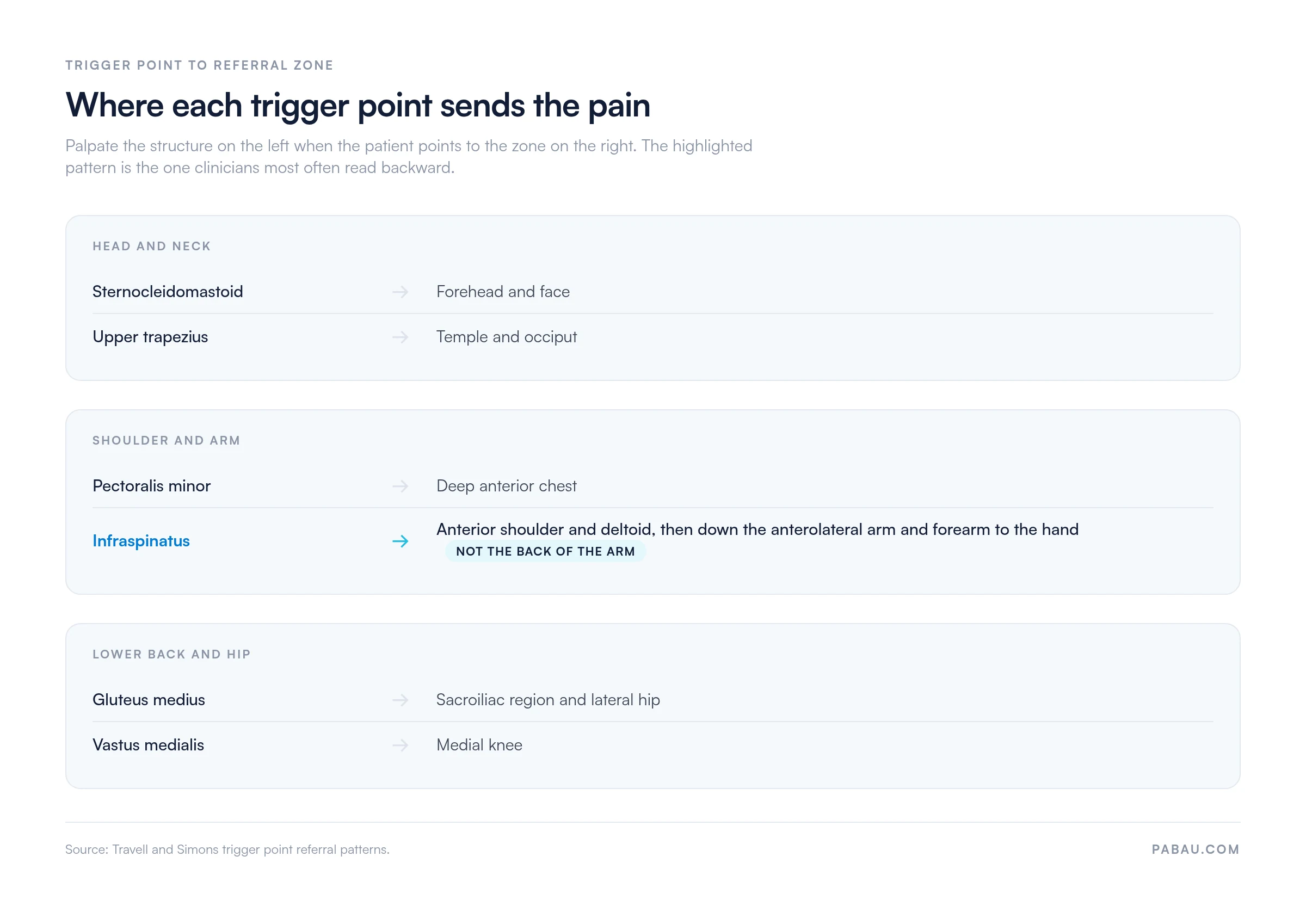
Head and neck: Sternocleidomastoid trigger points refer to the forehead and face. Upper trapezius trigger points refer to the temple and the occiput. Both are worth checking before a headache is called a migraine.
Shoulder and arm: Pectoralis minor trigger points refer deep into the anterior chest. Infraspinatus trigger points refer to the anterior shoulder and deltoid region, then down the anterolateral arm and forearm to the hand. Overhead athletes present with both patterns often, and reading them correctly prevents an unnecessary shoulder scan.
Lower back and hip: Gluteus medius trigger points refer to the sacroiliac region and the lateral hip. Vastus medialis trigger points refer to the medial knee. Low back pain often traces to a hip trigger point rather than the lumbar spine.
The downloadable chart carries these and the rest, grouped by body region so you can find a zone mid-assessment.
Three errors account for most of the wasted sessions.
Flag cardiac referral patterns as urgent and refer for medical assessment before treating. Left arm, jaw, or back pain with chest discomfort, nausea, or breathlessness is visceral referral rather than a musculoskeletal pattern.
Most practices split the mapping across two places. The drawing arrives on a paper intake form and the palpation findings go into the note. The referral zone often survives only as a sentence typed from memory.
Practice management software like Pabau puts them on the same patient file. Digital intake forms capture the pain drawing before the appointment. Custom fields in the treatment note then hold the source structure and the referral zone separately.
So the pattern is readable across a course of care. You can see at the fourth visit which structure you treated at the first, and whether the zone shrank. Pabau Scribe, our AI scribe, drafts the note from the consultation, so the detail lands without a second typing pass.

Capture the pain drawing at intake and hold the source structure and referral zone in the treatment note. The reasoning stays on the file for the next visit.

The chart is only as good as the step it changes. If it moves your hand from the temple to the trapezius, it has done its job.
The part worth remembering is the red flag. Somatic referral is reproducible and safe to treat, while visceral referral needs medical assessment first. When autonomic features appear, stop mapping and refer.
Download the chart, work it into your intake, and record both locations every time. Book a demo to see how Pabau holds the source and the referral zone on one patient record.

Working from a single reported site? Pain locator chart narrows the description before you start palpating.
Want intensity alongside location? Numeric pain rating scale tracks change across a course of care.
Building your first-visit paperwork? Physical therapy intake form collects history, pain location, and consent in one pass.
Documenting manual therapy sessions? SOAP notes for chiropractic structure the assessment so the source is recorded.
It helps you identify the source of a patient’s pain by showing which structures refer pain to which zones. A patient reporting temple pain sends you to the upper trapezius, the sternocleidomastoid, and the cervical spine. You then test those structures instead of treating the temple.
Referred pain comes from spinal cord convergence, so the brain misreads which pathway is firing. It is reproducible when you palpate the source and usually carries no neurological signs. Radiating pain follows a dermatome or peripheral nerve, feels sharp or burning, and often brings numbness, tingling, or weakness. The distinction decides whether you release a trigger point or investigate nerve compression.
Ask the patient to mark the pain on a body chart, then read that zone against the map. Palpate each candidate structure and add range-of-motion and functional tests. Reproducing or changing the reported pain confirms the source. Record both the source and the zone so the finding can be checked next visit.
The mechanisms are the same across sexes. Female patients more often present with gynecological visceral referral, which reaches the lower abdomen, the sacral region, and the inner thigh. Rule out a primary gynecological cause before treating lower abdominal pain as musculoskeletal referral.
Yes, and it happens in two directions. A temple headache from a neck trigger point gets treated as migraine, and referral gets read as nerve compression. Visceral referral from the heart, liver, or appendix is the one to catch, because missing it is dangerous. Screening questions for red flags alongside the map prevent most of these errors.