Cervix length during pregnancy chart
A cervix length during pregnancy chart records cervical length in millimeters ag...

2
Last Updated: Oct 14, 2026
A reason for visit is the primary concern or symptom that has prompted a patient to seek medical attention at your clinic.
Distinct from the diagnosis and the chief complaint, reason for visit captures the patient’s own words about why they scheduled an appointment — essential for triage, documentation accuracy, and clinical workflow optimization. This guide covers the definition, best-practice documentation steps, common examples across specialties, and a free downloadable template to standardize this critical intake field in your practice.
Capturing reason for visit systematically supports three operational outcomes: faster scheduling decisions (staff route the patient to the right clinician and slot length), more accurate billing documentation (E&M coding links directly to documented reason for visit), and better patient experience (the patient feels heard because their stated concern is recorded in writing from the outset).
A ready-to-use intake form capturing patient chief concerns, visit purpose, symptom history, functional impact, and triage flags to streamline your clinic’s appointment workflow and ensure thorough documentation from the first interaction.
Download template
Reason for visit is the patient’s stated primary concern — distinct from chief complaint (clinician interpretation) and diagnosis (medical conclusion).
Structured reason-for-visit capture improves triage speed, reduces no-shows, and supports accurate visit-type coding and billing.
Best practice: open-ended initial question (“What brings you in today?”) followed by brief clarification and severity check.
Pabau’s digital intake forms automate reason-for-visit collection pre-appointment, reducing front-desk workload and enabling same-day triage.
In clinical documentation, reason for visit is the patient’s stated purpose for their appointment in their own language. It answers the simple question: “Why did the patient book an appointment today?” This is not the diagnosis (the clinician’s medical conclusion after assessment), nor the chief complaint (the clinician’s structured summary of the patient’s concern). The reason for visit is what the patient says when they call to book or when you ask them on the intake form.
The reason for visit sits at the bridge between patient perception and clinical assessment. It is the entry point that shapes every subsequent decision: which clinician handles the visit, how much appointment time to allocate, what screening tools to administer, and how to document the encounter for billing and continuity of care. Capturing this consistently reduces appointment confusion and no-shows because the patient’s expectation aligns with what your scheduling system offers.
Structured reason-for-visit documentation drives three direct operational benefits. First, triage accuracy: front-desk and clinical staff route the patient to the right provider and allocate the correct appointment length based on stated need, not guesswork. Second, billing alignment: Centers for Medicare & Medicaid Services (CMS) E&M documentation requirements explicitly link visit complexity to the patient’s stated reason, so documented reason for visit becomes a key piece of code-selection evidence. Third, patient compliance and satisfaction improve when the patient sees their concern written back to them — it builds trust that their reason was heard and addressed.
Reason-for-visit phrasing varies by specialty and care setting. Below are categorized examples that reflect how real patients describe their visits across primary care, mental health, aesthetics, and allied health. Use these as reference when building your practice’s standard intake form vocabulary.
Documenting reason for visit accurately requires a three-step intake conversation. This workflow, used across clinical specialties, ensures the reason is recorded in the patient’s language while giving clinicians enough context to triage and prioritize care.
Best practice: keep reason for visit concise but complete. Aim for one to three sentences. Avoid vague phrasing (“just a checkup”) and document specifics (“annual physical + blood pressure monitoring + medication side-effect review”). This specificity streamlines intake workflows and ensures clinicians have the context they need before the appointment begins.
A well-designed reason-for-visit template balances open-ended patient voice with structured data capture. It includes the core fields that support clinical documentation, billing, and triage.
The template is available as a PDF that your team can print for paper-based intake or adapt into your existing digital forms. Customize the symptom list, severity scales, and associated-condition checkboxes to match your specialty and patient population. Pabau’s digital forms builder lets you build this exact workflow online, enabling patients to complete reason-for-visit capture before they arrive at your clinic.
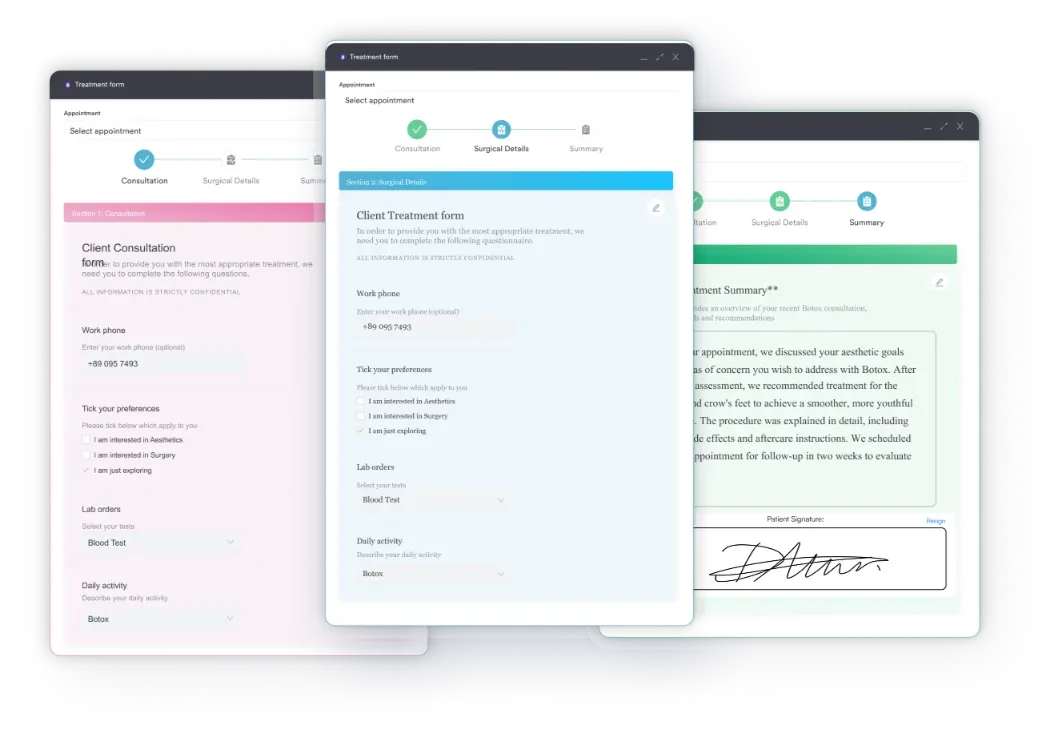

Pre-appointment intake forms capture reason for visit, chief complaints, and medical history before the patient walks in — reducing front-desk workload and improving triage accuracy.

Two visit types often create documentation confusion: “establish care” visits and routine physicals. Understanding the distinction helps you document reason for visit accurately and select the correct billing code.
Document reason for visit in the context of the visit type: for establish-care visits, state the presenting complaint (if any) plus a note that this is the patient’s first visit; for preventive physicals, note “annual physical” or “routine preventive visit” as the reason. Billing documentation requirements vary by payer, so confirm your EHR’s compliance settings match your practice’s documentation protocols.
Manual reason-for-visit collection on paper forms or via phone creates bottlenecks: staff spend time transcribing, data entry errors occur, and clinicians receive incomplete intake information minutes before the appointment. Pabau’s pre-appointment patient portal shifts this workflow online: patients complete a customized intake form — including reason for visit — before they book or arrive. The clinic receives complete, structured data in real time, and clinical staff review triage priorities before the session begins.
Practice management software that integrates intake forms with scheduling also enables follow-up workflows: patients returning for second visits have their prior reason for visit visible in context, so clinicians can confirm whether they’re returning for the original concern or a new one. This continuity of care improves outcomes and patient satisfaction.
Capturing reason for visit systematically — in the patient’s language, before clinical assessment — is foundational to efficient clinic operations, accurate billing, and patient experience. The template provided gives your practice a starting point; customize it to your specialty’s common presentations and your team’s workflow. For clinics ready to move beyond paper or phone-based intake, Pabau’s integrated booking and intake system automates reason-for-visit collection and routes it to the right clinician in real time, eliminating data-entry steps and ensuring your clinic never misses the patient’s initial concern.

Need a structured approach to patient intake? Psychiatric Evaluation Template provides a step-by-step framework for comprehensive mental health assessments and reason-for-visit documentation.
Looking to reduce appointment scheduling errors? How to Schedule Patients Effectively covers workflow strategies for matching patient need to appointment type and clinician.
Ready to digitize your intake process? Pabau’s Capture Forms enables you to build custom patient intake workflows that collect reason for visit, medical history, and consent before the appointment.
Reason for visit is the patient’s stated concern in their own words (“I have a sharp pain in my knee”). Chief complaint is the clinician’s structured summary of that concern after initial assessment (“Acute right knee pain, mechanical mechanism”). The reason for visit is documented as the patient says it; the chief complaint is the clinician’s clinical interpretation.
Record reason for visit BEFORE the clinician’s assessment. Capture it during intake — either on a form, via phone when scheduling, or through pre-appointment digital forms. This ensures the patient’s initial concern is documented without clinical interpretation, supporting accurate triage, billing documentation, and continuity of care on follow-up visits.
Yes. CMS and payer guidelines link evaluation and management (E&M) code selection to the patient’s stated reason for visit and medical decision-making complexity. Documented reason for visit is part of the evidence that supports appropriate code selection and reduces audit risk.
Document the PRIMARY reason for visit (the patient’s most pressing concern), then note secondary concerns in an associated-symptoms field. The primary reason determines appointment routing and time allocation; secondary concerns are addressed in the clinician’s assessment and may influence medical decision-making complexity for billing.
Yes. On follow-up visits, reason for visit might be “follow-up for knee pain from prior visit” or “new concern: upper back stiffness.” Using the same template for all visits ensures consistent documentation and lets clinicians track whether the patient is returning for the original complaint or a new one, supporting care continuity.