Tanja Lepcheska

Musculoskeletal review of systems: Questions and template
Download your free musculoskeletal review of systems A ready-to-use musculoskele...

3
Last Updated: Oct 30, 2026
Free PDF 2 pages, print-ready Clinician-reviewed
A pregnancy resting heart rate chart sets out the expected resting pulse for each trimester.
In a healthy pregnancy, resting heart rate typically runs 10 to 20 beats per minute (BPM) above the woman’s pre-pregnancy baseline. Those bands are reference points rather than fixed cut-offs, because individual baselines vary widely.
A resting rate that stays above 100 BPM on repeated readings needs clinical review. So does any reading that comes with chest pain, breathlessness or fainting. This guide covers the expected ranges, why heart rate rises, how to measure it accurately, and when to seek help.
A seven-page log for recording resting heart rate across all three trimesters, in week bands from weeks 1 to 4 through weeks 35 to 40. Each band has fields for the reading, the date and notes, with a reference range printed beside it.
Start from scratch, or upload this PDF or any form you already use, and Pabau's AI Form rebuilds it with tick boxes, text fields and a signature. Attach it to the treatment once, and every patient gets it on time.
AI Form rebuilds the consent, history and aftercare forms you already use. You review each one, then publish.
Patients complete forms on their phone before they arrive, so the front desk stops retyping paper.
Every signed form is versioned and attached to the treatment record, ready when you need it.
Set how long a consent stays valid. Returning patients skip forms they have already signed.
Supports HIPAA and GDPR compliance AES-256 encryption 4.8 on G2 4.7 on Capterra Trusted by 4,000+ practices worldwide

A pregnancy resting heart rate chart gives expected ranges per trimester, typically 10 to 20 BPM above the pre-pregnancy baseline.
Resting heart rate above 100 BPM is tachycardia, but obstetric thresholds for concern can differ from general definitions.
Measure at rest in the morning, before rising, counting the radial pulse for a full 60 seconds.
Seek urgent review for persistent elevation with chest pain, breathlessness, fainting or dizziness, regardless of the chart.
Pabau, the practice software we build, lets practices add the chart to digital forms and antenatal vital-signs records.
The table below sets out expected resting ranges across each trimester. Treat each band as a general reference for a healthy pregnancy, not a diagnostic threshold.
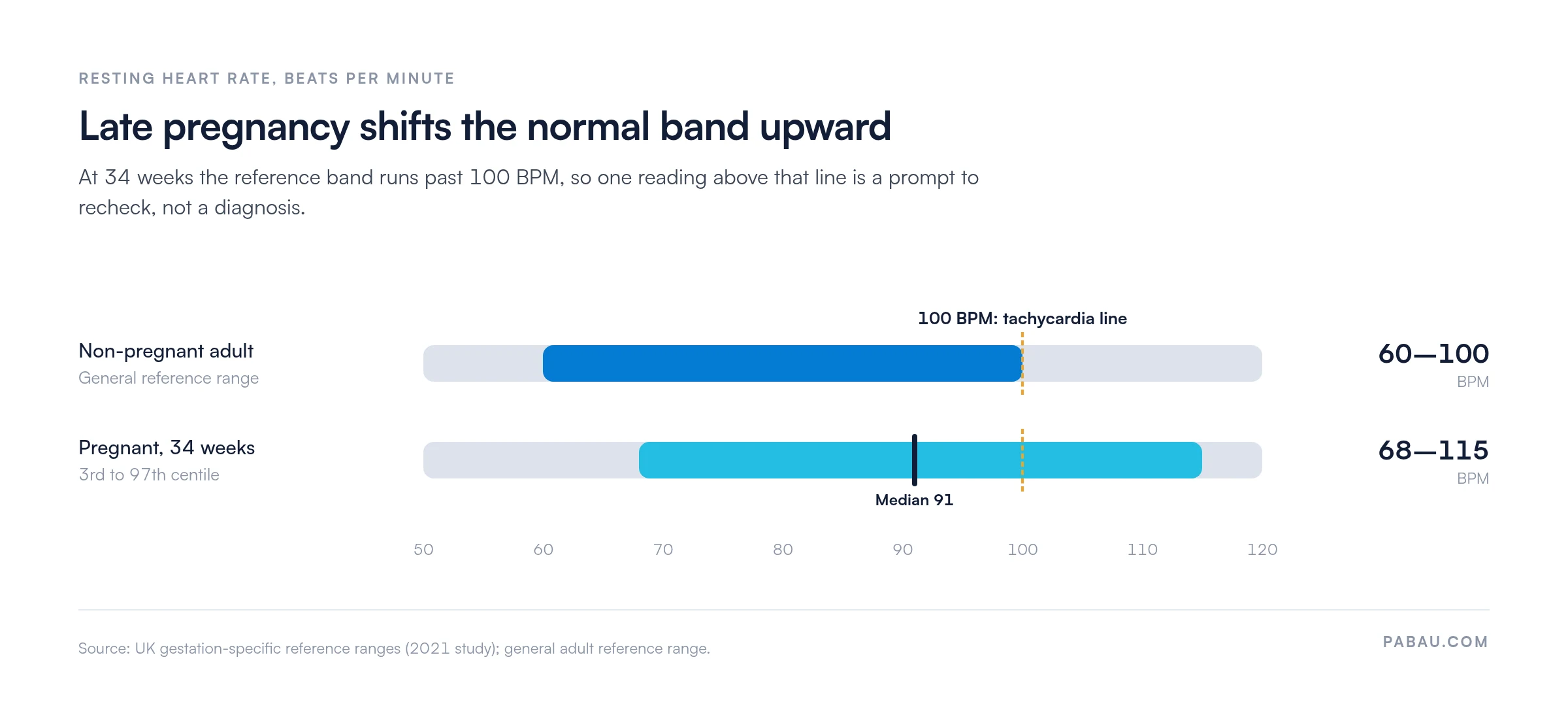
A 2021 peer-reviewed study reported a median resting heart rate of about 91 BPM at 34 weeks. Its 3rd to 97th centile range ran from 68 to 115 BPM. That figure describes one study population, so it should not be applied as a fixed value for every patient. Set beside the non-pregnant adult range, the 34-week band shows how far normal shifts upward late in pregnancy.
Resting heart rate rises in pregnancy because the cardiovascular system is working harder to supply the placenta and the growing body. Blood volume increases, the heart pumps more blood per beat, and hormonal shifts affect vascular tone. This chart tracks the mother’s pulse only. The baby’s heartbeat is a separate measurement, checked against normal fetal heart rate ranges.
Measure in the morning, before getting out of bed, after a few minutes of lying still. Consistent timing makes readings comparable from one day to the next.
Wearable devices can track trends, but accuracy during pregnancy is not well established. Where a device and a manual count disagree, use the manual count and discuss the difference with your clinician.
Tachycardia is generally defined as a resting heart rate above 100 BPM. In pregnancy, clinicians may apply different thresholds for concern, so a persistent reading above 100 BPM warrants review rather than automatic alarm. Take blood pressure at the same check and log it on a blood pressure pregnancy chart, so the clinician sees both readings together.
Brief palpitations are common in pregnancy and are often benign. Any symptom on the list above needs same-day clinical assessment, and emergency symptoms need emergency care.
The comparison below places non-pregnant adult women beside each trimester. It shows how much elevation is expected, which helps avoid alarm over normal change.
Many midwifery and obstetric practices still log resting heart rate on a paper chart or a loose spreadsheet. The reading from 20 weeks then sits apart from the one taken at 34 weeks. Nobody sees the trend until it is already a problem.
In Pabau, the chart becomes a digital form inside each patient’s record. Staff record a resting reading at every antenatal visit against the expected band. Patients can also log home readings through a form sent before the appointment, and those land in the same record automatically.
The result is one timeline per pregnancy, so a slow climb shows up at a glance. Practices that already run Pabau as their fertility clinic software can carry the same record from conception into antenatal care. Gynecology teams get the same continuity through our OBGYN EMR.

Pabau’s digital forms and Client records let practices capture resting heart rate at every antenatal visit and spot a rising trend early.

A faster resting pulse is one of the most predictable changes of pregnancy, and on its own it rarely signals trouble. The useful question is whether the rate is drifting beyond the patient’s own expected band, or arriving with symptoms.
That makes the trend more valuable than any single number. Measure the same way, at the same time of day, and record gestational age with each reading. A change then stands out early, while a calm reading spares the patient needless worry.
Keep the chart as a reference, never as a substitute for clinical judgment. Book a demo to see how Pabau keeps every antenatal heart rate reading in one patient record, ready for review.

Monitoring fetal well-being later in pregnancy? Nonstress test: what it is, procedure, and results walks through the procedure and what the results mean.
Tracking other measurements across the trimesters? Prenatal growth chart sets out fetal length and weight by week.
Screening for gestational diabetes? 3-hour glucose test results chart helps record and interpret each result.
Watching for preterm labor risk? Cervix length during pregnancy chart covers cervical length measurements through pregnancy.
Supporting healthy eating in pregnancy? Nutrition tracker for pregnancy helps patients log what they eat through pregnancy.
A resting rate persistently above 100 BPM is tachycardia, but a dangerous pattern is defined by symptoms as well as numbers. Chest pain, breathlessness or fainting always needs urgent assessment.
A 2021 peer-reviewed study reported a median of about 91 BPM at 34 weeks. Its 3rd to 97th centile range ran from 68 to 115 BPM. This is one study population, not a universal target.
Resting heart rate usually rises early and stays elevated through pregnancy. Cardiac output rises early and stays elevated through the second and third trimesters. Patterns vary, so a single reading matters less than the trend.
Count the radial pulse for a full 60 seconds, first thing in the morning before rising. Repeat on several days to see the trend.