Copenhagen Burnout Inventory
The Copenhagen Burnout Inventory (CBI) is a free, 19-item questionnaire that mea...

Last Updated: Oct 14, 2026
A 3 hour glucose test results chart lists the cutoff for each blood draw in the 100-gram oral glucose tolerance test (OGTT). Clinicians use it to diagnose gestational diabetes mellitus (GDM) in pregnancy.
ACOG’s Carpenter-Coustan cutoffs are 95 mg/dL fasting, 180 at 1 hour, 155 at 2 hours and 140 at 3 hours. A value at or above its cutoff is abnormal.
Two or more abnormal values confirm GDM, while a single abnormal value is a borderline result that needs follow-up. Some labs still use the higher NDDG thresholds, so the same result can pass at one lab and fail at another. Check which criteria set your lab reports before you interpret a result.
A one-page, ten-item patient questionnaire with a five-point scale from never to always. It covers understanding of the test, confidence managing readings, who to contact, and satisfaction with care. Fill in the patient details and add it to the record.
Download template
The chart lists one cutoff for each of the four draws: fasting, 1-hour, 2-hour and 3-hour.
ACOG Carpenter-Coustan cutoffs run 5-10 mg/dL lower than NDDG cutoffs, so a result can be normal under NDDG but abnormal under ACOG.
Two or more values at or above their cutoff confirm GDM. A single abnormal value is a borderline result that calls for follow-up, not a diagnosis.
Most patients who fail the 1-hour screen do not have GDM, which is why the 3-hour test confirms the diagnosis before treatment starts.
Pabau, the practice management platform we build, keeps glucose results in the patient record and sends automated reminders for repeat tests and follow-up visits.
The 3-hour glucose test is the diagnostic test ordered when a pregnant patient fails the 1-hour glucose challenge test (GCT).
The GCT is a screening test offered to pregnant patients at 24-28 weeks of gestation. It uses a 50-gram glucose load and needs no fasting. If the result reaches the lab’s cutoff, usually 140 mg/dL, the patient is referred for the 3-hour test.
The 3-hour OGTT confirms or rules out GDM. It measures how the body handles a 100-gram glucose load at four time points over three hours. OB-GYNs, maternal-fetal medicine (MFM) specialists and primary care clinicians order it when screening suggests possible GDM. The CDC’s gestational diabetes overview covers risk factors and testing for patients.
The 3-hour OGTT follows a fixed protocol that measures fasting glucose and the body’s response to a large glucose load over time.
Each of the four values is compared against its threshold. Labs use either the ACOG Carpenter-Coustan or the NDDG criteria. If two or more values meet or exceed their threshold, GDM is confirmed.
The ACOG Carpenter-Coustan criteria are the most widely used diagnostic standard in the United States. The table below shows the threshold for each draw.
GDM diagnosis: Gestational diabetes mellitus is diagnosed when two or more of the four values meet or exceed their threshold. This two-value rule is the one set out in ACOG Practice Bulletin No. 190.
The National Diabetes Data Group (NDDG) criteria, developed in 1979, set higher thresholds than ACOG Carpenter-Coustan. Some US laboratories still use NDDG, particularly in certain regions or health systems. The table compares the two sets.
The NDDG thresholds run 5-10 mg/dL higher than the ACOG criteria. A patient with a fasting glucose of 98 mg/dL would fail under ACOG but pass under NDDG. Always confirm which standard your lab uses, and name the criteria set on every order and result note.
Normal (passed) result: All four glucose values fall below the lab’s thresholds for the criteria set in use. The patient does not have GDM, and glucose tolerance is normal.
Abnormal (failed) result: One or more glucose values meet or exceed the threshold. Two or more abnormal values confirm GDM under ACOG criteria. A single abnormal value is not GDM, and this is sometimes called a borderline result. It may lead to dietary changes, repeat testing or closer monitoring rather than GDM treatment.
The flow below shows how the count of abnormal values sets the next step.
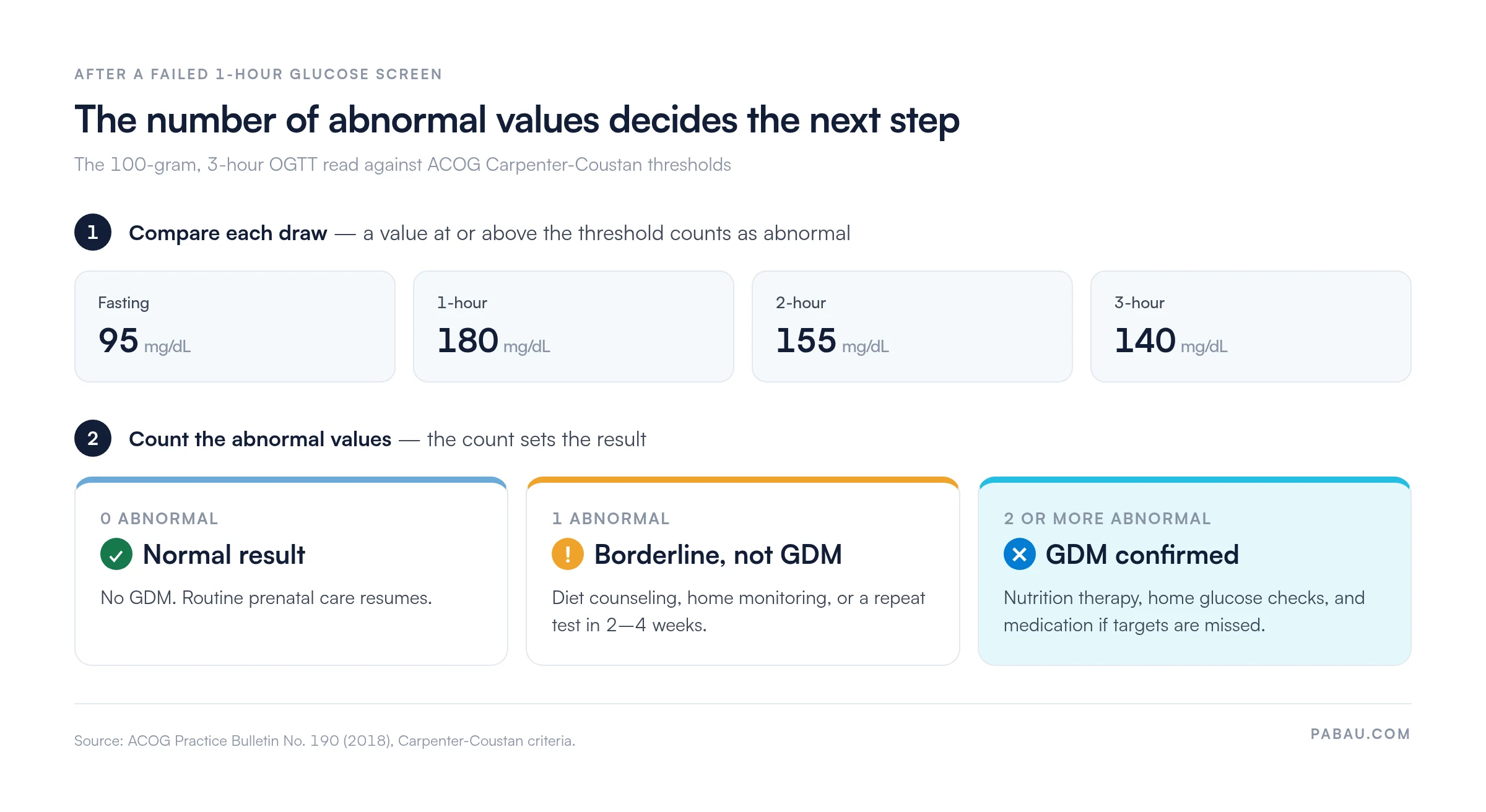
A single abnormal value is not GDM, but it does call for follow-up. ACOG criteria require two or more abnormal draws for a diagnosis. Clinicians manage this borderline group in one of several ways.
Two or more abnormal values confirm GDM under ACOG criteria, and management starts right away.
GDM also raises the risk of preeclampsia, so many practices track readings at each visit on a blood pressure pregnancy chart. Patients who need medication usually add fetal surveillance in the third trimester, such as a nonstress test.
A passing result means all four glucose values fall below the thresholds your lab uses. The patient does not have gestational diabetes and needs no diabetes management for the rest of the pregnancy.
Preparation directly affects result accuracy. Standard lab protocols call for these steps.
What to avoid: On test day, the patient should not eat, drink anything other than water, smoke, or exercise. Some clinicians also advise avoiding gum, which may contain sugar. Stress hormones can raise glucose briefly, so a calm wait helps too.
The 1-hour glucose challenge test (GCT) and the 3-hour OGTT do different jobs in the diagnostic pathway. The first one screens and the second one diagnoses, which is why an abnormal screen leads to a second test.
Most patients who screen positive on the 1-hour test do not have GDM. The confirmatory 3-hour test matters because it spares patients with normal glucose tolerance from unnecessary treatment.
In many obstetric practices, glucose screening lives across lab slips, phone calls and a separate reminder list. A patient who fails the 1-hour screen can go weeks before anyone books the 3-hour test. Pabau’s OB-GYN EMR software keeps the result, the notes and the next appointment in one patient record.
Clinicians record each glucose value in Client records, next to the prenatal notes and appointment history. Automated workflows then send the reminders and follow-up messages your team sets up. One might prompt a patient to book the 3-hour test, or a repeat test in 2-4 weeks.
Pabau Scribe, our AI scribe, drafts the note from the consultation where you explain the result, so less of your day goes to typing. Practices that also offer IVF can run both services on the same fertility clinic software.

Pabau stores glucose results in the patient record and sends automated reminders, so fewer patients miss the confirmatory 3-hour test or a repeat check.

Read every 3-hour result against the criteria set your lab reports, then count the abnormal values before you act. That count separates a normal result, a borderline result that needs a plan, and a confirmed GDM diagnosis.
The single-value result needs the most deliberate follow-up, because no diagnosis forces the next appointment. Book the repeat test or the nutrition referral before the patient leaves, and the borderline case stays visible.
Book a demo to see how Pabau keeps glucose results and follow-up reminders together for your prenatal patients.

Screening for other conditions in the same trimester? Alpha-fetoprotein (AFP) blood test explains the prenatal screen and how to read its results.
Tracking blood pressure alongside GDM? Blood pressure pregnancy chart sets out the readings that flag hypertension in pregnancy.
Planning fetal surveillance after a GDM diagnosis? Nonstress test: what it is, procedure, and results walks through how the test runs and how to interpret it.
Planning care after delivery? Postpartum care plan organizes recovery goals and follow-up visits after birth.
Normal 3 hour glucose test values are all four draws below the lab’s diagnostic thresholds. ACOG Carpenter-Coustan criteria require fasting <95 mg/dL, 1-hour <180 mg/dL, 2-hour <155 mg/dL, and 3-hour <140 mg/dL. NDDG thresholds are slightly higher (fasting <105, 1-hour <190, 2-hour <165, 3-hour <145 mg/dL). Confirm which standard your lab uses.
A single abnormal value does not meet ACOG criteria for GDM diagnosis, which requires two or more abnormal values. Your clinician may recommend dietary modification, repeat testing in 2-4 weeks, referral to a dietitian, or home glucose monitoring to monitor the trend.
You passed if all four glucose values (fasting, 1-hour, 2-hour, and 3-hour) fall below the thresholds used by your lab. The lab report will typically state “normal,” “negative,” or “pass,” and your clinician will notify you that no further glucose testing is needed during pregnancy.
A 3 hour glucose test counts as failed (positive) when two or more of the four values meet or exceed the diagnostic thresholds. The lab uses either ACOG Carpenter-Coustan or NDDG criteria. This meets criteria for a GDM diagnosis and requires referral for diabetes management during pregnancy.